
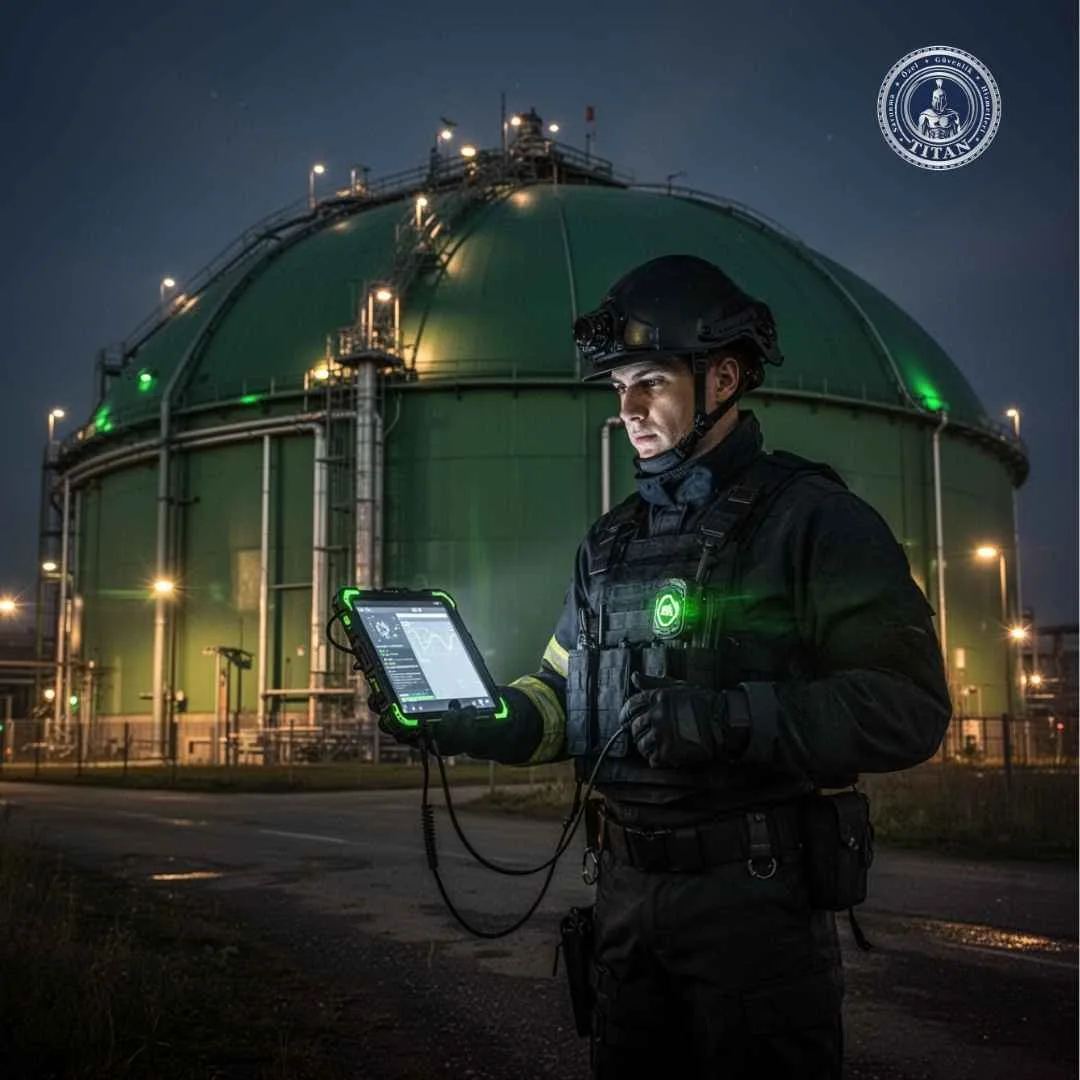
From a security point of view, biomass power plants and waste-to-energy facilities in Turkey look less like power stations and more like logistics yards with a fuel store attached. Trucks arrive all day, loads are weighed on the weighbridge, fuel waits on site in open or covered piles, and most plants run through the night. The biggest risk is usually not theft but fire: self-heating of stored fuel, a spark from outside or arson. Add to that complaints from neighbours about odour and truck traffic.
The short answer: at these plants the security team's job is to keep a clean record of truck acceptance and the weighbridge process, spot and report early signs of fire in the fuel yard, control access during night operations, and run the plant's own procedures correctly when complaints or emergencies arise. This article focuses on plants burning solid fuel, as opposed to biogas plants that use anaerobic digestion.
This article is general information, not legal advice.
The fuel yard: where fire risk concentrates
Wood chips, agricultural residues, pellets and refuse-derived fuel can heat up while stored in piles. The UK Environment Agency's fire prevention plan guidance requires operators storing combustible waste at permitted sites to have security measures against arson such as fencing, intruder alarms and CCTV, including outside working hours; to monitor pile temperatures; to have procedures and a quarantine area for hot loads; to have detection that works when the site is closed; and to show fire engine access routes on the site plan. That guidance does not apply in Turkey, but insurers and international investors tend to ask about the same topics.
The security team's part in this is limited but important:
- On patrol, look for smoke, steam, unusual smells or discoloured pile surfaces and report them to the control room at once.
- Where the plant provides thermal cameras, watch the feed and pass alarms on according to procedure.
- Enforce the no-smoking and no-naked-flame rule in the fuel yard, and report cutting or welding without a hot work permit.
- Stop fire access routes being blocked by parked trucks or temporary stockpiles.
- Report gaps in the perimeter fence and combustible material that could be thrown over it.
Truck acceptance and the weighbridge
The weighbridge is where the plant's commercial and environmental records begin. For waste incineration plants, Article 9 of Turkey's Regulation on the Incineration of Waste (Atıkların Yakılmasına İlişkin Yönetmelik) requires the operator to determine the mass of each waste category before accepting it. The newer Regulation on the Management of Industrial Emissions (Endüstriyel Emisyonların Yönetimi Yönetmeliği), published on 14 January 2025 and in force since 1 December 2025, has not repealed it: its Article 21 applies the incineration regulation alongside it when waste incineration and co-incineration plants are certified. Confirm with your environmental adviser which obligations apply to your plant. Whatever the applicable rule, the security principle is the same: each vehicle's entry, weighing and exit should produce records that can be linked to one another.
| Step | Security record | What to watch |
|---|---|---|
| Arrival at the gate | Plate, company, driver name, arrival time, booking check | Site approval for unbooked vehicles |
| Document check | Presence of the waybill or transport document | Assessing its content is the acceptance unit's job |
| Loaded weighing | Time onto the weighbridge | Position of driver and vehicle on the scale, camera coverage |
| Unloading | Area the truck was sent to | Smoking or hot loads sent to the quarantine procedure |
| Empty weighing and exit | Exit time, seal or sheet condition | Leaving with an undischarged load, an unrecorded second weighing |
The weighbridge operator, not security, keeps the weighing records. The gate log, however, gives an independent cross-check. Mismatches between gate and weighing times, the same truck weighed twice in a short period, or a driver staying in the cab on the scale only become visible when the two records are compared.
Odour and community complaints
Turkey's Regulation on the Control of Odour-Causing Emissions was published in the Official Gazette on 19 July 2013. Article 6 requires operators to prevent odour and to take additional measures when complaints arise; under Article 10, complaints are made by petition to the competent authority (yetkili merci) and assessed through on-site inspection.
For a neighbour who comes to the gate, the first contact is often a security officer. Handling that moment well matters for both reputation and records:
- Listen politely, do not argue, and do not speculate about the source of the smell.
- Record the date, time, location, the person's contact details (with consent) and the substance of the complaint.
- Pass the complaint the same day to the plant's designated environmental or community contact.
- Tell the person that formal complaint channels exist and that the plant will get back to them.
Trucks passing through villages, night noise and mud on roads are also frequent complaints. Route instructions for drivers and a booking plan reduce them, and security can check at the gate that the instructions are being followed.
Night operations
Fewer people are on site at night, but fuel deliveries and loader traffic may continue. The plan should settle:
- which vehicles may be accepted at night and who decides about unbooked arrivals;
- lighting and camera coverage of the fuel yard and weighbridge;
- regular check-in calls for lone operators and guards;
- the communication channel, and its backup, between the control room and the security post.
A worked example
At two in the morning a truck that is not on the booking list arrives at the gate; the driver says the load is urgent. The guard does not let it in, calls the shift supervisor in the control room with the plate and company details, and waits for a decision. Meanwhile the second guard on patrol notices light steam at one corner of the fuel yard, reports the location and time by radio, and does not touch the pile. The supervisor defers the truck until morning and sends the technical team to the pile. Both events appear, with times, in the morning report. What went right: the decision stayed with the authorised person, and the observation was passed on quickly and without speculation.
Emergency coordination
Article 11 of Turkey's Occupational Health and Safety Law No. 6331 requires employers to prepare emergency plans, appoint enough trained people for firefighting and evacuation, and arrange liaison with outside organisations. The security team's typical role in that plan is to pass the alarm to the control room and to 112, Turkey's single emergency number, as planned; meet the fire brigade at the right gate and keep the fire access route clear; stop entry and exit; and support the headcount.
Article 7 of Law No. 5188 gives private security officers the power to enter workplaces in their area of duty during fires and natural disasters, and to protect the scene and evidence. After a fire where arson is suspected, protecting the area and preserving CCTV footage matters both for the police or gendarmerie investigation and for the insurance claim.
Common mistakes
- Gate and weighbridge records kept on different clocks.
- Fire access routes blocked by truck queues at busy times.
- Odour complaints brushed off without being logged.
- Guards left to decide alone about unbooked night deliveries.
- No written rule on who receives thermal camera alarms.
Related topics are covered on our industrial facility security and energy site security pages.
About Titan Savunma
Titan Savunma is an Ankara-based private security company holding an operating licence from the Ministry of Interior under Law No. 5188. It holds ISO 9001, 14001, 45001, 22301 and 28000 certificates, works with international companies in English and Turkish, and plans services for sites in different provinces of Turkey with a single point of contact, written scope and regular reporting. See our private security services in Turkey page for more.
Sources and Further Reading
- Fire prevention plans: environmental permits, Environment Agency (GOV.UK)
- Koku Oluşturan Emisyonların Kontrolü Hakkında Yönetmelik (RG 19.07.2013, 28712), Resmî Gazete
- Atıkların Yakılmasına İlişkin Yönetmelik (RG 6.10.2010, 27721), Alomaliye
- Endüstriyel Emisyonların Yönetimi Yönetmeliği (RG 14.01.2025, 32782), Çevre, Şehircilik ve İklim Değişikliği Bakanlığı
- 5188 sayılı Özel Güvenlik Hizmetlerine Dair Kanun, Mevzuat Bilgi Sistemi
- 6331 sayılı İş Sağlığı ve Güvenliği Kanunu, Mevzuat Bilgi Sistemi