Short answer: On a textile shift where most of the workforce are women, the security plan does not start at the factory gate; it starts where the shuttle bus stops. Bring the bus inside the fence if you can, or otherwise to a lit bay covered by cameras and in direct view of the gatehouse; keep an officer at that point until the last worker on the night shift is on board; have a woman officer at the gate at every hour when searches may take place; and carry out body and bag checks in a separate space, away from the queue. These are the most concrete steps a mill in Denizli can take for this shift.
This article is general information, not legal advice.
Why this is every mill's question in Denizli
According to the Social Security Institution (SGK) Statistical Yearbook 2025, 82,940 of the 203,793 compulsorily insured employees in Denizli are women, a share of 40.7%. By our own ranking that is the highest share of any of Turkey's 81 provinces, against 34.7% nationally. The same yearbook lists 29,884 insured employees in textile manufacturing and 7,843 in clothing; together they make up roughly one in five insured employees in the province. The same yearbook shows 537 workplaces in the province with 50 or more insured employees, and 2,086 registered workplaces in textile and clothing manufacturing.
For the security team this means protecting goods and buildings is not enough. Hundreds of people on each shift arrive and leave by shuttle bus, and at the end of a night shift many women have to step off or onto a bus in the dark. The most exposed minutes of the working day are often not on the production floor but on that short walk.
The shuttle stop: the weakest link
Two legal provisions need to be read together here. The first is the employer's duty on transport. Article 6 of the Regulation on the Conditions for Employing Women on Night Shifts requires employers outside municipal boundaries, and those inside them where getting to and from work by public transport is difficult at shift-change times, to take women working night shifts from the centre nearest their homes to the workplace and back in suitable vehicles (Regulation, Art. 6, current text on mevzuat.gov.tr). The article has not changed since it was first published in 2013. Whether the duty applies to a given site depends on its location and on public transport at shift-change times; wherever a shuttle runs, the stop is an area the employer arranges.
The second is where a private security officer has authority. Under Article 9 of Law No. 5188, officers may use the powers listed in Article 7 only during their hours of duty and within their area of duty; that area can be extended only in compulsory cases by decision of the provincial commission (Law No. 5188, Art. 9). Our inference is this: if the bus stops in a lay-by outside the factory fence and that spot is not part of the area of duty set in the permit, the officer cannot use the powers in the Law there. The officer can watch it from the gate and report to the police, but is not in a position to exercise powers on that pavement.
So the first decision is about layout. Where possible, the drop-off and pick-up point should be moved inside the site boundary, close to the gate and separated from lorry traffic. Where there is no room, it should at least be moved to a spot that is directly visible from the gatehouse, well lit and inside a camera's field of view, and the contract with the shuttle operator should state that vehicles stop and leave only there.
What does the research say?
1. Fear peaks at night and outside the vehicle
A study that gave the same survey to 13,323 university students in 18 cities on six continents reports that gender was an overriding determinant of fear, and that women students took more precautions than men in every city. Students felt safer by day than by night, and fear was lower inside the vehicle than when walking to a stop or waiting there; women students tended to sit near the driver or choose well-lit stops (Ceccato and Loukaitou-Sideris, Violence Against Women, 2022). The sample was a convenience sample of students, collected in 2018–2019, and cannot be generalised directly to factory workers. Still, the lesson for a mill is simple: fear is concentrated less in the bus itself than in the walk from the bus to the gate and in the wait for it.
2. Cameras reassure women less than men
A study of the 2003 customer satisfaction survey of Chicago's rail passengers found that safety measures work differently for women and men: the presence of video cameras had a weaker effect on women's perceived safety, while having experienced a safety problem affected women significantly more than men (Yavuz and Welch, Urban Studies, 2010). The study is American and survey-based. Our inference is that a camera at the shuttle stop is needed for the record but is not enough, on its own, to reassure women workers; an officer actually present at the point, within a well-run routine, may make a different impression.
3. Lighting reduces crime, but does not solve everything
An up-to-date systematic review covering almost half a century of evaluations examined 21 studies from four countries. Pooling the 17 that could be meta-analysed, it found street lighting associated with a reduction of about 14% in crime in treated areas compared with control areas. The fall in property crime was significant, while violent crime showed no significant reduction (Welsh, Farrington and Douglas, Criminology & Public Policy, 2022; the same authors' report at Brå). This is not a reason to skip lighting at the stop, but a warning not to treat it as the only measure. Light lets the officer and the camera see; the routine at the point does the rest for personal safety.
Planning the night-shift exit
- The shuttle list at the gate: the gate officer holds the plate, driver and route of every vehicle; a vehicle not on the list is not admitted to the bay.
- Nobody leaves before the bus arrives: workers wait in a lit, sheltered area until the bus pulls in, not at the roadside.
- The officer stays until the last bus leaves: if a bus is late, the employer's representative and the shuttle coordinator are called.
- A written step for anyone who misses the bus: who is called, how another vehicle is arranged and where the worker waits meanwhile.
- A record: arrival and departure times go into the shift log, and repeated delays are reviewed with the operator.
Denizli's summer belongs in the plan too. According to the Turkish State Meteorological Service, the city's average July maximum is 34.8 °C and its highest recorded temperature 44.4 °C. For workers waiting for the bus at an afternoon shift change, and for the officer at the point, shade and water matter as much as lighting.
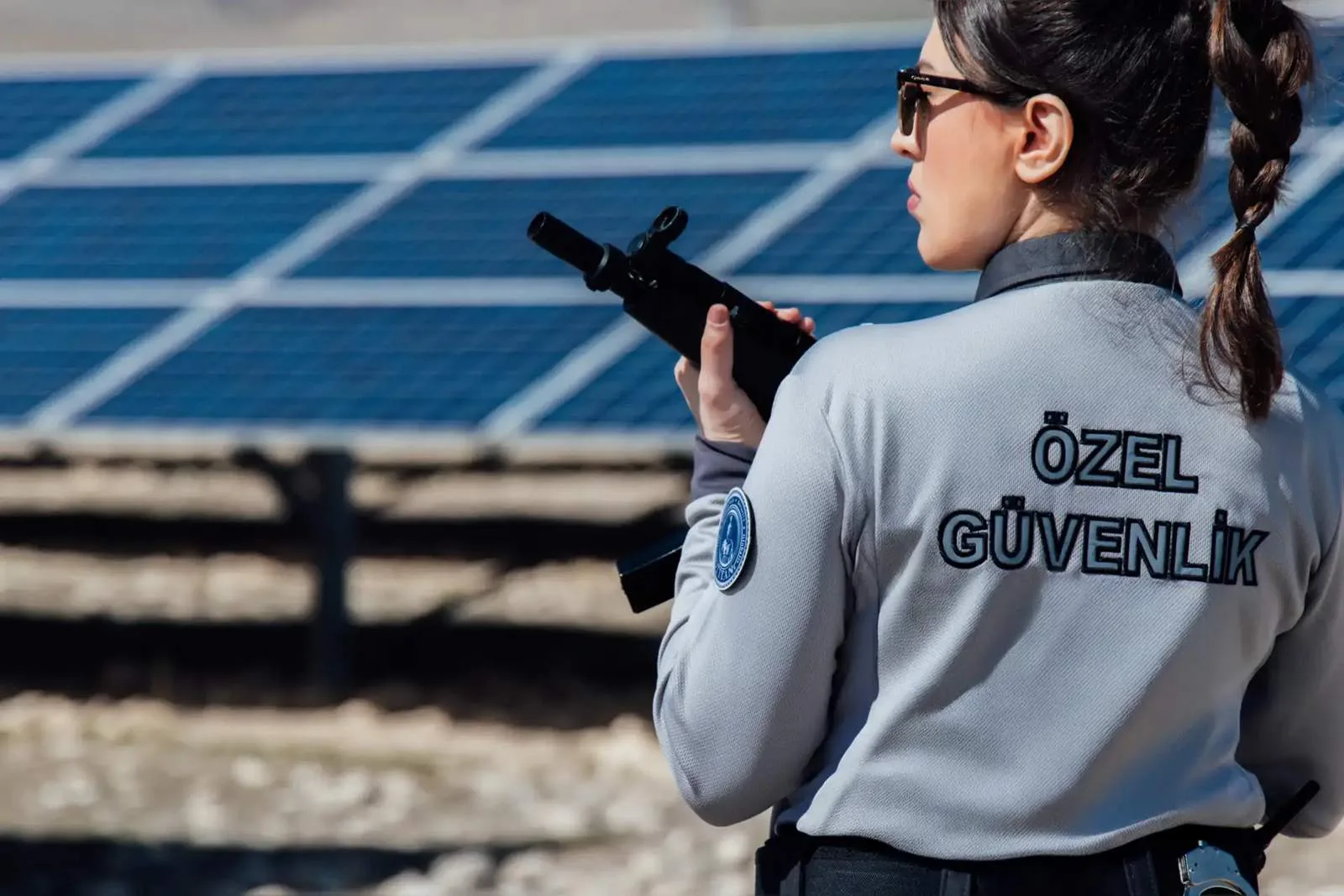
Women security officers: when and why
Article 7(a) of the Law lets officers pass anyone entering the protected area through a walk-through detector, search them with a detector, and pass their belongings through X-ray or similar security systems (Law No. 5188, Art. 7(a)). Article 14 of the Implementing Regulation describes three methods of preventive search: detector, X-ray and, only in cases the Law provides for and when needed, a body search. Its last sentence adds a rule of its own: whoever carries out the search must be the same sex as the person being searched (Implementing Regulation, Art. 14).
In our reading, at a mill where most of the workforce are women, that sentence becomes a rostering rule: a woman officer must be at the gate at every hour when searches may take place. The gaps appear most often on night shifts, weekends and holiday periods. If a site with a woman officer on the day roster leaves only men at the gate at night, the rule cannot be applied at exactly the most sensitive hour. When the roster is drawn up, those hours should be filled first, and the relief officer chosen on the same principle.
A woman officer does more than search. For a worker waiting at the stop, or one who wants to report something that made her uncomfortable on the way out, having a woman to speak to at the gate can make it more likely that reports are actually made.
Privacy in searches and checks
- Equipment first: the Regulation lists the detector and X-ray first; hand searches should be kept to the cases the Law provides for and where they are genuinely needed.
- A separate space: bag and body checks take place in a screened booth or a room next to the gatehouse, not in the middle of the queue.
- Camera angles: the gate camera should cover the flow of people, not the inside of the search booth. Processing of personal data falls under Law No. 6698; set recording and retention rules with your legal adviser.
- Brief and quiet: checks done quickly, without comment and letting the person open her own bag protect dignity.
- A report when something is found: if a check turns up something that may be a criminal item or evidence, Article 7(g) of the Law allows it to be held in safekeeping on condition that the police are told immediately. The officer does not argue; a report is written and the employer's representative called.
Practical checklist
| Area | Question to ask |
|---|---|
| Shuttle stop | Do buses stop inside the fence, or at least in a lit bay visible from the gate and covered by a camera? |
| Area of duty | Does the security plan distinguish where the officer exercises powers from where the officer only watches? |
| Night exit | Does an officer stay at the point until the last bus leaves, and is there a written step for anyone who misses it? |
| Woman officer | Is a woman officer at the gate at every hour when searches may happen, including nights, weekends and holidays? |
| Privacy | Are searches done in a separate booth that the camera does not see into? |
| Waiting area | Do workers wait in a lit, shaded, sheltered place rather than at the roadside? |
| Shuttle contract | Are the stopping point, vehicle list and delay reporting written into the contract? |
| Reporting | Do workers know whom to tell, and how, if something makes them uncomfortable? |
Common mistakes
- Letting the bus stop at the roadside outside the mill and leaving that point out of the security plan.
- Rostering women officers on days only and leaving the gate to men at night.
- Doing bag and body checks in front of the queue at the turnstiles.
- Using a camera angle that also records the search point.
- The officer leaving the post before the last night bus has gone.
- The shuttle operator changing vehicles or drivers without telling the gate.
- Treating lighting as sufficient and not setting up an officer routine at the stop.
A note for sites in Denizli
Some of Denizli's textile sites are located in organised industrial zones. At a site inside a zone, the position of the shuttle stop should be agreed together with the zone management's road and parking layout. You can read about our approach to plant security on our factory security page and about our service in the province on our private security in Denizli page.
Titan Savunma is an Ankara-based private security company licensed by the Ministry of Interior under Law No. 5188 and certified to ISO 9001, 14001, 45001, 22301 and 28000. We work with international companies in English and Turkish, and our Denizli City Manager, supported by our Aegean Regional Directorate in İzmir and our Istanbul General Directorate, reviews your shuttle stop and night-shift exit on site at shift-change time and builds a team routine with you that includes women officers. To request a site survey, please use our contact page.
Sources and Further Reading
- SGK — İstatistik Yıllığı 2025, Bölüm 1 Sigortalı ve İş Yeri İstatistikleri (Tablo 1.11, 1.14, 1.17)
- Meteoroloji Genel Müdürlüğü — Denizli il ve ilçeler istatistikleri (1957–2025)
- 5188 sayılı Özel Güvenlik Hizmetlerine Dair Kanun (md. 7, md. 9) — mevzuat.gov.tr
- Özel Güvenlik Hizmetlerine Dair Kanunun Uygulanmasına İlişkin Yönetmelik (md. 14) — mevzuat.gov.tr
- Kadın Çalışanların Gece Postalarında Çalıştırılma Koşulları Hakkında Yönetmelik (md. 6), RG 24.07.2013/28717; değişiklik RG 19.08.2017/30159 (md. 5) — mevzuat.gov.tr güncel metin
- Ceccato, V. & Loukaitou-Sideris, A. — Fear of Sexual Harassment and Its Impact on Safety Perceptions in Transit Environments: A Global Perspective, Violence Against Women 28(1), 26–48 (2022)
- Yavuz, N. & Welch, E. W. — Addressing Fear of Crime in Public Space: Gender Differences in Reaction to Safety Measures in Train Transit, Urban Studies 47(12), 2491–2515 (2010)
- Welsh, B. C., Farrington, D. P. & Douglas, S. — The impact and policy relevance of street lighting for crime prevention: A systematic review based on a half-century of evaluation research, Criminology & Public Policy 21(3), 739–765 (2022)
- Welsh, B. C., Farrington, D. P. & Douglas, S. — Effectiveness of street lighting in preventing crime in public places, Brå (İsveç Ulusal Suç Önleme Konseyi) (2021)