This article is general information, not legal advice.
An export-control Internal Compliance Programme (ICP) is the set of policies and procedures a company uses to make sure dual-use goods, software and technology leave the company only with the right authorisation. Most of it is paperwork: classification, screening of customers and end users, licences. One element is physical. The European Commission's guidance lists "physical and information security" as the seventh core element of an ICP, because a controlled item or a drawing that walks out of the plant, or is shown to the wrong visitor, defeats every licence check done at the desk.
For a Turkish plant that makes dual-use items, supplies a European group, or holds controlled technology from a foreign partner, this element is where the export-control officer and the security function have to work together. This article explains what dual-use items and ICPs are, what the physical and information security element asks for, how the Turkish framework fits, and how to build the link with your security provider.
Dual-use items and ICPs in brief
EU Regulation (EU) 2021/821 defines dual-use items as "items, including software and technology, which can be used for both civil and military purposes". Control lists reach into ordinary industrial product ranges such as certain machine tools, sensors, composites, chemicals, electronics and encryption-related products, so the question "are we a dual-use exporter?" often has a surprising answer. The regulation's definition of export is wide: it covers not only shipping goods but also the transmission of software or technology by electronic media, including by fax or telephone (Article 2(2)(d)). Technology is therefore an export risk even when no box leaves the site.
The same regulation defines an ICP as ongoing, effective, appropriate and proportionate policies and procedures adopted by exporters to comply with the rules (Article 2(21)). Exporters using EU global export authorisations must implement one, unless the competent authority considers it unnecessary (Article 12(4)). Commission Recommendation (EU) 2019/1318 sets out seven core elements:
- Top-level management commitment to compliance.
- Organisation structure, responsibilities and resources.
- Training and awareness raising.
- Transaction screening process and procedures.
- Performance review, audits, reporting and corrective actions.
- Recordkeeping and documentation.
- Physical and information security.
A separate Recommendation (EU) 2021/1700 adapts the model for research organisations, which is useful for plants with R&D centres or university partnerships.
The Turkish framework
Turkey is one of the 42 participating states of the Wassenaar Arrangement, which maintains the multilateral dual-use control list. At national level, the Ministry of Trade lists the Communiqué on the Control of Exports of Dual-Use and Sensitive Items (Export: 2003/12) among its export regulations. In its published text:
- Exports of materials and technology on the Wassenaar dual-use list and the Australia Group chemical precursors list require permission (Article 2). The text names the former Undersecretariat of Foreign Trade, whose export functions now sit with the Ministry of Trade.
- Applications go to the General Secretariat of the Istanbul Mineral and Metals Exporters' Associations, with technical documents and an end-use certificate from the importer (Article 2), and are forwarded for a final assessment after a preliminary review (Article 3).
- Items not on those lists can still require permission in certain cases, for example when the end user is suspected of developing weapons of mass destruction (Article 6).
Check the current position with the Ministry or the exporters' association before relying on any of this for a specific shipment, as procedures and lists change. Separate rules apply to military goods and to chemicals listed under the Chemical Weapons Convention.
The 2003/12 communiqué sets out a licensing procedure; it does not contain an ICP template like the EU's. In practice, Turkish plants meet the seven-element model through European parent companies, EU customers that ask suppliers to describe their ICP, and licence conditions.
What the physical and information security element asks for
Recommendation 2019/1318 is short on this element, but clear. Based on its own risk assessment, the company should protect controlled items against unauthorised access or removal by employees, contractors, suppliers or visitors. Examples given include restricted access areas and personnel access or exit controls, together with physically safeguarding the items. For software and technology it names antivirus checks, file encryption, audit trails and logs, user access control and firewalls, and it asks for protective measures when controlled technology is uploaded to, stored in or sent through the cloud.
On a plant, that translates into four questions:
- Where are the controlled items? Finished goods, components, prototypes, test rigs, scrap that still carries controlled characteristics, and the rooms or servers that hold controlled drawings and source code.
- Who may access them? A named list maintained by the export-control officer, not by the security desk.
- How is access enforced? Zoning, access control readers, key control, locked storage, escorting, and checks on what leaves the zone.
- How is it proved? Access logs, visitor records, key registers, camera footage, and IT logs that can be matched to them.
Visitors and foreign nationals in controlled technology areas
Because the EU definition of export includes sending technology electronically, and because technical visits are an obvious way to pass know-how, a site visit should be treated as a possible transfer of technology until the export-control function says otherwise. A practical model:
- Every visit request names the visitor, the employer, the nationality, the purpose and the areas and equipment to be seen.
- The export-control officer screens the visitor and the employer through the same transaction screening used for customers, including sanctions and end-use concerns, and approves, limits or refuses the visit in writing.
- The security desk admits only visitors on an approved list, issues badges that show the approved zones, and logs entry and exit times.
- A trained host escorts the visitor the whole time inside controlled zones. Photography and personal storage devices are handled under a written rule.
- Contractors and maintenance technicians who need to work near controlled equipment are treated as visitors, not as staff, unless they have been through the same approval.
Foreign nationals employed at the plant raise a different question: whether the technology they work with is covered for them by the licences or rules that apply. That is a legal assessment for the export-control officer. Security's role is to enforce the resulting access list without exceptions.
Records and audits
The Recommendation's recordkeeping element asks for an adequate filing and retrieval system, effective indexing, records that can be produced promptly for authorities, and attention to the legal retention periods that apply. Physical security produces records that belong in that system: approved visitor lists, visitor logs, badge issue and return records, controlled-zone access logs, key registers, CCTV retention logs and incident reports.
The performance review element suggests internal checks such as random checks and the "four eyes principle", and audits described as systematic, targeted and documented inspections to confirm that the ICP is correctly implemented. Useful physical-security audit tests include sampling a week of controlled-zone access logs against the authorised list, tracing three visits from request to exit, and checking that badges of leavers were withdrawn on their last day.
Coordinating with your security provider
Guards do not classify items or decide who may see controlled technology. They enforce decisions made by the export-control officer, so the interface must be written down:
- Post orders that name the controlled zones, the approved-list procedure, escort rules and what to do with an unannounced visitor.
- A single point of contact in the export-control function, reachable when the gate faces an unexpected request.
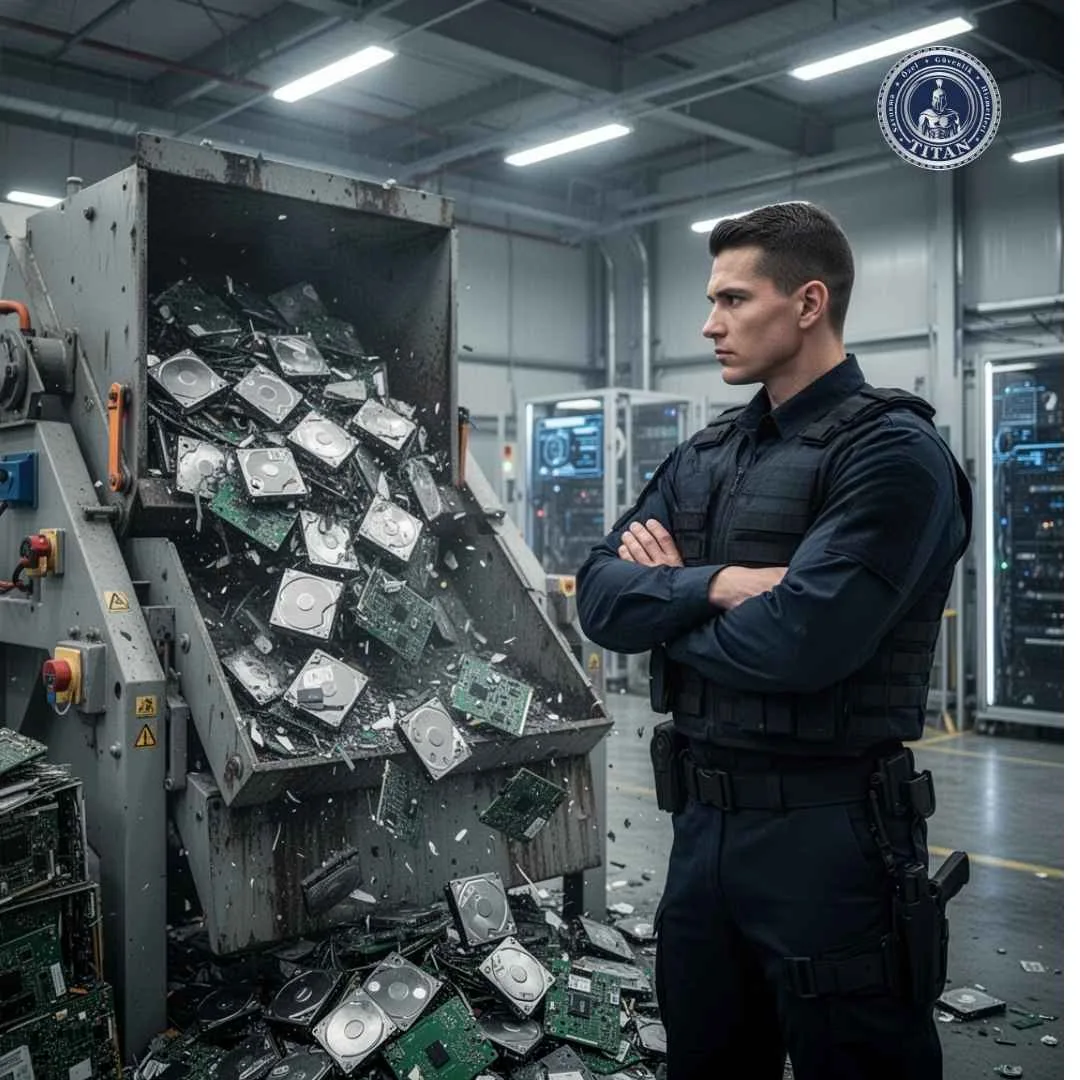
- Exit controls for controlled items: material passes for equipment, samples and scrap leaving the site, checked at the gate against the shipping or disposal authorisation.
- Incident escalation for tailgating into controlled zones, missing items, unauthorised photography or a visitor leaving the escort.
- Personal data rules. Visitor logs and nationality data are personal data under the Personal Data Protection Law No. 6698, so collect only what the process needs and set retention periods.
In Turkey, a contracted guarding provider must hold an operating licence from the Ministry of Interior under Law No. 5188. Ask the provider to report access exceptions to the export-control officer, not only to facility management.
Common mistakes
- An ICP manual that describes screening in detail but says nothing about who can walk into the test lab.
- Visitor approval done by the host engineer alone, with no export-control review.
- Controlled scrap and rejected parts leaving with general waste.
- Access rights that are granted for a project and never removed.
- Security logs kept by the guarding company in a format the export-control officer cannot search.
Working with Titan Savunma
Titan Savunma is an Ankara-based private security company licensed by the Ministry of Interior under Law No. 5188 and certified to ISO 9001, 14001, 45001, 22301 and 28000. We work with international companies in English and Turkish to turn zone, visitor and exit rules into written post orders and regular reports. See our approach to factory security and industrial facility security.
Sources and Further Reading
- European Commission — Commission Recommendation (EU) 2019/1318 on internal compliance programmes for dual-use trade controls (2019)
- European Union — Regulation (EU) 2021/821 setting up a Union regime for the control of exports, brokering, technical assistance, transit and transfer of dual-use items (2021)
- European Commission — Commission Recommendation (EU) 2021/1700 on internal compliance programmes for controls of research involving dual-use items (2021)
- Wassenaar Arrangement — About us / participating states
- T.C. Ticaret Bakanlığı — Çift Kullanımlı ve Hassas Maddelerin İhracatının Kontrolüne İlişkin Tebliğ (İhracat: 2003/12)
- T.C. Ticaret Bakanlığı — İhracat Tebliğleri listesi
- Mevzuat Bilgi Sistemi — 6698 sayılı Kişisel Verilerin Korunması Kanunu
- Mevzuat Bilgi Sistemi — 5188 sayılı Özel Güvenlik Hizmetlerine Dair Kanun