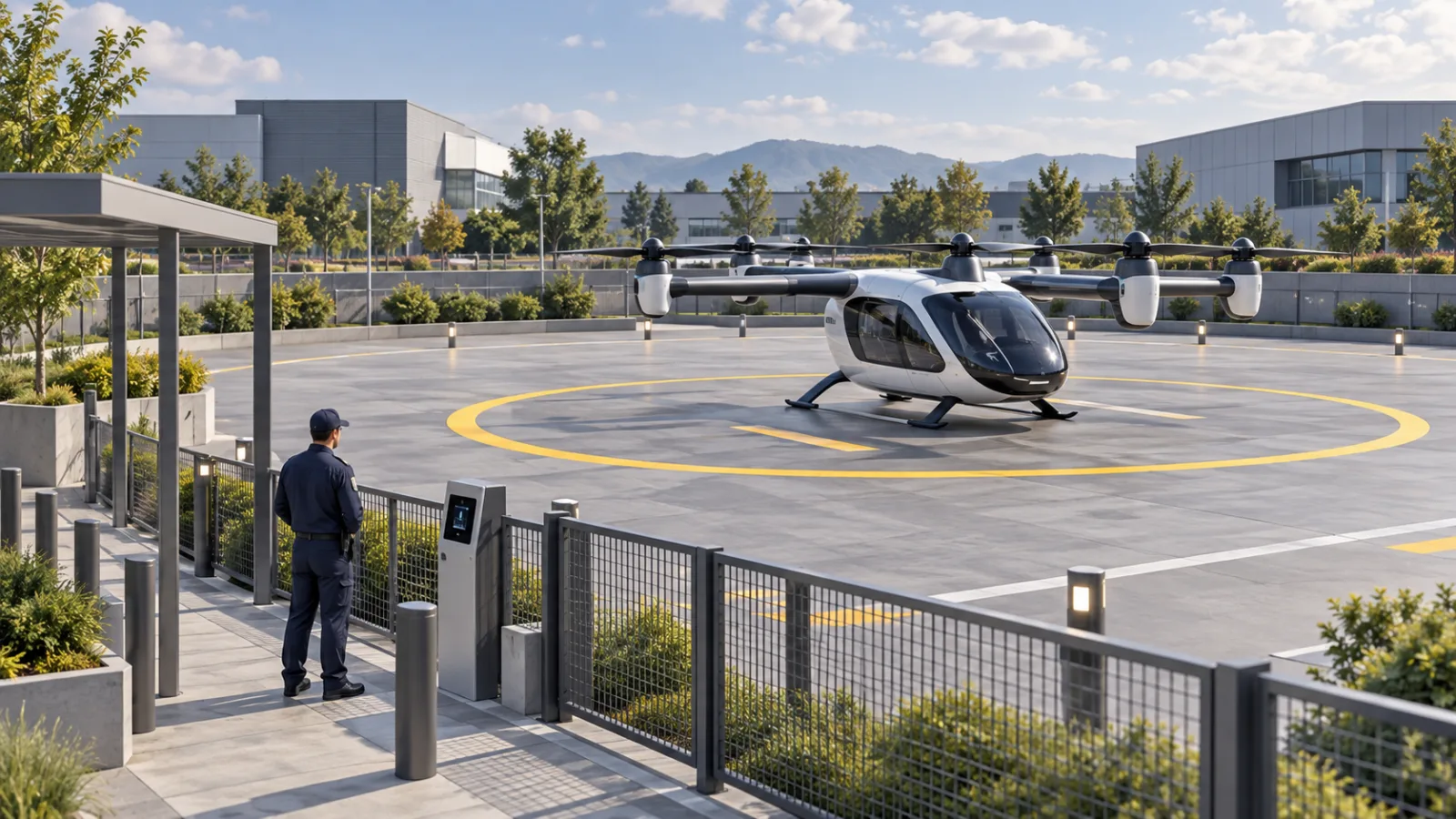
A factory may have controlled gates and a secure perimeter fence. What happens if an unexpected aircraft approaches? The development of flying vehicles invites facility managers to consider airborne events alongside ground-level security. This guide distinguishes the safe operation of authorised air mobility from unauthorised approaches and misuse scenarios.
Flying-vehicle safety and security extend well beyond an aircraft's ability to leave the ground. Passenger access, movement towards the aircraft, authorisation to enter charging areas, and responsibility for responding to an alarm are connected processes. The question asked while watching a demonstration—“can it fly?”—therefore needs a second question when planning a facility: “under what conditions, with which permissions, and under whose responsibility will it operate?”
This guide is intended for facility managers, investors, procurement teams and security managers. It combines distinctions drawn from academic and official sources with examples that teams can discuss on site. The scenarios and checklists below are a proposed assessment framework, not an approved aviation design, flight instruction or certification service. Sources were checked on 16 October 2026.
1. Flying cars, eVTOL aircraft and vertiports are different concepts
“Flying car” is an everyday expression applied to different vehicles. A road-capable aircraft, a vehicle demonstrating brief airborne movement, and an electric vertical take-off and landing aircraft may have different operating models. eVTOL describes electric vertical take-off and landing capability; it does not, by itself, establish roadworthiness, autonomy or permission for commercial passenger transport.
UAM describes the urban air mobility context; AAM is the broader advanced air mobility approach; a vertiport is a facility arranged for VTOL arrivals, departures and associated ground activities. The security scope cannot be defined properly until the actual aircraft type and intended use are known. The FAA's infrastructure explanation considers these concepts alongside facility planning.
For example, describing a rooftop project as “an air taxi stop” is insufficient for procurement. The aircraft, passenger and staff movements, operating hours, maintenance activities and energy infrastructure need to be identified. Unknowns should appear as assumptions in the procurement file, rather than as confirmed technical conditions.
2. Where do safety and security intersect?
In this guide, safety concerns the control of accidental and operational hazards; security concerns protection against unauthorised or intentional interference. An unauthorised door opening may be a security incident. If that door leads people towards an operating aircraft, it also creates a safety risk. The responsibilities and records for these interacting areas need to be designed together.
A 2025 academic review involving UC Berkeley researchers considers aircraft, vertiports, network planning, air traffic and human factors together. Our management inference is that protection should not be reduced to the aircraft alone or the entrance gate alone. This interpretation is not evidence that a particular service reduces accidents by a specified percentage. Academic review
We recommend answering three questions for every significant risk: who detects the problem, who decides what happens next, and who verifies the outcome? Instead of saying “everyone is responsible,” identify the primary owner, supporting team and people to notify. Check situations where an issue is closed in the security log but remains open in the maintenance system.
3. Could a flying vehicle enter a private facility without permission?
An aircraft's ability to approach over a perimeter fence shows why a security assessment cannot rely solely on road entrances. However, being physically able to approach does not mean being able to land safely anywhere or having legal authority to do so. Flight and landing conditions, aircraft and operating permissions, and site suitability require consideration together. Vertical landing capability does not remove surrounding obstacles, surface constraints or hazards to people.
Two questions should therefore be separated. “Is this site suitable for an authorised landing?” concerns aviation and engineering. “How do we protect people and the facility if an unexpected aircraft approaches?” belongs in emergency and security planning. The latter is also relevant to a factory, logistics centre, campus or residential development without its own vertiport. It does not mean that every business needs the same technology or budget.
An expected authorised movement, a coordination error, an emergency landing following a technical problem and a deliberate unauthorised approach are different events. Intent may be unknown when the first report arrives. The FAA specifically states that UAS detection systems cannot determine intent or threat level. A sensor alert should therefore not automatically be labelled an attack. FAA: detection, mitigation and response
4. Deliberate misuse and critical facilities: separate scenarios from evidence
Unauthorised entry, targeted violence against people and sabotage are distinct misuse scenarios that a risk assessment may consider. Discussing them does not establish that such acts involving passenger-carrying eVTOL aircraft are becoming common or will occur at a particular facility. The sources reviewed here do not provide that frequency or a site-specific probability.
An academic review in Sensors examines UAV misuse and detection technologies. That literature can inform the questions asked, but findings about a small unmanned aircraft are not direct evidence for a passenger-carrying eVTOL. Aircraft mass, operating arrangements and people on board call for separate assessment. Seidaliyeva and colleagues, Sensors
Considering airborne threats to high-consequence locations such as nuclear facilities is not a new idea. IAEA physical protection recommendations explicitly cover airborne threats identified in a State's threat assessment. The IAEA also addresses external events such as aircraft impacts in nuclear safety and security work. These sources do not establish that a particular eVTOL could cause severe damage at a particular facility. The outcome requires aircraft- and facility-specific assessment by competent specialists. IAEA NSS No. 13 · IAEA external events framework
A responsible public discussion should address people to protect, continuity of service, decision-making authority and preparedness. Describing vulnerabilities at an identifiable facility or explaining how an attack could be carried out is outside this guide's purpose. Safeguards should develop through verified information and proportionate decisions, rather than an assumption that every flying vehicle is hostile.
5. How should facility security evolve? Combine technology, people and planning
The following is an applied facility-management proposal informed by the sources, rather than a mandatory standard for every business or a performance promise for a particular product.
- Three-dimensional risk assessment: Alongside gates and the perimeter, examine the consequences of an airborne approach for employees, visitors and service continuity. Assess the individual site and restrict access to sensitive findings.
- Protection within the site: Building access and permission controls should remain effective even if the perimeter has been crossed. Consider protection of people, safe waiting arrangements and emergency access within the same plan. New physical measures must not compromise fire exits or aviation safety.
- Verifiable early awareness: Record where and when an alert arose, what observation corroborated it and whom it reached. Keep detection separate from assessing intent, with human evaluation retained.
- Coordination arranged in advance: Define notification routes between management, security, emergency leads and the relevant competent authorities. An officer should know whose decision is required when an event is uncertain.
- Protection appropriate to the scenario: Have competent specialists assess sheltering in place, moving people and suspending particular activities in advance. Do not assume the same automatic response is right for every event.
- Measurement and learning: Track false-alarm workload, verification time, time to reach the correct team, exercise findings and corrective actions. Review training and plans as technology changes.
Innovation involves more than installing additional cameras. Research examines combining radar, electro-optical/thermal imagery, acoustic sensing and appropriate radio-frequency detection. The academic review addresses environmental limitations and sensor fusion. No system should be assumed to recognise every aircraft without error in every condition. Detection research
Our proposal is to define measurable acceptance criteria for the intended aircraft class and actual site conditions before purchasing. Ask how AI-assisted classification reports false alarms and missed events. A performance rate from a small-UAV test must not be presented as passenger-eVTOL performance. Data custody, applicable privacy obligations including KVKK in Türkiye, cybersecurity and maintenance ownership also belong in the selection process.
Another area for development is tabletop exercises supported by a digital site model. Management can test notification and people-management options before a real event occurs. This is a proposed use; a digital model does not itself guarantee a security outcome. A security officer's role is observation, notification and support for the approved site plan. Signal jamming, taking control of an aircraft or forcibly disabling it should not be presented as routine facility-security measures; authority and flight safety require separate assessment.
6. Example scenario: an unexpected approach to a factory without a vertiport
Imagine employees at a factory reporting an unexpected aircraft. It is not yet known whether there is an emergency, a navigation mistake or deliberate conduct. The initial objective is to get verified information to the correct responsible person without exposing people to danger, rather than declaring an attack on assumption.
A tabletop exercise might ask: Who records the first report? How will employees be discouraged from gathering out of curiosity? Who decides on safe waiting or movement under the existing plan? How will access for emergency teams remain open? If an aircraft has landed, whose approach should be restricted pending coordination with technical and emergency teams? Who authorises a return to normal activity?
The review should go beyond stating that an aircraft was detected. Examine whether people were protected, whether the communication chain worked and whether records were accurate. This turns flying vehicles from a discussion only about future technology into a practical preparedness and coordination exercise that can be developed today.
7. How should Turkish requirements and international guidance be read?
Türkiye's Directorate General of Civil Aviation, SHGM, defines vertiports in its SHT-HAVA KAMPÜS instruction dated 9 August 2024 and sets out construction and use processes. Article 8(5) addresses security and rescue/firefighting measures at air campuses used for commercial air transport. It is therefore incorrect to say that Türkiye has no regulation in this area. Facility permission, aircraft suitability and flight/operator requirements nevertheless need separate assessment. SHGM instruction
FAA and EASA publications are useful technical references; they do not replace operating permission in Türkiye. In particular, EASA's 2022 vertiport document is a set of prototype technical design specifications. Project teams should record a reference's date and its aircraft and operating scope. A historical statement that a requirement has “not yet been developed” should not be repeated as today's position. EASA vertiport guidance
We suggest adding an applicability register to the procurement file: document title, version, relevant activity, reviewing specialist and unresolved question. This distinguishes international design guidance, national requirements and the operator's own choices. Open issues can then be resolved with the competent authority and relevant specialists.
8. Assign responsibilities before duties begin
The following responsibility matrix is an example for discussion. The actual allocation depends on the operating model, permissions and contracts.
- Starting and continuing a flight: This belongs to the authorised aircraft operator and flight crew. Facility security communicates verified information about site conditions.
- Layout and technical suitability: These are assessed by competent engineering teams and the relevant authorities. Security staff help preserve the approved boundaries.
- Charging, maintenance and high voltage: These belong to authorised technical personnel. Security staff check access permission and report irregularities.
- Fire and rescue: These are handled by the defined emergency management structure and competent teams. Security supports alarm communication, wayfinding and access arrangements.
- Physical entry and visitors: Checks follow the operator's approved arrangements and remain within the team's duties and legal authority.
- Records and personal data: Teams follow the lawful recording and disclosure processes established by the data controller and authorised personnel.
The presence of a security officer does not make that person an air traffic controller, battery technician or aviation rescue and firefighting specialist. Job descriptions should preserve this distinction. If an individual has several roles, competence, authority and simultaneous workload should be assessed separately for each.
9. An illustrative vertiport zone matrix
Rather than dividing the site simply into “inside” and “outside,” discuss why people enter and how far each person may proceed. The following example is neither a layout drawing nor a mandatory zoning standard.
- Reception and waiting: Monitor passengers, accompanying people and visitors. Question: where will a growing queue be directed?
- Controlled passenger passage: Verify passengers who have completed the relevant process and authorised staff. Question: who may open or suspend passage?
- Aircraft movement area: Manage authorised operations staff access according to operating conditions. Question: who confirms that the area is ready?
- Charging and technical work: Match technical personnel's work to their authorised access scope. Question: when does that permission expire?
- Emergency access route: Keep the route available to response teams. Question: what is the alternative if the main entrance cannot be used?
- Records and control room: Assess physical access and account permissions together. Question: who may export footage?
The matrix makes control questions visible. Allowing a technician through the entrance, for instance, does not demonstrate authorisation to work on a particular battery. Entry permission, work order and technical authorisation can be matched as separate records. When a contractor's assignment ends, physical credentials and remote access should be reviewed together.
10. Consider pedestrians, crowds and airflow together
The FAA's December 2024 EB105A introduces a caution area for downwash and outwash. Planning considers parking and ground movements as well as touchdown. Distances depend on the aircraft and conditions; one universal safe radius cannot be prescribed for every facility. FAA EB105A
Building on that technical context, our proposed site review follows the passenger's actual journey: leaving ground transport, handling baggage, passing a checkpoint, waiting, receiving directions and boarding. Consider families with children, passengers using mobility support, visitors unfamiliar with the language and queues caused by delays as distinct scenarios. Check that everyday queue arrangements do not obstruct emergency exits.
Signage alone does not demonstrate that a process works. Observe how the same passage is managed after staff change. Moving a barrier, parking a cleaning vehicle or installing a temporary event structure may affect the passenger route. These changes should not be treated as minor adjustments without informing the responsible operations team.
Observations about loose objects or damaged surfaces also need a clear reporting route. An officer should not enter an aircraft movement area without authorisation to resolve a problem. They should use the operator's safe coordination process. The aim is to alert the right team without enlarging the hazard, rather than merely to appear fast.
11. Role boundaries matter particularly around batteries and charging
UAM.OP.MVCA.205 in EASA's March 2026 Air Operations compilation links charging or battery swapping while passengers embark, remain on board or disembark to risk assessment, procedures and training. Associated guidance considers electrical hazards, overheating and evacuation together. This does not establish that an ordinary car-park charging arrangement is automatically suitable for aviation operations. EASA current operations rules
For facility security, the proposed focus is preventing unauthorised approach, recognising alarms, reaching the correct contact and supporting the established safe evacuation arrangements. Opening battery packs, disconnecting cables, restarting defective equipment or improvising a firefighting method are not natural extensions of that role.
The operator, technical specialists and fire/rescue professionals should work together. They can document who receives each alarm, how locations are described, which entrance responding vehicles use and where passengers assemble. This guide does not prescribe extinguishing agents, response distances or battery-handling methods. Competent teams need to determine those matters for the actual aircraft and facility.
12. Physical and cyber security should not remain separate files
ICAO's public explanation of Doc10213 places cyber risk within aviation safety and security processes. Door credentials, maintenance accounts and control screens should consequently be considered more than administrative conveniences. ICAO cyber risk framework
Our practical recommendation is to associate access with a person, a task and a period. Prefer permissions with identifiable owners, access that ends with the assignment, and authorised change records over shared accounts. Preserve personal-data boundaries when reviewing physical and digital access records together. Security staff should not be assigned to inspect flight software or reconfigure aircraft systems.
For example, a person claiming to be a maintenance technician should not be admitted solely because of their clothing or confident explanation. Approval, the work order and access scope can be checked through the operator's established contact. If escalation is defined in advance, staff can resolve uncertainty without inventing decisions under pressure or unnecessarily delaying essential technical work.
13. Human factors: automation does not remove responsibility
A 2021 University of Michigan study used a five-expert focus group to examine automation, training, safety/security and regulation together. This small qualitative study is not a basis for claiming that automation automatically eliminates human responsibility. Human factors research
In the shift design we propose, teams observe the combined demand from alarms, visitor reception and telephone traffic. Staffing is not calculated from total visitor numbers alone. Identify who provides support when one person is occupied during a critical period. Shift handover should communicate unresolved defects, temporary access permissions and expected technical work.
In addition to an attendance sheet, training assessment can check whom a person contacts in a scenario and where their authority ends. The response to false alarms matters too: efforts to reduce unnecessary interventions should not create a habit of dismissing genuine warnings. Use training findings to identify procedural and workload problems before treating every failure as an individual's fault.
14. Example scenario: a technical alarm and a passenger queue coincide
Imagine an alarm from a technical area while delays are increasing the number of people in the waiting area. This is a training example, not an event at a particular facility. Its purpose is to test connections between teams, rather than teach unqualified staff how to fight an aircraft fire.
A tabletop discussion can address these questions in sequence. Who first saw the alarm? How did they identify the location to the technical lead? Who decided to suspend passenger passage? Who explained the situation to waiting passengers? Who was responsible for passengers needing assistance? Who kept response routes available? Who had authority to reopen the area?
The observer records missing information as well as elapsed time. If two teams use different names for the same location, revise the map and communication terminology. If a telephone number fails, verify an alternative contact route. Assign an owner and completion date to each finding, then check that the correction has been implemented. This process is intended to reveal plans that exist on paper but do not work in practice.
15. Cameras and visitor records: more data is not always better
Türkiye's Personal Data Protection Authority, KVKK, emphasises relevance, limitation and proportionality in camera-related decisions; video and audio recording require distinct consideration. A vertiport's recording purpose, access permissions and retention period should be assessed alongside its legal basis. KVKK decision 2020/212
We suggest asking of each data field: “which decision or obligation makes this necessary?” Passenger information, visitor logs and technical work records should not automatically be combined into one list visible to everyone. Evaluate footage export requests against the requester's authority and the scope of disclosure. Facial recognition and continuous audio recording should not be default solutions.
16. What evidence should a security procurement request seek?
An impressive-looking proposal does not establish that its scope is correct. We suggest using this checklist to compare proposals on consistent terms:
- Scope: Are duties in public, controlled and technical areas described separately?
- Boundaries: Do flight, maintenance, high-voltage and fire/rescue responsibilities remain with the appropriate teams?
- Workload: Have peaks, breaks, leave, handovers and simultaneous incidents been considered?
- Competence: How will site-specific duties be assessed alongside general training?
- Coordination: Are current contacts available for the operator, technical service and emergency teams?
- Data: Who may access, disclose and delete records, and when?
- Change: Who reassesses the scope when a different aircraft or charging system is introduced?
- Assurance: What record demonstrates that findings have been closed?
A supplier should not be expected to imply aviation authorisation that it does not possess. Its training, supervision, reporting and cover arrangements within its actual remit should nevertheless be specific. Instead of unlimited promises such as “complete security,” a proposal should identify duties, deliverable records, owners and exclusions. Pricing can then be compared for the same service.
17. Which data can support improvement?
Suggested measures include expired permissions that remain active, access irregularities, unresolved site findings, communication gaps found in exercises and correction times. Read incident counts alongside passenger or operating volumes. Increased reporting can sometimes indicate better visibility rather than worse performance.
If response time is measured, define its start and end. Alarm generation, an officer noticing it, notification to the correct team and the start of a competent response are different timestamps. Combining them into one figure can hide where the difficulty lies. A short management report should show what changed, which risks remain open and who owns the next correction.
Frequently asked questions
Is painting a rooftop marking enough to create a vertiport?
No. Layout, structure, aircraft, surroundings, operating conditions and permissions require consideration together. Markings do not replace those assessments. Applicable conditions must be resolved for the project with the competent teams.
Will every flying vehicle be pilotless?
No. Electric propulsion or vertical take-off capability does not imply pilotless operation. A security plan should follow verified aircraft and operating characteristics rather than promotional language.
What should a security officer do after a battery alarm?
Support notification, access arrangements and evacuation in line with their training and the approved emergency plan. They should not assume technical or firefighting authority and training that they do not possess.
Can a fixed staffing number be recommended?
Not from this information. Without the layout, working hours, simultaneous duties, staff leave and cover needs, a headcount would be unreliable. First establish where and when each duty arises.
Which document should be prepared first?
A short scope document identifying aircraft and operating assumptions, zones, responsibilities and open questions is a useful start. Competent specialists' assessments can then inform the duty plan, training and verification steps.
A sound facility starts by aligning authority, information and practice, before claiming to possess the most impressive technology. As flying vehicles develop, the value of that work will be seen in how clearly people understand their responsibilities during everyday operations and unexpected events.
Discuss the security needs of your existing facility
You can discuss access control, visitor arrangements, patrols and reporting at your existing facility with TİTAN Savunma. Explore our manned guarding services or use our contact page. The discussion concerns facility security, rather than flight, aircraft or vertiport certification.
The cover image is an AI-generated illustrative concept. It does not depict a real facility, a client project or an approved aviation design.
Sources and Further Reading
- SHGM — Hava Kampüslerinin İnşa Edilmesi ve Kullanılması Talimatı (SHT-HAVA KAMPÜS)
- FAA — Advanced Air Mobility Infrastructure
- FAA — Engineering Brief 105A: Vertiport Design
- EASA — Prototype Technical Design Specifications for Vertiports
- EASA — Easy Access Rules for Air Operations, Revision 24, March 2026
- ICAO — Global Cyber Risk Considerations (Doc 10213)
- Sengupta ve diğerleri — Urban Air Mobility Research Challenges and Opportunities
- Panesar, Mathur, Atkins ve Sarter — Moving From Piloted to Autonomous Operations: Investigating Human Factors Challenges in Urban Air Mobility
- Schweiger ve Preis — Urban Air Mobility: Systematic Review of Scientific Publications and Regulations for Vertiport Design and Operations
- KVKK — Ses kayıt özelliği bulunan güvenlik kamerası kullanılması, 2020/212 sayılı karar özeti
- FAA — UAS Detection, Mitigation, and Response on Airports
- Seidaliyeva ve diğerleri — Advances and Challenges in Drone Detection and Classification Techniques: A State-of-the-Art Review, Sensors 2024, 24, 125
- IAEA — Nuclear Security Recommendations on Physical Protection of Nuclear Material and Nuclear Facilities, NSS No. 13, özellikle 3.34–3.47
- IAEA — External Events Safety Section: About EESS