For an international company opening a regional headquarters in Istanbul or Ankara, the reception desk is both the visitor's first contact with the company and the building's first layer of security. When those two functions share one desk, the same questions come up: can the person who greets guests also be the security officer, how should the visitor log be kept, and who opens the door for a contractor arriving late at night?
The short answer: the receptionist and the licensed private security officer (özel güvenlik görevlisi) are two different roles, and Turkish law gives that distinction real consequences. Article 16 of Law No. 5188 on Private Security Services says private security personnel may not be employed in work other than protection and security. Visitor logs are personal data under Law No. 6698 on the Protection of Personal Data (KVKK), subject to rules on notice, proportionality and retention.
This article is general information, not legal advice.
Two roles, two job descriptions
Reception handles greeting guests, directing them to meeting rooms, refreshments and the switchboard. The security officer handles protection work: identity checks, entry control, responding to incidents and keeping records. Using an officer for coffee service, the switchboard or courier runs breaches Article 16, and Article 20 of the Law provides for an administrative fine for each instance found.
| Task | Reception | Security officer |
|---|---|---|
| Greeting guests, notifying the host | Yes | No (limited to entry control) |
| Verifying identity, issuing visitor badges | Possible, by policy | Yes |
| Walk-through detector, X-ray, hand-held detector | No | Yes (Article 7) |
| Suspicious situations, incident logs, calling the police | Alerts security | Yes |
| Refreshments, meeting rooms, switchboard | Yes | No (Article 16) |
The powers in Article 7 belong only to licensed officers, and Article 12 says an officer not wearing the state-issued ID card (kimlik kartı) may not use them. So reception staff, however experienced, should not check bags or search people. Article 14 of the implementing regulation also requires that a body search be carried out by an officer of the same sex as the person searched.
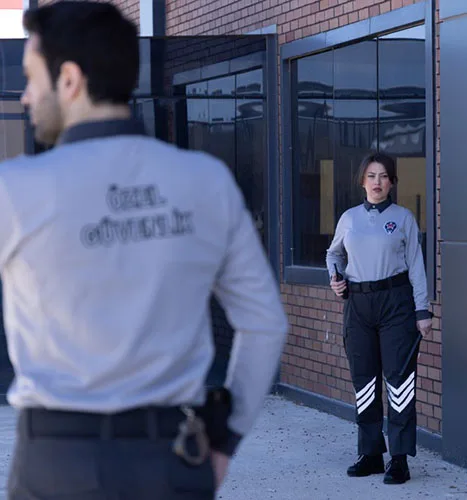
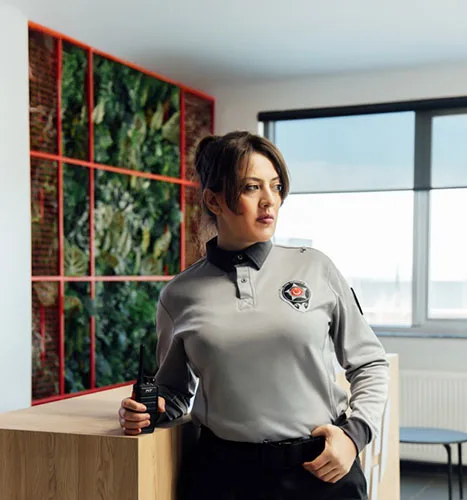
A note for companies that want a corporate look: under Article 13, private security officers wear uniform on duty, and working in plain clothes requires permission from the provincial private security commission. A request for officers "in suits" should therefore be planned as a permit question.
A KVKK-compliant visitor log
Article 4 of the KVKK requires personal data to be relevant, limited and proportionate to its purpose and kept only as long as necessary. For a visitor log this means:
- Name, company, host, time in and out and badge number are enough for most regional headquarters.
- Photocopying or scanning ID cards should not be standard practice unless the company has assessed that it is proportionate to the purpose.
- The retention period should be written into the company's retention and destruction policy, and records destroyed when it expires.
- In multi-tenant buildings, the lobby log kept by building management and the tenant's own floor log are separate data controller responsibilities.
The duty to inform comes from Article 10 of the KVKK: visitors are told the identity of the data controller, the purpose, who data may be transferred to, the collection method and legal basis, and their rights. A short notice at the desk with a link or QR code to the full text works well. The data protection authority's guide on the duty to inform gives sample texts. The Board's principle decision No. 2026/347 of 18 February 2026, published in the Official Gazette on 24 March 2026 (official announcement), stresses that the privacy notice must be separate from any explicit consent text and that visitors should not be asked to "accept" the notice.
If the overseas head office wants access to visitor lists, that is a cross-border transfer question, assessed under Article 9 of the KVKK as amended in 2024. For more on visitor and camera records, see our bulletin on CCTV, visitor logs and KVKK in Turkey.
Contractors and deliveries
Maintenance technicians, IT contractors and fit-out teams need a different flow from ordinary guests. Reception welcomes them, but security rules decide which areas they may enter, for how long and with which escort.
- Contractor visits are pre-notified with a work order; anyone not pre-notified waits in the lobby until the host confirms.
- Escort is mandatory in areas such as server rooms, archives or executive floors.
- Higher-risk work such as hot work or electrical work is tied to the building's permit-to-work system.
- Couriers deliver at the lobby; unexpected or unaddressed parcels are left with the security officer and not opened.
After-hours access
After-hours access at a regional headquarters usually involves three groups: staff working late, cleaning and maintenance crews, and managers on calls with a head office in another time zone. Reception is closed at these times, and all entry runs through security.
- The list of people with after-hours access, and the manager who approved it, should be in writing.
- Security should know which duty manager to call when someone not on the list arrives.
- Security should know when staff are working alone late, and who to call in an emergency.
- Keys and cards handed over at shift change should be logged.
Staffing and shift patterns are planned for each building according to its operating hours, legal working-time limits and risk assessment.
Hospitality expectations of international firms
Foreign head offices usually expect a welcome in Turkey close to their own global standard. Security should be part of that experience without feeling heavy:
- Visitors receive an email in advance with entry instructions, the address and parking directions.
- Greetings are in Turkish and English, and the names of frequent visitors are known in advance.
- If a non-disclosure agreement must be signed, reception handles it before the badge is issued.
- For senior visits, security and reception share the same programme beforehand; the checkpoint is not hidden, but it is calm and quick.
- Accessible entry and assistance are planned for visitors with disabilities.
Set-up checklist
- Are there separate written job descriptions for reception and security?
- Is it checked that officers are not given non-security tasks?
- Are visitor log fields proportionate, and is the retention period written down?
- Is the privacy notice visible at reception and separate from any consent text?
- Are there separate flows for contractors, couriers and after-hours access?
- Is the boundary between building management's lobby security and the tenant's reception in writing?
For wider planning for office buildings, see our page on office and business centre security.
About Titan Savunma
Titan Savunma is an Ankara-based private security company operating under a Ministry of Interior licence issued under Law No. 5188. It holds ISO 9001, 14001, 45001, 22301 and 28000 certificates, works with international companies in English and Turkish, and plans services for sites in different provinces of Turkey with a single point of contact, written scope and regular reporting. Learn more on our private security in Turkey page.
Sources and Further Reading
- Law No. 5188 on Private Security Services, Mevzuat Bilgi Sistemi
- Law No. 6698 on the Protection of Personal Data, Mevzuat Bilgi Sistemi
- Aydınlatma Yükümlülüğünün Yerine Getirilmesi Rehberi announcement, Kişisel Verileri Koruma Kurumu
- Public announcement on Board principle decision No. 2026/347 (18 February 2026) on separate consent and notice texts, Kişisel Verileri Koruma Kurumu