This article is general information, not legal advice.
In Turkey, trade secrets are protected mainly through the unfair competition rules of the Turkish Commercial Code No. 6102, the Turkish Criminal Code No. 5237 and employees' duty of loyalty under the Labour Law No. 4857. In practice, information that the company itself has left open is hard to protect under any of them. If a dispute reaches court, one of the first practical questions is what the company did to keep the information secret, and on a production site much of that evidence is physical: who could enter the room, who could photograph the line, who signed for the drawing.
This article connects the legal anchors with the shop-floor measures that make them usable. It is written for plant managers, legal teams and foreign parent companies that have moved process know-how, tooling or formulations into a Turkish facility.
Why the shop floor is where secrets live
Manufacturers often think of patents first, but much valuable know-how is never patented. A 2017 study by the EU Intellectual Property Office's Observatory, based on Community Innovation Survey data covering almost 200,000 firms, found that the use of trade secrets to protect innovation was higher than the use of patents for most types of companies and in most economic sectors, and that trade secrets were more likely to be used for process innovation. The authors caution that the results show associations, not proof of cause and effect.
Process innovation is exactly what a plant contains: machine settings, recipes, curing times, jig and fixture designs, yield data, supplier specifications and the small modifications that operators make to a line. Much of it is visible to anyone standing in the right place with a phone.
The legal anchors in Turkey
Turkish Commercial Code (TTK). Article 54 states that the purpose of the unfair competition rules is honest and undistorted competition. Article 55 lists the main forms of unfair competition. Among them:
- Article 55(1)(b)(3): inducing workers, agents or other assistants to disclose or obtain their employer's production and business secrets.
- Article 55(1)(c): unauthorised use of another's work products, such as offers, calculations or plans entrusted to someone.
- Article 55(1)(d): unlawfully disclosing production and business secrets, in particular exploiting or communicating information obtained secretly and without authorisation or otherwise unlawfully.
Article 56 gives those harmed civil remedies, including a declaration, an injunction and removal of the consequences. Article 62 makes intentional unfair competition under Article 55 a criminal offence, prosecuted on the complaint of a person entitled to sue.
Turkish Criminal Code (TCK). Article 239 penalises giving or disclosing to unauthorised persons trade, banking or customer secrets learned through one's position, duty, profession or trade, and also covers persons who obtained them unlawfully. Its second paragraph extends the rule to scientific discoveries, inventions and information on industrial application. The offence is generally prosecuted on complaint, and Article 73 sets a six-month complaint period running from when the entitled person learns of the act and the perpetrator. That deadline is one reason incident handling must start quickly.
Labour Law. Article 25(II)(e) of Law No. 4857 lists, among conduct contrary to honesty and loyalty that can justify termination by the employer, a worker revealing the employer's trade secrets.
"Reasonable steps": the international benchmark
Turkey is a member of the World Trade Organization and bound by the TRIPS Agreement. TRIPS Article 39 requires members to let natural and legal persons prevent information lawfully within their control from being disclosed to, acquired by or used by others without consent in a manner contrary to honest commercial practices, provided the information is secret, has commercial value because it is secret, and has been subject to reasonable steps under the circumstances to keep it secret. WIPO's trade secrets guidance summarises the same three conditions and gives examples of protective measures, including non-disclosure agreements, IT security and controlled access to important documents.
The Turkish provisions above do not reproduce this three-part test word for word. But in any dispute, a company that can document its protective measures is in a far stronger position than one that cannot show the information was ever treated as confidential. Physical measures are often the easiest to prove because they leave records: access logs, visitor registers, signed declarations and photographs of signage.
Physical measures that show reasonable protection
Zoning
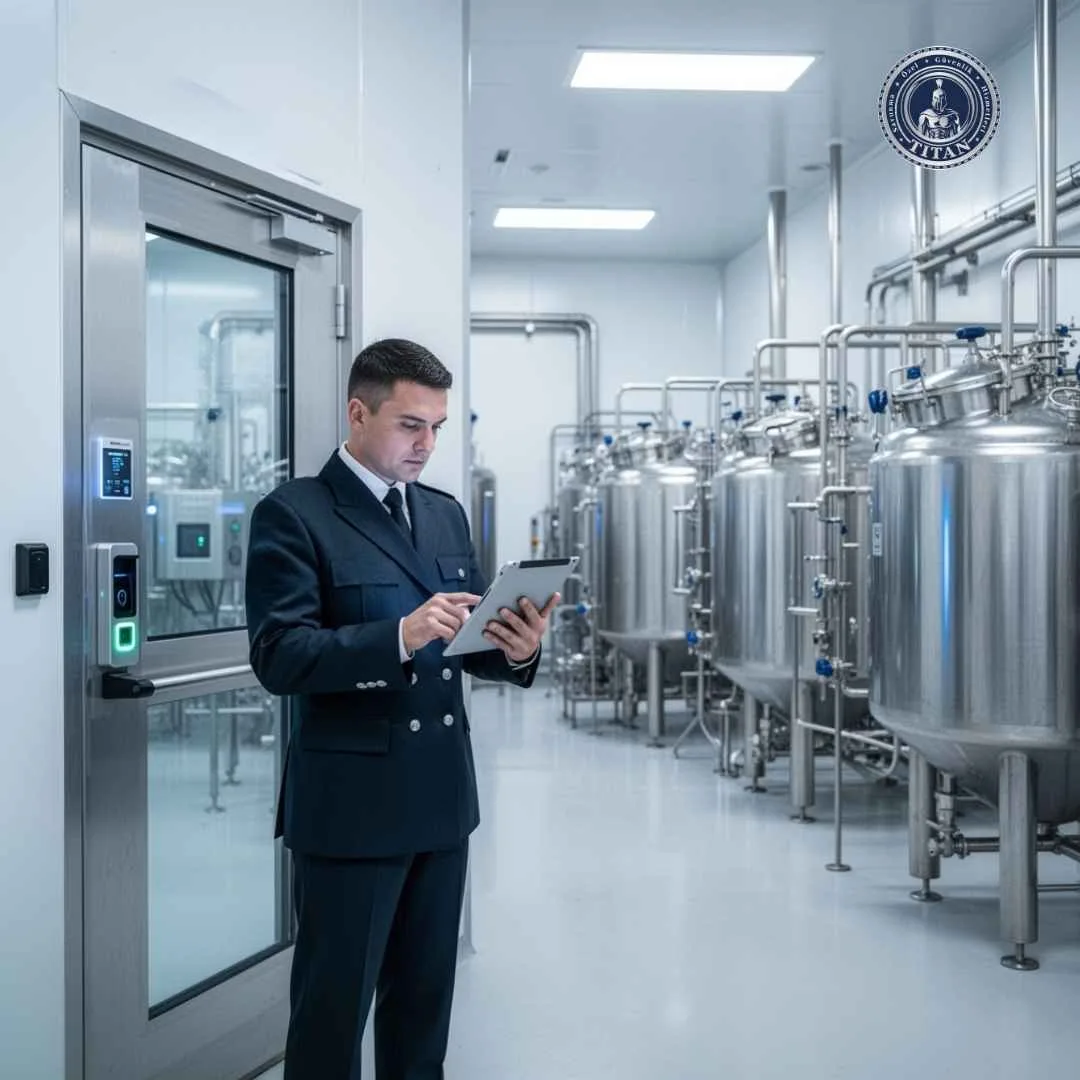
- Classify areas by sensitivity: public reception, general production, and restricted zones such as R&D labs, tool rooms, pilot lines and recipe control rooms.
- Restrict restricted zones to named roles, enforced by badge access and reviewed periodically.
- Mark restricted zones clearly at the door. A sign is cheap evidence that people were told.
Visitors and customers
- Register every visitor, with the host's name and the purpose of the visit; escort visitors in production areas.
- Plan visit routes that show what the visit needs and avoid sensitive lines; use screens or curtains where a route passes a confidential process.
- Have visitors acknowledge site rules on arrival, including photography and confidentiality.
Photography and devices
- Set a written rule for phones and cameras in restricted zones: prohibited, sealed, or allowed only with a permit.
- Apply the rule to employees, contractors and visitors alike, and to drones and smart glasses.
- Control removable media and the printing of drawings; mark controlled documents and keep a register of copies.
Waste and returns
- Rejected prototypes, scrapped moulds and test samples can reveal more than a drawing. Route them to controlled destruction with a record.
- Shred or securely dispose of printed specifications.
Information security standards such as ISO/IEC 27001 include physical controls on secure areas and equipment that can be used as a structure for these measures.
Suppliers, contractors and service providers
Toolmakers, maintenance contractors, cleaning crews, logistics firms and security staff themselves all see parts of the process. Contracts should carry confidentiality clauses, but a signature alone is weak evidence of protection if the contractor's people wander freely. Combine both:
- Non-disclosure clauses in supplier and contractor agreements, with a requirement to pass them down to their staff.
- Contractor access limited to the area and time of the job, with escort in restricted zones.
- Drawings shared with toolmakers marked confidential, numbered and returned or destroyed at the end of the job.
- Security staff briefed on what is confidential, without being given the secret itself.
When something leaks: incident handling and evidence
- Secure, do not confront. Restrict the suspected person's access through HR and IT in a lawful, documented way. Avoid improvised interviews by security staff.
- Preserve evidence. Stop automatic overwriting of relevant CCTV and access logs, export them with a record of who exported what and when, and keep visitor registers and material exit notes.
- Involve counsel early. Decide whether to pursue civil remedies under the TTK, a criminal complaint, or both, keeping the six-month complaint period in mind.
- Respect data protection. Evidence collection must stay within the Personal Data Protection Law No. 6698: purpose-bound, proportionate and documented.
- Close the gap. Review which control failed and update zoning, visitor routes or device rules.
Common mistakes
- Labelling everything "confidential", which weakens the label for what really matters.
- Strict rules for visitors but none for long-term contractors.
- CCTV retention too short to cover the period before a leak is noticed, or so long it conflicts with data minimisation.
- No record of who was told the rules.
- Rolling out a parent-company confidentiality policy in English only, without adapting it to the actual workflow on site; a rule employees cannot read is weak evidence.
About Titan Savunma
Titan Savunma is an Ankara-based private security company licensed by the Ministry of Interior under Law No. 5188 and holding ISO 9001, 14001, 45001, 22301 and 28000 certificates. We work with international companies in English and Turkish on the physical layer of information protection, such as zoned access, visitor control and incident records, under a written scope with regular reporting. See factory security and office and business centre security.
Sources and Further Reading
- EUIPO European Observatory on Infringements of IP Rights — Protecting Innovation through Trade Secrets and Patents: Determinants for European Union Firms (2017)
- World Trade Organization — TRIPS Agreement, Part II Section 7, Article 39 (Protection of Undisclosed Information)
- WIPO — Trade Secrets
- Republic of Türkiye — Turkish Commercial Code No. 6102 (mevzuat.gov.tr)
- Republic of Türkiye — Turkish Criminal Code No. 5237 (mevzuat.gov.tr)
- Republic of Türkiye — Labour Law No. 4857 (mevzuat.gov.tr)