This article is general information, not legal advice.
Workplace violence usually looks sudden. Looking back at the records, though, there are almost always earlier signs that someone noticed and nobody owned: repeated threatening e-mails, a dismissed employee waiting at the gate, an ex-partner calling reception, a manager verbally abusing a team. A prevention programme exists to bring those signs to one table, assess them and respond in proportion.
The short answer: an effective programme has five parts, namely a written policy, a multidisciplinary threat assessment team, safe reporting and support channels, graded response protocols, and recovery with review. Turkey has no single "workplace violence act"; the employer's duties come together from occupational health and safety law, the Code of Obligations and private security legislation. This guide gives a cross-sector corporate framework for companies in Turkey; hospital "white code" procedures are a separate topic.
The legal ground: what Turkish law expects from employers
- Turkish Code of Obligations No. 6098, Art. 417: the employer must protect and respect the employee's personality, keep the workplace in line with good-faith principles and, in particular, take the measures needed so that employees are not subjected to psychological or sexual harassment and that those who have been do not suffer further harm.
- Occupational Health and Safety Law No. 6331: the employer carries out or commissions a risk assessment (Arts. 4 and 10), informs employees about risks and measures (Art. 16), trains them (Art. 17) and consults them when risks and measures are determined (Art. 18). Violence is a natural part of the risk assessment wherever staff face the public, work at night or work alone.
- Prime Ministry Circular No. 2011/2 on preventing psychological harassment (mobbing) at work: it states that combating psychological harassment is first of all the employer's responsibility and that employers must take all necessary measures; it also provides for psychological support by psychologists through the ALO 170 line, careful examination of complaints by labour inspectors with the utmost care for privacy, and awareness training.
Internationally, the reference point is the International Labour Organization's Violence and Harassment Convention, 2019 (No. 190). The ILO Türkiye Office's 2022 forum publication on preventing violence against women at work records two points relevant to employers: speakers stressed that women working in direct contact with third parties, such as customers, patients or service users, face violence and harassment more often, and trade union speakers described collective agreements in Türkiye that have started to draw on C190, for example by widening risk assessment to psychosocial factors. For a multinational, the Convention's definitions and employer duties offer a clear structure that can be applied consistently across subsidiaries.
What C190 says, and how it shapes the programme
The Convention text (Art. 1) defines violence and harassment as a range of unacceptable behaviours and practices, or threats of them, whether single or repeated, that aim at, result in or are likely to result in physical, psychological, sexual or economic harm. Its scope (Art. 3) goes beyond the workplace itself to rest and meal areas, work-related trips and events, work-related communications including those enabled by technology, and employer-provided accommodation.
Article 9 asks states to require employers, in proportion to their degree of control, to adopt a workplace policy on violence and harassment in consultation with workers; to take violence, harassment and associated psychosocial risks into account in occupational safety and health management; to identify hazards and assess risks with worker participation and take measures to prevent them; and to provide information and training. These four duties map closely onto the risk assessment, information, training and consultation duties already in Law 6331. The efficient route is therefore to build the programme as a module of the existing OHS system, not as a separate bureaucracy.
Programme components at a glance
| Component | Content | Turkish anchor |
|---|---|---|
| Policy | Zero-tolerance statement, definitions, scope (employees, visitors, contractors), no retaliation | Code of Obligations Art. 417; Circular 2011/2 |
| Risk assessment | Public-facing work, night and lone work, dismissal processes | Law 6331 Art. 10 |
| Threat assessment team | Collects and assesses cases, plans interventions | Internal governance decision |
| Reporting and support | Several channels, confidentiality, referral to support | Law 6331 Arts. 16 and 18; Circular 2011/2 |
| Response | Graded protocols, role of security, police notification | Law 5188 Arts. 7 and 9 |
| Training and review | Role-based training, exercises, annual review | Law 6331 Art. 17 |
The threat assessment team
The core of the programme is a small, competent team that brings reports of concerning behaviour to one table. A typical core:
- Human resources: discipline, employment contract and history.
- Legal: limits set by data protection, employment and criminal law.
- OHS specialist and workplace physician: the link to the risk assessment and to health.
- Security manager: physical measures and direction of the on-site security team.
- The relevant line manager: case by case, for context.
External psychological expertise can be called in when needed. The team should use structured professional judgement rather than tick-box scoring. A useful reference is the 2012 paper by Meloy, Hoffmann, Guldimann and James in Behavioral Sciences & the Law, which treats acute, dynamic changes in a person's behaviour as "warning behaviours" and proposes eight types: pathway, fixation, identification, novel aggression, energy burst, leakage (revealing intent to third parties), directly communicated threat and last resort. The typology is not a prediction tool; it gives the team a shared vocabulary for what information to look for and which changes need attention.
Team records may contain special categories of personal data under KVKK, such as health information. Keep access narrow, process only what the purpose requires and set a retention period.
Reporting channels and support for employees
Without reports, the team is blind. To build trust:
- Offer at least two channels: a person outside the direct line (HR or the team coordinator) and a confidential digital or telephone channel.
- Tell the reporter in writing what happens next: who will see the report and when they will hear back.
- Write the no-retaliation rule into the policy and enforce it.
- Define practical support for the person at risk: shift or desk changes, escort to the car park, a photo alert at reception, referral to psychological support.
- Include domestic violence that follows an employee to work; with the employee's consent, plan the workplace measures together.
The security team's role and its limits
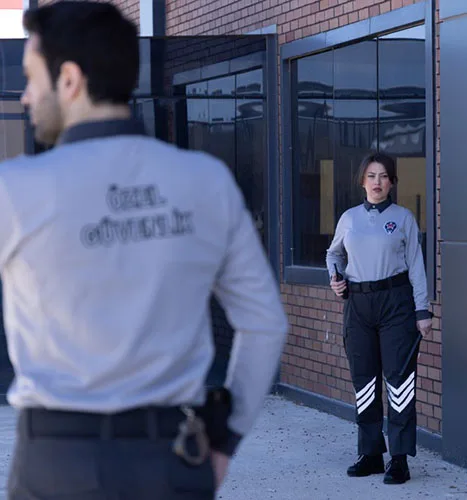
Private security officers are the visible face of the programme, but they are not decision makers. Law No. 5188 lists their powers narrowly (Art. 7), including entry screening, apprehension in defined circumstances, taking dangerous items into safekeeping, protecting the scene and evidence, and use of force only within the legal grounds the article cites. These powers apply only during duty hours and within the duty area; incidents requiring force or apprehension are reported to the police or gendarmerie by the fastest means, and anyone apprehended is handed over to them (Art. 9).
In practice, the security team is expected to:
- enforce entry restrictions decided by the team and report the arrival of a person of concern;
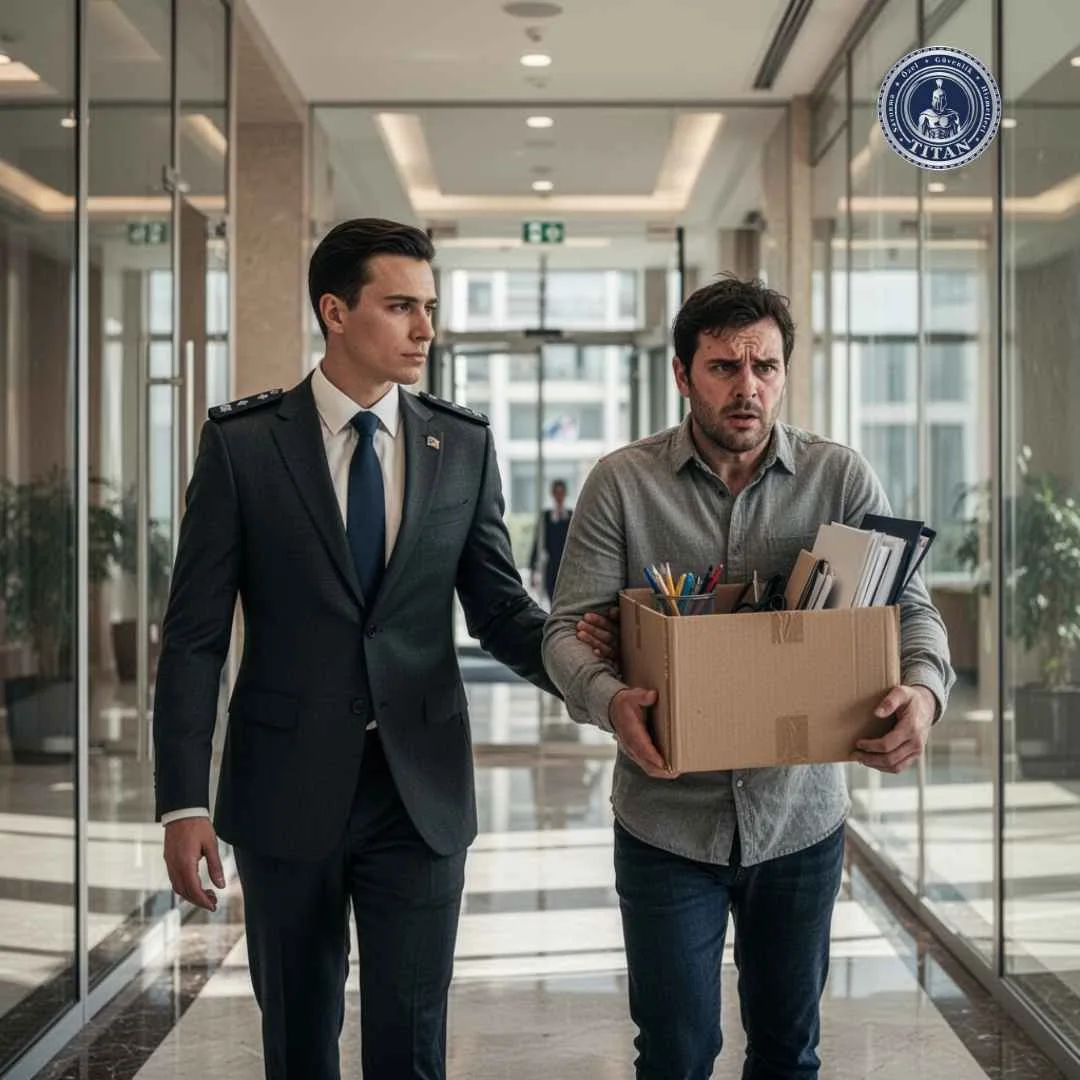
- escort an employee at risk and stand nearby at sensitive moments such as dismissal meetings;
- try to de-escalate, move people away, call the police and protect the scene during an incident;
- report observations factually and promptly.
Officers do not run investigations, do not make psychological assessments of employees and do not replace the threat assessment team. Their instructions should be written and reflected in the manned guarding contract.
Training, exercises and review
Make training role-based. All staff learn the policy, the reporting channels and basic behaviour during an incident. Managers get additional training in noticing concerning behaviour and holding a first conversation. Reception and security rehearse verbal de-escalation and escalation steps through tabletop scenarios. Team members practise case management and record discipline.
Review the programme at least once a year and after every serious incident. Ask: which channels did reports come through, how many were handled in time, were responses proportionate, did the affected person feel supported, was the risk assessment updated? Report the results to senior management and, where one exists, the OHS committee.
Common mistakes
- Leaving the programme to security alone; without HR and legal, decisions come late or out of proportion.
- Publishing a policy without setting up a reporting channel.
- Turning every report into a disciplinary file, which deters the next report.
- Running high-risk moments such as dismissals and contract terminations without a plan.
- Responding to an incident only with more physical measures and never examining the root cause.
How Titan Savunma supports a programme
Titan Savunma is an Ankara-based private security company licensed by the Ministry of Interior under Law No. 5188. We define the security team's part in programmes like this with a written scope, a single point of contact and regular reporting, in English and Turkish, and apply the same framework across sites in different provinces. Our approach for head offices is described on the office and business centre security page.
Sources and Further Reading
- ILO Türkiye Office — Çalışma Yaşamında Kadına Yönelik Şiddetin Önlenmesi Deneyim Paylaşım Forumu, ed. Demirkaya & Güler (2022)
- ILO Violence and Harassment Convention, 2019 (No. 190) — official text, UK Treaty Series Miscellaneous No. 7 (2021)
- Meloy, Hoffmann, Guldimann & James — The role of warning behaviors in threat assessment: an exploration and suggested typology, Behavioral Sciences & the Law 30(3) (2012)
- Mevzuat Bilgi Sistemi — 6098 sayılı Türk Borçlar Kanunu (2011, current text)
- Mevzuat Bilgi Sistemi — 6331 sayılı İş Sağlığı ve Güvenliği Kanunu (2012, current text)
- Resmî Gazete — Başbakanlık Genelgesi 2011/2, İşyerlerinde Psikolojik Tacizin (Mobbing) Önlenmesi (2011)
- Mevzuat Bilgi Sistemi — 5188 sayılı Özel Güvenlik Hizmetlerine Dair Kanun (2004, current text)