For Kahramanmaraş’s Spinning Mills, Industrial Zones and Energy Sites · Turkey

Private Security Company in Kahramanmaraş

In Kahramanmaraş, Titan Savunma helps protect spinning and weaving mills, production plots in organised industrial zones, energy sites, hospitals and public buildings; it is a private security company holding an operating licence from the Ministry of the Interior under Law No. 5188. When you are deciding between security companies in Kahramanmaraş, we would ask you to find out who the team answers to every day before you move on to officer numbers and unit prices. With us that question has a single answer: our Kahramanmaraş City Manager, the manager who surveys your premises, selects and leads the team, and reviews the posts daily. Behind the City Manager stand our Çukurova Regional Directorate, centred in Adana, and at the top tier our Ankara General Directorate; these two tiers contribute to planning, inspect sites without advance notice and set the yardstick for training and reporting. Our plans start from the province’s own make-up: spinning and weaving plants, broad industrial zones employing tens of thousands of people, an energy sector that stands out nationally, and a dry summer that can pass forty-five degrees.

Private Security Company in Kahramanmaraş

Service Scope

Four Groups of Site We Plan For in Kahramanmaraş

According to 2025 social security data, 205,913 compulsorily insured employees work at 21,169 workplaces in Kahramanmaraş. Manufacturing accounts for 25.4% of them, a little above the national 23.8%, but what really sets the province apart is what that manufacturing rests on: the weight of textile products in local employment is about 5.9 times the national average. In electricity, gas and steam the province ranks third by insured headcount, after Istanbul and Ankara. Looking at that picture, we organise the service around four groups of site.

Spinning and Weaving Mill Security in Kahramanmaraş

At spinning and weaving plants running round the clock on three shifts, we draw together in one duty plan the receipt of raw materials, night rounds of the stores holding cotton and fibre bales, gate records for yarn and fabric dispatch, and the heavy flow of staff at each change of shift.

Industrial Zone and Plant Security in Kahramanmaraş

Within the large organised industrial zones we protect your plot’s fence line, lorry and car access, open stock yards and rooftop or ground-mounted solar panels, setting out in writing from day one where our responsibility ends and the zone’s shared areas begin.

Energy Site Security in Kahramanmaraş

On sites linked to power generation, distribution and lignite extraction, we cover contractor camps, materials and spares stores and the surroundings of transformer and switchyard areas with a service built on entry logs and patrols that does not clash with the operator’s own protection arrangements.

Hospital, Campus and Public Building Security in Kahramanmaraş

At hospitals and university campuses the Law allows unarmed officers only, and that is what we provide; at public buildings we provide a team tied to the posts and hours in the specification, with orderly visitor reception and records that can be audited.

A Planned Start

How the Service Is Planned

Before preparing a proposal in Kahramanmaraş, we answer three questions with you: if production never stops, at what times will the posts change hands; through which gate, and against which document, will raw materials and goods come in and go out; and where will the rules of the industrial zone, institution or building management meet our own orders?

  1. Two Surveys: at Shift Handover and After Midnight

    Our Kahramanmaraş City Manager walks the site twice: once as one shift gives way to the next, and again during the night, when production carries on but the administrative staff have gone home. Gates, the weighbridge and receiving area, bale and bobbin stores, what the cameras can and cannot see, lighting and the fence line are all recorded on the spot.

  2. The Permit File for the Governorship of Kahramanmaraş

    The private security permit is requested from the Governorship of Kahramanmaraş in the name of the organisation receiving the service, and the request is examined by the province’s private security commission. Our City Manager gathers the required documents with you, and the file is not lodged until it is complete.

  3. Team, Rota and Site Orders

    Post assignments and the choice of shift leader are the City Manager’s decisions, as is the wording of the gate, store, dispatch and emergency orders, fitted to the way your production runs. Where fifteen or more officers are deployed, this is also when the legally required security supervisor is appointed.

  4. Regional and General Directorate Audits, and a Monthly Report

    Whether the posts are properly kept each day is checked by our City Manager; that checking is in turn tested by auditors from the Çukurova Regional Directorate and the Ankara General Directorate, partly through unannounced visits. At the end of every month you receive a single report showing what was found, which gaps were closed and which remain open.

Your Sector’s Priorities

Hands-On Management for Plants Whose Shifts Never Stop

According to 2025 social security data, spinning and weaving, fabricated metal and paper stand out among the manufacturing sectors that are more concentrated in Kahramanmaraş than in Turkey as a whole, and together they employ about 32,000 insured people. At plants where production carries on through the night, security means keeping the gate, the stores and dispatch in order at the same hours. On site, that load is carried by our Kahramanmaraş City Manager, who builds the plan, leads the team and makes the call on the spot when something goes wrong. Our Çukurova Regional Directorate in Adana and our Ankara General Directorate give this local management institutional backing by helping with plans, auditing separately from the City Manager, supplying common training content and fixing one report format.

Law Enforcement Background

The professional experience and security training of retired law enforcement personnel within our team contribute to our approach.

  • Night Rounds in Bale and Bobbin Stores

    In stores holding cotton, fibre and yarn, rounds pass through fixed checkpoints, the time at each one is logged, and any sign of heat or smoke is reported without delay.

  • A Clear Split of Duties at the Plot Boundary

    The zone’s shared-area security and the responsibilities of the team on your plot are separated in writing, and the line of communication between the two is defined in the orders.

  • Keeping the Governorship of Kahramanmaraş Informed

    The governorship is sent the contract copy and told of each officer who starts or leaves, inside the legal deadlines; our City Manager keeps that calendar.

For International Companies

For international brands in Turkey, we offer a single point of contact, a written scope and regular reporting. Work with us as your security partner

Expert View and Recommendations

Choosing a security firm in Kahramanmaraş: the questions to ask for each type of site

For a business looking for security in Kahramanmaraş, the questions vary a good deal with the type of site. At a spinning mill that never stops, how do posts change hands, and who watches the bale store at night? In an industrial zone covering well over a thousand hectares, where does security on your plot begin and the zone’s end? On a publicly owned energy site, in which areas and under whose rules does a private security team work? How is a crowded factory gate kept orderly at the start of a shift? In a province where temperatures close to forty-seven degrees have been recorded, how is an officer at an outdoor post protected, and what does the team do in a fire or a long power cut? The six sections that follow deal with these questions one by one, using social security and meteorological records, within the limits of Law No. 5188.

Research we draw on (4)
  1. 5188 sayılı Özel Güvenlik Hizmetlerine Dair Kanun — Mevzuat Bilgi Sistemi
  2. Özel Güvenlik Hizmetlerine Dair Kanunun Uygulanmasına İlişkin Yönetmelik (Mevzuat Bilgi Sistemi, güncel metin)
  3. SGK İstatistik Yıllığı 2025
  4. Meteoroloji Genel Müdürlüğü — Kahramanmaraş il istatistikleri

Spinning and weaving: the continuous production that carries local employment

According to 2025 social security data, 24,658 insured employees work at 390 workplaces in textile manufacturing (spinning, weaving and finishing) in Kahramanmaraş. That is about 7.1% of all insured textile employees in Turkey and places the province sixth in the sector, while the sector’s share of local jobs is about 5.9 times the national average. Adding clothing manufacturing brings the figure to 27,808, so roughly one in every seven or eight insured employees in the province works in these two sectors. The weight lies in spinning and weaving rather than garment making: clothing’s share of local employment is only about half the national average.

Spinning and weaving plants are relatively few but heavily staffed, and most run day and night. The security plan is therefore built around these headings:

  • Shift handover: Staggering the change of guard so that it does not coincide with the production shift change, and orderly passage at the staff shuttle drop-off point
  • Raw material receipt: Vehicles carrying cotton and fibre accepted against weighbridge and delivery-note records, with drivers kept in a designated area while unloading
  • Stock watch: Key handover logs and out-of-hours rounds for bale, bobbin and fabric-roll stores
  • Goods out: Yarn and fabric dispatch leaving the gate only once vehicle, plate and paperwork match, with waste and seconds placed under a separate record

The business decides who is checked and when, and that decision is written into the orders; discipline and any inquiry into stock differences also stay with the business.

Two large industrial zones: wide ground, plot boundaries and solar panels

Industry in Kahramanmaraş is largely gathered in two broad organised industrial zones. According to Ekonomim on 21 March 2025, Erkenez Organised Industrial Zone, covering 1,404.74 hectares, is the twelfth-largest in Turkey, with about 200 industrial firms and some 34,000 employees across 748 plots. According to Ekonomi Gazetesi on 10 September 2026, Kahramanmaraş Organised Industrial Zone covers 320 hectares, production is under way on 58 of its 70 industrial plots and about 11,700 people work there. Alongside textiles and technical textiles, that zone is home to kitchenware, aluminium, furniture, insulation, medical products, air conditioning, solar panels and food production, and the same report puts the combined capacity of its 40 solar plants above 135 MW.

Plot security turns on four main issues:

  • Boundary of responsibility: Separating in writing the zone management’s shared-area security from the duties of the team inside the plot, and defining radio or telephone contact between the two
  • Heavy vehicles: Advance notice, a waiting area and document checks for lorries and articulated trucks, with drivers kept out of production areas
  • Open stock and scrap: Night patrols and lighting checks in open yards where aluminium sections, metal scrap and packaging waste build up
  • Solar sites: Camera monitoring against cable and inverter theft on rooftop and ground-mounted panels, and logged access for maintenance crews

Shared roads and main entrances fall under the zone management’s rules; our team works only on the client’s own plot.

Energy and lignite: where private security fits on largely public sites

According to 2025 social security data, 6,598 insured employees work at 225 workplaces in electricity, gas, steam and air-conditioning supply in Kahramanmaraş. That is about 5.3% of the sector’s employment in Turkey and puts the province third, after Istanbul and Ankara, while the sector’s share of local jobs is about 4.4 times the national average. Coal and lignite extraction accounts for 1,428 insured employees, and water collection, treatment and supply for 671. These sectors have few workplaces, so the figures reflect the weight of a handful of large facilities.

A large part of such sites is publicly owned or publicly regulated, and protection of the main installations is often handled by the operator’s own security unit under a tender specification. The areas where a private security team usually contributes are:

  • Contractor and maintenance areas: Entry logs and night watch at the camps, workshops and laydown areas set up during overhaul periods
  • Stores: Key handover and periodic rounds at spares, cable and consumables stores
  • Scattered points: Vehicle patrols on varying routes to points far from the main plant, such as transformer, switchyard and pumping stations
  • Visitor and vehicle reception: Entry against the operator’s authorisation list, and nobody admitted to site without the required safety induction

Operating and safety rules at energy installations are a matter for the operator and the relevant legislation; the officer does not work outside them and does not interfere with control or maintenance work.

Metal and paper: busy gates, outgoing loads and record-keeping

According to 2025 social security data, besides textiles two further manufacturing sectors are more concentrated than the national average: fabricated metal products, with 6,089 insured employees at 576 workplaces (about 1.3 times the average), and paper and paper products, with 1,194 insured employees at just 15 workplaces (about 1.45 times). The paper figures point to the weight of a few large plants.

At busy sites with several entrances, the hard part of security is keeping records without disrupting an ordinary working day:

  • Staff entry: Separate lanes so that card access does not jam at the start of a shift, staff who forget their card checked against the business’s staff list, and visitors and contractors admitted through a separate gate
  • Metal plants: Scrap and semi-finished goods leaving only with written approval, weighbridge records matched against delivery notes, and no loads leaving out of hours
  • Paper plants: Frequent rounds in reel and roll stores because of the fire load, and forklifts kept apart from vehicle traffic at the loading bay
  • Records: Incident, visitor and vehicle logs closed off daily and brought together in one place in the monthly report

The records belong to the business; we set out in the proposal how and how often they are kept, and report on them together with audit findings.

Scorching dry summers, snow and fire: protecting outdoor officers and planning for emergencies

The Turkish State Meteorological Service’s central Kahramanmaraş station, with records running from 1930 to 2025, shows a harsh summer: in August the mean temperature is 28.5 °C and the mean maximum 36.2 °C, and the highest value on record is 47.2 °C. From June to September rainfall is very low, with 2.7 mm in July and 2.2 mm in August. Rainfall is concentrated in winter (130.6 mm in December; the monthly averages add up to about 720 mm). The January mean is 4.9 °C, the lowest January reading on record is −9.0 °C, and snow has been measured at a depth of 37 cm.

What the orders say about outdoor posts:

  • A booth with shade and airflow, a steady supply of drinking water and shorter stints around midday
  • Open-yard and fence patrols moved to early morning and evening
  • A named relief officer and a set handover routine if anyone shows signs of heat illness
  • Officers enforcing the ban on smoking and naked flames near dry vegetation
  • Extra checks in winter for icy entrance ramps and for cameras whose view is reduced by snow

The plan also has a general emergency dimension. In a fire, a flood or a long power cut, the security team has a fixed list of jobs: opening automatic gates and barriers, leading people who leave the buildings to the assembly area, helping whoever the business has put in charge of the roll call, keeping the road for emergency vehicles free and turning away anyone without authority from parts of the site that have been evacuated. The emergency plan is the business’s; we detail the security team’s role in it down to names and posts, and rehearse it alongside the business whenever it holds a drill.

The Governorship of Kahramanmaraş: permits and notices, with local management and institutional audit

An organisation handing its security to a private security company asks the Governorship of Kahramanmaraş for the permit in its own name; under Article 3 of Law No. 5188 the applicant is the party receiving the service. It then goes before the provincial private security commission, and the governor’s sign-off completes the process. The governorship’s paperwork requirements are revised from time to time, so it pays to check which documents are currently needed before the file is opened.

Once the service begins, we keep track of the deadlines owed to the governorship. A copy of the signed contract has to reach it before the end of the working day on which the service starts (Article 5 of the Law and Article 10 of the Regulation). When a new officer joins the team, someone leaves or an officer moves to another site, notice is given within fifteen days (Law, Arts. 11–12; Regulation, Art. 8). A site staffed by fifteen or more officers must, under Article 5, also have a security supervisor educated to at least associate-degree level.

The organisations buying security in Kahramanmaraş fall into two camps: public bodies on one side and private manufacturers on the other. As a result, posts, hours and report content are set by a contract we write together at private businesses, and by the tender specification at public bodies.

Our Kahramanmaraş City Manager keeps that calendar. The City Manager’s plans are reviewed jointly with our Çukurova Regional Directorate, centred in Adana, and our Ankara General Directorate, and the unannounced auditors who visit sites come from these two tiers.

Wherever we can, we recruit people who already live in Kahramanmaraş. In SGK’s 2025 figures, security and investigation activities (NACE 80) account for 92 workplaces and 2,049 insured staff in the province, a smaller share of local jobs than the national average. The figure leaves out guards employed directly by organisations and people working for firms registered outside the province.

Before We Speak

Frequently Asked Questions

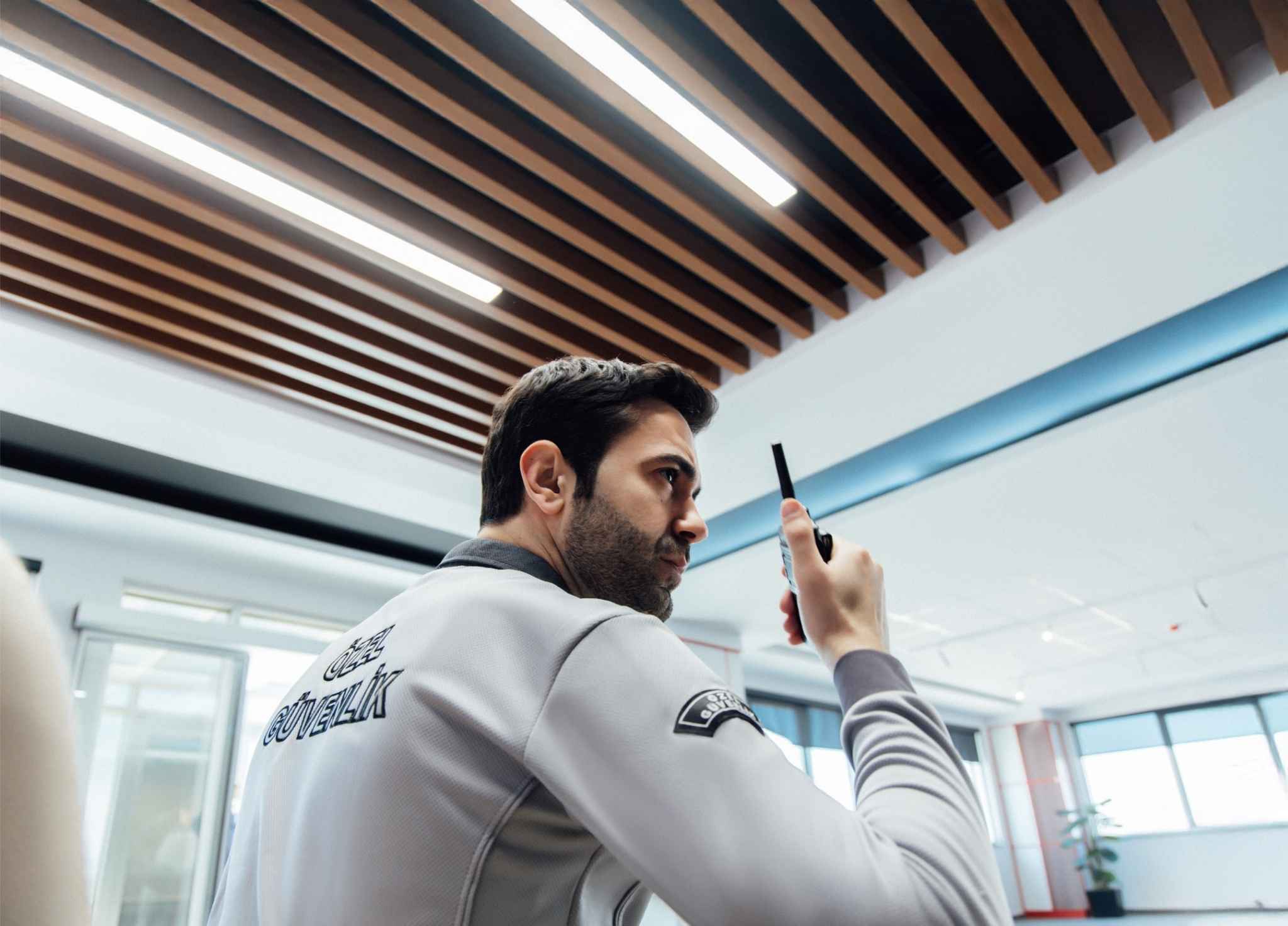
A Titan Savunma officer in a private security uniform communicating by radio inside a building.
What criteria should we use to choose between security firms in Kahramanmaraş?

First ask to see the operating licence the firm holds from the Ministry of the Interior under Law No. 5188. Then expect every bidder to explain the same points in writing: who will head the team on site, and whom will you reach if something happens in the middle of the night? Who covers for an officer who does not turn up, and how fast? Who carries out audits, how often, and are they unannounced? The answers tell you more than the figure on the quote, and we answer every one of them in our proposal, tailored to your site.

Whom do we contact about day-to-day matters at our site in Kahramanmaraş?

Our Kahramanmaraş City Manager. This is the manager who surveys your site, builds and runs the team and inspects the posts daily, and also your first point of contact whether you need an extra post, want an officer replaced or need an incident chased up. Behind the City Manager, our Çukurova Regional Directorate and our Ankara General Directorate contribute to the plan and audit independently.

Who applies to the Governorship of Kahramanmaraş for a private security permit, and how does it work?

It is the organisation buying the service, not the security company, that applies, and it does so under its own name (Law 5188, Art. 3). The request goes to the provincial private security commission in Kahramanmaraş and becomes effective when the governor signs off; the Regulation gives the commission ten working days to decide. Whether the site is a plot in an industrial zone, a hospital in town or an energy site does not change the procedure, and our City Manager stays with you while the documents are prepared.

How can I apply to work as a private security officer in Kahramanmaraş?

Please apply through our Careers page. Our Kahramanmaraş City Manager builds the local teams and matches each applicant to the working pattern of a particular site; we particularly welcome applications from people able to work night shifts. Among other conditions, Article 10 of the Law requires that the candidate be a Turkish citizen, be at least eighteen years old and have passed the basic private security training course. To take up a post, a work permit and a private security ID card, both issued by the Governorship of Kahramanmaraş, are also required (Arts. 11–12).

Our plant is inside an industrial zone that has its own security; do we still need a team?

In most cases yes, but the survey decides. Zone management security usually covers shared roads, main entrances and common facilities, while the stores, dispatch gate and production floor inside your plot remain your responsibility. In Kahramanmaraş scale makes that distinction matter: according to a report from March 2025, Erkenez Organised Industrial Zone, at 1,404.74 hectares, is the twelfth-largest in Turkey, and across ground that wide a shared patrol may pass your plot only now and then. We recommend bringing the line of communication with zone security, who checks what when vehicles arrive and who calls whom during an incident together in a single set of written orders.

What kind of security do you recommend for our rooftop or ground-mounted solar plant?

According to Ekonomi Gazetesi on 10 September 2026, Kahramanmaraş Organised Industrial Zone has 40 solar plants with a combined capacity of more than 135 MW, and around half of the businesses’ electricity use is met by the sun. Panel fields often lie away from production and are deserted at night; the main risk is theft of cable, inverters and panels. The arrangement we recommend: monitored cameras covering the fence line, night patrols with changing times and routes, logged access through the site gate and for maintenance crews, and triggering the business’s alert chain before stepping in if something looks suspicious. Touching electrical connections, fixing faults or carrying out maintenance is not the security team’s job, and officers are kept to protection duties alone.

What part does the security team play against fire risk at our spinning mill?

At spinning and weaving plants, cotton and fibre bales, bobbin stocks and packaging make for a high fire load, and Kahramanmaraş’s dry summer adds to that risk. The security team’s share is to notice early and alert the right person at once: an out-of-hours round through the stores with times logged, watching drying and blowroom sections for a while after machines stop, checking that fire doors and escape routes are clear and enforcing the no-smoking rule around stores. Maintaining suppression systems, stock layout and occupational health and safety duties stay with the business; the team’s role in a fire, down to which officer goes where, is defined by us in the orders.

We are a public body buying security for a hospital or campus by tender. What should we watch for?

The public sector carries real weight as a buyer of security in Kahramanmaraş: according to 2025 social security data, 15.4% of compulsorily insured employees work at public workplaces (Turkey: 12.5%), and adding civil servants, our own calculation gives a public-sector share of 30.4% of all employees. A specification that spells out posts, hours and officer numbers, defines extra posts for busy periods with visitors and patients’ relatives, and sets the report format makes the job easier. Under Article 8 of Law No. 5188, officers at education and health facilities work unarmed; at these sites strength comes from de-escalating communication, a dedicated post at the emergency entrance and an ambulance route kept clear. Admitting patients and disciplining students are not the officer’s job, and the orders say so.

Book a Site Survey in Kahramanmaraş and Get a Written Quote

Through the form, let us know what kind of site you have, which district it is in, whether it lies inside an industrial zone, how many gates it has, how your shifts run and how many people stay on site at night. Our Kahramanmaraş City Manager will agree a survey date with you, and the duty plan and price will reach you in writing, based on what we see on the day.

Request a Security Proposal

Contact

Request a Security Proposal for Your Organisation

Tell us your facility type, location and general requirements. Together, we can define a service scope that suits your organisation.

Tell Us What You Need

Fields marked * are required.

What Happens Next

  1. Initial DiscussionWe respond within 15 minutes and clarify your requirements and facility details together.
  2. Service ScopeWe assess staffing needs and the working arrangements.
  3. ProposalWe prepare our proposal for the agreed service scope.

General Directorates

Ankara · Çankaya
İstanbul · Levent

Nine regional directorates · 81 provinces

Looking for a role? Visit our careers page