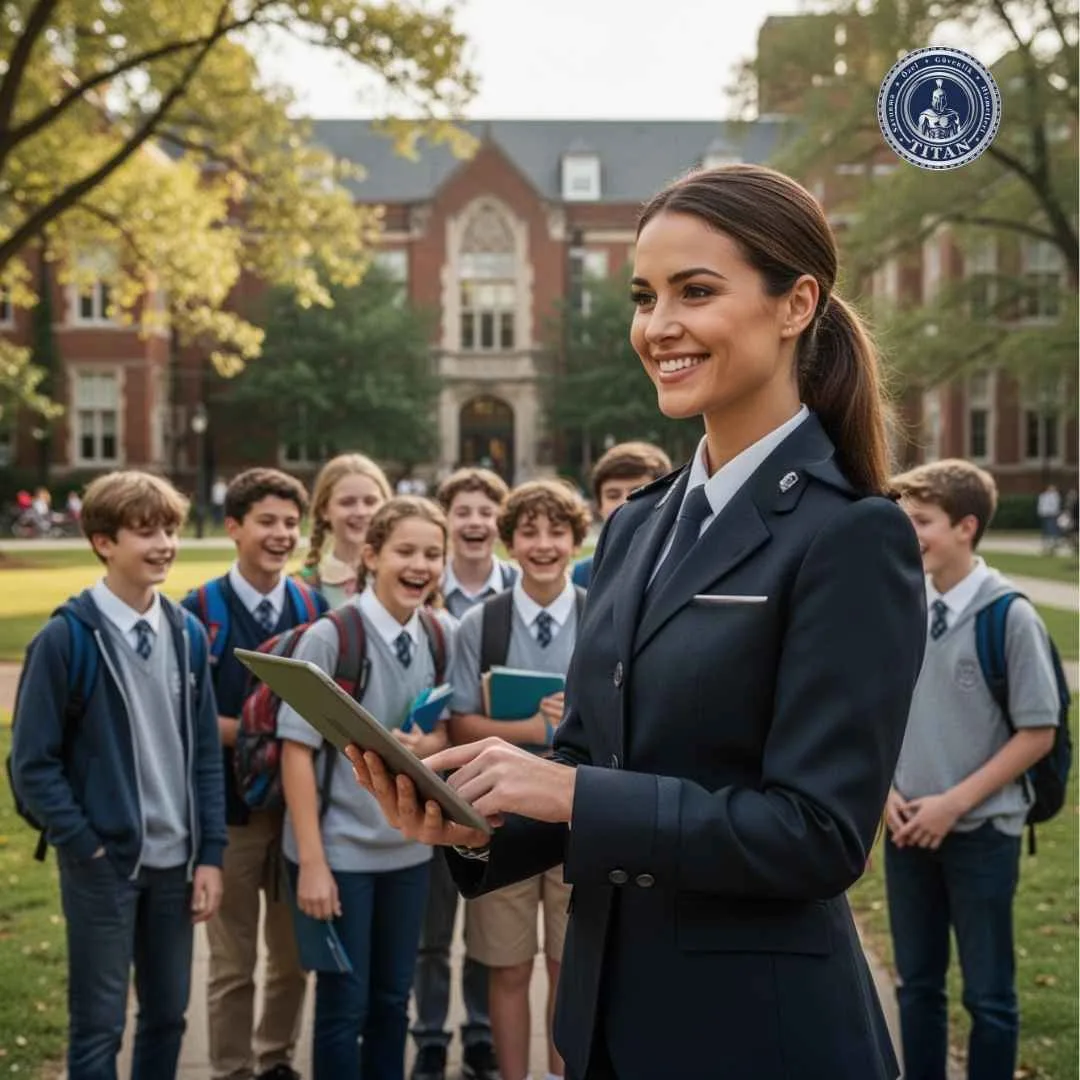
Short answer: In Adıyaman, a school's day-to-day security is tested in four short windows: the morning arrival, the minutes when school buses drop off and pick up pupils, the moment parents wait at the gate, and the locking-up of the building after the last pupil has gone. A written routine for each of these windows changes far more than placing one officer at the gate with an instruction to "keep an eye out". Armed private security officers may not be employed at educational institutions in Türkiye (Law No. 5188, Article 8). Visitor registration is a rule set by the school's management, which the officer applies while leaving exceptions to the school administration.
This article is general information, not legal advice.
Why the school gate deserves its own plan in Adıyaman
According to the Social Security Institution (SGK) Statistical Yearbook 2025, Adıyaman's education sector employs 4,379 people insured under category 4/1-a at 176 workplaces. That is about 4.7% of the province's 93,811 insured employees, against roughly 4.1% nationally. On a simple ratio we worked out, education weighs about 1.13 times as heavily in Adıyaman's workforce as in Türkiye overall, and the province ranks 33rd of 81 in this sector. Most teachers are civil servants and do not appear in these figures, so schools matter even more to the province than the number suggests. The start and end of the school day shape the daily timetable of a great many families here.
Climate belongs in the gate plan too. Records from the Turkish State Meteorological Service for 1963–2025 show an average January minimum of 1.5 °C in Adıyaman, a lowest recorded temperature of −14.4 °C and a record snow depth of 60 cm, while the average July maximum is 38.0 °C. The middle of the school year brings frost and snow, its two ends bring heat: pupils waiting outside before the gate opens, parents standing in the wind and an icy bus stop are all part of the plan.
What does the research say?
1. Morning drop-off habits are linked to child pedestrian collisions
An observational study of 118 elementary schools in Toronto, Canada, compared police-reported child pedestrian–motor vehicle collisions during school travel times in 2000–2011 with dangerous morning drop-off behaviours observed outside the schools in 2011. Dangerous behaviours were seen at 88% of schools (104); each additional type of dangerous behaviour observed was associated with a collision rate about 1.45 times higher (IRR 1.45). Higher-speed roads and social disadvantage were also associated with higher rates (Rothman et al., Traffic Injury Prevention, 2016). The authors note the small number of collisions and that driving was observed on a single day as limitations; the finding is an association, not proof of cause.
2. The problem is the norm, not the exception
The CHASE study, from the same research network, observed nine risky driving behaviours during morning drop-off at 552 elementary schools in seven Canadian cities in spring 2018 and 2019. At least one was seen at 98% of schools; the most common (80% of schools) was dropping a child on the opposite side of the street so that the child crossed mid-block without traffic controls. Schools with fewer types of risky behaviour had more favourable walkability scores and more often had kerb extensions, parking-restriction signs and better access to school entrances. The authors call the level of risky driving unacceptably high and say the findings can inform school, school board and municipal measures (Pitt et al., Traffic Injury Prevention, 2025). The study recorded which types of behaviour occurred, not how often.
3. The design of car parks and bus areas affects how safe pupils feel
A study of 4,717 students at 50 middle schools in the United States scored each school's physical environment against crime prevention through environmental design (CPTED) principles and compared the scores with students' reports on violence and safety. In most adjusted models, students at higher-scoring schools were less likely to miss school because of safety concerns (adjusted odds ratios 0.32–0.63). Notably, scores for parking and bus loading areas remained associated with greater perceived safety (odds ratios 1.28 and 1.32) and lower perceived risk (0.73 and 0.66) after accounting for school and student characteristics (Vagi et al., Journal of School Health, 2018). The study is cross-sectional and measures perceptions, but it suggests that a pupil's sense of safety is formed on the pavement where the bus stops as well as in the classroom.
4. After-school hours need supervision
A self-report study based on a national probability sample of US schools in the 1997–98 school year, together with data from after-school programmes in Maryland, found that the after-school hours are a period of elevated delinquency among young people, although the peak was modest compared with official records. Children left unsupervised after school reported more problem behaviour at all times of day, not only after school; the authors point to social competencies and social bonding as well as supervision (Gottfredson, Gottfredson and Weisman, Criminology & Public Policy, 2001). Our plain takeaway: once the bell rings, an emptying yard and building should not become a space nobody is watching.
Four windows, four different jobs
Morning arrival
- Opening time, which gate is for pedestrians and which for vehicles, and where late pupils are let in should all be written down. A single main pedestrian gate in the morning makes the flow much easier to watch.
- With the officer at the yard gate and the duty teacher at the building entrance, the school has two layers that can see each other.
- On winter mornings, a sheltered spot for pupils who arrive before the gate opens, and a gritting routine for icy steps and ramps.
Bus drop-off and pick-up
Türkiye's School Service Vehicles Regulation gives school management the task of designating where buses drop off and pick up pupils on school grounds (Art. 6/1-ç). A red "STOP" lamp at the rear of the vehicle is required during boarding and alighting (Art. 4/1-b); providing a guide (rehber personel), the attendant who rides with the driver (Art. 3), is the operator's obligation (Art. 5/2-b; transport under the state's bussed-schooling scheme is exempted from this point, Art. 15), and the guide helps children on and off (Art. 9). A private security officer does not take over these roles. The officer's job is to keep the bay designated by the school free of parents' cars, stop pedestrians crossing in front of or behind a bus and watch the surroundings while a vehicle manoeuvres. If the school and the bus operator agree arrival order and waiting times in advance, three buses squeezing into one bay at once becomes much rarer.
Parent waiting area
- At home time, parents crowding the gate block both the view and the bus bay. A marked, ideally covered waiting area that keeps the gate in clear sight largely solves this.
- Younger pupils are handed over by the teacher to the parent; when someone else is collecting a child, the school's own notification procedure applies. Handover decisions belong to teachers and the administration; the officer simply helps the procedure work.
- A parent waiting on the opposite pavement and calling a child across the road is the risk researchers see most often. Putting the waiting area on the school side of the street reduces this habit on its own.
Locking up after school
- Once the last pupil has left, a floor-by-floor closing round: classrooms, toilets, sports hall, boiler room, basement and roof door, with open windows and unlocked doors noted.
- If tutoring, courses or sports continue, the part of the building in use is separated from the part being closed, with a single entrance to the open section.
- Setting the alarm, handing over the keys and locking the yard gate are logged in one book with times.
- If there is unexpected activity in the yard in the evening, a card states whom the officer calls first and next (the school administration, then the police or gendarmerie if needed).
Entry at the school gate: whose rule is it?
Article 7 of Law No. 5188 lists a private security officer's powers one by one; passing people entering a protected area through a detector gate and searching them with a hand-held detector are among them (Art. 7/a). Visitor registration at a school gate does not come from that list but from the rule set by the school's management.
In practice the right arrangement looks like this: school management sets an entry procedure that records who a visitor is and whom they have come to see, as its own rule as the occupier of the building. The officer politely directs visitors to that procedure. If someone does not wish to give details, the officer does not argue or insist, but informs the school administration, which decides whether the person may enter. What goes into the visitor book and how long it is kept should also be set by the school under Türkiye's Personal Data Protection Law No. 6698.
Checklist: arrival, buses, waiting and closing
| Area | What to do | Why |
|---|---|---|
| Morning gate | Opening time, separate pedestrian and vehicle gates, late-arrival procedure in writing. | A single, defined entrance can be watched by a small team. |
| Bus bay | The area designated by the school is marked; parents' cars are kept out. | Parking and bus-area design has been linked to how safe pupils feel. |
| Boarding and alighting | The guide watches the child, the officer watches the surroundings; crossing in front of or behind the bus is prevented. | If roles blur, nobody watches the surroundings. |
| Parent drop-off | A "kiss-and-ride" point on the school side; drop-offs across the road discouraged. | Dropping children across the road was the most common risky behaviour observed. |
| Parent waiting area | Marked, not blocking the view of the gate, sheltered from winter wind. | A crowd at the gate blocks sight lines and the bus route. |
| Visitors | The school's registration procedure; exceptions and refusals decided by the administration. | Visitor registration is the school's rule; the officer applies it. |
| Closing round | Floor-by-floor round, open windows and doors noted, alarm and key log. | An emptying building after lessons needs supervision. |
| Winter routine | Gritting steps and ramps, a snow-clearing order, the bus bay kept clear in snow. | Frosty and snowy January mornings are part of planning in Adıyaman. |
| Emergency plan | For fire, flooding, heavy snow and long power cuts, an assembly area separate from the bus bay; the officer's place in drills defined. | Evacuation and bus traffic should not meet in the same space. |
Common mistakes
- Leaving the bus bay open to parents' cars and tolerating three buses jammed together at home time.
- Expecting the officer to decide whether a child may be handed over to an adult.
- Telling the officer to "check everyone" without writing down the rule and its exceptions, which invites arguments with visitors at the gate.
- Not marking a waiting area, so parents scatter in front of the gate and across the road.
- Leaving locking-up to "whoever leaves last" and missing the sports hall and basement from the round.
- Not agreeing gritting and snow clearing before winter, or shade and water at the end of summer.
- Keeping gate camera recordings and the visitor book without deciding who may see them and for how long.
A note on practice in Türkiye
Article 8 of Law No. 5188 does not allow armed private security officers at educational institutions, so school security is built on layout, timing, records and a clear chain for raising the alarm. The School Service Vehicles Regulation frames the bus routine, Law No. 6698 frames visitor and camera records, and officers' outdoor posts in winter and summer belong in the workplace hazard review that Law No. 6331 on occupational health and safety asks for. In state schools, the scope of the service is usually set by a technical specification, so post orders work well when drafted together with that specification, the school's emergency plan and the duty teacher rota. Standing at the gate for one morning arrival and one home time is worth doing before drafting a single line.
An officer's limits and the basic concepts at schools are covered in our school security entry, our services for schools and campuses under education security, and the way we work with sites in the province under private security company in Adıyaman.
Titan Savunma is an Ankara-based private security company licensed by the Ministry of Interior under Law No. 5188 and certified to ISO 9001, 14001, 45001, 22301 and 28000. We work with international companies in English and Turkish, and our Adıyaman City Manager, supported by our Southeastern Anatolia Regional Directorate in Gaziantep and our Ankara General Directorate, walks through your morning arrival, bus bay, parent waiting area and closing round and then sets out, together with your school management, unarmed post orders that match your specification. To book that visit, write to us via our contact page.
Sources and Further Reading
- Rothman, L., Howard, A., Buliung, R., Macarthur, C. & Macpherson, A. — Dangerous student car drop-off behaviors and child pedestrian–motor vehicle collisions: An observational study, Traffic Injury Prevention 17(5):454–459 (2016)
- Pitt, T. M., Macpherson, A., Fridman, L., Hagel, B. E., Winters, M., Cloutier, M.-S., HubkaRao, T., Fuselli, P., Howard, A. & Rothman, L. — Risky driving behaviors at school drop-off across Canadian municipalities: Findings from the Child Active Transportation Safety and the Environment (CHASE) study, Traffic Injury Prevention 27(1):84–88 (çevrim içi 2025)
- Vagi, K. J., Stevens, M. R., Simon, T. R., Basile, K. C., Carter, S. P. & Carter, S. L. — Crime Prevention Through Environmental Design (CPTED) characteristics associated with violence and safety in middle schools, Journal of School Health 88(4):296–305 (2018)
- Gottfredson, D. C., Gottfredson, G. D. & Weisman, S. A. — The Timing of Delinquent Behavior and Its Implications for After-School Programs, Criminology & Public Policy 1(1):61–86 (2001)
- 5188 sayılı Özel Güvenlik Hizmetlerine Dair Kanun (md. 7, 8), Mevzuat Bilgi Sistemi
- Okul Servis Araçları Yönetmeliği, Resmî Gazete 25.10.2017, sayı 30221 (md. 3, 4, 5, 6, 9)
- SGK — İstatistik Yıllığı 2025 (Sigortalı ve İşyeri İstatistikleri, Tablo 1.11)
- Meteoroloji Genel Müdürlüğü — Resmî İstatistikler: Adıyaman (1963–2025)