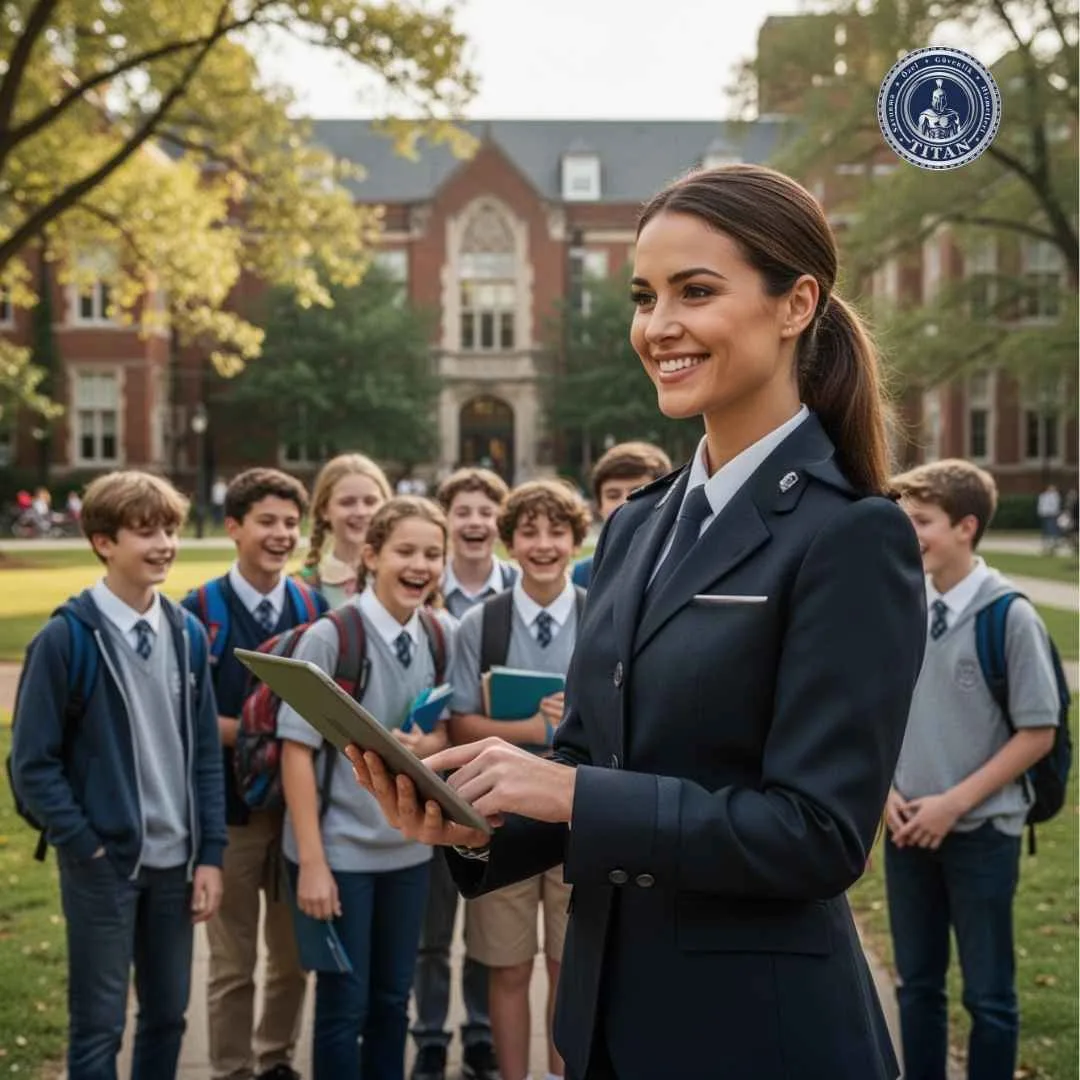
A good school security plan in Turkey starts with layout, not equipment. During school hours there should be one controlled entrance for people, watched from the school office or a reception desk; visitors should come by appointment, be checked against that appointment and be recorded; drop-off and pick-up should keep children on foot away from cars and school buses; the playground and the fence line should be visible from the building; and everyone should know where the emergency assembly areas are and how to reach them. Cameras belong at entrances, gates and car parks, never in toilets or changing rooms, and they are subject to the Personal Data Protection Law (KVKK, Law No. 6698).
The tone matters as much as the plan. A school is a place of learning, and the research summarised below suggests that piling on visible security measures does not necessarily make pupils feel safer. The aim is a calm, orderly campus where control is built into the design rather than displayed at the door.
This article is general information, not legal advice.
Four layers, from the fence to the classroom
The US Cybersecurity and Infrastructure Security Agency (CISA) organises school physical security into four layers in its K-12 School Security Guide companion product (2024): the grounds perimeter, the school grounds, the building perimeter and the building interior. CISA stresses that every school is unique, that there is no one-size-fits-all approach, and that equipment, site design, staff, procedures and training have to work together as one system. It is an American document, but the layering translates well to Turkish public and private schools, international schools and multi-building campuses.
| Layer | What it covers | Layout decisions |
|---|---|---|
| Grounds perimeter | Fence, hedges, gates, the pavement outside | How many gates are open and when; where the school bus and parent drop-off sit in relation to the pedestrian gate |
| School grounds | Playground, sports pitch, car park, garden | Sightlines from classrooms and the duty teacher's route; lighting; keeping vehicles out of play areas |
| Building perimeter | Main door, side and fire exits, deliveries | One public entrance in school hours; fire exits that open from inside only; a separate delivery point |
| Building interior | Corridors, offices, canteen, gym | Reception sightline over the entrance; which areas visitors may reach; cameras only in common areas |
What the research says, modestly
The most directly useful study for layout is by Vagi and colleagues, published in the Journal of School Health (2018). Evaluators scored 50 US middle schools with an assessment tool based on Crime Prevention Through Environmental Design (CPTED), and the scores were compared with survey answers from 4,717 pupils. In unadjusted models, higher scores were generally associated with higher perceived safety and lower reported violence; after adjustment for school and pupil characteristics, the scores for parking and bus loading areas remained associated with higher perceived safety and lower perceived risk. This is an association in one country, not proof that a given redesign will work, but it supports paying attention to the places where children arrive and leave.
A state-of-the-art review by Reingle Gonzalez, Jetelina and Jennings in Policing: An International Journal (2016) examined metal detectors, cameras, access control and security staff in schools. Its abstract concludes that adding more security measures may not be an effective policy and that more measures often coincide with lower perceived safety among pupils. A recent scoping review by Stilwell and colleagues (2025) found only two studies that met its criteria for evaluating interventions against weapon carrying in US schools, described the overall evidence base as weak and called for broader approaches beyond physical security, such as social and emotional learning, mental health support and a positive school climate. The practical reading: design for natural visibility and an orderly arrival, and add technology only where it answers a specific need.
What Turkish rules ask schools to do
For schools under the Ministry of National Education (MEB), public and private, the circular for the 2026-2027 school year (No. 2026/70, 19 August 2026) sets the current expectations. Item 6 asks for existing school-security instructions to be applied in full, for provincial and district executive boards to review risks around schools at the start of the year, and for physical improvements to be completed quickly: controlled entry and exit, separation of pedestrian and vehicle traffic, lighting of blind spots, and maintenance that allows fast and safe evacuation in an emergency. Item 26 asks for fire, earthquake and other disaster work and drills. Item 30 states that parent meetings are to be planned only through the Okul Randevu Sistemi (school appointment system), and that parents without an appointment and people who are not a pupil's parent or guardian are not to be admitted.
Where a private school or campus uses private security officers, Law No. 5188 applies. Employing officers or contracting a licensed company requires the governor's permission after a decision of the provincial private security commission (Art. 3). Article 8 does not allow armed private security officers in education institutions, and Article 9 limits officers' powers to their working hours and their area of duty. Within that area, Article 7(a) allows officers to pass people through a walk-through detector and screen bags, but whether such screening suits a school is a policy decision, and the research above is a reason for caution.
Entrance, visitors and the drop-off peak
One public entrance
In school hours, one door should be the only way in for visitors, with the school office or a reception desk looking straight at it. Other doors stay closed from outside but open from inside for evacuation. If the layout forces visitors to pass classrooms before reaching the office, move the reception point, not the classrooms.
Visitor management
The appointment system gives the gate a list. The person at the entrance compares the visitor with the appointment, issues a visible visitor badge, records arrival and departure, and directs the visitor to a meeting room near the entrance rather than into teaching corridors. Contractors and deliveries need their own procedure, ideally timed outside arrival and departure peaks.
Drop-off and pick-up
The busiest and most crowded moments of the day happen on the pavement. Separate the school bus bay, the parent drop-off lane and the pedestrian gate, so that children on foot never cross a line of moving cars. Staff at the gate during peaks help more than any device. Remember that the street outside is public space: a private officer's powers stop at the boundary, so traffic arrangements outside are agreed with the municipality and the police.
Playground, perimeter, nights and assembly areas
The playground should be visible from the building and from the duty teacher's route; tall hedges and parked vehicles next to play areas work against that. The fence line needs to be continuous and well lit, with gates that are closed when not in use. Outside school hours the risk changes from people to property: intruder alarms, lighting and, where justified, mobile patrols. If the gym or pitch is used by outside groups in the evening or at weekends, give them a separate route that does not open the rest of the school.
Emergency assembly areas should be away from vehicle routes, large enough for the whole school, signed, and reached by routes that are kept clear. Drills are where a plan proves itself: who checks attendance, where pupils with reduced mobility go, and how parents are informed and reunited with children in an orderly way.
Cameras and children's privacy
KVKK sets out general principles in Article 4 of Law No. 6698: processing must be lawful and fair, for specific, explicit and legitimate purposes, relevant, limited and proportionate, and kept only as long as needed. Article 10 requires people to be informed, and Article 12 requires technical and administrative measures to keep data secure. The law has no separate article on children, so these general principles apply with particular care.
In June 2026 the Personal Data Protection Authority published an announcement on workplace security cameras. It says cameras should not be placed in private areas such as toilets, changing rooms, prayer rooms and rest areas; that entrances, exits and genuine risk points can be proportionate depending on position and angle; that audio recording is highly intrusive; and that footage should be kept for the shortest necessary time with automatic deletion. It also asks controllers to consider people in public areas who are not under the workplace's supervision, especially vulnerable people and children. For a school this points to cameras at gates, entrances, car parks and the perimeter, no classroom or changing-room filming as a security measure, a short retention period and a written list of who may view footage.
Sketching the school on the Security Digital Twin
Our free Security Digital Twin Simulator (school template) runs in the browser and sends no data. You enter floor area, floors, entrances and hours, and a schematic 2D plan and 3D view redraw as you type. You can place guard posts, a patrol route, cameras, turnstiles, barriers and detectors, or start from the suggested layout and move things around. It shows how many guard posts are suggested at the same time in each time band (day, night, weekend), a simplified camera coverage view and technology suggestions. It gives no prices and no headcount, because staffing depends on shift pattern, hours and legal limits and is planned per site; the drawing is schematic, not a site survey. It is a quick way for a head teacher, a facilities manager and a security adviser to agree where the entrance, drop-off and assembly areas should be before anyone visits the site. Other sectors are available in the full simulator.
Before the term starts: a checklist
- Draw the four layers and mark one public entrance for school hours.
- Check that the office or reception can see that entrance without leaving the desk.
- Align visitor procedure with the appointment system: check, badge, record, escort.
- Separate the bus bay, parent drop-off and pedestrian gate; agree street arrangements with the municipality and police.
- Walk the playground and fence line: sightlines, lighting, gates.
- Confirm emergency assembly areas and routes, then hold a drill.
- Review every camera position, the KVKK notice and the retention period; remove any camera that looks into private areas.
- Run the free security risk pre-assessment to see which risks should drive the design.
For the service side of school and campus protection, see our page on education security.
Titan Savunma is an Ankara-based private security company operating under a Ministry of Interior licence granted under Law No. 5188, with ISO 9001, 14001, 45001, 22301 and 28000 certificates. We work in English and Turkish and plan services for sites in different provinces with a single point of contact, a written scope and regular reporting. More about us as a private security company in Turkey.
Sources and Further Reading
- Vagi, K.J., Stevens, M.R., Simon, T.R. et al. — CPTED Characteristics Associated With Violence and Safety in Middle Schools, Journal of School Health 88(4) (2018)
- Reingle Gonzalez, J.M., Jetelina, K.K. & Jennings, W.G. — Structural school safety measures, SROs, and school-related delinquent behavior and perceptions of safety, Policing: An International Journal 39(3) (2016)
- Stilwell, S.M. et al. — Securing schools, protecting minds: a scoping review of limited evidence for weapon carriage prevention in K-12 schools, Cogent Mental Health (2025)
- CISA — K-12 School Security Guide Companion Product for School Business Officials (2024)
- T.C. Millî Eğitim Bakanlığı — 2026-2027 Eğitim ve Öğretim Yılına İlişkin İş ve İşlemler, Genelge 2026/70 (2026)
- T.C. Mevzuat Bilgi Sistemi — Law No. 5188 on Private Security Services
- T.C. Mevzuat Bilgi Sistemi — Law No. 6698 on the Protection of Personal Data
- KVKK — İş yerlerinde güvenlik kamerası sistemi kullanımında dikkat edilecek hususlara dair kamuoyu duyurusu (2026)