
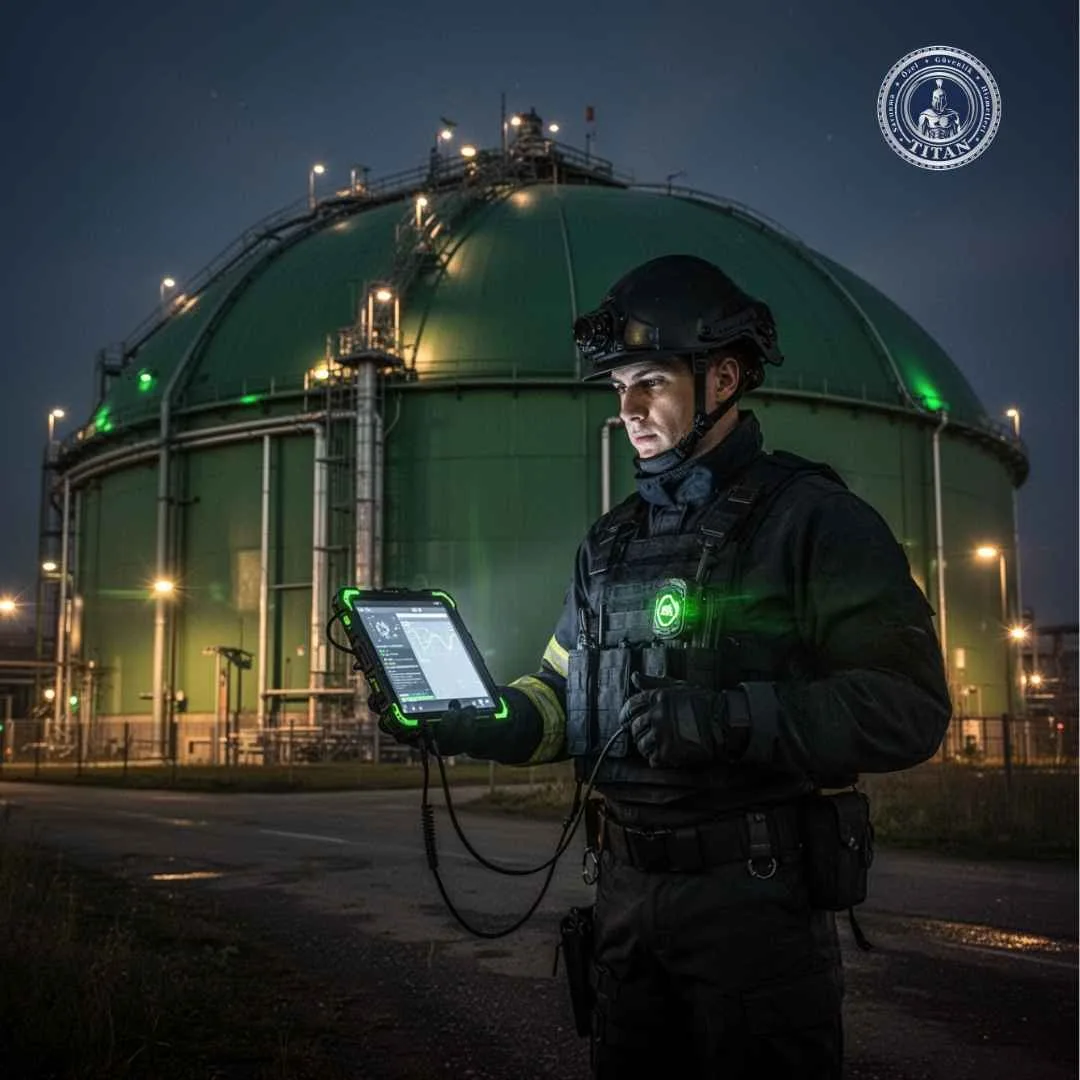
Alarm verification is the step that turns a raw alarm signal into a decision: is this a real intrusion or hold-up, or a false activation? The three common methods are sequential (a second, independent detector confirms the first), audio (an operator listens to the protected area) and visual (an operator sees images from the area at the moment of the alarm). Technology produces the evidence; a trained operator still has to judge it and start the right response.
This article is general information, not legal advice.
The basic building blocks, the alarm panel, detectors and the receiving centre, are covered in our encyclopedia entry on the alarm receiving centre. This article goes one step further: what verification means in European standards, how each method works in practice, what privacy rules apply in Turkey when cameras are used, and how verification should be written into post orders and contracts.
What the European standards say about verification
Intruder and hold-up alarm systems in Europe are designed against the EN 50131 series. Verification has its own document in that series: CLC/TS 50131-9:2014, Alarm verification – Methods and principles. It is a CENELEC Technical Specification rather than a full European Standard, and according to its published scope it is available for use where alarm verification methods are considered necessary. It gives recommendations for adding verification technology to intrusion and hold-up systems built to EN 50131-1, and it notes that verification is also called "alarm confirmation".
The published table of contents shows how the document is organised: sequential verification of intruder alarms, sequential verification of hold-up alarms, audible verification, visual verification, and a separate section on faults in the alarm transmission system. The Estonian standards body catalogue entry adds an important boundary: the specification does not detail verification that relies solely on procedures inside the alarm receiving centre, and it points to EN 50518 for how receiving centres monitor these notifications. In other words, the technical side (what equipment produces verification evidence) and the human side (how the centre handles it) are deliberately treated as two linked pieces.
EN 50518 itself sets minimum requirements for monitoring, receiving and processing alarm messages. Its published scope places intrusion and hold-up alarms, and video surveillance used for security with emergency response, in its security category of receiving centre.
The three methods in practice
Sequential verification
Two or more independent detectors, covering different parts of the route, must activate within a defined period before the alarm is treated as confirmed. A single trigger is still reported, but it is handled differently from a confirmed sequence. The strength of this method is that it needs no cameras or microphones, so it is the least intrusive. Its weakness is that it depends entirely on correct design and on detectors staying clean, aligned and tested; the exact parameters are set by the system designer, not by the user.
Audio verification
When the alarm triggers, the receiving centre can listen to the area for a short period. Breaking glass, voices or movement help the operator decide. Audio is quick and works in the dark, but it needs an operator who is trained to interpret sounds calmly, and it raises clear privacy questions, discussed below.
Visual (video) verification
Images or a short clip from the moment of the alarm are sent to the operator. This gives the richest evidence: the operator can see whether there is a person, how many, and what they are doing. It also gives the responding team a description before arrival. Visual verification depends on lighting, camera position, network bandwidth and, above all, on a person actually looking at the pictures within seconds.
Which method fits which site?
| Method | Main strength | Main limitation | Typical fit |
|---|---|---|---|
| Sequential | No images or sound; low privacy impact | Relies on detector design and maintenance | Offices, warehouses outside working hours |
| Audio | Fast, works in darkness | Sounds can be ambiguous; privacy impact | Small premises, hold-up scenarios where policy allows |
| Visual | Richest evidence for the responder | Needs light, bandwidth and an attentive operator | Remote sites, multi-site estates, high-value stock |
Privacy: verification cameras are still cameras
In Turkey, the Personal Data Protection Authority published a public announcement on 8 June 2026, "Points to consider when using security camera systems in workplaces". Its main points apply directly to cameras installed for alarm verification:
- Purpose first. The purpose, such as workplace security, must be defined from the start. The announcement states that using cameras to track attendance, performance or discipline is not a legitimate purpose. A verification camera should not quietly become a staff-monitoring camera.
- Proportionality. Entrances, exits, warehouses and cash areas may be proportionate depending on position and angle; wide-angle recording of the whole workplace or face-focused recording should be avoided.
- No cameras in private areas such as toilets, changing rooms, prayer rooms and rest areas.
- Notice. People must be informed that the area is recorded, under Article 10 of Law No. 6698.
- Audio is highly intrusive. The announcement says cameras with audio should not be used unless a lawful basis and necessity are clearly established. This matters for audio verification: decide it deliberately, document why, and keep it off where it is not justified.
- Retention and access. Keep recordings no longer than necessary, with automatic deletion; only authorised persons should access footage, under written procedures and technical and administrative measures such as an authorisation matrix.
For a quick self-assessment of your camera set-up against these points, use our CCTV privacy self-check.
How verification changes the response chain
An unverified alarm leaves the operator with a weak choice: call the keyholder, wait, or send someone to a site that is probably empty. A verified alarm changes the priority. The operator can tell the responding team, and where appropriate the police or gendarmerie, what is happening, where and how many people are involved. That information shapes how the team approaches the site and whether it should wait for law enforcement rather than enter.
Verification also protects credibility. Sites that generate repeated false alarms train everyone, including their own staff, to react slowly. A verified alarm carries weight precisely because it has been checked by a person.
The human operator's role
Every method above ends with a human decision. The operator must:
- look at or listen to the evidence within the agreed time, not when the queue allows;
- apply a written decision rule: confirmed, unconfirmed or technical fault;
- follow the site's call list and escalation steps in order;
- brief the responding team clearly and log every action with a timestamp;
- record the outcome, so false-alarm causes can be fixed by maintenance.
On site, the guard or mobile patrol who arrives treats the alarm as live until the area is checked. Post orders should state who enters, who waits outside, and when to stop and wait for law enforcement.
Contract and service-level language
Verification is only as good as what is written down. When you buy monitoring or guarding, ask for:
- the verification method for each zone and why it was chosen (including a documented decision on audio);
- the receiving centre's procedure for confirmed, unconfirmed and fault signals;
- a call list and escalation order the client reviews at agreed intervals;
- who responds to a verified alarm, how arrival is measured, and how it is reported;
- how verification images are accessed, retained and deleted, and who is authorised;
- regular end-to-end tests, from detector to receiving centre to the person who arrives.
Common mistakes
- Buying cameras and assuming verification follows. Without a defined operator procedure, images arrive and nobody acts.
- Turning on audio by default. It should be a documented decision, not a factory setting.
- Never testing the full chain. A detector test that stops at the panel proves little.
- Letting verification footage drift into HR use. The KVKK announcement is clear that this is not a legitimate purpose.
A professional security partner
Titan Savunma is an Ankara-based private security company operating under a Ministry of Interior licence under Law 5188, certified to ISO 9001, 14001, 45001, 22301 and 28000, and working with international companies in English and Turkish. We plan guarding together with your technology: who verifies, who goes, and what the post orders say, with a single point of contact, written scope and regular reporting across provinces. Start with our free security risk assessment or read about our security partnership for international companies in Turkey.
Sources and Further Reading
- CENELEC — CLC/TS 50131-9:2014 Alarm systems: Alarm verification, methods and principles (2014)
- EVS — CLC/TS 50131-9:2014 catalogue entry and scope (2014)
- CENELEC — EN 50518:2019 Monitoring and alarm receiving centre (2019)
- KVKK — İş Yerlerinde Güvenlik Kamerası Sistemi Kullanımında Dikkat Edilecek Hususlara Dair Kamuoyu Duyurusu (2026)


