
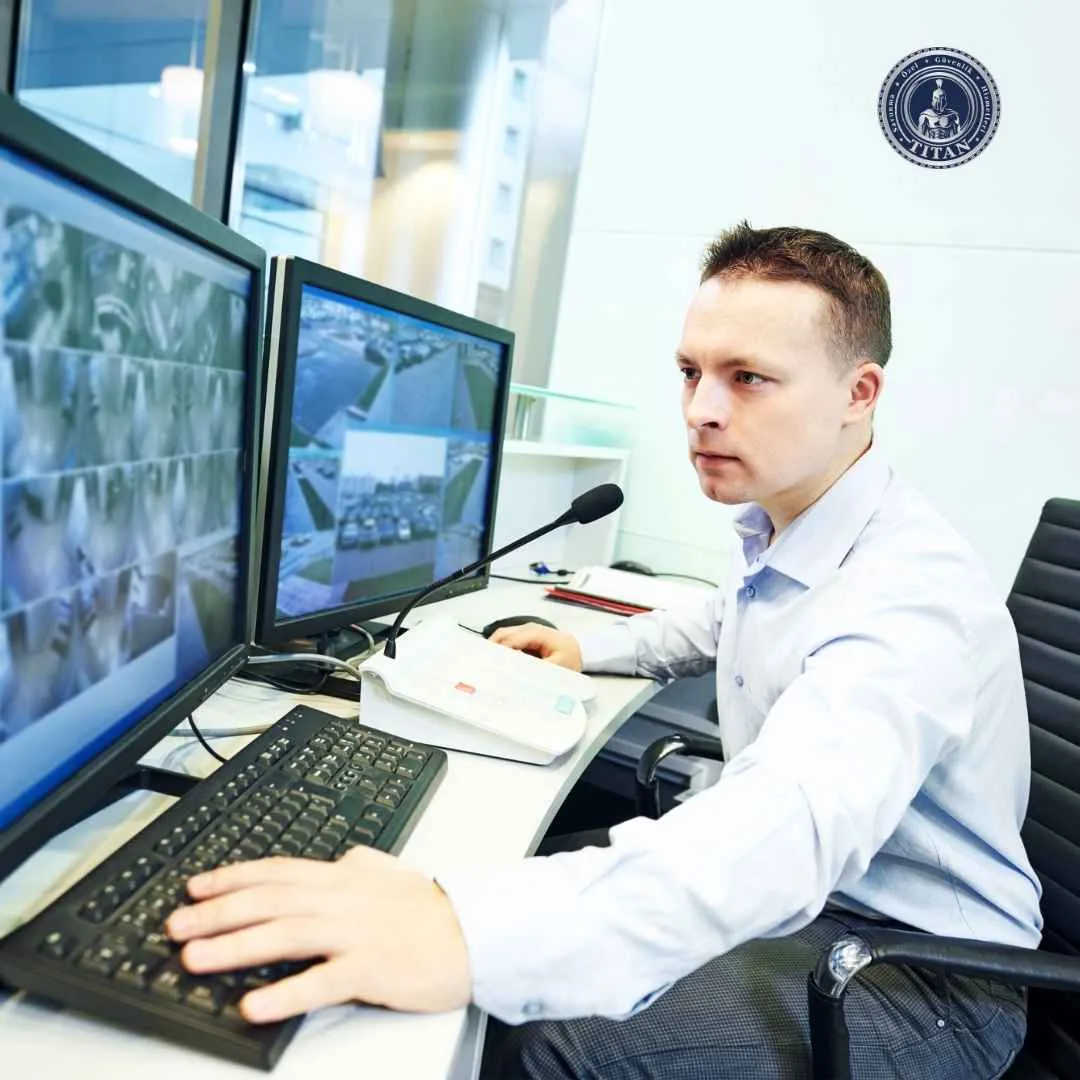
A CCTV operator watches live images, spots suspicious activity, verifies it and directs the team on the ground. The research is clear: human attention over long periods and across many screens is limited, and experience, training, workload design and breaks make a measurable difference. Adding cameras does not add security unless you can answer who is watching, how, and for how long.
This article gives no staffing formula (operators per screen, cameras per person), because the right answer depends on the site, the risk and the task. Instead it summarises the evidence and the design principles you can apply.
What is the vigilance decrement?
In psychology, vigilance is the ability to wait for and detect rare targets over long periods. The vigilance decrement is the drop in detection as time on task increases. Such tasks were long thought of as boring but easy. A 2008 review in Human Factors by Warm, Parasuraman and Matthews challenged that view: the studies it covers show that vigilance tasks impose high mental workload and are stressful, which the authors note matters directly for people monitoring automated systems.
For a control room this means the operator sitting quietly in front of the screens is doing demanding work. The fatigue is invisible until an incident is missed.
What research with CCTV operators found
One of the most direct studies is by Donald, Donald and Thatcher, published in Applied Ergonomics in 2015. In the first stage, 42 full-time CCTV operators watched a 90-minute video and tried to detect four target behaviours; this group showed no overall vigilance decrement. In the second stage, 31 novices were added and operators were split into generalists and specialists (73 participants in total). The findings:
- About half of the target behaviours were detected, and false alarms were high.
- Novices and generalists showed a vigilance decrement.
- Specialists maintained their performance for the first hour and then improved it.
The authors relate these differences to surveillance background, work exposure, transfer of learning, selection, training and motivation. For organisations the takeaway is that who is assigned to monitoring, and how well they are prepared, matters as much as how many screens there are.
Multi-screen monitoring and change blindness
A wall of monitors looks impressive, but nobody can look at all of them at once. In a 2013 field study in a real police CCTV control room covering a Scottish city, Stainer, Scott-Brown and Tatler tracked the eye movements of two trained operators. They spent most of their time on a single main monitor and surprisingly little time on the multiplex wall. They switched cameras frequently and chose feeds according to time of day; areas with night-clubs, for example, were watched closely at night but rarely in the morning. The same paper reports earlier laboratory work in which detection fell as the number of simultaneously displayed pictures grew.
Add to this change blindness, which Simons and Rensink’s 2005 review describes as the striking failure to see large changes. What happens while the operator’s gaze is on another screen, or as an image briefly changes, may go unnoticed. This is not carelessness but a natural limit of human vision, and the answer is good task design, not a reminder to “pay more attention”.
Designing breaks, rotation and workload
A fixed number would mislead here. These principles work better:
- Define the task: is the operator searching for specific events, answering alarms, or supporting the team on the ground? Each needs different attention.
- Limit unbroken screen time: plan switches between active screen watching and other duties such as radio, logging and reporting.
- Rotate: where possible, alternate operators between monitoring and patrol or access duties during the day.
- Front-load busy periods: add attention resources when risk rises (opening, closing, event egress, shift change).
- Specialise: the Donald et al. findings suggest operators familiar with an area or behaviour type perform better.
- Train and debrief: review missed and caught incidents regularly with the team.
In the UK, ProtectUK’s tactical note on active CCTV monitoring also recommends regular breaks to keep operators alert, and notes that unmonitored systems mainly provide evidence after the event.
Analytics plus operator: alarm-based monitoring
As camera numbers grow, “watch everything all the time” gives way to alarm-based monitoring. Video analytics or an intrusion detector flags an event, the image comes to the operator, who verifies and decides. This reduces attention load, but a high false alarm rate creates a new kind of fatigue. For the analytics side see our video analytics entry. Cameras that raise no alarms should still be reviewed on a planned schedule.
Control room ergonomics: ISO 11064
The international reference for control room ergonomics is the ISO 11064 series, “Ergonomic design of control centres”. Its parts deal separately with design principles, the arrangement of control suites, workstation layout and dimensions, environmental requirements and evaluation. We do not quote values from clauses we have not read, but the approach can be summarised: the room, screens and desks are designed around the operator’s task, not the other way round. Glare, noise, temperature and viewing angles are therefore security issues. For how a control room is organised more broadly, see our security operations centre entry.
Checklist
- Is the owner of the monitoring task named in writing for every shift?
- Are unbroken screen time and breaks planned?
- Is it decided which cameras are actively watched and which open on alarm?
- Is extra attention available at peak times?
- Do operators know the site and talk regularly to the team on the ground?
- Are missed incidents reviewed to learn, not to blame?
To get a first view of when and where a site needs people, try our Security Coverage Planner.
How a professional security partner helps
Cameras record; people notice, verify and direct the response. As an Ankara-based private security company operating under a Ministry of Interior licence under Law 5188, certified to ISO 9001, 14001, 45001, 22301 and 28000, we plan guarding together with your technology, defining the monitoring task with coverage hours, rest patterns and a response plan in a written scope, with regular reporting in English and Turkish. See our approach to shopping centre security.
Sources and Further Reading
- Donald, Donald & Thatcher — Work exposure and vigilance decrements in closed circuit television surveillance, Applied Ergonomics (2015)
- Stainer, Scott-Brown & Tatler — Looking for trouble: oculomotor search strategies during live CCTV operation, Frontiers in Human Neuroscience (2013)
- Warm, Parasuraman & Matthews — Vigilance requires hard mental work and is stressful, Human Factors (2008)
- Simons & Rensink — Change blindness: past, present, and future, Trends in Cognitive Sciences (2005)
- ProtectUK (NaCTSO) — Tactic IB5: Actively monitor CCTV/VSS and review out-of-hours footage (2023)


