
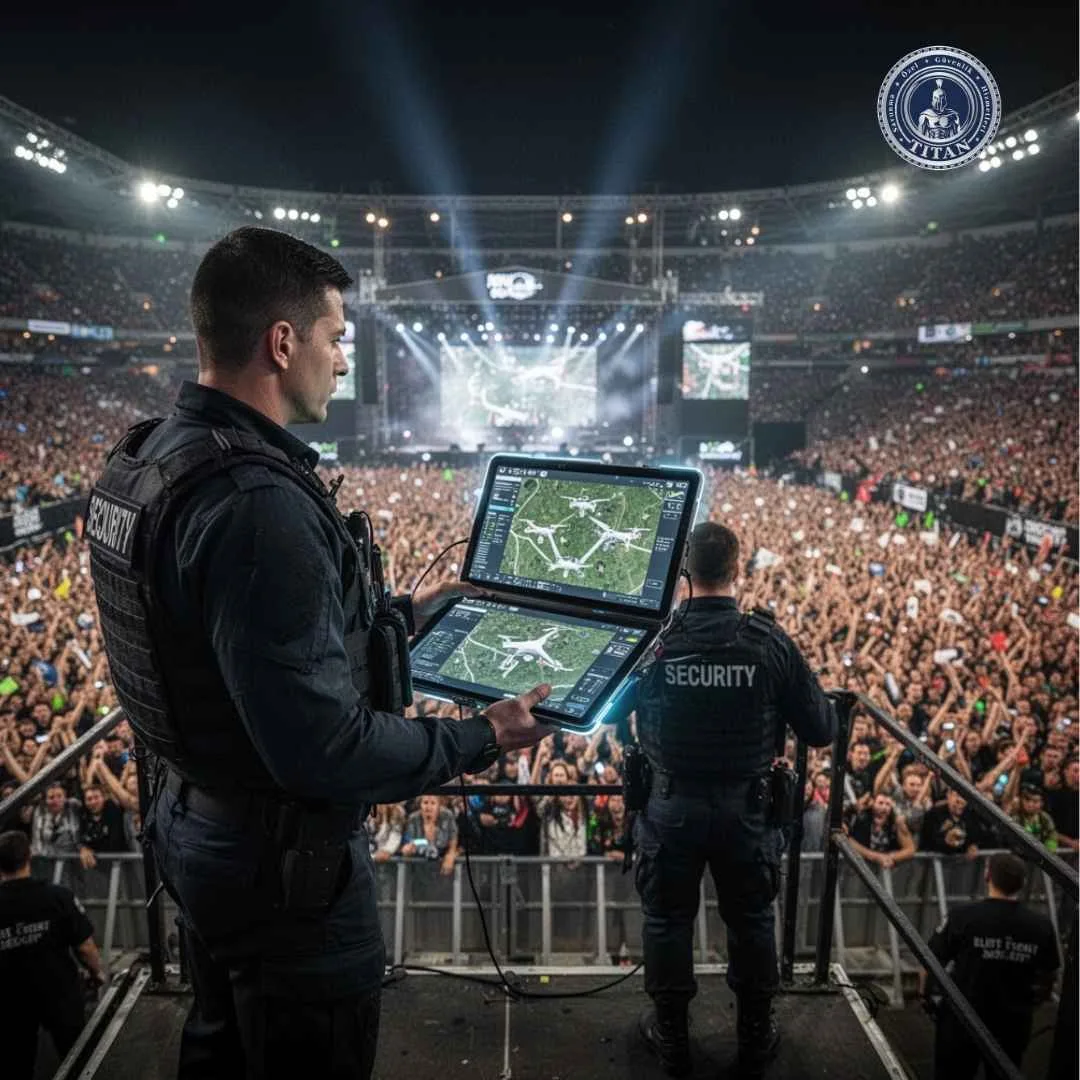
Cameras can count people and estimate crowd density well enough to support decisions, but the numbers only make a crowd safer when someone has agreed in advance what each number means and who acts on it. Counting technology tells you how many people passed a line or roughly how packed an area is; crowd science tells you why density and flow matter; your event plan has to say which gate closes, who announces it and who records it.
This article is general information, not legal advice.
This article is for event organisers, shopping centre and stadium operators. It looks at the technology side of crowd monitoring and at the decision chain behind it. For the underlying concepts see the encyclopedia entries on crowd density and crowd management.
Counting and density technologies at a glance
There are two different questions, and they need different tools:
- How many people are inside? (counting) Sensors at entrances and exits count crossings of a virtual line in each direction. Typical options are overhead cameras or depth sensors looking straight down at a doorway, camera analytics with line-crossing rules, and data from ticket scans or turnstiles. Occupancy is in minus out, so small errors at each door accumulate over a long day.
- How tightly packed is an area? (density) Wide-view cameras with analytics estimate the number of people in a defined zone and divide by its area, often shown as a heat map. Density estimation is harder than door counting: people hide one another, lighting changes and the camera angle distorts distances.
Some systems also estimate numbers from the wireless signals of phones. These rely on device identifiers, so they raise more privacy questions than optical counting and need a separate data protection assessment.
Whatever the method, accuracy is local. A sensor that performs well in a bright mall entrance may struggle at a dark festival gate. Calibrate each counting point with manual counts at different times, record the results, and treat the dashboard figure as an estimate with a known margin, not a precise truth.
Crowd science: density and flow
Crowd safety research explains why these numbers matter. In his doctoral thesis Crowd Dynamics (University of Warwick, 2000), G. Keith Still modelled crowds as individuals interacting with space and validated the model against field data from venues such as Wembley Stadium. Two ideas from that work are especially useful to operators:
- Speed depends on density. In the online version of the thesis (chapter 2), Still states that speed is a function of density, and he cautions against treating crowds as a simple fluid. As an area fills, people slow down, so the number who can pass through a gate or corridor per minute does not keep rising with demand.
- Risk rises sharply at high density. In a note added to the same chapter, Still writes that above four people per square metre there is significant risk of crushing, trips, slips, falls and shockwaves. He also attributes most incidents to a lack of understanding of flow rates, fill times and safe capacities.
Still also makes a point that matters for technology: he notes that at Wembley the turnstile system's flow rates were not recorded or analysed for trends in arrival patterns. Counting systems can close that gap, if someone reviews the data after each event.
Two practical notes on cameras. Still's crowd density reference images warn that density can appear higher when CCTV is mounted at a low angle, so operators should be trained with reference views of known densities. And safe capacity is calculated by competent people from the venue's layout, exits and management; in the UK, for example, the Green Guide of the Sports Grounds Safety Authority sets out guidance on calculating safe capacity at sports grounds. A camera estimate supports that calculation; it does not replace it.
When a threshold is reached: the decision chain
The most common gap is not the sensor but the moment after the alert. Before the event, write down:
- Trigger points: which occupancy or density levels, in which zones, start which actions. These come from the venue's safety assessment, not from the software's default settings.
- Who verifies: a control room operator confirms the figure by looking at the live image; numbers can spike because of a sensor fault.
- Who decides: the person with authority to slow or stop entry, open an overflow area or change a route, usually the event safety officer or a designated deputy. Name them in the plan.
- Who acts: stewards and security officers at the named gates receive a clear instruction by radio; a public announcement is prepared in advance in the languages your audience speaks.
- Who records: time, figure, decision and outcome go into the event log for the debrief.
Practise this chain in a tabletop exercise before doors open. If an instruction to hold a gate cannot be given and carried out within a few minutes, the counting system is only producing a record of what went wrong.
Our free event security planner helps you start a plan that links density data to decisions.
Anonymous data and KVKK
Many organisers want counting that does not identify anyone. Turkey's data protection authority defines anonymisation on its guidance page on deletion, destruction and anonymisation as making personal data impossible to associate with an identified or identifiable person in any way, even when matched with other data. A count of people per zone, without images or identifiers, can be designed to meet that idea.
Keep two points in mind. First, the count may be anonymous, but the camera that produces it still sees people; how its images are processed, whether they are stored and for how long need their own assessment. Second, wireless-signal methods work with device identifiers, so they deserve particular care. Practical design choices include:
- prefer methods that produce only counts or density figures at the device, without keeping images for counting purposes;
- keep counting data separate from CCTV recordings, and define who can access each;
- document the purpose, the retention period and the method, and include them in your privacy notice.
Checklist
- Are counting points calibrated against manual counts, and is the margin known?
- Are trigger points written for each zone, with a named decision-maker?
- Can the control room verify every alert visually?
- Are stewards, security officers and announcements ready for each action?
- Is the counting method assessed for personal data, with retention defined?
- Is arrival and density data reviewed after each event?
How a professional security partner helps
Density data is valuable only when it is matched to a decision. Titan Savunma is an Ankara-based private security company operating under a Ministry of Interior licence under Law 5188, certified to ISO 9001, 14001, 45001, 22301 and 28000, and working with international companies in English and Turkish. We plan guarding together with your technology: who watches the figures, who verifies them and which team acts at which gate. See concert and event security.
Sources and Further Reading
- University of Warwick (WRAP) — Still, G. K.: Crowd Dynamics, PhD thesis (2000)
- G. Keith Still — Crowd Dynamics, Chapter 2: Crowd problems and crowd safety (online version of the thesis)
- G. Keith Still — Crowd density reference images
- Sports Grounds Safety Authority (SGSA) — Guide to Safety at Sports Grounds (Green Guide), 6th edition
- KVKK — Kişisel Verilerin Silinmesi, Yok Edilmesi veya Anonim Hale Getirilmesi


