This article is general information, not legal advice.
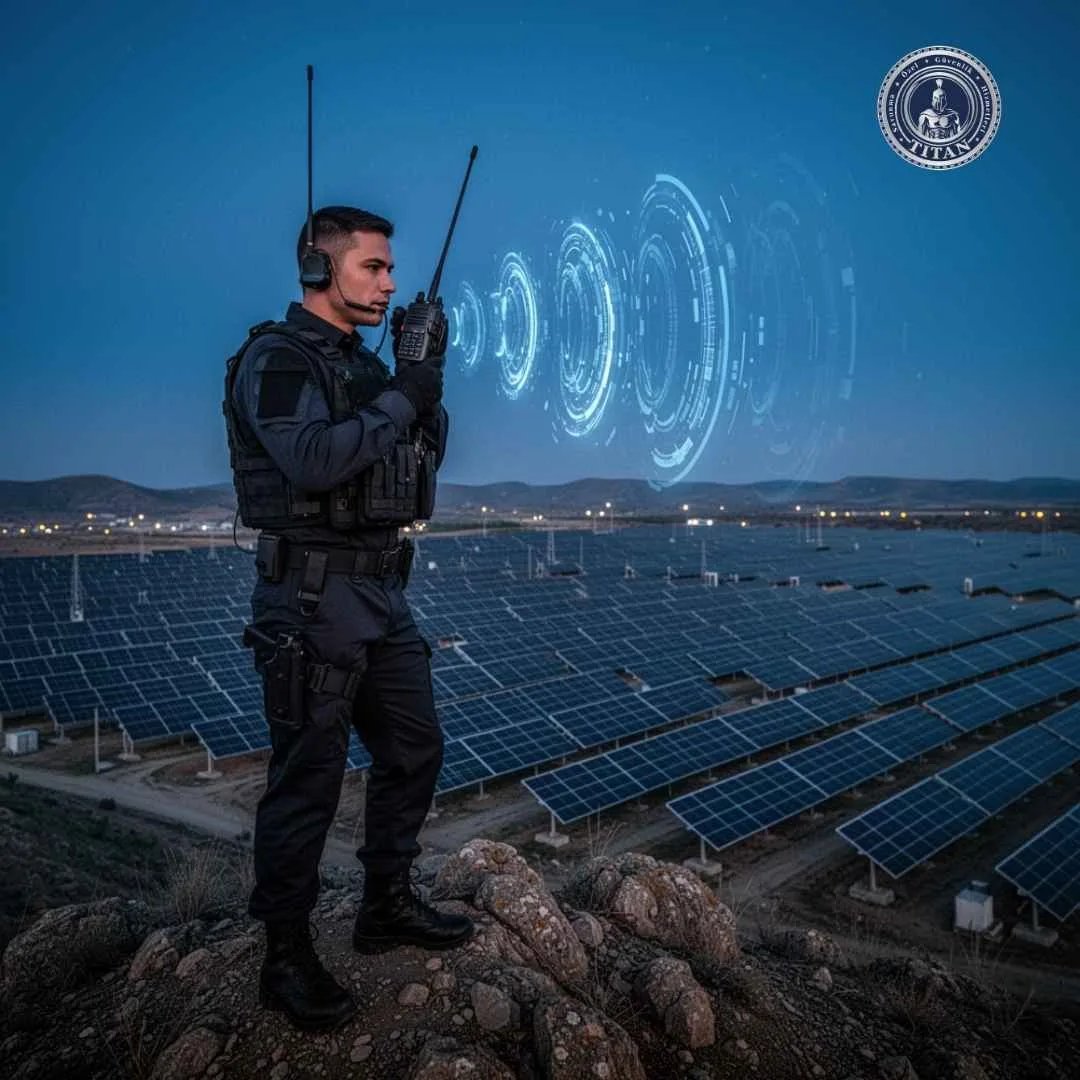
If a drone hovers over your solar plant, substation or factory in Turkey, your private security team may watch it, record what it sees and report it to the police or gendarmerie. It may not jam it, capture it, shoot it down or chase it with another drone. Stopping a drone in flight is a use of force that Turkish law leaves to public authorities such as the police; the powers that Law No. 5188 gives private security officers do not cover it.
That answer frustrates many site managers, but it is also the safest one for the company. The useful work happens before the drone appears: a short written procedure, a clear reporting line, good records and an understanding of the new civil aviation rules. This article explains each of these at planning level.
How drone flights are regulated in Turkey since 2026
Civil drones in Turkey are regulated by the Directorate General of Civil Aviation (Sivil Havacılık Genel Müdürlüğü, SHGM). In 2026 SHGM announced a renewed Unmanned Aircraft Systems Instruction (SHT-İHA). The points that matter for a site owner are these:
- Pilot licences instead of weight classes. Flight authority now depends on the pilot's licence level (P0 amateur, P1 commercial, P2 advanced) and on the zone, not only on the drone's weight.
- A zone map. Under Article 12 of the instruction, Turkish airspace is shown on the map of the new traffic management system (İHATTYS) as green, red and orange zones. Green zones allow flights within set limits without a separate permit. Red zones are closed by the competent authorities. Orange zones show where someone currently holds a permit. Everything outside green zones counts as restricted. In areas outside the three mapped zone types, SHGM decides on permit applications after obtaining the consent of the local civil administrator (the district governor or governor); flights in red zones need the consent of the authority that closed the area.
- Registration and remote identification. Apart from very small "simple" drones, users must register, and drones subject to registration must carry remote identification.
- Sanctions. Breaches are handled under the Turkish Civil Aviation Law No. 2920 and SHGM's administrative fines regulation, and licences can be suspended or cancelled.
- Transition. Existing permits and authorisations remain valid until 31 July 2027. SHGM's announcement describes this date as a transition period for adapting to the new rules and says İHATTYS will be launched as soon as possible.
Two practical consequences follow. First, a drone over your site is not automatically illegal: it may belong to a grid operator surveying a line, a neighbouring developer mapping land or a licensed media crew with a permit. Second, whether a flight was lawful is for SHGM and the police to establish. Your team's job is to give them accurate facts.
Why stopping a drone is a state power
Law No. 5188 on Private Security Services gives private security officers a closed list of powers in Article 7: screening people and bags at entrances, holding found or dangerous items, protecting an incident scene, apprehension in defined cases and use of force only within the limits of the general law provisions it names, such as self-defence and necessity. Nothing in that list covers interfering with an aircraft. Article 9 adds that these powers apply only during duty hours and inside the assigned duty area, and that events requiring force or apprehension must be reported to the police or gendarmerie by the fastest available means.
Academic work in Turkey points the same way. In a study of counter-drone measures, Kaşlı (2021) analyses counter-drone systems as part of the police's use-of-force powers under the Police Duties and Powers Law (PVSK). The paper describes the two functions of such systems, detection and neutralisation, and notes their side effects: jamming devices can interrupt all radio-frequency communication, and a drone stopped by jamming cannot always be brought down in a safe place, so the danger may simply move elsewhere. Risks of this kind help explain why such measures sit with public authorities.
International guidance takes the same position. The IFC good practice handbook on the use of security forces starts from the principle that the host government has primary responsibility for law enforcement, and that a company's security response must be proportional to the threat. For lenders and foreign shareholders, a guard force that improvises counter-drone action is a compliance problem, not a reassurance.
In practice this rules out jammers, signal spoofers, nets, projectiles, lasers and "interceptor" drones flown by site staff. If the operator wants its own drone for inspections or perimeter imagery, that flight is itself subject to SHT-İHA licensing and zone rules.
Observe, record, report: the routine your guards should follow
A good drone procedure fits on one page and mirrors the way the site already handles other unusual events. A typical structure:
- Observe from where you are. Note time, approximate height, direction of travel, colour, size, lights and behaviour (passing through, circling, hovering over a particular building or the substation).
- Record facts, not guesses. Fixed CCTV or a handheld camera may capture the drone and, where visible from inside the perimeter, a vehicle or person apparently operating it. Do not leave the duty area to follow anyone.
- Report through one line. The guard informs the control room or shift supervisor; the supervisor calls the police or gendarmerie (in Turkey, through 112) and informs the site manager named in the plan.
- If the drone lands or falls inside the site, do not handle it. It may carry a damaged lithium battery or an unknown payload. Keep people away, protect the scene and hand it over to the authorities, as Article 7 envisages for incident scenes.
- Close the record. The incident log states what was seen, who was informed and when, and what the authorities said. Interpretation ("probably the competitor", "probably surveillance") stays out of the factual record.
The procedure should also say what the guard must not do: confront a suspected operator outside the fence, demand a phone or controller, or publish images on social media.
Privacy: your recordings are personal data too
Recording a drone often means recording other things: a public road, a neighbour's land, a person standing near a car. Under Law No. 6698 on the Protection of Personal Data, CCTV recording is personal data processing. The Personal Data Protection Authority (KVKK) has reminded employers that camera use needs a defined purpose, proportionality, a visible notice, limited retention and controlled access, and that after an incident only the relevant footage should be kept for the legal process.
For drone sightings this means: export only the clip that shows the event, store it with the incident record, limit who can view it and give it to the police on request. Do not keep wide-angle footage of the neighbourhood "just in case". The same logic protects your staff when the drone, rather than your camera, is doing the filming: the right reaction is to report a possible privacy breach, not to seize the operator's equipment.
Sites with special airspace status
Some locations are already covered by red zones closed by the competent authorities, and under SHT-İHA these are published on the İHATTYS map. Do not assume that an energy plant, a data centre or an industrial site automatically sits in one. Check the official map for your coordinates, note the result in the security plan and re-check after major changes to the system or to your site.
Where you believe your site deserves restricted status, the route runs through the public authorities, typically the governorship (valilik) and the institution responsible for that type of facility, not through private signage or a fence notice. Sites near airports, military areas or prisons may already be inside controlled or closed airspace; that changes how the police may respond, not what your guards may do.
Building drones into the site security plan
| Plan element | What to write down |
|---|---|
| Airspace status | Zone shown on the official map for the site, date checked, who re-checks it |
| Reporting line | Guard to supervisor to police or gendarmerie, and the site manager to inform |
| Recording rules | Which cameras, export of relevant clips only, retention, access list |
| Downed drone | Do not touch, keep distance, protect scene, hand over |
| Own drone use | Licensed pilot, zone permission, flights logged, no pursuit of other drones |
| Training | Short briefing on the procedure and the legal limits, refreshed with shift changes |
Common mistakes we see in plans: buying detection equipment without a reporting procedure behind it, writing "neutralise the threat" into a guard instruction, keeping long recordings of neighbouring land, and treating every sighting as hostile. Repeated sightings matter more than single ones; a monthly review of the log will show whether a pattern exists and whether the authorities should be asked to look more closely. For energy assets, see also our notes on critical infrastructure security and solar power plant security.
About Titan Savunma
Titan Savunma is an Ankara-based private security company operating under a Ministry of Interior licence granted under Law No. 5188. We write site procedures, including drone sighting routines that stay within the law, and work with international clients in English and Turkish with one point of contact and regular reporting. More on our approach for energy generation and distribution sites.
Sources and Further Reading
- Directorate General of Civil Aviation (SHGM) — Unmanned Aircraft Systems Instruction SHT-İHA (2026)
- SHGM — Announcement: SHT-İHA published (2026)
- Kaşlı, E. — Suçlu Drone Saldırılarına Karşı Polisin Zor Kullanma Yetkisi, Türkiye İnsansız Hava Araçları Dergisi 3(2) (2021)
- Law No. 5188 on Private Security Services (mevzuat.gov.tr)
- KVKK — Public announcement on security cameras in workplaces (2026)
- IFC — Good Practice Handbook: Use of Security Forces: Assessing and Managing Risks and Impacts (2017)