
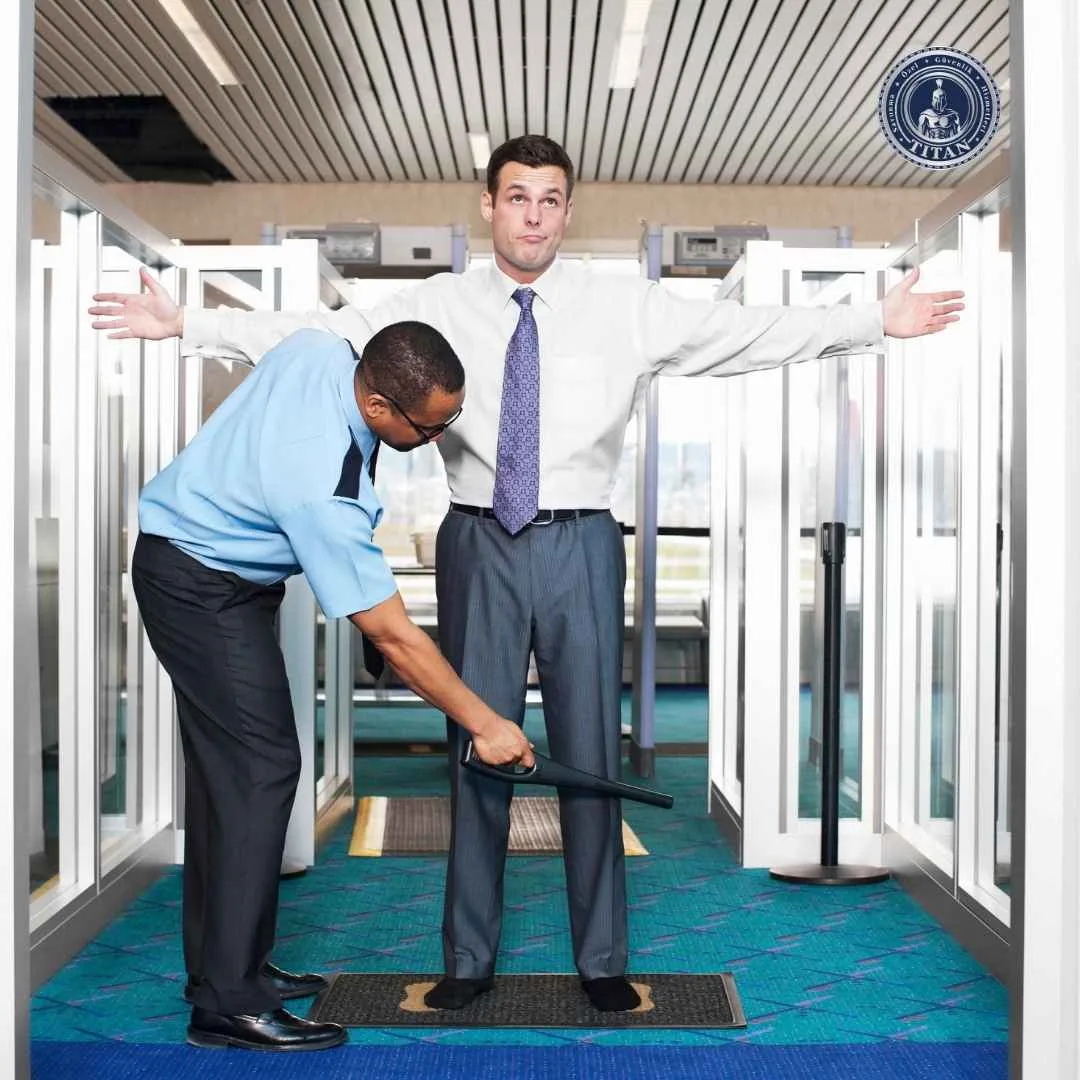
Event entry screening works when the search line is designed around how and when people actually arrive. A long, dense queue outside the gates is itself a safety and security risk, so the plan has to match screening capacity to peak demand, announce the bag policy well before the day, combine detectors with trained staff, and set out in advance how respectful searches and refusals are handled. Equipment finds metal and shows the inside of bags; people manage the flow, resolve alarms and make the decisions.
This article is general information, not legal advice.
It is written for international event organisers, professional congress organisers and venue operators planning concerts, festivals, congresses and sports events in Turkey. Our general event planning articles cover the whole operation; this one looks only at the screening line, from the end of the queue to the moment a guest is inside. For background, see our encyclopedia entries on crowd management and checkpoint screening.
The queue itself is a risk
It is tempting to think of the queue as the safe side of the checkpoint. Official guidance says otherwise. The UK's National Protective Security Authority, in its 2024 guidance on protecting pedestrian queues, notes that dense crowds and people lined up in queues can be attractive targets, and recommends keeping queues short where possible, avoiding long straight lines, keeping them away from live traffic, and planning quick dispersal routes. It also advises caution about publishing detailed information such as times, numbers or security arrangements that could help someone with hostile intent.
Crowd safety points the same way. The UK Health and Safety Executive's event safety guidance says people must have a safe way out of a queue without pushing into others or into traffic, that queues should not block emergency access routes, and that security search procedures must not compromise people's safety. It also recommends arrangements for monitoring and estimating the number of people arriving. The Sports Grounds Safety Authority's ingress guidance adds that entry should be managed so arrivals do not cause congestion or delays outside the ground, and notes that congestion occurring on a regular basis may lower the safety management assessment and with it the permitted capacity.
The organisational conclusion: someone must own the queue. A named queue supervisor, stewards along the line, a view from the control room and agreed triggers for action turn a crowd outside the gate into a managed space.
Throughput logic and bottlenecks
The capacity of a screening line is simple in principle: the number of open lanes multiplied by how many people each lane can process in a given time. In practice, each part of that equation has many inputs. The SGSA lists factors that affect the rate of entry, including admission policies, the efficiency and reliability of electronic card entry systems, the design and condition of entry points, the capabilities of entry staff and the level and type of security screening. ProtectUK's search planning guidance says the search process should be designed and resourced for the maximum expected demand, with arrival rates assessed by time of day, season and event.
Rather than a fixed formula, use a reasoning sequence:
- Demand profile: when will most guests arrive? Doors opening, support acts, the main act and the end of the working day all create peaks.
- Lane rate: measure it at a rehearsal or a comparable event instead of trusting a brochure; bag policy and search depth change it more than equipment does.
- Bottlenecks: the slowest step sets the pace, often the bag table, the ticket scan after screening or alarm resolution.
- Reserve: plan extra lanes or staff that can be opened when the queue passes an agreed point, and decide in advance who gives that order.
Our event security planner helps you list entry points and coverage hours as a starting point for this calculation.
Announce the bag policy before the day
The fastest search is the one that does not need to happen. ProtectUK advises telling visitors in advance what the search will involve and which items are prohibited, so they can prepare and delays are reduced. The HSE guidance points to communication channels such as transport hubs, local radio and social media on the day. In practice:
- Publish the bag size limit and the prohibited items list with ticket sales, in the reminder message and on site signage, in Turkish and English for international audiences.
- Explain what the search involves: walk-through detector, hand-held detector, bag check.
- Tell people with medical devices or access needs how to reach the accessible lane.
- Provide a cloakroom or bag drop for items that cannot go in, or say clearly that there is none.
Respectful searches and refusals
In Turkey, Article 7(b) of Private Security Law No. 5188 gives private security officers the power, at meetings, concerts, sports competitions, stage shows and similar events, to ask for identification, pass people through walk-through detectors, search them with a detector and pass belongings through X-ray or similar systems. Article 8 states that private security officers may not work armed at private meetings, sports competitions, stage shows and similar events, and Article 9 limits these powers to duty hours and the duty area.
ProtectUK recommends policies for searching every group attending, including children, vulnerable adults, people with reduced mobility and religious groups, and discreet search areas for these needs. For the line, that means:
- Same-sex searching wherever physical contact may be involved, with female and male officers rostered on every lane at peak times.
- A private area near the line for searches on request.
- An accessible lane for wheelchair users, people with medical devices, families with small children and anyone who needs more time.
- A refusal procedure: explain calmly that the search is a condition of entry, offer the private area, and if the guest still refuses, do not admit them; call the lane supervisor, log the event and involve the police only where there is a suspicion of crime.
- Safekeeping: items that may be criminal, evidence or dangerous are held under Article 7(g) with immediate notification to the police, and recorded.
One line, technology and people together
A good screening lane combines equipment and people with clear roles:
- Walk-through detectors filter people; an officer watches the alarm and a second officer resolves it with a hand-held detector.
- Bag tables or X-ray handle belongings; X-ray needs a trained operator with protected breaks, and many events rely on visual bag checks instead.
- CCTV and counting show the control room the length of the queue; the control room tells the queue supervisor when to open reserve lanes.
- The lane supervisor resolves disputes, refusals and finds, and keeps the log.
Daily tests of detectors, radio checks and a short briefing before doors open belong in the post orders, along with who stops entry if equipment fails and what fallback method applies.
Common mistakes
- Opening all lanes only when the queue is already long.
- Announcing the bag policy only at the gate.
- No accessible lane, so guests with medical devices wait in the main line.
- Treating refusals as arguments to win rather than procedures to follow.
- Leaving the queue outside the venue without an owner.
Technology screens, people keep entry safe
Detectors and scanners show where metal is and what is inside a bag; trained officers manage the queue, verify alarms, talk to guests and decide who enters. Titan Savunma is an Ankara-based private security company holding a Ministry of Interior operating licence under Law 5188 and ISO 9001, 14001, 45001, 22301 and 28000 certificates, and we work with international organisers in English and Turkish, with a single point of contact, written scope and regular reporting. We plan guarding together with your technology and your venue's layout. Learn more about our concert and event security.
Sources and Further Reading
- ProtectUK (NaCTSO) — Search Planning (2022)
- NPSA — Election Protective Security Guidance: Protecting Pedestrian Queues (2024)
- HSE — Event safety: Put crowd controls in place
- Sports Grounds Safety Authority — Green Guide: Ingress
- Mevzuat Bilgi Sistemi — 5188 sayılı Özel Güvenlik Hizmetlerine Dair Kanun (md. 7, 8, 9)


