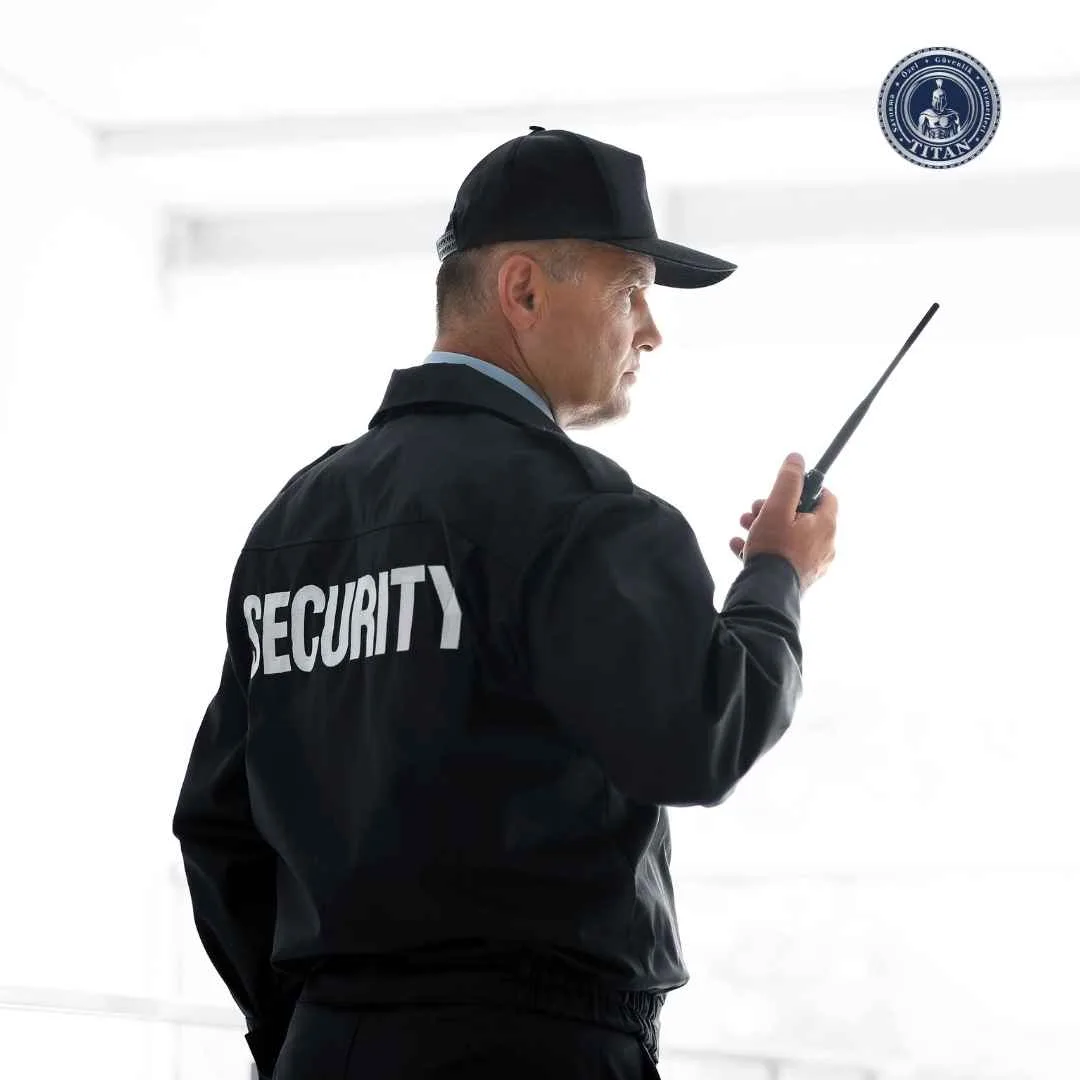
Planning security for an event in Turkey starts with four questions: who is coming, when and by which route; where will they gather inside; who decides if something goes wrong; and how will everyone leave? The questions are the same for a concert, a congress, a trade fair and a corporate launch, but the answers differ sharply. At a concert the risk concentrates in the standing crowd at the front of the stage; at a congress, at registration and around protocol guests; at a fair, on build-up nights and at contractor gates; at a launch, around the guest list and the press area. The legal frame is shared: Law No. 5188 on Private Security Services.
This article is general information, not legal advice.
Below we explain what the Law says about events, what crowd-safety research and the UK's official guidance add to planning, and how the plan changes across four event types. If you are an international organiser bringing an event to Istanbul, Ankara or Antalya, the free Event Security Planner gives you a first draft in English.
The Turkish legal frame for event security
Under Article 3 of Law No. 5188, contracting a private security company normally requires the governor's permission, given on a decision of the provincial private security commission. The same article makes events easier: for meetings, concerts, stage shows and similar events, the governorship (valilik) may grant private security permission without a commission decision. Under Article 5, the security company notifies the relevant governorship in writing of a service it provides to a third party by the end of working hours on the day the service starts; for urgent and temporary services this time limit does not apply. Build your timeline around this: the permission and notification steps are handled together with the security company, well before the event date.
What officers may do at the entrance is set out in Article 7. Article 7(b) allows private security officers, at meetings, concerts, sports competitions, stage shows and similar events, to ask for identification, pass people through a walk-through detector, search them with a detector, and pass their belongings through X-ray or similar security systems. These are screening powers; the Law lists no general power to search a person or a bag by hand. That is why announcing the bag policy (size, prohibited items) with the ticket or invitation avoids arguments at the door. Items found during screening that constitute an offence, may be evidence or may cause danger can be taken into safekeeping on condition that the police are informed immediately (Art. 7(g)).
On weapons the Law is clear: Article 8 says private security officers may not work armed at private meetings, sports competitions, stage shows and similar events. Sports competitions are also covered by Law No. 6222 on the Prevention of Violence and Disorder in Sports. For short definitions, see the encyclopedia entry on event security.
What crowd research tells planners
A useful empirical study of how crowd disasters develop is the analysis by Helbing, Johansson and Al-Abideen in Physical Review E (2007). Working from video recordings of the 2006 crowd disaster in Mina, the authors identified two sudden transitions in crowd flow: first from smooth flow to stop-and-go movement, then to what they call a turbulent state, in which sudden pressure releases displaced people, knocked them down and led to trampling. The lesson for a planner is that danger usually arrives as an observable deterioration rather than a single moment; a team that watches where and when flow turns stop-and-go gains time to act. The authors note that their findings help identify where and when crowd accidents are likely. This article deliberately gives no numerical density thresholds; such values depend on the venue, how the crowd moves and how it is measured, and belong with a competent specialist.
On the practical side, the event-safety guidance of the UK Health and Safety Executive (HSE) is clear on three points. First, overall responsibility for crowd safety stays with the organiser: you can contract out tasks such as stewarding, but the organiser keeps overall responsibility for public safety, roles should be set early and everyone should know their own. Second, security searches must not create overcrowding; queues must stay off emergency routes, people must be able to leave a queue without pushing past those behind or stepping into traffic, and exits must be unlocked and routes clear before anyone is admitted. Third, monitoring is about more than total numbers: how people are spread across the site matters too, and entrances, standing areas, pinch-points such as stairs, and queues are the places to watch.
The SGSA Green Guide (6th edition, 2018) is written for sports grounds, but two of its principles transfer well to other events. It states that safety comes from a balance between good management and good design, and treats the area outside the stadium where spectators arrive and leave as a zone of its own. An event plan does not stop at the door either; car parks, shuttle stops and walking routes are part of it.
How the plan changes by event type
| Event | Where risk concentrates | Where the plan puts its weight |
|---|---|---|
| Concert | Doors opening, front of stage, bars, mass exit at the end | Phased entry, front-of-stage barrier and pit, staggered dispersal |
| Congress / conference | Registration desk, movement between halls, protocol guests | Accreditation, badge zones, protocol coordination |
| Trade fair | Build-up and break-down days, nights, loading areas | Contractor access list, protection of stands and equipment |
| Launch / gala | Guest entry, press, VIP movement, alcohol service | Guest-list control, separate VIP route, confidentiality |
Concerts
At a concert the crowd arrives together and leaves together. If door time, the number of screening lanes and the bag policy are not planned as one, the queue spills onto the pavement. Where a standing audience faces a stage, plan a pit behind the barrier where stewards and first-aiders can work, and escape routes on both sides; the barrier's technical design is a job for a competent specialist. At the end, transport information and, where possible, a staggered exit are how you plan dispersal as carefully as arrival. Our concert and event security page describes how we approach these services.
Congresses and conferences
At a congress the risk is mostly about who can enter where. Badge printing, lost badges, last-minute substitutions and zone permissions by badge colour should be settled before doors open. When officials or diplomats attend, the division of tasks with their own protection teams and the relevant authorities is agreed in advance and in writing. Accreditation lists are personal data: under Article 10 of the Personal Data Protection Law (KVKK, Law No. 6698) attendees are informed, and the lists are deleted when no longer needed.
Trade fairs
A fair's security calendar starts before the show days and ends after them. During build-up and break-down many contractors enter the hall, and valuable equipment stays on stands overnight. A contractor access list, control of the delivery area and an overnight protection plan are therefore the core of a fair plan.
Corporate launches and galas
Attendance at a launch is usually small, but reputational risk is high. Entry against a guest list, a separate press area, separate routes for senior executives and artists and, where alcohol is served, de-escalation around the bar come to the fore. The guest list and movement plan are shared only with authorised people.
A phase-by-phase planning timeline
- Weeks before: risk assessment with an audience profile, a check of venue suitability, clear roles (who stops the programme, who speaks to the crowd), permission and notification steps.
- Final week: emergency roles agreed with the venue, police, medical team and contractors; a briefing pack for all security staff with the site plan, zones, radio channels and contact list.
- Before doors open: exits unlocked, routes clear, barriers and signs in place; briefing and radio check.
- During the event: monitoring of distribution as well as totals, adjusting entry flow if queues build, an incident log.
- Finish and after: planned dispersal, handover of items held in safekeeping with a written record, a debrief the same or next day, deletion of footage and lists that are no longer needed.
Using the Event Security Planner
The Event Security Planner asks, in three steps, for the event type (concert, conference, fair, launch, sports, festival), venue, attendance band, duration, entry method, queues and parking, and your current readiness. It returns the zones to cover in priority order, readiness gaps, entry-screening options with their basis in Law 5188, a checklist by phase and coordination steps. It runs in your browser, asks for no event name, date or venue name, and sends nothing unless you choose to submit the enquiry form. It gives no staff numbers, crowd-density thresholds or prices; staffing depends on the shift pattern, hours and legal working limits and is planned after a venue survey.
Common mistakes
- Treating security as the search at the door and leaving parking, queues and dispersal out of the plan.
- Sizing screening lanes by the equipment available rather than by door time and arrival profile.
- Announcing the bag policy for the first time at the entrance.
- Not agreeing in writing where the venue's own emergency team's tasks end.
- Leaving build-up and break-down nights at a fair outside the scope.
- Skipping the debrief and not carrying the incident log into the next edition.
Titan Savunma is an Ankara-based private security company operating under a Ministry of Interior licence granted under Law No. 5188, with ISO 9001, 14001, 45001, 22301 and 28000 certificates. We work in English and Turkish and plan services for events in different provinces with a single point of contact, a written scope and regular reporting. More about us as a private security company in Turkey.
Sources and Further Reading
- T.C. Mevzuat Bilgi Sistemi — Law No. 5188 on Private Security Services (consolidated text), Art. 3, 5, 7 and 8
- Helbing, D., Johansson, A. & Al-Abideen, H.Z. — Dynamics of crowd disasters: An empirical study, Physical Review E 75, 046109 (2007)
- UK Health and Safety Executive — Event safety: Set clear roles and responsibilities (Managing crowds safely)
- UK Health and Safety Executive — Event safety: Put crowd controls in place
- UK Health and Safety Executive — Event safety: Monitor the crowd
- Sports Grounds Safety Authority — Guide to Safety at Sports Grounds (Green Guide), 6th edition (2018)
- Sports Grounds Safety Authority — Zone Ex
- Titan Savunma — Etkinlik Güvenliği Planlayıcı / Event Security Planner (tool logic checked 2026-11-11)