
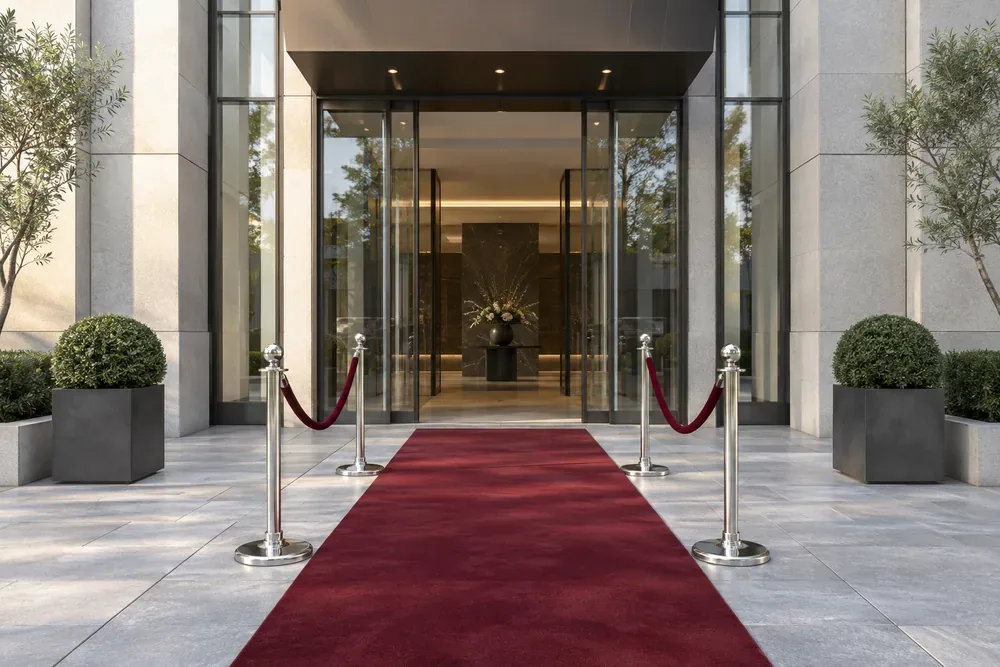
The core of security for a private party at home is deciding in advance who comes through the door, against which list, and how far into the house they may go. Four things need proper planning: the guest list and door control, valet parking and car keys, where hired staff can and cannot go, and rules on photographs. If you plan to use professional security officers in Turkey, remember that this involves a legal permit process.
This article is general information, not legal advice.
Why a party at home is different
A hotel or venue has its own entry routine, staff and cameras. At home, the house becomes an event space for the evening, yet its private rooms, valuables and family life remain in place. On one night the host, event planner, caterers, valets, musicians and guests all pass through the same door. The risk rarely comes from an outside attack; it comes from uncertainty about who should be where.
Unlike our earlier piece on wedding security and jewellery handovers, this article focuses on a party hosted inside the home.
Guest list and door control
A door without a list is a door anyone who “looks familiar” can walk through. At a large party the host cannot be expected to recognise everyone.
- Keep one current list. If the host, planner and assistant hold different versions, the door becomes a place of argument. Freeze the final version the day before.
- Clarify plus-ones. State on the invitation whether guests may bring someone.
- Put someone who knows the list at the door. They should be able to check quietly with the host when someone is not on it, without embarrassing anyone.
- Use a single entrance. Keep garden gates, service doors and the garage closed or supervised. Give staff and suppliers a separate but logged entrance.
A guest list is personal data. Where a business such as an event planner processes it in Turkey, the data security and information duties of Law No. 6698 on the Protection of Personal Data come into play. Share the list only with those who need it and delete spare copies afterwards.
Valet parking: keys and responsibility
The valet desk is the least considered and most valuable link of the evening: dozens of car keys sit in one place for hours. Agree the following in writing with the valet company beforehand:
- Who is responsible for damage or loss, and does the company carry insurance covering it?
- Where are keys kept during the event, under whose control, and in a locked cabinet?
- Are cars returned against a numbered ticket, and how is identity checked if a guest loses the ticket?
- Where are cars parked, and is that area supervised?
- Are valet staff names and numbers shared in advance?
Keys for keyless-entry cars left in the open on a desk add their own risk; keeping keys in a closed box improves both order and security.
Hired staff and closed areas of the house
Catering, service, music and décor teams are essential, but you will be meeting most of them for the first time.
- Ask suppliers for a list of staff names and give it to the person on the door.
- Decide which parts of the house are open to guests. Bedrooms, the study and rooms with valuables should be locked or clearly closed.
- Give staff a separate area for breaks and belongings, which reduces the need to move through the house.
- Put jewellery, watches, cash and documents in a safe or locked room before the party.
- Manage departures as carefully as arrivals, and know who the last supplier to leave is.
Photography and social media
Photos taken at a party affect both guests' privacy and the security of the home. A single post can reveal the layout, the valuables and who was present.
- Set a polite photo policy on the invitation or at the door, for example no photos in private areas and no posting of other guests without their consent.
- If you hire a photographer, put in the contract where images are stored, who receives them and when they are deleted.
- If you have cameras inside the house, think about which areas they record during the event.
Two legal points are useful in Turkey. Article 28 of Law No. 6698 excludes from its scope processing by individuals for activities relating entirely to themselves or family members living in the same home, provided the data is not given to third parties and data security rules are observed; sharing images with others can take you outside that exemption. Article 134 of the Turkish Penal Code makes violating the privacy of private life a crime, treats doing so by recording images or sound as aggravated, and separately criminalises unlawfully disclosing images or sounds relating to someone's private life.
Using private security officers: the permit question
For large gatherings or well-known guests, professional security support may make sense. A common mistake is to see this as “calling in a few people”. Under Article 3 of Law No. 5188 on Private Security Services, having security services provided by a company requires the governor's permission, given on a decision of the provincial private security commission; for meetings, concerts, stage shows and similar events, the governorship may grant a private security permit without a commission decision. How a party at home is treated under this framework and how the application is made depend on the event, so plan the process well in advance with a licensed company. For the basic concepts, see our event security entry.
Beyond the permit, a good plan aims to stay unobtrusive rather than visible: a courteous welcome at the door, calm supervision of parking and the garden, and one communication line straight to the host. Well-known guests may bring their own protection teams; coordinating with them before the event avoids confusion. If the host needs protection in their own right, a VIP close protection plan should be built alongside the party plan.
Quick checklist and common mistakes
- Is there one current, frozen guest list?
- Is there a single entrance, with other doors closed?
- Are liability, insurance and key handling agreed in writing with the valet company?
- Is the suppliers' staff list at the door?
- Are closed rooms locked and valuables put away?
- Have guests been told the photo policy?
- If professional security is used, has the permit process been planned?
- Who will call 112 in an emergency, and are the first aid kit and exits known?
The most common mistake is keeping the list on the host's phone instead of at the door, which sends the host running to the entrance mid-party. Another is leaving valet keys on an open table. A third is assuming everyone leaves at once; closing the evening needs as much attention as opening it. Our free event security planner can help you build the plan step by step.
Security at a private party means planning entry, parking, staff and privacy together without spoiling the guests' evening. Titan Savunma is an Ankara-based private security company operating under a Ministry of Interior licence issued under Law 5188, certified to ISO 9001, 14001, 45001, 22301 and 28000, working with international companies in English and Turkish, with a written scope, a single point of contact and regular reporting. To discuss a security plan for your event, see our event security page.


