
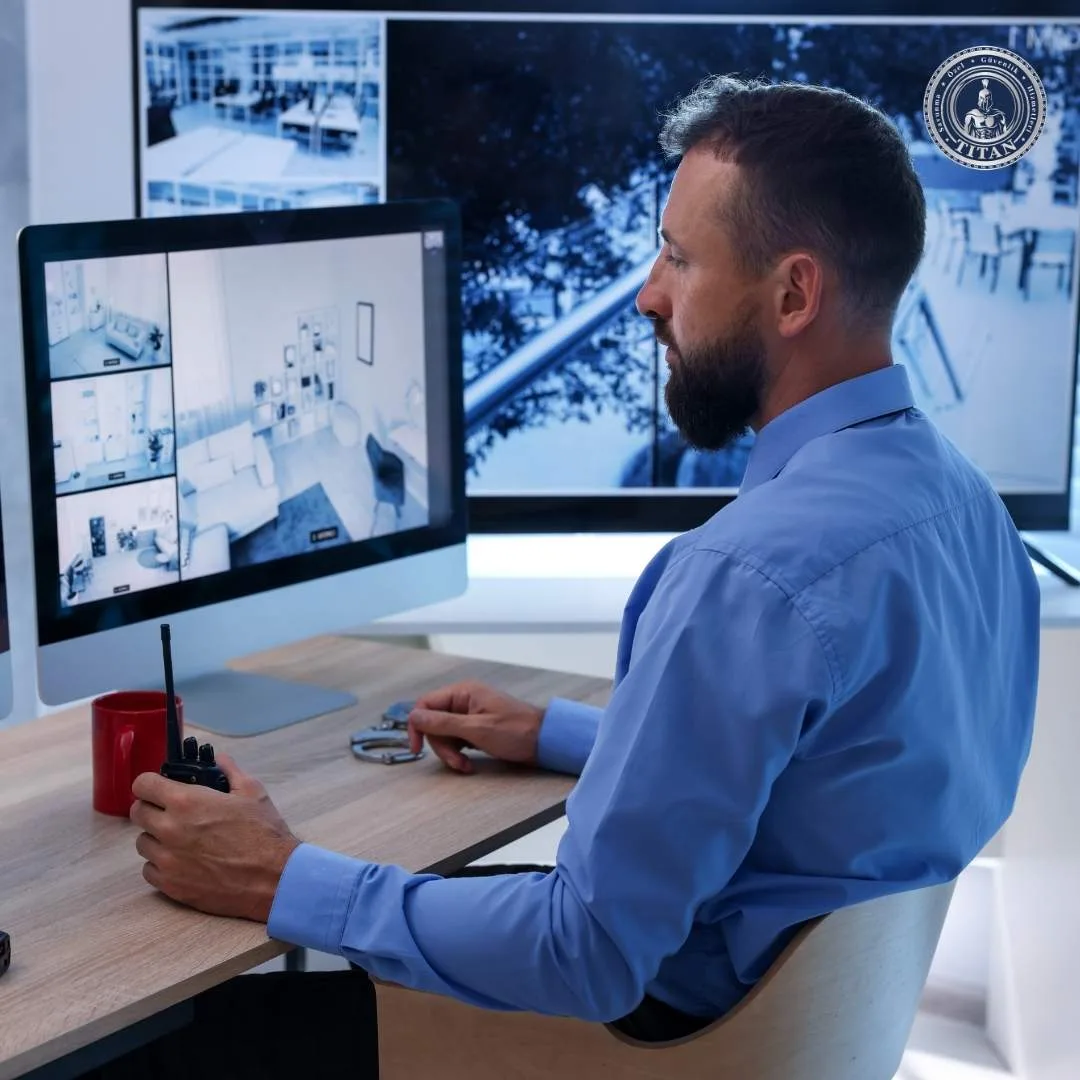
A PTZ camera is a moving security camera that can be panned left and right, tilted up and down and optically zoomed by remote control. A fixed camera records one area continuously; a PTZ is for following an incident and getting close to the detail. In short, a PTZ is an operator’s tool: if nobody is steering it, it is usually looking the wrong way.
For the basic definition see the PTZ camera entry in our Security Encyclopedia. Here we go further: how a PTZ’s job differs from a fixed camera’s, where automatic features stop helping, and the operator procedure that makes a PTZ worth having.
How a PTZ camera works
A PTZ has three main parts: a motorised housing that turns the camera horizontally and vertically, a zoom lens whose focal length can change, and a control interface that drives these movements remotely. Fast-moving dome models are often called “speed domes”. The operator steers with a joystick, mouse or software and can jump to saved viewpoints (presets) with one command.
Most PTZ cameras also offer:
- Presets: saved views of gates, loading bays or car park entrances.
- Tours: the camera cycles through presets in a set order.
- Auto-tracking: the camera tries to follow a moving object on its own.
- Return to home: after a period without operator input, the camera goes back to a default view.
Fixed versus PTZ: different jobs
The two are complements, not rivals. The difference is clearest when you look at the task:
| Aspect | Fixed camera | PTZ camera |
|---|---|---|
| Main job | Record a defined area continuously | Follow an incident, zoom in on detail |
| Recording integrity | The area is always on record | Only where it is pointing is on record |
| Human need | No operator needed to record; monitoring needed for deterrence and response | Most of its value depends on a live operator |
| Maintenance | Lens cleaning, view checks | Also motors, bearings and preset accuracy |
| As evidence | Before and after in the same frame | Close-up detail, but wider context can be lost |
Good designs keep critical points (entrances, cash areas, loading bays) under continuous fixed coverage and add PTZs on top for following incidents across wide areas. The international application guideline for video surveillance, IEC 62676-4:2025, treats the system as a whole from planning to maintenance; the choice of camera type should be an outcome of that plan, not its starting point.
Limits of tours and auto-tracking
Automatic features are attractive, but know what they cannot do:
- Tours leave gaps: while the camera sits on one preset, the others are not recorded. A tour does not replace a fixed camera.
- Auto-tracking makes mistakes: in crowds or with several moving objects it may switch to the wrong target or lose it; rain, branches and headlights can confuse it. It is an aid, and an operator must confirm the track and take over when needed.
- Zooming in loses context: when the camera is close on one person it does not see what happens around them. Operators should keep the wide picture on fixed cameras.
- Mechanical wear: a camera that moves constantly can drift; regular preset checks belong in the maintenance plan.
None of this makes a PTZ less useful. It simply places it where it belongs: not as a self-running device, but as a tool that is effective in trained hands.
Operator and incident procedure
The evidence supports active monitoring. In their 2019 meta-analysis covering 40 years of evaluation research, Piza, Welsh, Farrington and Thomas found that CCTV schemes with active monitoring generated larger effects than passive systems, and that schemes combining CCTV with other measures did better than those using CCTV alone. A PTZ is the most direct tool of active monitoring: the operator spots something, turns the camera, zooms in and directs the guard on the ground. ProtectUK’s tactical note on active monitoring likewise lists verifying perimeter intrusion alarms and tracking intruders among the functions of CCTV and describes it as extra support for security staff on the ground, and its CCTV guidance stresses that such technology relies to some extent on the effectiveness of the control room and the security staff.
For each PTZ, the post orders should state at least:
- Who controls it: which operator on which shift, and what the priority order is so two people do not fight over one camera.
- Default view: which critical area it returns to when nobody is steering it.
- During an incident: whom the operator calls, how the guard is directed, which recordings are bookmarked.
- Evidence: how footage is marked and who exports it.
- Privacy: zoom rights defined so the camera is not pointed at places that should not be filmed, such as residential windows or changing areas, using the system’s masking features where needed.
Questions to ask before buying
Beyond the technical specifications in the encyclopedia entry, decide with these questions:
- Is there an operator to follow incidents live in this area, and during which hours?
- Is there a fixed camera recording the same area while the PTZ looks elsewhere?
- Does the camera deliver the required detail at night, in rain and wind, and will acceptance tests check this?
- How quickly can the operator steer the PTZ, and has the control room been trained?
- Who approves presets and the home position, and when are they reviewed?
- Are mechanical maintenance and preset checks written into the maintenance contract?
Ports, logistics yards and large car parks are where PTZs are especially useful, because incidents move across wide areas. You can see how cameras and guard posts might be planned together on our Security Digital Twin for logistics sites, and our security operations centre entry covers the control room side.
Common mistakes
Using a PTZ instead of a fixed camera: it can look like covering more with fewer cameras, but a critical area spends most of its time off record. A PTZ without an operator: left on tour, it can produce less information than a fixed camera in the same place. Untrained use: following a fast-moving target takes practice, and operators need regular drills to keep the skill.
How a professional security partner helps
A PTZ is only as good as the person steering it. As an Ankara-based private security company operating under a Ministry of Interior licence under Law 5188, certified to ISO 9001, 14001, 45001, 22301 and 28000, we plan guarding together with your technology, defining the monitoring task, the operator’s link to the team on the ground and your response plan in a written scope with regular reporting, in English and Turkish. For wide open sites see our approach to port and marina security.
Sources and Further Reading
- Piza, Welsh, Farrington & Thomas — CCTV surveillance for crime prevention: A 40-year systematic review with meta-analysis, Criminology & Public Policy (2019)
- IEC — IEC 62676-4:2025 Video surveillance systems for use in security applications, Part 4: Application guidelines
- ProtectUK (NaCTSO) — Tactic IB5: Actively monitor CCTV/VSS and review out-of-hours footage (2023)
- ProtectUK — CCTV (Venues and Public Spaces guidance, 2022)


