
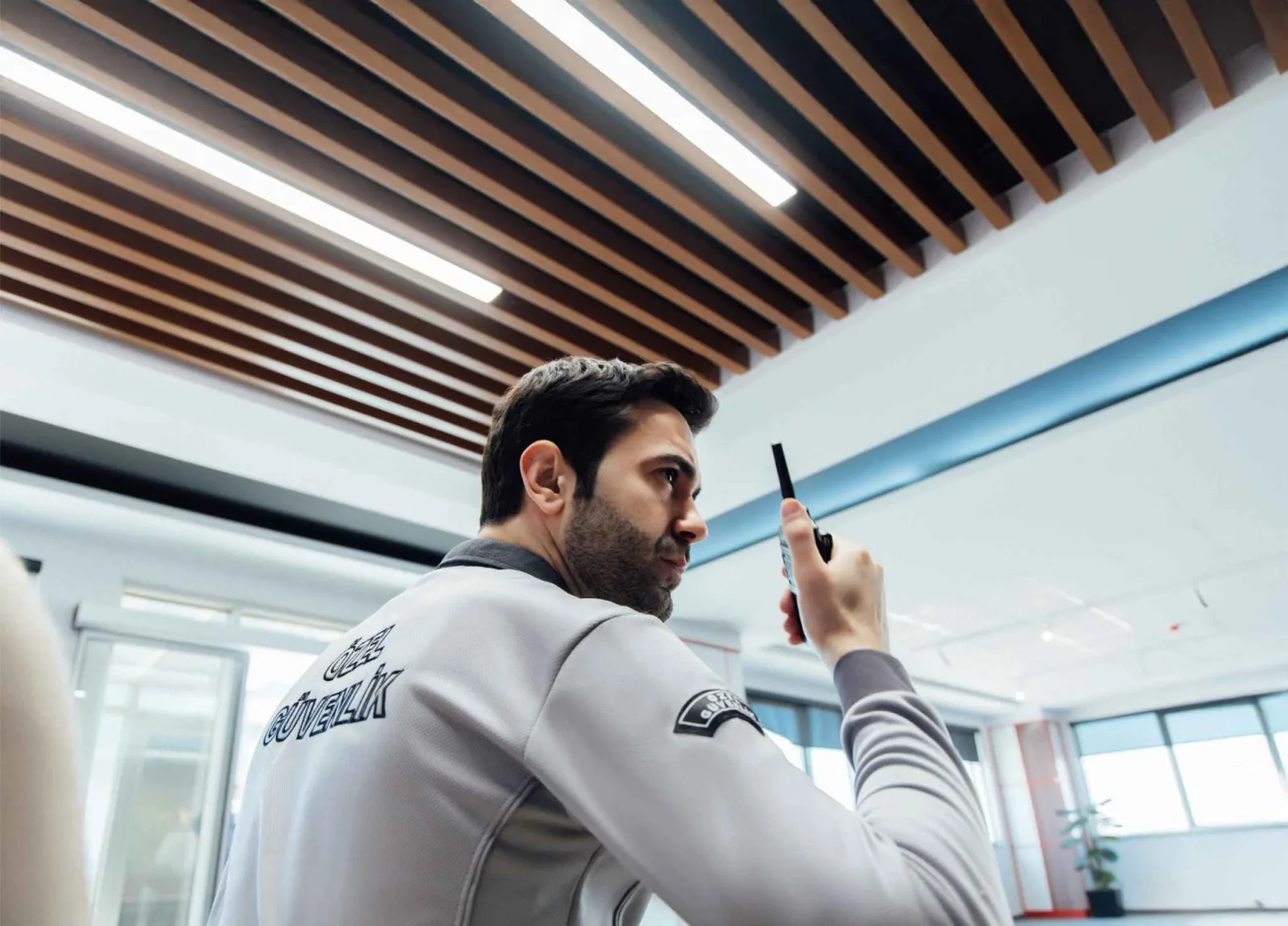
For a single site with basements, plant rooms and car parks, licensed two-way radio is usually the more dependable backbone because it does not rely on a mobile operator's network. For teams spread across cities, push-to-talk over cellular (PoC) gives coverage that radio alone cannot. Many organisations end up with a hybrid: radio on site, cellular push-to-talk between sites and to management, and a written plan for when either fails.
This article compares the technology classes without naming products, then looks at indoor coverage, outages and disasters, recording and privacy, and how to decide. Licensing and frequencies are covered only as stated by Turkey's Information and Communication Technologies Authority (BTK).
This article is general information, not legal advice.
Three technology classes, briefly
Analogue two-way radio
The classic handheld: press to talk, everyone on the channel hears. It is simple, robust and quick to learn. Limitations are voice quality at the edge of coverage, few data features and limited privacy on the channel.
Digital mobile radio
Digital radio carries voice and some data in digital form. A widely used European standard is DMR, defined by ETSI. The standard's air-interface specification describes three tiers: Tier I equipment with an integral antenna working in direct mode under a general authorisation; Tier II systems under individual licences, working direct or through a repeating base station; and Tier III trunking systems under individual licences, where a controller automatically regulates communications. The specification also notes that the tiers work independently and are not interoperable. In practice, digital radio adds features such as individual calls, status messages and, on some systems, emergency signalling, while keeping the core strength of radio: handheld-to-handheld talk without a mobile network.
Push-to-talk over cellular
PoC uses smartphones or rugged handsets over the mobile operator's data network. Groups can span cities or countries, and many applications add location, messaging and photo sharing. The trade-off is dependence on operator coverage and data capacity. There is also a standardised, more demanding variant: 3GPP, the body behind mobile network standards, completed Mission Critical Push to Talk (MCPTT) in Release 13 in March 2016, with group and private calls, emergency calls and off-network operation. Do not assume every commercial push-to-talk app offers these features; ask the provider which standards and functions it actually implements.
Coverage, especially indoors
Most communication failures on security sites happen in predictable places: underground car parks, stairwells, plant rooms, thick-walled archives and large steel structures. Before choosing, do a walk test at every post and patrol point, with the actual handsets, at busy and quiet times.
- Radio direct mode works without any infrastructure, but range shrinks quickly through concrete and floors. Repeaters improve coverage but are infrastructure: they need power, maintenance and, for licensed systems, BTK permission for each added device or frequency and for any change outside the allocated values.
- Cellular push-to-talk works wherever the phone has data coverage. Basements and plant rooms are often where it is weakest. Indoor coverage solutions belong to the building and operator, not to the security team.
Record the walk-test results in the post orders: "From the car park level, call the control room by radio; if no answer, go to the ramp exit and call again."
Network outage and disaster scenarios
Turkey's disaster authority AFAD states on its emergency app page that one of the biggest problems in disasters, earthquakes above all, is the interruption of communication, and that its app aims to reduce congestion on GSM lines by placing emergency calls over the internet. For a security team, the lesson is that any system that depends on a single network can fail at the moment you need it most.
- Local power cut: handheld radios keep working on charged batteries; repeaters and some network equipment need backup power.
- Operator network congestion or damage: cellular push-to-talk may slow down or stop; radio direct mode on site is unaffected.
- Large disaster: both can be degraded. Teams need pre-agreed actions for when nobody can be reached, plus physical meeting points.
We cover backup communication planning in more depth in a separate article on outages; the point here is to test the chosen technology against these scenarios before buying.
Recording and privacy
Many digital radio and PoC systems can record calls and log who spoke, when and, with PoC, from where. Recording is valuable after an incident, but voice recordings and location logs relate to identifiable people, so they are personal data under Turkey's Law No. 6698. Decide in advance and write down: which talk groups are recorded, why, who can listen back, how long recordings are kept and how they are deleted. Keep location features switched to what the security purpose needs, not continuous tracking of individuals.
Licensing: follow BTK, not hearsay
BTK's guidance on installing and using radio systems states that anyone who wants to install and operate a radio device or system must have frequency allocation and registration carried out by the Authority, and that users who need allocation must also obtain an installation and use permit and a radio licence. Devices that can be used without any permit or licence are listed separately by BTK. Each additional device or frequency needs its own permission, and changes outside the allocated values need prior approval. Interference with other communications is a matter for BTK and the competent authorities; a security team should never try to block or disrupt signals itself.
A hybrid set-up and a decision table
| Need | Radio (analogue or digital) | Cellular push-to-talk |
|---|---|---|
| One site, basements and plant rooms | Strong, after a walk test | Depends on indoor data coverage |
| Teams in several cities | Not practical alone | Strong |
| Works without the operator network | Yes, in direct mode | No, unless off-network features exist and are configured |
| Location and photo sharing | Limited, system-dependent | Common |
| Licensing | BTK allocation and licence unless exempt | Uses the operator's licensed network |
| Power cut on site | Handhelds work; repeaters need backup power | Depends on operator sites and phone battery |
A typical hybrid design: radio for officers and the control room on each site; cellular push-to-talk for supervisors, mobile patrols and the regional coordinator; a dedicated phone line as a third path; and a physical rally point when everything is silent.
People make the system work
The handset carries the voice; trained people make the call useful. The security operations centre or site control room owns the channel plan, acknowledges every call, logs incidents and escalates. Post orders should state who answers emergency calls, how an officer confirms they are safe, what the officer does when there is no reply and how often handsets are tested. Train for short, clear messages and test the system weekly, not just at commissioning.
Checklist before you buy
- Walk test at every post and patrol point with the actual handsets.
- Outage scenarios tested: power cut, operator congestion, repeater failure.
- BTK licensing status confirmed for any radio equipment.
- Recording, retention and access rules written.
- Battery charging, spares and handover between shifts defined.
- Channel or talk-group plan agreed with the control room.
If you are writing a tender, add these items to the scope with the security RFP builder.
How a professional security partner helps
Titan Savunma is an Ankara-based private security company operating under a Ministry of Interior licence under Law 5188, certified to ISO 9001, 14001, 45001, 22301 and 28000. We work with international companies in English and Turkish and plan sites in different provinces with a single point of contact, written scope and regular reporting. We plan guarding together with your technology, including one communication plan across all your sites. See private security in Turkey.


