
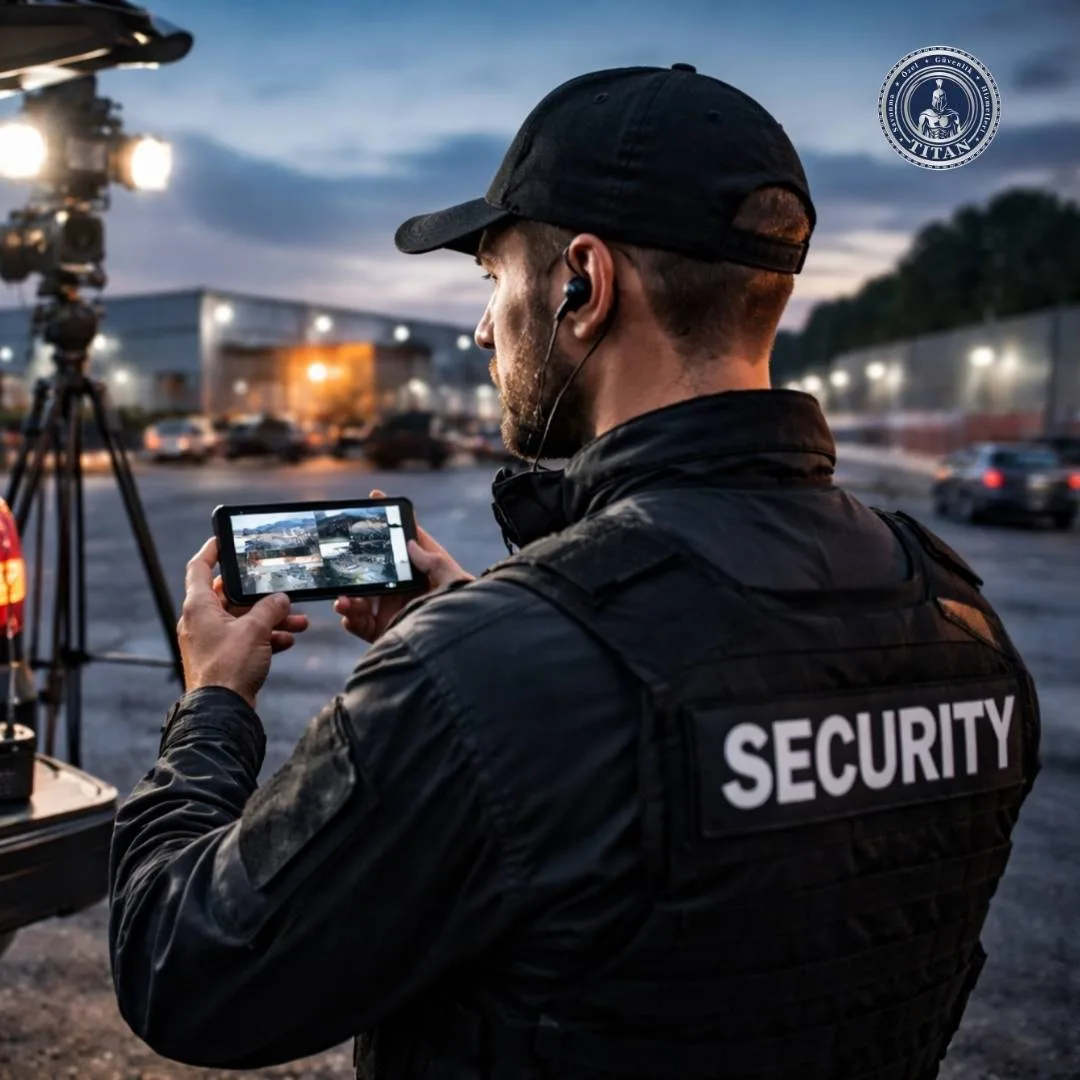
Remote video monitoring lets trained operators in a central room watch a site's cameras, verify alarms and call the right people, often across many sites at once. What it cannot do is open a gate for a delivery, check a visitor's identity, secure a scene or deal with a person in front of the camera. Whether it is enough for your site depends on four things: how far and how long a physical response takes, how much face-to-face work the site needs, which legal powers must be used on the ground, and what happens when the connection or power fails. For many sites, the sensible answer may be a combination: remote monitoring at some hours, officers on site at others.
This article is for facility managers of international companies in Turkey and owners of remote sites such as solar plants, warehouses and construction sites. It does not repeat the case for AI-assisted monitoring or hybrid models in general; it offers decision criteria. This article is general information, not legal advice.
What remote monitoring does well
A remote monitoring centre combines detection technology with human judgement. Cameras and detectors raise an event; an operator looks at the images, decides whether the event is real, and follows the written instructions: call the site manager or keyholder, notify the police, direct a response team. In between alarms, operators can carry out scheduled video checks of the site and keep a full record of what they saw and did.
Research supports the role of the human in this loop. A 40-year systematic review with meta-analysis by Piza, Welsh, Farrington and Thomas (2019) found, as its abstract states, that CCTV schemes incorporating active monitoring generated larger effect sizes than passive systems, and that schemes deploying multiple interventions alongside CCTV did better than those deploying a single other intervention or none. The findings concern CCTV schemes in general rather than any one private site, but the lesson carries over: cameras that someone actively watches, linked to a response, achieve more than cameras that only record.
Standards also treat this as serious work. CENELEC's EN 50518 for monitoring and alarm receiving centres places video surveillance used in security applications that require an emergency response in Category I, the category held to a higher level of construction, security and integrity. When choosing a remote monitoring provider, ask which standard its centre is built and run to.
What remote monitoring cannot do
A camera cannot shake hands, sign a delivery note or stand at a door. Several everyday tasks need a person on site:
- Acceptance and control: receiving visitors, contractors and deliveries, checking documents and escorting where needed.
- Checks and rounds: locking up, checking doors, gates, fences and plant rooms, reporting faults the cameras do not see.
- First response: guiding people in a fire or evacuation, meeting emergency services at the gate, protecting the scene after an incident.
There is also a legal dimension. Article 7 of Turkey's Law No. 5188 on Private Security Services lists the powers of private security officers, such as passing people through detector gates, screening belongings, protecting the scene and evidence, and apprehension in the cases the law defines. Article 9 states that these powers may be used only during duty hours and within the assigned duty area, and that incidents requiring force or apprehension must be reported to the competent police or gendarmerie by the fastest means. A remote operator watching from another city is not on the site and cannot exercise those powers there.
The United Kingdom shows the same reality from the police side. The National Police Chiefs' Council security systems policy notes that police officers will not normally enter premises without the keyholder, and that responding officers may not always be able to wait for the keyholder if there is no obvious sign of an offence. Remote monitoring still needs someone who can physically attend.
Response chain and distance
Every remote model rests on a response chain: detection, verification, decision, dispatch, travel and access to the site. On an urban office site, the chain may be short. On a solar plant or a warehouse outside town, travel usually dominates. Before choosing, answer these questions in writing:
- Who attends after a verified alarm, from where, and how is their arrival recorded?
- Who holds keys and access cards, and can they open the gate at night?
- What does the operator do while waiting: keep watching, update the police, talk to the attending team?
- How is each link of the chain measured and reported each month?
Avoid contracts that promise a single response time without saying how it is measured. A chain is only as fast as its slowest link, and that link is usually travel.
Connection and power failure
A remote model depends on network and power. When the link drops, the centre is blind exactly when it may matter most. Plan for this scenario explicitly:
- Is loss of the video or alarm link itself treated as an event, with a defined action such as calling the keyholder or sending someone?
- Are there independent communication paths, and is the backup tested?
- Do cameras, recorders and network equipment have standby power, and for how long has that been tested?
- Does local recording continue during an outage, so evidence is not lost?
On a staffed site, a power cut is an inconvenience the officer reports and manages. On an unstaffed site, it can mean several hours without eyes or ears unless the plan says otherwise.
Decision matrix
| Criterion | Remote monitoring can be enough when | On-site presence is needed when |
|---|---|---|
| Response distance | A responder or keyholder can reach the site quickly at all hours | The site is remote and the travel time leaves the site exposed |
| Site interaction | No visitors or deliveries outside business hours | Regular visitors, deliveries, contractors or shift changes |
| Legal powers | Watching, verifying and reporting are sufficient | Law 5188 powers such as detector screening or scene protection are part of the job |
| Connectivity and power | Robust, supervised paths with tested backup | Unreliable network or power, or no plan for outages |
| Risk and consequence | Low-value assets, limited consequences of delay | People at risk, high-value or hazardous assets |
Most real answers fall in between. One possible outcome is remote monitoring at night and weekends, with officers present during working hours, deliveries and shift changes. Our security coverage planner helps map those hours. For the role of a control room, see our encyclopedia entry on the security operations centre.
People make the model work
Whichever model you choose, the core division of labour is the same: technology detects and records; trained people monitor, verify, decide and respond. Write it down: what the remote operator does, what the on-site officer does, when one hands over to the other, and how incidents are reported. Remote viewing of camera images also raises privacy questions; our CCTV privacy self-check helps you list them before you change your set-up.
How a professional security partner helps
Titan Savunma is an Ankara-based private security company operating under a Ministry of Interior licence issued under Law 5188, certified to ISO 9001, 14001, 45001, 22301 and 28000, and working with international companies in English and Turkish. We plan sites in different provinces with a single point of contact, a written scope and regular reporting. We plan guarding together with your technology, deciding with you which hours and tasks need officers on site as part of your monitoring, verification and response plan. Read more about our manned guarding service.
Sources and Further Reading
- Piza, Welsh, Farrington & Thomas — CCTV surveillance for crime prevention: a 40-year systematic review with meta-analysis, Criminology & Public Policy (2019)
- Office of Justice Programs (NCJRS) — abstract of Piza et al., CCTV Surveillance for Crime Prevention (2019)
- CENELEC — EN 50518:2019 Monitoring and Alarm Receiving Centre (catalogue abstract, NSAI) (2019)
- Mevzuat Bilgi Sistemi — 5188 sayılı Özel Güvenlik Hizmetlerine Dair Kanun (2004)
- National Police Chiefs' Council — Security Systems Requirements and Policy (2026)


