
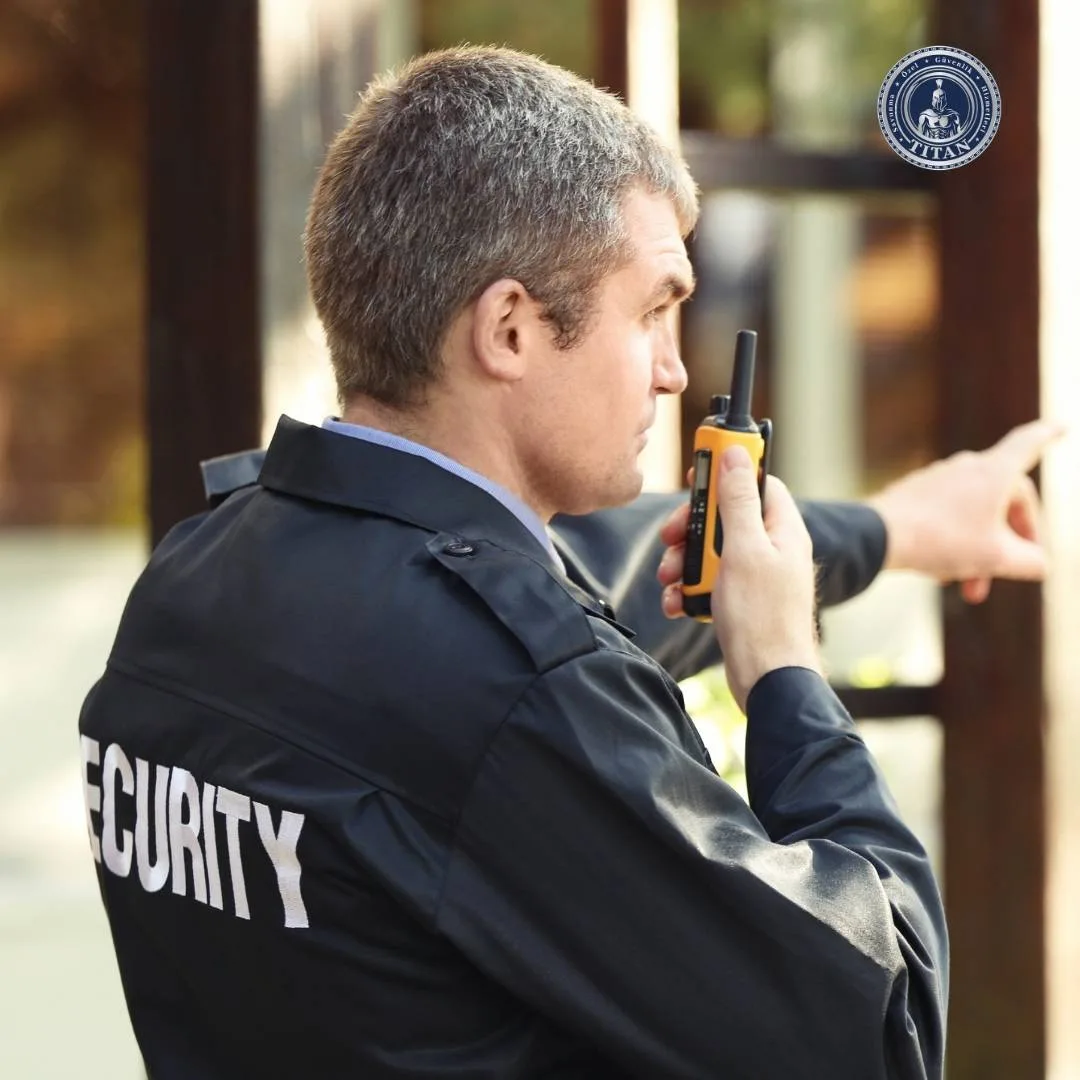
A security gatehouse belongs where the officer can see approaching vehicles and pedestrians, the barrier and the gate without obstruction, where queues do not spill onto the public road, and where the officer can step out safely when needed. Inside it sit the entrance camera screens, barrier controls, radio, phone and a panic button; heating, cooling, lighting and access to a toilet for a long shift are part of the design too. A gatehouse is not just a building but a duty post: the technology inside records and controls, while the trained officer decides and responds.
This article is general information, not legal advice. It covers placement, the technology package and working conditions together, for factories, residential sites, construction sites, logistics facilities and architects. For a definition, see our guard booth entry.
Placement: sight lines first
On many drawings the gatehouse is simply marked "next to the gate", and everything else is left to chance. Yet placement decides whether the officer can do the job. The UK National Protective Security Authority's perimeters and checkpoints guidance describes entry and exit points as the optimal location for controlling access by authorised people at a secure perimeter, while reminding readers that these points are exposed to reconnaissance, physical attack, smuggling and insider help. A good position answers both facts. Ask:
- Can the officer see approaching traffic? Vehicle, plate and driver should be visible before the vehicle reaches the barrier.
- Can they see the barrier and the pedestrian entrance at the same time? Where vehicle and pedestrian entrances are separate, both must be visible directly or by camera.
- Can they see inwards too? Departing vehicles and the internal approach road are also the officer's responsibility.
- Where does the queue form? Vehicles waiting for checks should not back up onto the public road, and a vehicle that is refused entry needs somewhere outside the site to turn safely.
- Is emergency access preserved? NPSA lists emergency egress and access requirements among the points to consider; fire engines and ambulances must not be slowed by the gatehouse and barrier layout.
- Is the officer protected from traffic? The gatehouse should not sit where manoeuvring vehicles can strike it; protect it with a barrier or bollards if needed.
NPSA also mentions measures such as blast- or bullet-resistant guard houses to protect the guard force. Whether such protection is needed should follow a risk assessment; it is not needed at every site entrance.
The technology package inside
The gatehouse is where site technology meets the officer. A typical package includes:
- Screens: entrance cameras, plate images and selected views from perimeter cameras if needed. Showing the officer the views relevant to their own post is usually more realistic than putting the whole site on the wall; wide-area monitoring is the control room's job.
- Barrier and gate control: remote opening, a manual fallback and a written procedure for what happens during a power cut.
- Communications: radio and charging station, landline, a resilient route to the control room and shift supervisor, and intercoms at vehicle and pedestrian entrances.
- Panic button: so the officer can quietly alert the control room under threat; where it reports to and what happens next must be written down.
- Visitor and vehicle log: electronic or paper, with a procedure that matches access control permissions.
- Support equipment: uninterruptible power, torch, first-aid kit, fire extinguisher and an occurrence book.
Each of these records or controls something, but the officer decides whether an alarm is real, whether a vehicle comes in and how to calm an argument. That is why the post orders explaining what to do with each device belong in the gatehouse next to it. Our duty post entry explains the relationship.
Officer safety and comfort: the occupational health angle
A gatehouse is also a workplace. Under Article 4 of Turkey's Occupational Health and Safety Law No. 6331, the employer must ensure employees' work-related health and safety, including taking all measures to prevent occupational risks, providing training and information, supplying the necessary tools and equipment, and adapting measures to changing conditions. The same article requires the employer to carry out or commission a risk assessment, and states that obtaining services from outside experts or organisations does not remove the employer's responsibilities.
Article 5 lists among the principles of protection taking care in the design of workplaces and the choice of work equipment and methods so that work is adapted to people, and keeping up with technical progress. Article 23 requires employers who share the same working area to cooperate and coordinate on health and safety measures. A gatehouse at a site with outsourced security is exactly such an area: the contract should state clearly who provides the physical conditions and who provides the officer's training and instructions, and the two parties should apply their measures in coordination. See our Law No. 6331 entry for the wider framework.
In practice the risk assessment for a gatehouse should cover:
- Heating, cooling and ventilation suited to summer and winter.
- Interior lighting that does not glare on screens or stop the officer seeing out at night.
- Seating and standing options for long shifts, with screens at a sensible height.
- How the officer reaches a toilet and drinking water without leaving the post unattended.
- Regular check calls and a panic button for lone workers.
- Protection against vehicle impact, bad weather and electrical hazards.
Barrier and visitor flow
A gatehouse works only as well as the flow around it. If staff cars, visitors, delivery lorries and pedestrians all squeeze into one lane, the officer manages traffic instead of checking it. A good layout:
- Separates pedestrians from vehicles; the pedestrian entrance is visible from the gatehouse and, where possible, uses its own turnstile or gate.
- Sends registered vehicles (by card or plate) and vehicles needing checks to different lanes or holding points.
- Handles delivery checks and paperwork at a suitable holding point rather than at the barrier.
- Decides whether visitors are received at the gatehouse or at reception; half-registration in both places creates gaps.
ProtectUK's physical security guidance describes multi-layered measures as the best route to effective physical security, with access control integrating with physical barriers to provide delay and detection; the gatehouse is where those layers are staffed. Try placing the gatehouse, barrier and routes on our digital twin for factories.
Short checklist
- Can the officer see the approaching vehicle, the barrier and the pedestrian entrance from inside?
- Do waiting vehicles stay off the road, and can a refused vehicle turn safely?
- Is emergency vehicle access written down and tested?
- Do screens, barrier control, radio, phone and panic button work, with instructions in the gatehouse?
- Has a health and safety risk assessment been done for the gatehouse, coordinated between site owner and security provider?
- Is there a plan for barrier, screens and communications during a power cut?
Common mistakes
- Placing the gatehouse late in the design without considering sight lines.
- Putting every site camera in the gatehouse and expecting the officer to monitor and control the gate at once.
- Not planning toilets, climate control and breaks; a tired, uncomfortable officer loses focus.
- Fitting a panic button without writing down where it reports and who responds.
Working with a security partner
Titan Savunma is an Ankara-based private security company operating under a Ministry of Interior licence under Law 5188, with ISO 9001, 14001, 45001, 22301 and 28000 certificates. We work with international companies in English and Turkish and plan sites in different provinces with a single point of contact, written scope and regular reporting. A gatehouse is a duty post; plan it together with its screens, radio and instructions. We plan manned guarding together with your technology. Learn more about our residential site security.


