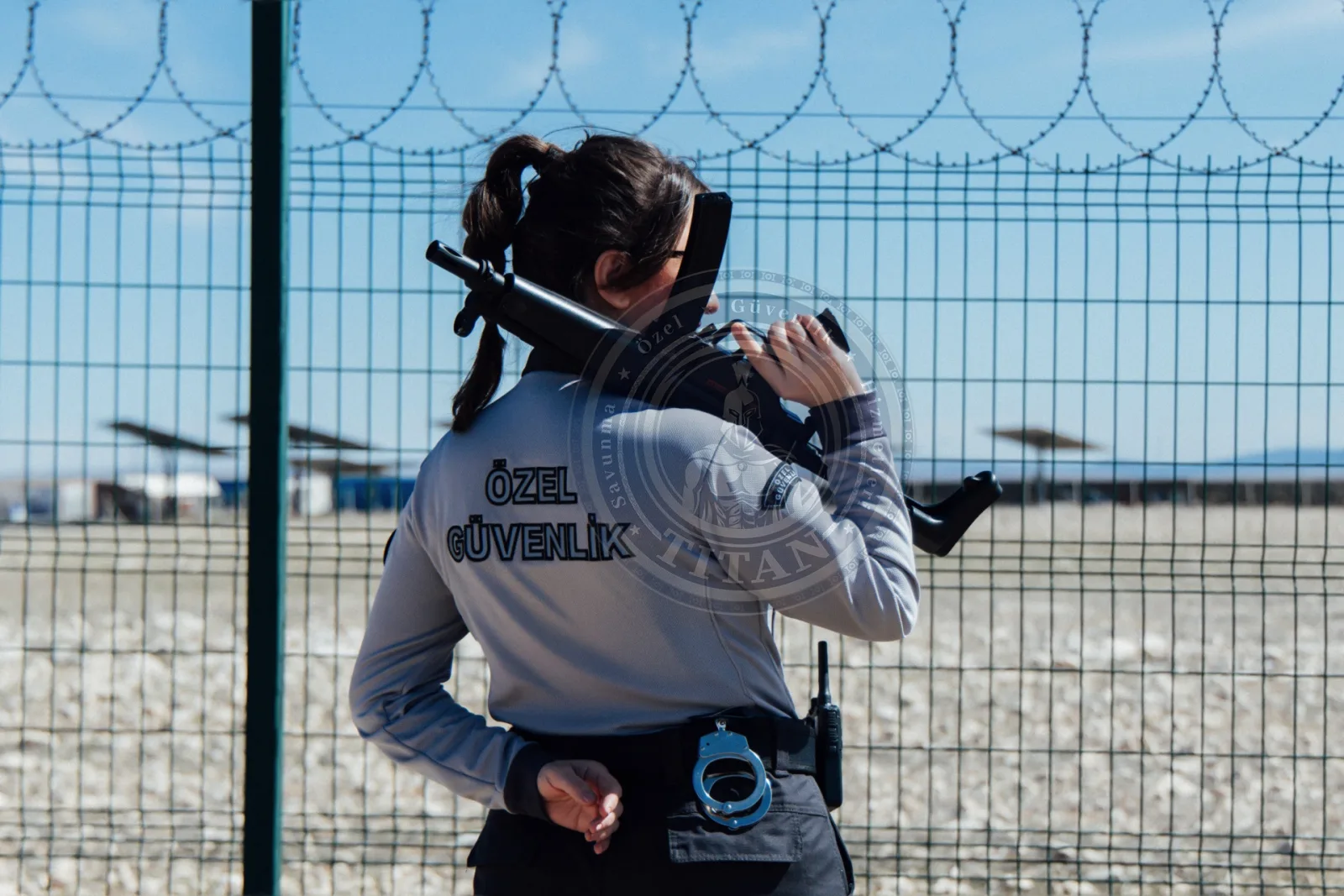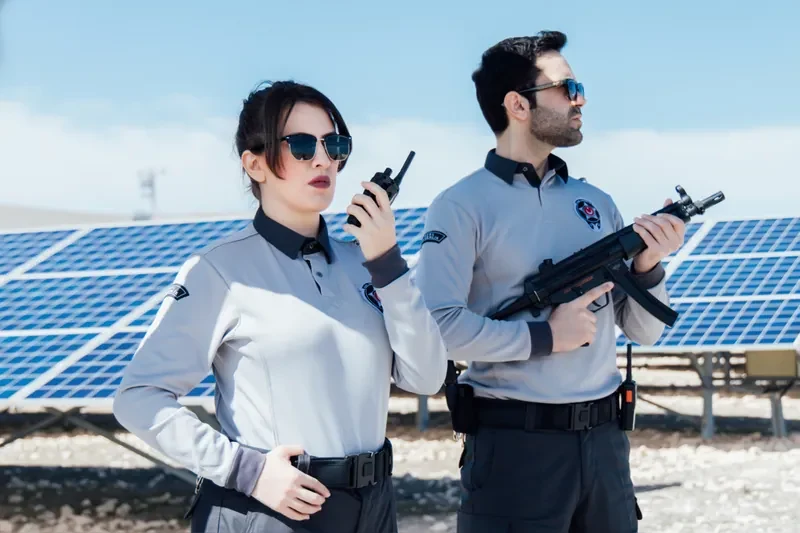
At a remote solar plant at night, security officers are often the only people on site. That makes it easy for requests from the operator to drift outside their job: “Could you restart that inverter?”, “Check inside the transformer room”, “Wash the panels”. An officer’s value on site lies in observation, reporting, access arrangements and coordination during an emergency. Electrical intervention is not on that list.
The legal frame: no work outside protection and security
Article 16 of Turkey’s Law No. 5188 says private security personnel may not be employed in any work other than the protection and security services set out in the Law. Article 20 provides an administrative fine for those who use an officer for other work. Article 5 requires a security company’s field of activity to be exclusively protection and security services.
Where these provisions draw the line is assessed case by case. The practical approach is still simple: before adding panel washing, grass cutting, meter reading or inverter resets to a security contract, ask your legal adviser. Those tasks should be handled separately within the plant’s operations and maintenance arrangements.
Where do an officer’s powers come from?
The powers are listed in Article 7 of the Law. Those most relevant at a solar plant include:
- Passing people who wish to enter the protected area through a detector gate, searching them with a detector and passing their belongings through security systems.
- Apprehension under the conditions in the Law, and protecting the scene and evidence under the Criminal Procedure Code.
- Taking abandoned and found property into safekeeping.
- Entering workplaces in the area of duty during fires, earthquakes and similar events, or when help is requested.
Under Article 9, these powers apply only while on duty and within the area of duty. Incidents requiring apprehension or force are reported to the general law enforcement agencies by the fastest available means, and anyone apprehended and any items seized are handed over to them. Under Article 12, an officer without an identity card cannot use these powers. Nothing on this list authorises electrical work. The boundary of the area of duty matters too, so settle in advance what officers may do on a road or neighbouring land outside the fence.
The limit on electrical intervention
Article 59 of Turkey’s Regulation on Heavy Current Electrical Installations says people outside the profession may not enter such installations or touch them without special equipment. Where entry would be dangerous for visitors, it requires supervision by someone the operator has specifically appointed and who knows the installation. Article 60 deals with the responsible electrical engineer at high-voltage installations and requires a certificate or an engineer’s supervision for work under high voltage. Article 61 sets out maintenance steps such as cutting the supply and preventing it from being restored.
Your electrical lead should state in writing which parts of the plant fall within this scope and who is authorised. A security officer can observe from outside whether a transformer room, medium-voltage cubicles and panels look locked and intact. Any need to go inside is a matter for separate instructions.
The particular point about solar: voltage continues in daylight
Something being switched off on the grid or inverter side does not mean the site is dead. The IEA PVPS report on firefighter operations describes photovoltaic systems as energised electrical equipment that cannot power down when illuminated. The BRE report says parts of a system are always live while modules are exposed to daylight, and that there is a risk of electric shock when cables are cut or damaged by fire. These sources were written for fire services, but the warning also applies to the officer who reaches the scene first.
A German firefighter guideline quoted in the IEA report advises staying at least 1 metre from components that may be live, and leaving defective switches and the isolation of modules to electricians. That distance was given for firefighters; your electrical lead should set the distance in security instructions.
Do and do not: an example table
| Situation | The officer does | The officer does not |
|---|---|---|
| Inverter or transformer alarm | Logs it, informs the control centre and electrical lead, reports what can be seen from outside | Reset it, or operate fuses or breakers |
| Cut cable | Stays clear, clears the area, sends photo and location as instructed | Touch it, gather it or tape the ends |
| Suspected smoke | Calls the fire service and operator, clears the area, meets crews at the gate | Open a panel or use water on it |
| Maintenance crew arrival | Checks identity, approval and list, and logs entry | Decide whether a permit to work is technically adequate |
| Suspicious person or vehicle | Observes, logs, reports to general law enforcement | Set off on an unprepared pursuit |
This is an example to adapt to the site, not a statutory list.
What does observation and reporting cover?
A good patrol report says what was seen, where and when. “Fault” is less useful than “Door of inverter station 3 open, lock missing, 02.40”. The observation list should be prepared with the technical team:
- Damage to fences, gates, cable duct covers and panel locks.
- Unusual smell, smoke, sparks or noise, reported without guessing the cause.
- Unregistered vehicles, people or contractors on site.
- Loss of cameras, lighting or communications.
- Environmental observations such as dry vegetation that could feed a fire.
Article 20 of the Law provides a sanction for officers and managers who learn of a crime through their duties and do not inform the competent general law enforcement agency. So do not write a practice of waiting for the operator’s approval into instructions without taking legal advice.
The support role in an emergency
Article 11 of Turkey’s Law No. 6331 makes the employer responsible for identifying emergencies, planning for them, appointing people and running exercises. Article 16 requires information to be given to the employers of workers who come from other workplaces. If security comes from a contractor, site risks and the emergency plan must reach the officers.
Article 15 of the Implementing Regulation says officers must assist search and rescue personnel during fires, earthquakes, floods and similar events. Support on site should be seen in that light: making the emergency call, opening gates, directing crews to the right point, passing on the list of people on site and clearing the area.
Article 12 of Law No. 6331 requires that workers facing serious and imminent danger who cannot reach a supervisor be able to act within their knowledge and available technical equipment. Article 13 covers leaving a danger area for a safe place when serious and imminent danger cannot be prevented. For an officer without electrical training, “knowledge and equipment” does not extend to intervening in a panel. Nobody should expect the officer to take that risk.
What should the job description say?
- The officer does not operate, reset, open or repair electrical equipment.
- The electrical lead sets the conditions for entry to electrical installations and the list of authorised people.
- The person to contact on any suspicion of live equipment, and their deputy, are in writing with current numbers.
- Requests for non-security work are not given to officers but passed to the security supervisor.
- Site-specific induction takes place before duty starts and is recorded.
Use an exercise to check that the contract and duty cards match reality. If the limit keeps being pushed in practice, that points to the operating model before it points to personnel: who handles a night-time fault, and how soon can they reach it?
For more, see our pages on solar power plant security, energy generation and distribution security and critical infrastructure security. References to electrical regulations rely on a text published on a secondary website. They offer direction rather than interpretation, so confirm them with your electrical lead and legal adviser.
Sources and Further Reading
- 5188 sayılı Özel Güvenlik Hizmetlerine Dair Kanun (Mevzuat Bilgi Sistemi)
- Elektrik Kuvvetli Akım Tesisleri Yönetmeliği (isguvenligi.net metni)
- IEA PVPS Task 12: Photovoltaics and Firefighters’ Operations (2017)
- BRE National Solar Centre: Fire and Solar PV Systems, Recommendations for the Fire and Rescue Services (2017)
- 6331 sayılı İş Sağlığı ve Güvenliği Kanunu (Mevzuat Bilgi Sistemi)
- Özel Güvenlik Hizmetlerine Dair Kanunun Uygulanmasına İlişkin Yönetmelik (Sakarya Üniversitesi metni)