
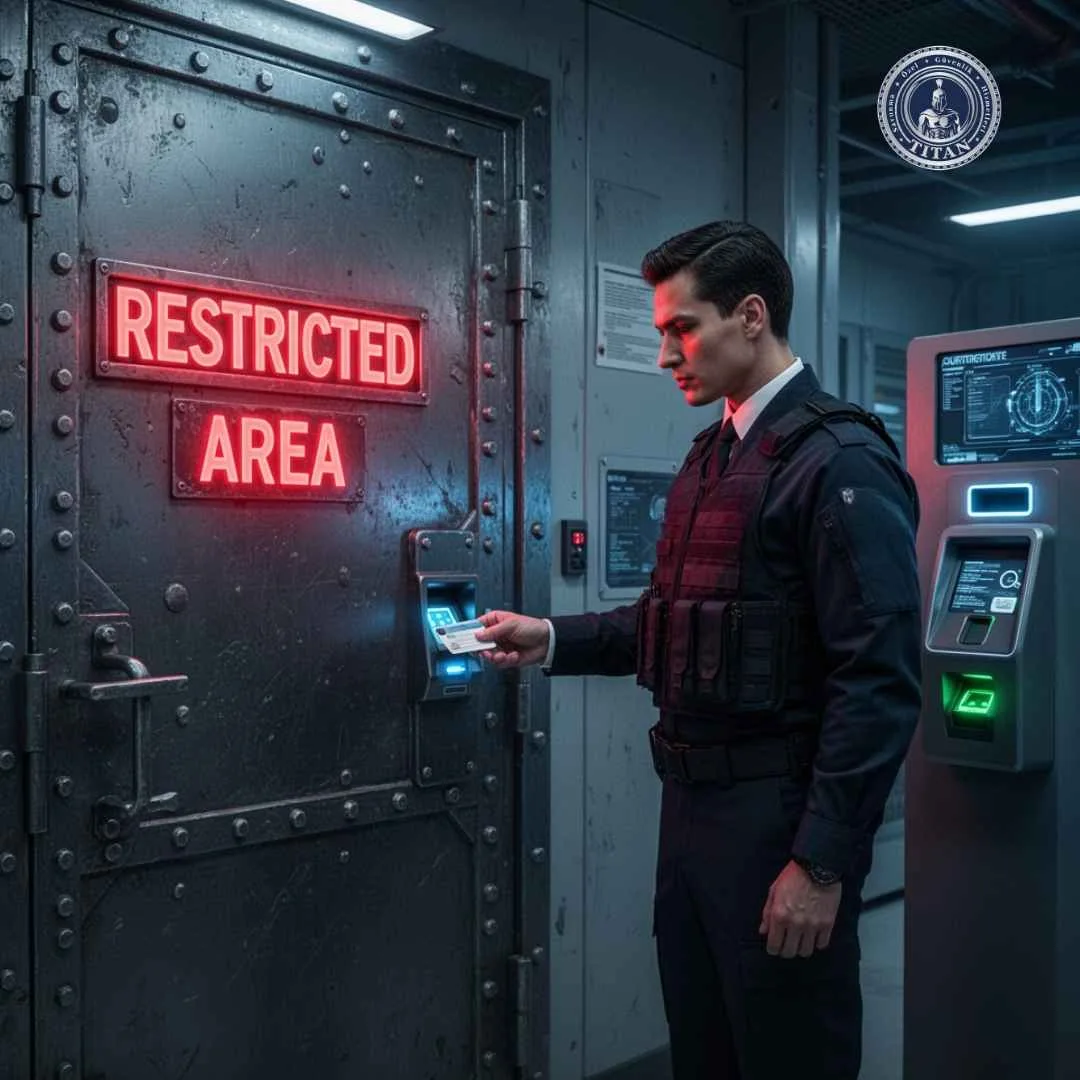
Tailgating is when someone without a valid badge follows an authorised person through a controlled door; badge sharing is when a personal access card is handed to someone else. Both break the basic assumption of an access control system: one badge equals one person, and every passage is made with a badge. No single device fixes this. Good door design, software rules such as anti-passback, a trained officer who watches the alarms and a culture in which managers follow the same rule all have to work together.
This article is for offices, business centres and server rooms that already have card access. It focuses on daily practice: why the problem appears, what each technical measure does and does not solve, what the officer at the door actually says, and how to measure progress.
Why tailgating and badge sharing are so common
Most of the time there is no bad intent. Holding the door for the person behind you is ordinary politeness, and letting it close in someone's face feels rude. A courier carrying boxes, a colleague who left their badge at home and a visitor running late all benefit from that reflex. Badge sharing usually starts as a favour too: lending your card to a colleague, a shared "storeroom card" that everybody uses, or an intern using someone else's badge until their own arrives.
The result is that the system no longer knows who is inside. Logs show the wrong person, the headcount does not add up during an evacuation, and investigating an incident from the records becomes hard. Someone with bad intent can exploit the same polite reflex, which is why the topic belongs alongside social engineering awareness. For the basic definition, see our encyclopedia entry on tailgating; this article is about practice.
What official guidance says
The UK National Protective Security Authority's user guide on automatic access control systems defines anti-tailgating as a function that prevents two people passing through a portal on one credential. Anti-passback stops a single token being used to enter again before its holder has been registered as leaving. According to the guide, a fully secure system combines the two. The same guide notes that automatic systems should not be treated as a total replacement for security personnel where their use is appropriate.
The ProtectUK access control page, run by UK counter-terrorism policing, says an effective system includes staff training and should highlight how to overcome bad practice such as tailgating and holding doors open. It also says staff should feel empowered, and safe, to challenge anyone entering an area without the correct pass.
NIST's SP 800-53 control catalogue, under physical access control (PE-3), explicitly names unauthorised following of an authorised person as "piggybacking or tailgating" when it describes access control vestibules. In other words, auditors expect to see this risk addressed.
Technical measures: what each one actually solves
Measures complement each other; none replaces the rest. The table below summarises the questions to ask:
| Measure | What it does | What it does not solve alone | Who follows it up |
|---|---|---|---|
| Anti-passback | Refuses re-entry for a card with no exit record; makes card sharing visible. | Someone holding the door for a second person. | Control room operator, refused-entry reports |
| Door-held-open alarm | Alerts when a door stays open longer than set. | A double passage while the door closes normally. | Operator and patrol officer |
| Turnstile or speed gate | Designs passage around one person and orders the flow. | A badge handed to someone else. | Lobby officer |
| Interlocked vestibule | Creates a verification space between two doors. | It is not practical at every entrance and slows flow. | Officer or remote operator |
| Camera verification | Helps confirm what happened at the alarm moment. | Footage nobody watches prevents nothing. | Monitoring centre |
Choosing turnstiles and deciding where interlocked vestibules make sense are covered in separate articles. The core idea here: every technical measure detects or records an event; post orders decide who responds, how fast and how. The NPSA guide likewise recommends that security officers respond to system alerts using standard operating procedures, and that audit logs are reviewed and actioned by a supervisor.
The officer at the door: polite but clear
Tailgating happens in seconds, and most people do not feel they are breaking a rule. The officer's tone should therefore be helpful, not accusatory. Example lines you can put into post orders:
- "Good morning, could you tap your badge please? The system records everyone separately."
- "Forgot your badge? No problem, we can issue you a day pass right now."
- "Are you visiting? Let me take you to reception so your host can collect you there."
- "Thanks for holding the door. Everyone needs to use their own badge here, so could your colleague tap in too?"
The officer needs real alternatives to offer: a fast temporary badge, visitor registration, a phone call to the host. Without alternatives, people get creative. Post orders should also say when to call a supervisor, how to stay calm with someone who insists or gets annoyed, and where the event is logged. The officer's job is to manage the situation verbally, record it and escalate when needed, not to block anyone physically.
Awareness and leading by example
The NPSA guide recommends that user training covers at least: use and security of tokens, PIN policy, wearing badges, what to do when a token is lost, procedures for system failure, rules for visitors and emergency evacuation. Add two plain sentences of your own: "Never lend your badge" and "You do not have to hold the door for someone you do not know; sending them to reception is not rude."
The strongest message comes from leadership. When the managing director taps in at the turnstile and waits, the rule becomes legitimate for everyone. The reverse is also true: a senior manager who skips the reader because "everyone knows me" quietly removes the officer's authority to remind anyone else. Writing down at board level that the rule has no exceptions helps.
Measuring progress: alarm logs and authorised tests
You cannot improve what you do not measure. Access control systems already keep event logs; the point is to read them regularly:
- Alarms per door: Which door produces frequent "held open" alarms? It may be a layout problem, such as a delivery door or a route to the smoking area.
- Refused anti-passback events: Whose cards are refused often? This usually signals badge sharing or a faulty reader.
- Officer incident notes: Number of polite reminders and repeat cases, used for targeted training rather than punishment.
- Authorised tests: Unannounced awareness tests carried out with written management approval and agreed rules are one way to observe how officers and staff react. Use the results to update training and post orders, not to blame individuals.
To see where you stand, try our free security risk assessment tool and walk through your entrances one by one.
Short checklist
- Are anti-passback and door-held-open alarms switched on, and does each alarm reach a screen and a person?
- Is there a fast, logged temporary badge process for people who forget theirs?
- Have shared, anonymous "storeroom" or "cleaning" cards been withdrawn?
- Do post orders contain polite intervention lines and a clear escalation threshold?
- Does staff training explicitly cover badge sharing and holding doors?
- Does a named person read alarm and incident logs at least monthly?
Common mistakes
"We installed turnstiles, so it's solved." Turnstiles order the flow but do not stop a badge being handed over. "We switched the alarms off because they kept going off." Frequent alarms tell you the door layout or the process needs fixing; silencing them just hides the problem. "The officer knows everybody." Recognition does not replace a record; in an emergency the list of people inside still comes from the log.
Titan Savunma is an Ankara-based private security company holding a Ministry of Interior operating licence under Law 5188, with ISO 9001, 14001, 45001, 22301 and 28000 certificates, and works with international companies in English and Turkish. Your access control system detects and records; we plan guarding together with your technology and turn "who watches the alarms and what is said at the door" into written post orders. See our office and business centre security page for details.


