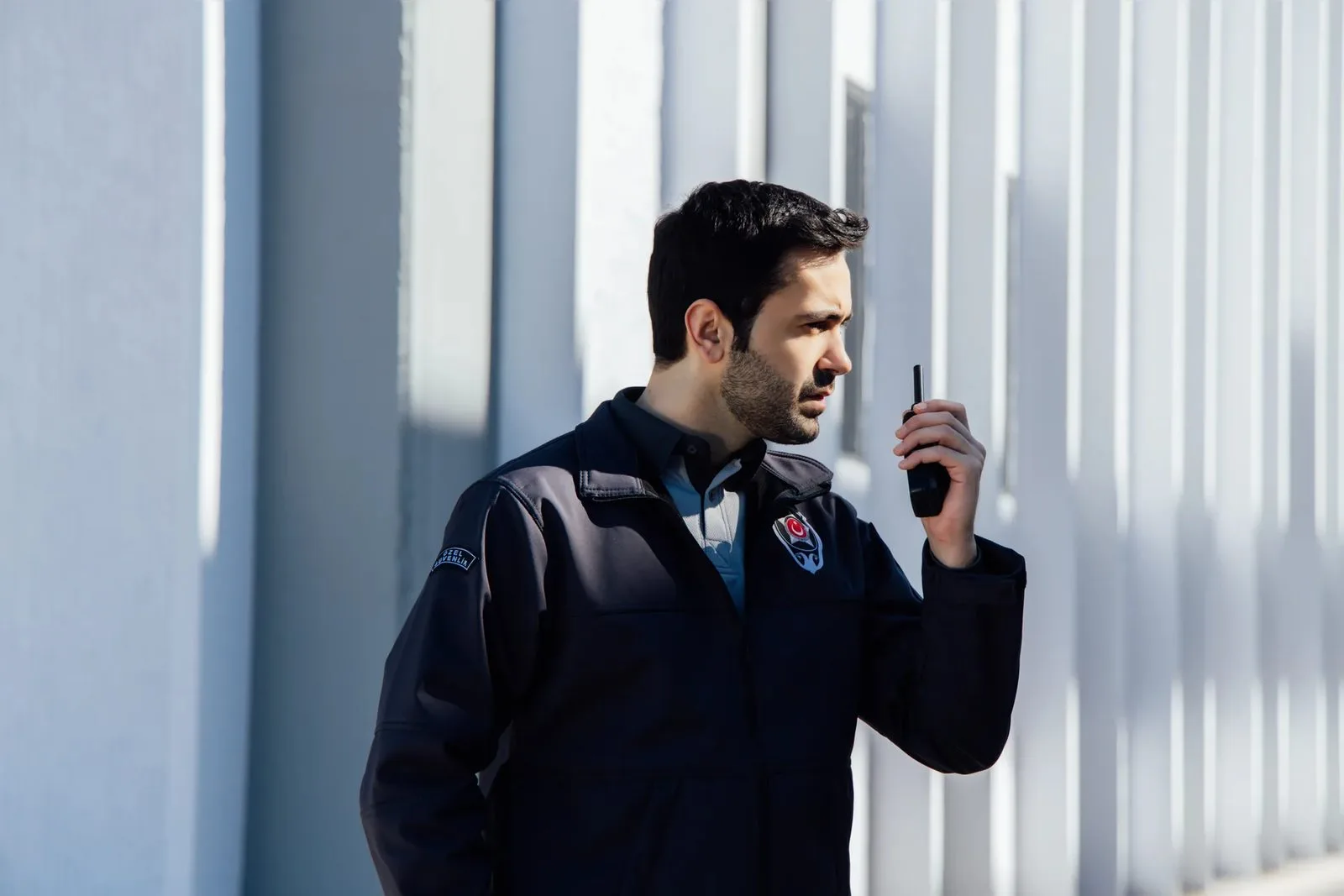
Short answer: Keeping a bale yard safe at a textile recycling plant in Uşak rests on three routines that work as one: a night patrol that walks the site with fire in mind once the working day is over, a hot-spot check that passes any suspicious heat, smell or smoke to the plant's own team without delay, and a truck intake routine that controls each lorry's load, driver and parking position. Fighting a fire and managing stock are the operator's responsibilities. The security officer's part is to be the person with eyes on the yard through the night: to notice early, to log what was seen and to play their assigned part in the emergency plan without gaps.
This article is general information, not legal advice.
Why the bale yard is a security question of its own in Uşak
Industry in Uşak revolves around fibre. According to the Turkish Social Security Institution's 2025 Statistical Yearbook, the province has 667 workplaces and 13,128 compulsorily insured employees in textile manufacturing. By our calculation that is roughly one in five insured employees in the province, and the sector's share of compulsorily insured employment in the province is about 9.3 times the national average. The same yearbook lists 5 workplaces in Uşak with 1,000 or more insured staff. Clothing carries little weight; the province stands out for yarn, weaving and recycled fibre.
Recycling operates at scale too. A peer-reviewed review by researchers at Uşak University describes the province as the centre of textile recycling in Turkey, and notes that the large quantities of non-recyclable dust and of fibre unsuitable in size for spinning generated in local production are a problem in their own right (Arıkan and Tüzüm Demir, Uşak University Journal of Science and Natural Sciences, 2025). Figures presented at a 2022 industry meeting in the Uşak Organised Industrial Zone put recycled textile volume at 708,000 tonnes a year, with 303 active firms and about 15,000 employees in that zone (ekonomim, 2022). These are figures reported by the zone's and the local chamber of commerce's management, not official statistics, but the picture is clear: offcuts, fibre and compressed bales of raw material sit in covered stores and open yards at many of the province's mills.
Climate also shapes the patrol calendar. Records from Turkey's State Meteorological Service give Uşak a January mean of 2.4 °C, a lowest recorded temperature of −19.9 °C and a highest of 41.7 °C (August). In winter, frost and ice slow the night round and call for proper kit; on hot, dry summer days everything around fibre stored in the open needs closer attention.
What the research says
Fire in compressed fibre can move slowly and from the inside
In a laboratory experiment by researchers in China and Hong Kong, smouldering (flameless combustion) was studied in a 36-litre cotton bale with a density of 225 kg/m³, tied with thin steel wire rope. Without wind, smouldering first spread across the surface at about 13 cm per hour and then moved inward at about 4 cm per hour. As wind speed rose, spread rate and peak temperature rose almost linearly; the peak temperature climbed from 510 °C in near-still air to 750 °C at 2.8 m/s. Strong wind occasionally triggered a transition to flaming, but the flame was not sustained (Xie et al., Fire Technology, 2020). This is a single, small-bale experiment and does not represent the mixed content of a recycling bale. Our takeaway: in compressed fibre a problem can carry on for hours without an obvious flame on the surface, and a windy night calls for different attention from a calm one.
Density, exposed fibre and outside ignition sources matter most
Researchers in the United States who evaluated the flammability of cotton bales write that bale density is the most significant factor affecting fire risk, because it governs the air space inside the bale and the air exchange that feeds smouldering (Wakelyn and Hughs, Fire and Materials, 2002). In miniature-bale tests, smouldering started in the interior was not sustained above 225 kg/m³, while at lower densities it broke out in a share of the bales. The authors note that the risk of fire loss is greater when cotton left exposed by its packaging combines with low bale density, that all bales are vulnerable to fire from external causes, and that cotton does not self-ignite unless contaminated with significant amounts of a self-heating oil. The study concerns raw cotton bales; recycled offcuts may differ in density, mix several fibres and sometimes carry oil or chemical residue. The lesson for security is that not every bale in the yard carries the same risk, and that controlling outside ignition sources is the core of the job.
Fires at waste sites mostly start with how the site is run
A peer-reviewed study of fires at waste facilities in Norway and Sweden lists the main ignition causes as self-heating, thermal runaway in batteries, friction, human activity, equipment and electrical faults, and unfavourable combined storage. The authors note that frequent fires in outdoor storage appear to be making insurers more reluctant to work with these facilities, and they propose measures covering facility design and operation, waste handling and storage, and limiting damage during and after a fire (Mikalsen et al., Fire Safety Journal, 2021). The study is not specific to textiles and describes Scandinavian sites. Our inference: some of these causes have on-site forms a night patrol can see, such as a cigarette, a forklift, an electrical panel, intrusion or a jumbled stack.
Night patrol: the questions matter as much as the route
The value of a night patrol in a bale yard depends less on how many rounds are walked than on which questions are asked on each one. Based on our field experience, we suggest the following list:
- Are the stack aisles clear? Gaps between bale rows and the route a fire engine would use may have been blocked during the day by a forklift, pallets or loose offcuts. A blocked aisle is photographed and passed to the morning shift supervisor.
- Is any ignition source left behind? A cigarette end in a no-smoking zone, a forklift or battery left charging, an electrical panel with its cover open, a vehicle idling near the stock: each is a separate log entry.
- Has the hot-work area been watched? If welding, grinding or cutting took place during the day, check that the area has been added to the patrol for the monitoring period set in the plant's hot-work permit.
- Is the perimeter intact? A cut fence, a side gate left open, rubbish piled against a wall or combustible material thrown in from outside matters for both theft and arson.
- Has the weather changed? On nights when the wind picks up and during long hot spells, rounds become more frequent; in icy winter conditions the patrol path and lighting are checked as well.
Hot-spot checks: the officer reports, the plant diagnoses
Measuring whether a bale is heating inside and, if needed, pulling it out of the stack is a decision for the plant's fire lead or operations team. The security officer does not open bales or tackle a fire alone; they describe what they see. The signs to look for fit on a short list: a burning or sooty smell, a thin wisp of smoke or vapour from the bale surface, melting or darkening of the wrapping or stretch film, and a surface that looks clearly different from the bales around it. If the plant uses a handheld thermometer or a fixed monitoring system, officers should have written guidance on how to read it and whom to call at which value.
Where incoming bales are placed is also part of the check. Because the cotton bale research shows that low-density, exposed or oil-contaminated material carries more risk, it makes sense to set such bales aside in an area chosen by the plant at intake and to have the patrol pay particular attention to that area. The operator sets the rule; the security team makes it visible and reports any deviation.
Where the security team sits in the emergency plan
Turkey's Occupational Health and Safety Law (No. 6331) makes the emergency plan the employer's responsibility. At night and at weekends the security team is often the only staff on site, so the first steps of the plan in those hours fall to them in practice. The plan should therefore spell out the officer's role: whom to alert and in what order, which gate to meet the fire brigade at, how to keep gates and roads clear, how to halt vehicles and people entering the site, and where to collect the list showing who is inside. As Uşak lies in an earthquake zone, the same plan should cover assembly points, headcounts and business continuity steps. Drills should also include the night shift; if they are run with day staff only, the night team may learn its part for the first time during a real incident.
Stock security in the open yard
Bales stored outdoors carry a loss risk alongside the fire risk. When bales are tagged or numbered and counted regularly, shrinkage gets noticed; in an untagged stack it only surfaces at the period-end count. The routine we recommend is simple: each stack block has a number, daily movements in and out are logged against it, and the night patrol records any visible change in a block's outline. Lighting that reaches between stacks, re-checking camera blind spots whenever stack height changes, and opening the yard gate after hours only with a logged authorisation all limit losses. Keeping easily carried items such as scrap metal, bale wire and spare parts in a separate locked area also discourages night-time entry.
Truck intake: fire and loss prevention starts at the gate
A lorry delivering raw material to a recycling plant brings both a load and a possible ignition source onto the site. The points a security team applies at intake can be listed as follows:
- Pre-notified vehicles: The purchasing or stores team sends the registration and supplier of expected lorries a day ahead; a vehicle not on the list waits outside and is not admitted until the responsible manager approves.
- Waiting bay away from stock: Queuing lorries wait in a designated bay, not beside the bale stacks, and engines are not left running.
- First look at the load: If smell, smoke or a sign of heat comes from under the tarpaulin, it is reported before the vehicle reaches the unloading area. Loads that look oil-stained or wet are directed to a separate area under the plant's rules.
- Drivers escorted on site: Drivers stay in the cab or a designated rest area, do not wander the yard during unloading, and smoke only in the marked area.
- Post-unloading check: Once new bales are unloaded, that area joins the patrol's first round; if intake happens at night, this check is always done within the same shift.
- Record: Vehicle, time in and out, unloading area and any note sit in a single record; being able to match it against stack numbers makes losses visible too.
Practical checklist
| Topic | Practice | Basis |
|---|---|---|
| Night patrol | Every round asks about aisles, ignition sources, hot-work areas, the perimeter and the weather. | Human activity, friction and electrical faults are among the main causes of waste-site fires. |
| Windy nights | More frequent rounds and extra checks of the open yard. | In the experiment, smouldering spread faster and hotter as wind increased. |
| Hot spots | Smell, smoke, melting and darkening; if a meter is used, a written threshold and a named contact. | Combustion in compressed fibre can move slowly from the surface inward. |
| Separate intake area | Torn, oil-stained or suspect bales wait in an area set by the plant. | Low density, exposed fibre and oil contamination raise the risk. |
| Emergencies | Night team's role in writing; fire brigade gate, headcount list, night drills. | The employer's emergency plan under Law No. 6331. |
| Stock | Numbered stack blocks, daily movement log, locked scrap area. | Unrecorded shrinkage goes unnoticed until period end. |
| Truck intake | Pre-notification, waiting bay away from stock, first look at the load, escorted drivers, post-unloading round. | Incoming loads and vehicles can bring a new ignition source onto the site. |
Common mistakes
- Designing the patrol only against theft, so officers do not know what fire signs to look for.
- Letting stack aisles close up during the day and not checking the fire brigade route at night.
- Leaving a welding or grinding area unwatched once the job is finished.
- Letting lorries wait right next to the bale stacks with engines running.
- Putting a suspect bale back among the others, with no separate area and no note.
- Drilling the emergency plan with the day shift only.
- Leaving camera angles unchanged when stack heights change.
Notes for operating in Turkey
Under Turkey's Private Security Services Law (No. 5188), when a site wants its security provided by a private security company, permission is granted by the governorship on the decision of the provincial private security commission; for a site in Uşak the application goes to the Uşak Governorship. The implementing regulation requires a protection and security plan for the site; writing bale-yard patrols, hot-spot reporting and truck intake into that plan makes it easier to align with the employer's emergency plan under Law No. 6331. Vehicle and driver records kept by gate and yard cameras contain personal data and should be processed under the Personal Data Protection Law (No. 6698), following the retention and access rules the site has set.
You can read more about our approach for sites in the province on our private security page for Uşak, and about night and shift routines at production sites on our factory security page.
Titan Savunma is an Ankara-based private security company licensed by the Ministry of Interior under Law No. 5188 and certified to ISO 9001, 14001, 45001, 22301 and 28000. We work with international companies in English and Turkish. Our Uşak City Manager, together with our Aegean Regional Directorate based in İzmir and our Istanbul General Directorate, will visit your bale yard during night and truck intake hours and build your patrol, hot-spot reporting and intake routine with you; to arrange a site survey, please use our contact page.
Sources and Further Reading
- Xie, Q., Zhang, Z., Lin, S., Qu, Y. & Huang, X. — Smoldering Fire of High-Density Cotton Bale Under Concurrent Wind, Fire Technology (2020)
- Wakelyn, P. J. & Hughs, S. E. — Evaluation of the Flammability of Cotton Bales, Fire and Materials 26:183–189 (2002)
- Mikalsen, R. F., Lönnermark, A., Glansberg, K., McNamee, M. & Storesund, K. — Fires in waste facilities: Challenges and solutions from a Scandinavian perspective, Fire Safety Journal 120:103023 (2021)
- Arıkan, H. & Tüzüm Demir, A. P. — Üretim Aşamasında Oluşan Tekstil Atıklarını Değerlendirme Yöntemleri, Uşak Üniversitesi Fen ve Doğa Bilimleri Dergisi 9(1):59–73 (2025)
- SGK — İstatistik Yıllığı 2025 (Tablo 1.11, 1.14, 1.15)
- Meteoroloji Genel Müdürlüğü — Resmi İstatistikler: Uşak
- ekonomim — Uşak geri dönüşümde Türkiye'nin tüm kentlerine model olacak (30.06.2022; Ege İhracat Buluşmaları, Uşak OSB ve Uşak TSO yöneticilerinin aktarımı)