For Uşak’s Yarn, Leather and Ceramics Producers · Turkey

Private Security Company in Uşak

Titan Savunma holds an operating licence as a private security company, granted by Turkey’s Interior Ministry under the Private Security Services Law (No. 5188). In Uşak our clients include spinning and weaving mills, textile recycling plants, leather and ceramics producers, construction sites and public campuses. As you compare security companies in Uşak, set one question beside the prices: when trouble starts in your bale yard at midnight, whose phone rings and who decides what happens next? For us, that person is our Uşak City Manager. The City Manager tours every corner of the site at survey stage, picks and leads the officers, and owns each day’s inspections and the working relationship with your staff. Supporting that role is our Aegean Regional Directorate, with its seat in İzmir, which reports in turn to our Istanbul head office; together they feed into planning, carry out surprise audits and fix what training covers and what a good report looks like. Everything we propose grows out of conditions particular to Uşak: heaps of fibre and offcuts that burn easily, big employers with crowded shift changes, a great deal of construction and a high inland climate where winters bite.

Private Security Company in Uşak

Service Scope

The Main Sites We Protect in Uşak

According to 2025 social security data, 35% of compulsorily insured employees in Uşak work in manufacturing, against 23.8% across Turkey. Textiles are the backbone of that manufacturing: 13,128 insured employees work in textile manufacturing, and the sector’s share of local jobs is roughly 9.3 times the national average. Clothing, by contrast, carries little weight; the province stands out for yarn, weaving and recycled fibre. Leather, ceramics and food producers, high employment at temporary workplaces and a university campus complete the picture. That is why we build our duty plans around four groups.

Textile, Recycling and Industrial Zone Security in Uşak

At spinning, weaving and recovery plants where offcuts, fibre and bales pile up in open and covered yards, we tie out-of-hours fire watch, the raw material intake gate and patrols of the stock yard into one logging routine.

Leather and Ceramics Factory Security in Uşak

At tanneries we watch the chemical store and the intake of raw hides; at ceramics plants, kiln lines that never stop and wide dispatch yards. Each is given its own post and kept under the shift lead’s eye.

Construction and Quarry Site Security in Uşak

On road, infrastructure and building sites we cover material and fuel stores and plant parked overnight; at mines and quarries, entry control and perimeter patrols. The orders are updated as the works programme moves on.

Campus and Hospital Security in Uşak

On the university campus and at healthcare sites we deploy unarmed officers with strong communication skills, as the Law provides, on a rota that flexes around enrolment, exam weeks and visiting hours.

A Planned Start

How the Service Is Planned

Before we put a price on a yarn mill, recycling plant or construction site in Uşak, we agree three things with you: at what hours your stock and gates are most exposed, who will lead the officers on your site, and which record proves every round really happened.

  1. Two Surveys, One by Day and One by Night

    Our Uşak City Manager walks your site once during working hours and once in the evening, when the stock yard is empty, noting on the spot where bales and fibre heaps sit, how lighting, fencing and camera angles work, and where the blind spots are.

  2. The File for the Governorship of Uşak

    The permit application goes to the Governorship of Uşak under the name of the organisation that will use the service. Our City Manager runs through the document list with you line by line, so that any gap is filled before the file goes in.

  3. Choosing Officers and Writing Site Instructions

    It is our City Manager who decides who stands at which post and who leads each shift, who writes the gate, store and patrol instructions around your production calendar, and who keeps the team running from day to day. Where a site will need fifteen or more officers, this is also when we name the security supervisor that Law No. 5188 calls for.

  4. Unannounced Visits and a Month-End Report

    Day-to-day checking is the City Manager’s job. Inspectors sent by the Aegean directorate and by head office in Istanbul then test it, some of their visits announced and some not. Every month you get one report covering what was found, what has been fixed and what is still open.

Your Sector’s Priorities

A City Manager in Uşak, Backed by the Aegean Regional Directorate

Uşak’s entry in the 2025 social security yearbook shows 69,127 compulsorily insured employees spread across 10,890 workplaces. Compared with 2016, there are roughly 30% more workplaces and 15% more insured jobs. For a province of middling size, big employers matter a great deal: just 5 workplaces of 1,000-plus staff provide 9.6% of insured jobs, ahead of the 7.2% seen nationally, while the 153 workplaces with at least 50 staff hold 39.5%. Where employment is concentrated like this, good security comes down to someone who walks past the gate and the stock yard daily and can put a fault right before the day is out. Our City Manager is that person in Uşak. The institutional backing comes from the İzmir-based Aegean Regional Directorate and, one level up, the Istanbul head office: they share in drawing up the plan, inspect sites without telling the City Manager beforehand, and make sure every team is trained alike and every report follows one layout.

Law Enforcement Background

The professional experience and security training of retired law enforcement personnel within our team contribute to our approach.

  • Logged Night Rounds in Bale and Fibre Yards

    Out-of-hours patrols of open stock yards and stores are tied to checkpoints whose times are recorded.

  • Outdoor Posts Planned for Winter Frost and Summer Heat

    At open-air gates and site posts, booths, clothing and handovers are written up separately for each season.

  • Timely Notifications to the Governorship of Uşak

    Contract copies and changes to the team are passed to the Governorship of Uşak before the legal deadline.

For International Companies

For international brands in Turkey, we offer a single point of contact, a written scope and regular reporting. Work with us as your security partner

Expert View and Recommendations

The questions a yarn and leather city raises when choosing a security firm in Uşak

Anyone shopping for security in Uşak soon meets questions shaped by how the city makes things. Who stands guard overnight in a recycling yard where bales of offcuts and fibre sit outdoors? How does a tannery that handles chemicals record each delivery of raw hides? What should happen at the gate of a factory whose shifts are packed? Should a building site with a life of a few months be protected the same way as a campus that never closes? The six sections that follow rest on social security statistics and meteorological readings, and each answer stays inside what private security law allows.

Research we draw on (4)
  1. 5188 sayılı Özel Güvenlik Hizmetlerine Dair Kanun — Mevzuat Bilgi Sistemi
  2. Özel Güvenlik Hizmetlerine Dair Kanunun Uygulanmasına İlişkin Yönetmelik (Mevzuat Bilgi Sistemi, güncel metin)
  3. SGK İstatistik Yıllığı 2025
  4. Meteoroloji Genel Müdürlüğü — Uşak il istatistikleri

Textiles and recycling: fire watch over fibre, offcut and bale yards

Social security data for 2025 show 13,128 insured employees at 667 textile manufacturing workplaces in Uşak; that is about one in five of the province’s compulsorily insured workforce, and the sector’s weight in local jobs is about 9.3 times its national level. Clothing manufacture, by contrast, employs only 412. Uşak’s textile industry, in other words, is not garment-making but yarn, weaving, blankets and recycled fibre. According to accounts carried in the press in 2022, citing an exporters’ association and the industrial zone’s management, about 72% of Turkey’s textile recycling takes place in this province; the figure is not an official statistic.

What recycling and spinning plants have in common is flammable raw material held in large volumes, often in the open. The routine we recommend:

  • Stock yard: A timed and logged night round between bale and fibre heaps, noting that the aisles between heaps are kept clear
  • Raw material intake: A single-line record for every vehicle delivering offcuts, covering plate, driver, weighbridge ticket and unloading point
  • Hot work: Watching areas where welding, cutting or grinding has taken place for a set period after the work ends
  • Perimeter: Patrols on changing routes along long fence lines, with lighting and cameras checked every night

Where one business holds several plots in an industrial zone such as Uşak OSB, one checklist should run across all of them, with a separate page of the report for each plot. Installing and maintaining extinguishing systems is the operator’s responsibility.

Leather, ceramics and food: chemical stores, kiln lines and the shift gate

Leather and leather goods account for 826 insured employees at 95 workplaces, the 2025 social security figures show, giving the industry roughly 3.6 times its national weight in local jobs. Non-metallic mineral products, which include ceramics, account for 1,712 insured employees at 79 workplaces, and food products for 5,370 at 247. Large employers also loom large here: 23 workplaces have at least 250 staff, and five of those employ 1,000 people or more. Around 36% of insured employees are women.

At these sites, the security plan needs to treat three different risks separately:

  • Tannery: Limiting access to the chemical store to an authorised list, keeping separate records for raw hide intake and finished goods, and adding the wastewater and treatment area to the night round
  • Ceramics: Keeping unauthorised people away from kiln lines that run without a break, and matching pallet stock and the dispatch yard against count sheets
  • Shift gate: At factories where hundreds of employees come and go in the same half hour, putting staff, shuttle buses and lorries into separate lanes, with a fallback list check for when a card reader fails

At sites with a high proportion of female staff, we recommend including women officers in the team and planning procedures such as personal searches accordingly. At food plants the operator sets the rules for entering hygiene zones; the officer makes sure those rules are applied at the door.

Construction sites and quarries: orders written to a shifting works programme

In Uşak, temporary workplaces, in other words construction sites, account for a distinct share of employment. Social security data for 2025 show 11,167 insured employees at 1,263 temporary workplaces, or 16.2% of the province’s compulsorily insured workforce. Civil engineering such as roads and infrastructure employs 4,713, and this sector’s share of local jobs is about 3.7 times the national average. Mining and quarrying also hold an above-average share of local employment.

What these sites share is that both the ground and the risks change as the work moves on. The points we emphasise in the duty plan:

  • Materials and fuel: Protecting stores of cable, steel, formwork and fuel out of hours with locks and logged rounds
  • Plant: Lighting the overnight parking area and matching machines against the inventory every evening
  • Entry: Separate records for subcontractors’ staff, visitors and lorries, with the day’s list of workers kept at the gate
  • Mines and quarries: Perimeter patrols across large, scattered areas and stopping unauthorised vehicles from entering

Explosives stores are governed by their own legislation and by the operator’s internal rules; around them our team carries out only the duties those rules leave to us, in the way the operator approves. Posts are rewritten whenever the phase changes, from excavation to structural work and finishing.

Uşak University and healthcare sites: unarmed teams, open campuses and peak hours

Public-side demand in Uşak centres on the Uşak University campus and on the province’s public and private healthcare facilities. The 2025 social security figures put 2,733 insured employees in human health services. Add civil servants and roughly 28% of everyone in dependent employment in Uşak draws a public-sector salary, practically level with Turkey overall.

Armed officers are ruled out at schools, universities and hospitals by Article 8 of the Law, so every team we field there is unarmed. Priorities differ by setting:

  • Campus: Separate pedestrian and vehicle lanes at the main entrances, lock checks as faculty buildings empty in the evening, and additional posts at enrolment and exam time
  • Residences and social spaces: Enforcing the institution’s own opening hours, with frequent rounds overnight
  • Hospital: A dedicated post at A and E staffed by officers able to calm tense moments, an ambulance lane that is never blocked, and help for visitors finding their way

Disciplining students, registering patients and staffing the information desk are not security work. That boundary goes into the post orders, agreed with the institution’s own departments.

The inland Aegean climate and earthquakes: outdoor posts, seasons and business continuity

The meteorological service’s central station in Uşak has kept records since 1939, and through 2025 they show a climate far removed from the Aegean coast. January averages 2.4 °C with a mean low of −1.2 °C, and the thermometer has fallen as far as −19.9 °C. August averages 23.6 °C, yet June has reached 40 °C and July and August have gone higher, peaking at 41.7 °C. Summing the monthly averages gives roughly 558 mm of precipitation a year. Outdoor posts here must therefore cope with frost and ice in one season and heat in another.

What we suggest putting in writing for open-air posts:

  • Winter: a heated hut, seasonal kit and a prompt call to the operator when ramps or yard tracks ice over
  • Summer: a shaded, ventilated hut, drinking water and shorter stints in the hottest part of the day
  • Extra rounds through bale and fibre yards when it is hot and dry
  • A walk of fences, gate motors, lights and cameras once a storm or downpour has passed

Earthquakes form the other half of this section. Uşak, like much of the Aegean, sits in a seismic zone, and we deal with that purely as a matter of emergency and continuity planning. After shaking, the security team can be tasked with releasing gates, guiding staff to the muster point, holding a lane open for emergency vehicles, helping with the shift roll call and keeping people out of damaged buildings. We link each of those tasks to the matching step in the operator’s own plan, state in writing which officer does what at which post, and test it all in drills.

Permits and notices at the Governorship of Uşak, run locally with the Aegean directorate in support

An organisation in Uşak that wants an outside company to guard its premises is itself the applicant. Article 3 of the Law sends that application to the Governorship of Uşak, filed under the client’s own name; the province’s commission on private security reviews it, and once the governor endorses the commission’s view the permit is granted. The Regulation (Art. 8) sets ten working days as the outer limit for that ruling. The governorship revises its document list now and then, so check the latest version with it before compiling anything.

After go-live, three duties stay on our desk:

  • Contract copy: Law 5188 (Art. 5) and the Regulation (Art. 10) require a copy of the signed contract to reach the governorship on the first day of service, before offices close.
  • Joiners, leavers and transfers: Under Law 5188 (Arts. 11–12) and Article 8 of the Regulation, the governorship must hear of each within a fortnight.
  • Supervisor: Article 5 of the Law requires a security supervisor holding at least a two-year college diploma at any site with fifteen or more officers.

Buyers in Uşak come from both sides. Public-sector workplaces employ 11.5% of the province’s 4/1-a insured workforce, a touch under the 12.5% national figure, and the private side is led by textile, leather and ceramics makers. Some contracts are therefore shaped by a public tender specification and others by an agreement and post orders worked out with the company. In both cases the officer count per post, the hours and the contents of the report go down on paper.

That calendar, and the site itself, belong to our Uşak City Manager. One manager owns the whole chain of survey, recruitment, daily inspection and contact with your staff, so the person who sees a fault can also fix it. Above the City Manager sit the Aegean Regional Directorate and, a tier higher, the Istanbul head office: they help shape the plan, drop in on sites unannounced to the City Manager and define the bar for training and reporting.

We recruit from people living in Uşak first. The 2025 yearbook lists 53 workplaces and 620 insured staff for the province under security and investigation activities. That count leaves out in-house guards and staff of firms registered elsewhere, but it is still a modest pool, which is why selection matters. How often routine checks and surprise audits happen is fixed in our proposal; what they turn up is in every monthly report.

Before We Speak

Frequently Asked Questions

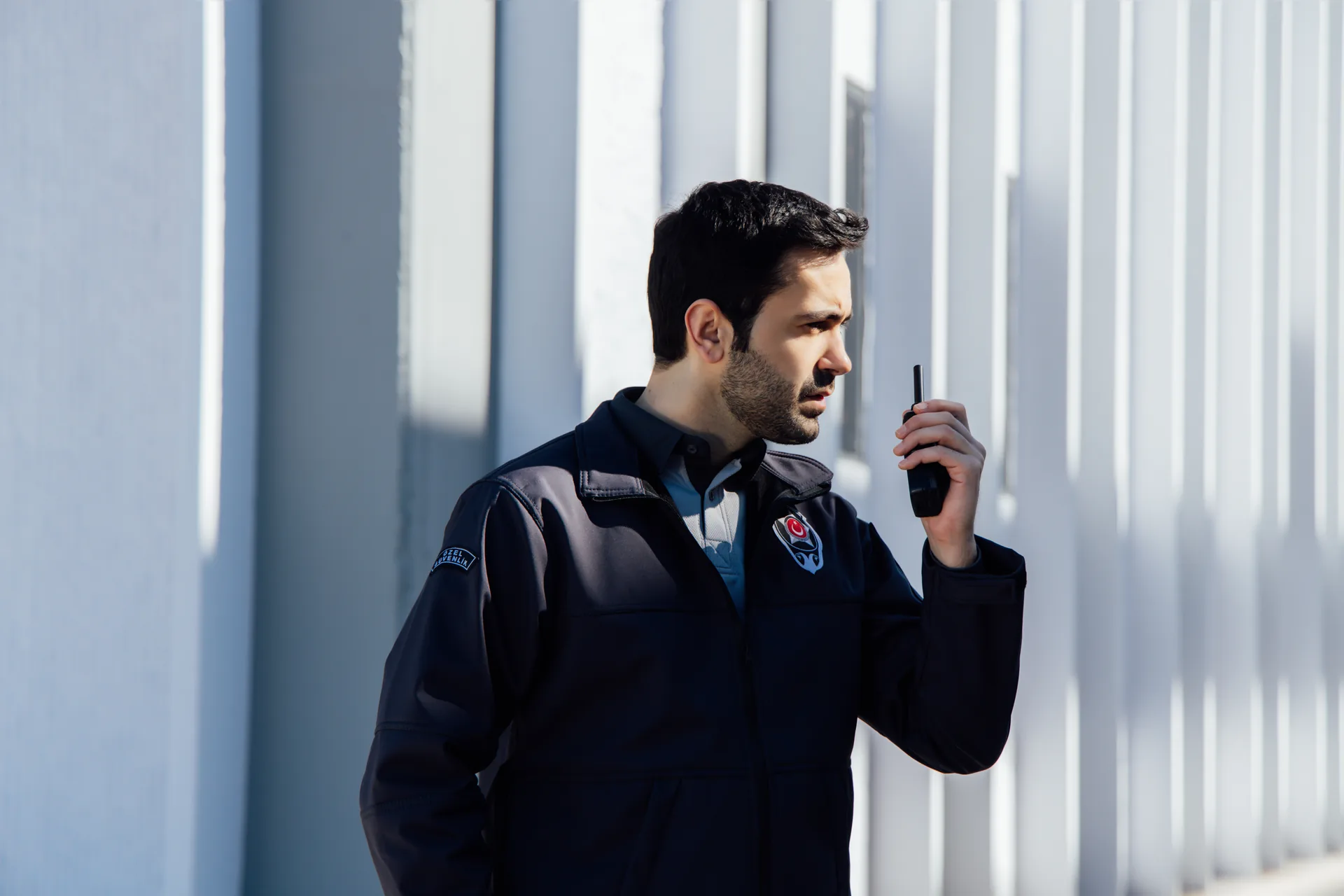
A uniformed Titan Savunma security officer on duty with a radio at an office entrance.
What should we look at when choosing among security firms in Uşak?

Ask to see the firm’s licence: under Law No. 5188 it must have been granted by the Ministry of the Interior. After that, send every bidder an identical written list. Who will lead the officers on your site? What record proves the night rounds happened? If an officer fails to turn up, who covers and within what time? Who audits without warning, and which report brings the results to you? Our proposal answers each of those for your particular site.

Whom do we deal with day to day at our site in Uşak?

Your Uşak City Manager. A single manager does the survey, puts the team together, heads the officers and carries out the daily rounds of checks; whether you need an extra post, a different officer or an update on an incident, the City Manager is your first call. A corporate second line stands behind that: the Aegean Regional Directorate and, above it, our Istanbul head office review the plan, send auditors in without warning and decide what training teams receive and the format every report follows.

Who obtains the private security permit for our factory, and from where?

The applicant is the business that will use the security service, and the permit is sought from the Governorship of Uşak. Uşak’s provincial commission for private security examines the request, and the governor’s signature gives its ruling legal force; under the Regulation, the ruling is due within ten working days at most. Nothing changes if your premises sit in an industrial zone, on a district building site or in the town centre; our City Manager helps you put the documents in order.

How can I apply to work as a private security officer in Uşak?

Through our Careers page. Our Uşak City Manager recruits for teams in the province and, at interview, talks through night duty, outdoor work in winter and the shift pattern with each candidate. The legal prerequisites sit in Article 10 of Law No. 5188 and include Turkish nationality, having turned eighteen and passing the basic training course. To go on duty, an officer also needs the work permit and private security ID card that the Governorship of Uşak issues (Arts. 11–12).

Is spotting fire in the bale yard of our recycling plant part of the security officer’s job?

Watching and raising the alarm, yes. Outside working hours the officer goes round the stock yard and stores through set checkpoints, starts the operator’s alert chain on seeing smoke, a smell of smouldering, sparks or an unlocked door, and records on each round that exits and fire doors are clear. Maintaining extinguishing equipment, stacking bales, counting and loading are the operator’s work; under Article 16 of the Law, nothing beyond protection may be added to an officer’s duties.

Our construction site will only run for a few months; how is a security plan set up for that?

Temporary workplaces make up a significant share of employment in Uşak; 2025 social security data show 11,167 insured employees at 1,263 temporary workplaces. On a short-lived site we tie the plan to the works programme: entry points that shift between excavation, structural work and finishing, plant parked overnight, theft-prone materials such as cable and steel, and the fuel store. Posts and officer numbers are rewritten each time the phase changes, and when the site closes, handover is recorded too.

How does Uşak’s climate affect outdoor posts?

Uşak lies in the inland, higher part of the Aegean, and its winters are noticeably colder than those of the coastal provinces. At the meteorological service’s central station the January mean is 2.4 °C and the January mean minimum −1.2 °C, with a recorded low of −19.9 °C. In summer, temperatures above 40 °C have been seen, the highest reading being 41.7 °C. For open gates, stock yards and construction sites we therefore write separate winter arrangements, with a heated booth, suitable clothing and reporting icing to the operator, and summer ones, with shade, water and shorter handovers in the hottest hours.

Which tasks should the security team have in our earthquake emergency plan?

Uşak, like many Aegean provinces, is in an earthquake zone, so we handle the topic within emergency and business continuity planning. The operator draws up the plan and the security team takes on whatever it is allotted. Typically that means swinging automatic gates and barriers open by hand once the shaking stops, sending staff to the agreed muster point, helping confirm from the shift roster who is out, holding the route open for fire engines and ambulances, and keeping everyone out of damaged buildings and the stock yard. Each officer’s share is written down individually and practised with the team during the operator’s drills.

Request a Survey and Proposal for Your Uşak Site

In the form, simply note the district or industrial zone, whether you keep stock in the open, the number of entrances and your shift times. Our Uşak City Manager will ring to book the survey, after which you receive a written proposal listing the posts, the officer numbers and the price for your site.

Request a Security Proposal

Contact

Request a Security Proposal for Your Organisation

Tell us your facility type, location and general requirements. Together, we can define a service scope that suits your organisation.

Tell Us What You Need

Fields marked * are required.

What Happens Next

  1. Initial DiscussionWe respond within 15 minutes and clarify your requirements and facility details together.
  2. Service ScopeWe assess staffing needs and the working arrangements.
  3. ProposalWe prepare our proposal for the agreed service scope.

General Directorates

Ankara · Çankaya
İstanbul · Levent

Nine regional directorates · 81 provinces

Looking for a role? Visit our careers page