
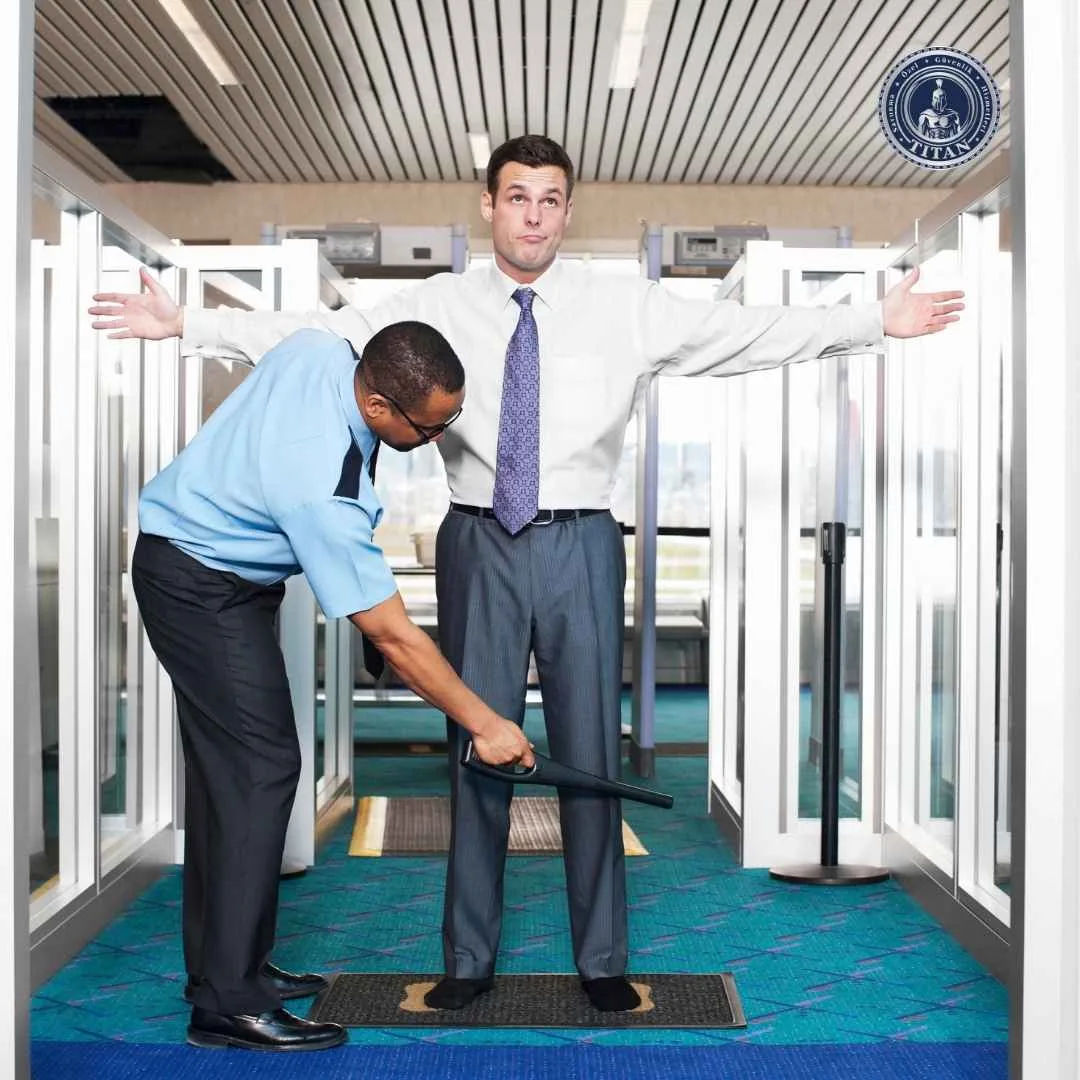
A walk-through metal detector creates a magnetic field inside its archway; when a metal object passes through, the detector senses the change in that field and gives an audible or visual alarm. Multi-zone models also show roughly where on the body the alarm occurred. What the detector cannot do is say what the object is: a trained officer resolves the alarm with a hand-held detector and decides whether it was a belt buckle or something that needs a closer look.
This article explains walk-through detectors for people who run entrances at public buildings, office towers, hospitals, schools and events: how they work, where to put them, how daily testing and record keeping should run, what happens after an alarm, and how to treat people with medical devices or reduced mobility. Our encyclopedia entry on walk-through metal detectors has the short definition. Sensitivity settings and detection limits are deliberately left out; they belong to the manufacturer, your risk assessment and authorised technical staff.
How it works: a magnetic field and its disturbance
NIJ Standard-0601.02, prepared by NIST for the US National Institute of Justice, defines an active walk-through detector as one whose generated energy takes the form of a magnetic field, with detection based on that field's interaction with metal objects in the portal. In plain terms, coils in the side panels generate a field; a metal object passing through disturbs it measurably, and the electronics compare the disturbance with a preset threshold to decide whether to alarm.
Two consequences follow. First, the device detects metal; non-metallic items need other methods. Second, it only says that something is there; establishing what, where and why takes a human check. A walk-through detector is a filtering step, not a final decision point.
What do detection zones add?
Basic models simply alarm. Multi-zone models divide the archway into several detection zones, and a zone indicator lights up when an alarm occurs. The NIJ standard refers to multizone detectors and asks that, during testing, the response be recorded for each sensor that corresponds to the position of the test object in the portal.
In the field, the zone indicator shortens secondary screening: the officer starts with the indicated area and then completes the scan. More zones do not automatically mean more security; the real difference shows in how quickly and respectfully alarms are resolved. The right configuration depends on the risk level of the entrance and the expected flow of people.
Installation and environmental effects
Walk-through detectors are sensitive to their surroundings, and the NIJ standard's test sections make this clear. The detector must not alarm without a test object present when operated near a metal wall, on a steel-reinforced floor or near a moving metal door, and it must show immunity to radiated magnetic fields; the standard also requires an indicator for problems with the mains supply. Those requirements map onto real site risks:
- Moving metal: revolving and automatic doors, lifts and turnstiles can cause nuisance alarms.
- Electrical noise: power cables, large motors and some electronic equipment can affect the field.
- Floor and fixing: the archway should stand on firm, level ground and be secured as the manufacturer instructs; vibration undermines stability.
- Flow layout: the tray table, the hand-held search area and the queuing space should be planned together with the archway.
After installation, authorised technical staff should confirm the set-up under the actual conditions at that spot, and repeat this whenever the unit is moved.
Daily operational tests and records
The NIJ standard expects the detector to self-test continuously while operating, to give a system status alarm if its condition could degrade detection performance, and to come with a preventive maintenance schedule from the manufacturer. It also defines test objects in size classes and includes a separate field test section. The practical lesson is the idea of a standard test object: the organisation regularly confirms, with a test object chosen through its own risk assessment, that the detector alarms as expected. Which object and which setting are used is internal, restricted information written into the procedure.
Post orders for the daily test should state:
- That the test is done at the start of each shift, and after the unit is moved, after a power cut or after a fault.
- Who performs it, who signs it off and where the record is kept.
- How entry is handled if the test fails: hand-held checks, a second lane, or temporarily closing the entrance.
- To whom a fault is reported, through which channel, and how it is logged for maintenance.
Those records matter for audits and for the question everyone asks after an incident: was the detector working that day? ProtectUK's search planning guidance similarly advises that search tools and equipment should address a defined requirement and be fit for purpose and well maintained, and that everyone carrying out searches should be fully trained in the site's procedures.
After an alarm: secondary screening
When the archway alarms, the response should be calm and standard. The officer steps the person aside with a short explanation, asks about forgotten metal items, may ask them to walk through again, and if the alarm persists moves to a check with a hand-held metal detector. The companion NIJ Standard-0602.02 for hand-held detectors also points to operator training. Legal powers, respectful search practice and what to do when someone refuses are a separate subject; the key rule here is that no one enters until the alarm is resolved.
Accessibility and people with medical devices
The NIJ standard requires the walk-through detector's operator manual to warn that the device may affect personal medical electronic devices. Every entrance therefore needs an alternative route for people who say they carry a medical device such as a pacemaker, or who cannot use the archway. Good practice looks like this:
- A clear sign at the entrance tells people with medical devices to speak to an officer.
- The alternative check is offered without demanding explanations or documents, and officers do not give medical opinions.
- A separate, calm area is available for wheelchair users, people with prostheses or limited mobility.
- Where needed, the check is done by an officer of the same sex, in a private area, according to the person's preference.
X-ray and walk-through detectors: different jobs
The archway checks the person; the X-ray scanner checks belongings. Neither replaces the other. At many entrances they run side by side: the bag goes through the X-ray while the person walks through the archway, and each alarm is resolved separately. Behind both machines are officers who watch the screen or the alarm light, make decisions and keep records.
Common mistakes
- Installing the detector and forgetting the daily test and log.
- Changing settings without authority because of nuisance alarms.
- Waving familiar faces through without resolving the alarm.
- Not planning an alternative route for people with medical devices.
Technology alarms, people resolve
A walk-through detector senses metal and raises an alarm; the trained team resolves that alarm with a respectful secondary check, runs and records the tests, and informs supervisors or the police when needed. Titan Savunma is an Ankara-based private security company holding a Ministry of Interior operating licence under Law 5188 and ISO 9001, 14001, 45001, 22301 and 28000 certificates, working with international companies in English and Turkish. We do not sell or install equipment; we plan guarding together with your technology. You can map your entrances with our event security planner and plan them with us under concert and event security.
Sources and Further Reading
- NIJ / NIST OLES — Walk-Through Metal Detectors for Use in Concealed Weapon and Contraband Detection, NIJ Standard-0601.02 (2003)
- NIST — The National Institute of Justice Standards for Hand-Held and Walk-Through Metal Detectors (Paulter, 2003)
- NIJ / NIST OLES — Hand-Held Metal Detectors for Use in Concealed Weapon and Contraband Detection, NIJ Standard-0602.02 (2003)
- ProtectUK (NaCTSO) — Search Planning (2022)


