
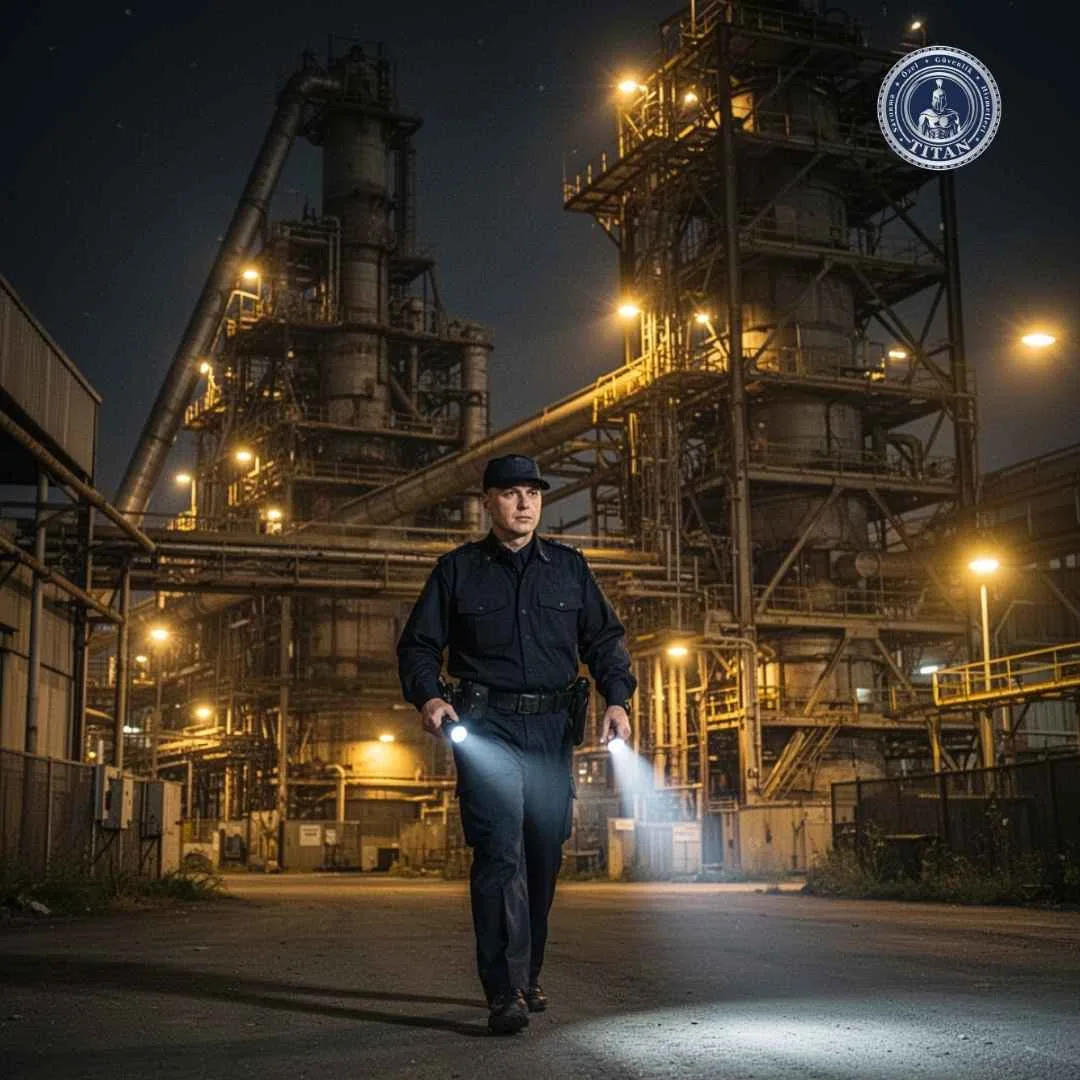
Short answer: no. A security robot can be useful as a moving platform that carries cameras and sensors on repetitive observation rounds, but in Turkey private security powers belong to qualified, trained security officers, not to devices. Independent field evidence that robots deter crime is also still thin. The better question is not "robot or officer?" but "which tasks can a robot take on so that officers spend more time on the work only they can do?"
This article is general information, not legal advice.
News stories show robots rolling through shopping centre corridors, campuses and car parks. For managers the issue is less curiosity than budget and accountability: what does the robot do, what can it not do, and who responds when something happens? We look at this through evidence and Turkish law, without naming brands or models.
What security robots can do
Devices sold as "security robots" are mostly wheeled, sometimes legged, platforms with cameras and sensors, operating autonomously or under remote control. As a technology class, their typical capabilities are:
- repeating the same predefined route without fatigue, including nights and holidays;
- collecting video, thermal images, sound or environmental data and flagging changes such as open doors, lights left on or leaks;
- sending an alert to the control room and letting a remote operator speak through the robot;
- producing video and patrol logs.
All of these are observation and recording functions. When the robot notices something, a person still assesses it, decides and goes to the scene. A robot is therefore not an officer replacing a patrol, but a mobile sensor feeding data to the security operations centre.
Deterrence: what the evidence says
Academic work on security robots is growing, but most of it is about how people interact with them. Ye and Robert's systematic literature review in ACM Transactions on Human-Robot Interaction gathers 47 studies of human interaction with security robots published between 2003 and 2023 and organises them under human, robot and context themes. The review examines the methods, tasks, predictors and outcomes those studies used; in other words, the field's centre of gravity is how people interact with security robots.
In one example, Inbar and Meyer ran four experiments in which participants judged images or animations of a robot or a human guard performing access control. The guard's politeness strongly shaped impressions, while responses to robot and human guards did not differ. That suggests how a robot addresses people matters; but it is a perception study in an experimental setting, not a measurement of crime on a real site.
At the time of writing we could not find an independent, peer-reviewed field evaluation showing that patrol robots reduce crime or loss at a site. That does not mean robots are useless; it means the deterrence claim is not yet proven. Vendor case studies do not have control groups. In a pilot, you need to measure it yourself.
Legal authority: officer versus device
Law No. 5188 on Private Security Services grants powers expressly to "private security officers". Article 7 lists them, including screening people entering a protected area with walk-through and hand-held detectors, asking for identity at events, apprehension in defined situations, taking custody of abandoned items, protecting an incident scene and its evidence, and using force within the limits of the relevant laws. The law adds that these powers may be used only while on duty and within the assigned area, and that incidents requiring force or apprehension must be reported to the police or gendarmerie by the fastest means.
Becoming an officer also has conditions. Article 10 requires, among other things, Turkish citizenship, being at least eighteen, successful completion of basic private security training and a positive security vetting. A device cannot meet them. In practice, a robot cannot ask for identity, search anyone or stop anyone; it can only record and pass on what it sees. Contracts and post orders should therefore never describe "robot patrol" as a service that stands in for a licensed officer.
Privacy, physical safety and cyber risk
Privacy. A robot is a roaming camera, often with a microphone. The Turkish Personal Data Protection Authority's public announcement of 8 June 2026 on workplace security cameras stresses that recording is personal data processing, that the purpose must be set in advance, that people must be informed, that audio recording needs a clear justification and that footage should be kept for the shortest possible time. Private areas such as toilets, changing rooms and rest areas must stay off the robot's route just as they stay out of fixed camera views.
Physical safety. A machine moving through a busy corridor can be a hazard for children, older people and visitors with disabilities. Route, speed and emergency stop procedures should be written down, along with who intervenes when the robot breaks down.
AI and cyber risk. The US National Institute of Standards and Technology's AI Risk Management Framework (AI RMF 1.0) warns that risks measured in a laboratory may differ from those that emerge in real-world operation, and that people may assume AI systems work well in all settings. It describes trustworthy AI as valid and reliable, safe, secure and resilient, accountable and transparent, explainable and interpretable, privacy-enhanced, and fair with harmful biases managed. Because a robot is a networked device, access rights, software updates and data location should also be in the contract.
Decision questions for a hybrid model
Robots tend to make sense in large, orderly areas that need repetitive observation: enclosed car parks, warehouse aisles, empty office floors after hours. Where contact with people is frequent and disputes or first aid are likely, the officer's presence is what counts. Before deciding, answer these questions:
- Which round will the robot take over, and how much officer time does that round use today?
- When the robot raises an alert, who watches it in the control room, and who reaches the scene, how fast?
- Who approved the robot's route, speed and emergency stop procedure?
- Are purpose, notice, retention and access written down for video and audio recording?
- How is the round covered during faults, charging and maintenance?
- How will we measure the pilot: incidents, response times, false alarm rate, visitor complaints?
- Do the post orders clearly divide work between robot and officer?
To see how post positions and patrol routes overlap in your own layout, try our shopping mall digital twin.
Common misconceptions
- Buying a robot to cut headcount and then leaving nobody to respond to its alerts.
- Accepting a vendor's deterrence claim without independent measurement.
- Treating a warning through the robot's speaker as the exercise of a legal power.
- Leaving audio recording on by default.
- Never asking visitors how they feel about meeting the robot.
How a professional security partner helps
Titan Savunma is an Ankara-based private security company operating under a Ministry of Interior licence under Law 5188, certified to ISO 9001, 14001, 45001, 22301 and 28000, and working with international companies in English and Turkish. We plan guarding together with your technology: we treat the robot as a sensor platform and write a monitoring, verification and response plan that keeps intervention, legal authority and human contact with the officer. See our manned guarding services.
Sources and Further Reading
- mevzuat.gov.tr — 5188 sayılı Özel Güvenlik Hizmetlerine Dair Kanun
- NIST — Artificial Intelligence Risk Management Framework (AI RMF 1.0), NIST AI 100-1 (2023)
- ACM Transactions on Human-Robot Interaction — Ye & Robert, A Human–Security Robot Interaction Literature Review (2025)
- IEEE Transactions on Human-Machine Systems — Inbar & Meyer, Politeness Counts: Perceptions of Peacekeeping Robots (2019)
- KVKK — İş Yerlerinde Güvenlik Kamerası Sistemi Kullanımında Dikkat Edilecek Hususlara Dair Kamuoyu Duyurusu (2026)


