
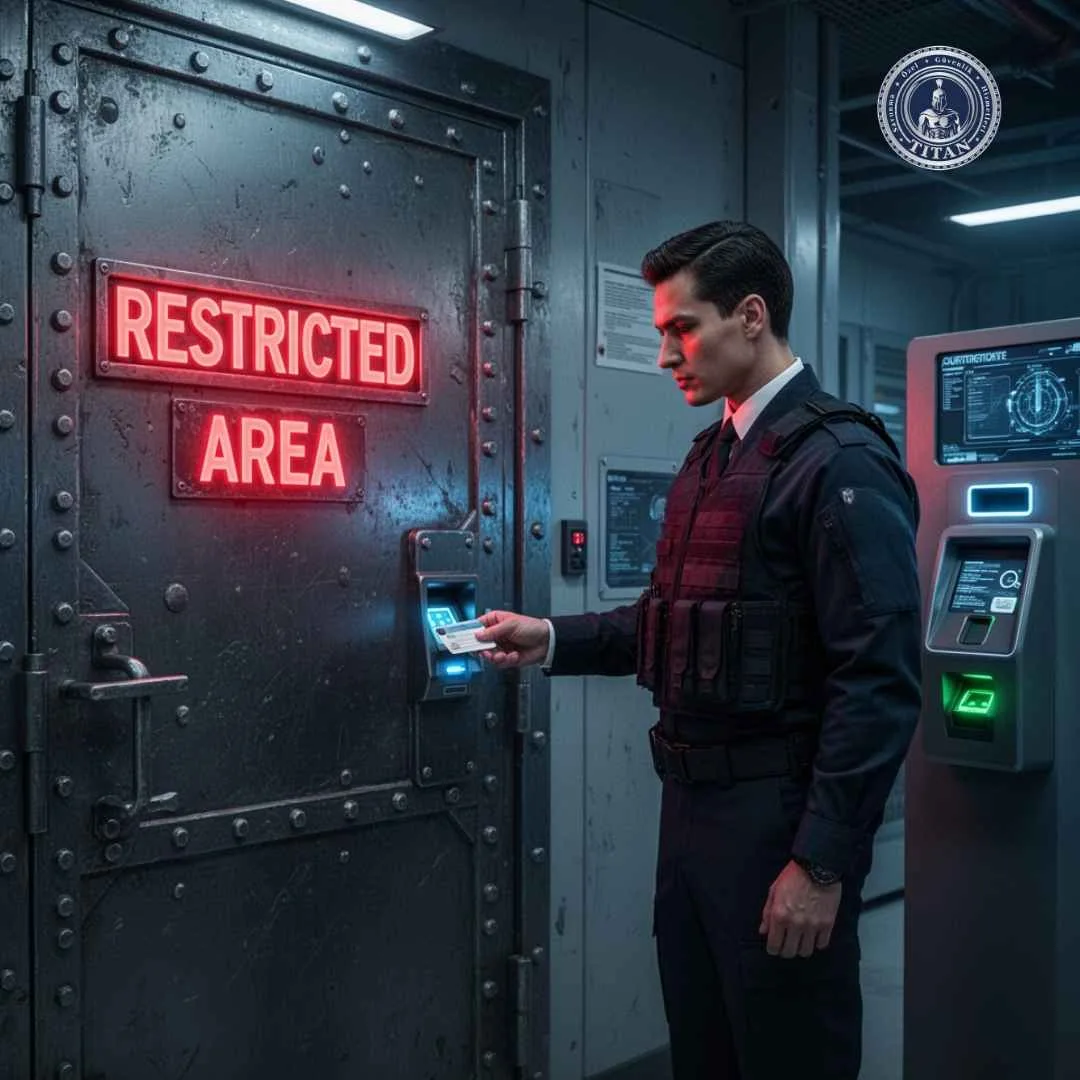
An access control system decides electronically who may pass which door of a building, and when. A person presents a credential (a card, a PIN, a phone or, in some cases, a biometric trait) to a reader; a controller checks whether that credential is valid for that door at that time, releases the lock if it is, and logs every event. The system locks, unlocks and records. What happens when something goes wrong at the door is decided by people.
The building blocks of an access control system
Our encyclopedia entry on access control systems gives the short definition. Here is how the parts fit together in practice:
- Credential: a contactless card or fob, a PIN, a mobile credential, or a biometric. For the radio technology behind most cards, see the RFID entry.
- Reader: the device beside the door. It reads the credential, sometimes asks for a PIN, and usually passes the data on rather than making the decision itself.
- Controller (panel): the decision-maker for one door or a group of doors. It holds the access list locally, so it can keep working on predefined rules if the network link drops.
- Lock and door hardware: the electric lock, a door contact that reports whether the door is open or shut, and a request-to-exit button or sensor on the inside.
- Management software: enrolment, access groups, time schedules, the alarm screen and reports.
- Event log: every grant, denial and door alarm with its date and time.
Internationally, minimum functions and performance for these systems are set out in IEC 60839-11-1:2013. According to the official abstract, it covers electronic access control systems and components used at entry and exit points in and around buildings and protected areas, including requirements for logging, identification and the control of information. Asking bidders to state conformity in writing is a simple way to bring the standard into a tender.
What happens in the second you badge in
- The user presents a card to the reader.
- The reader captures the identifier and sends it to the controller.
- The controller asks three questions: is this credential still valid (not revoked or expired)? Is this person authorised for this door? Is this an allowed time?
- If all three answers are yes, the lock releases for a few seconds and the door contact watches the door open and close again.
- The event is written to the log: granted, denied, forced, held open.
The weakest link is rarely the hardware. It is usually the access list. If a leaver's card is never revoked, the system works perfectly and lets the wrong person in. Card revocation therefore needs a written handover between HR and security.
Why card technologies differ in assurance
Cards do not all offer the same level of confidence. At a general level there are two families:
- Cards that only present a fixed number: the reader receives an unchanging identifier. Easy to deploy, but the read does not prove the card is genuine, so assurance is low.
- Smart cards with cryptographic authentication: the reader and card run an encrypted challenge-response exchange, so the card proves it holds a secret without revealing it.
The US National Institute of Standards and Technology makes this distinction explicit in its facility-access guideline, NIST SP 800-116 Rev. 1 (2018), written for US government identity cards. It states that cryptographic challenge-response protocols make the card counterfeit-resistant, and it deprecates the mechanism that relies only on reading a static identifier from the card because it provides "little or no" confidence in the cardholder's identity. The same guideline frames authentication as one, two or three factors: something you have (the card), something you know (a PIN) and something you are (a biometric). Confidence rises with the number of factors, and the guideline also stresses checking whether a card has expired or been revoked.
In practice, sensitive rooms such as server rooms or archives may justify card plus PIN, while general office floors often work well with a single factor. Which zone needs which level is a risk decision; our free security risk assessment tool is a reasonable starting point. In Turkey, biometric readers also trigger a separate and strict data protection assessment.
Door alarms, and who answers them
Door alarms are the least discussed and most labour-intensive part of access control. The common event types are:
- Door forced: the door opened without a valid credential or exit request.
- Door held open: access was granted, but the door stayed open longer than allowed, for example because it was wedged or a group followed through.
- Repeated denials: several attempts with an unauthorised or revoked card at the same reader.
- Tamper and communication loss: a reader cover opened, a controller offline, a power failure.
Every alarm asks a question the software cannot answer. The answer to "who deals with it?" should be written down:
- Monitor: an officer in the control room or at reception sees the alarm, acknowledges it and adds a note.
- Verify: checks the relevant camera if there is one, or calls the floor contact, or sends a patrol.
- Respond: an officer goes to the door, secures it, speaks politely with whoever is there and escalates to the supervisor and facility management if needed.
- Close: the event is classified as false alarm, technical fault or breach; faults get a maintenance ticket.
Without these steps in the post orders, the usual outcome is alarm fatigue: warnings are cleared unread. A door that is constantly held open is a process signal. If a loading-bay door is always open during shifts, the fix is a separate rule and staffing arrangement for that door, not muting the alarm. Someone following a cardholder through the door is a related but distinct problem, summarised in our tailgating entry.
Access logs and Turkish data protection law, briefly
This section is general information, not legal advice. Access logs show who passed which door and when, so they are personal data. Article 4 of Turkey's Personal Data Protection Law No. 6698 (KVKK) requires processing for specific, explicit and legitimate purposes, limited and proportionate to the purpose, and retention only for as long as necessary; Article 12 requires the technical and administrative measures needed for data security. In practice, write down the purpose of the logs, who can see them, how long they are kept and how they are destroyed. Reusing access logs for another purpose, such as working-time tracking, deserves its own assessment. Biometric readers involve special categories of data and are covered in a separate article.
Checklist for planning and running the system
- Define zones: public, staff-only and restricted.
- For each door, set the alarm types and timings and write down who receives each alarm.
- Agree a written process with HR for issuing cards, lost cards and revocation on leaving.
- Decide how doors behave during power or network loss and what the manual fallback is.
- Have your fire consultant confirm that escape-route doors meet fire and emergency rules.
- Restrict access to the management software, keep administrator accounts personal and track software updates.
- Put periodic testing of readers and door alarms into the maintenance calendar.
- Review the alarm report monthly: repeated alarms at the same door point to a process problem.
Common mistakes
- "We have cards, so we are secure": the card controls the door; officers handle visitors, couriers, forgotten cards and emergencies.
- An alarm screen nobody owns: an alarm that no one answers is just a log entry.
- Never reviewing permissions: over the years everyone ends up with access to everything.
- Keeping legacy card technology without review: reassess assurance for sensitive areas.
How a professional security partner helps
Titan Savunma is an Ankara-based private security company operating under a Ministry of Interior licence granted under Law 5188, with ISO 9001, 14001, 45001, 22301 and 28000 certificates, and we work with international companies in English and Turkish. We do not sell or install access control. We plan guarding together with your technology: where door alarms land, who verifies them, who walks to the door, and how that is written into post orders. See our office and business centre security page for more.


