
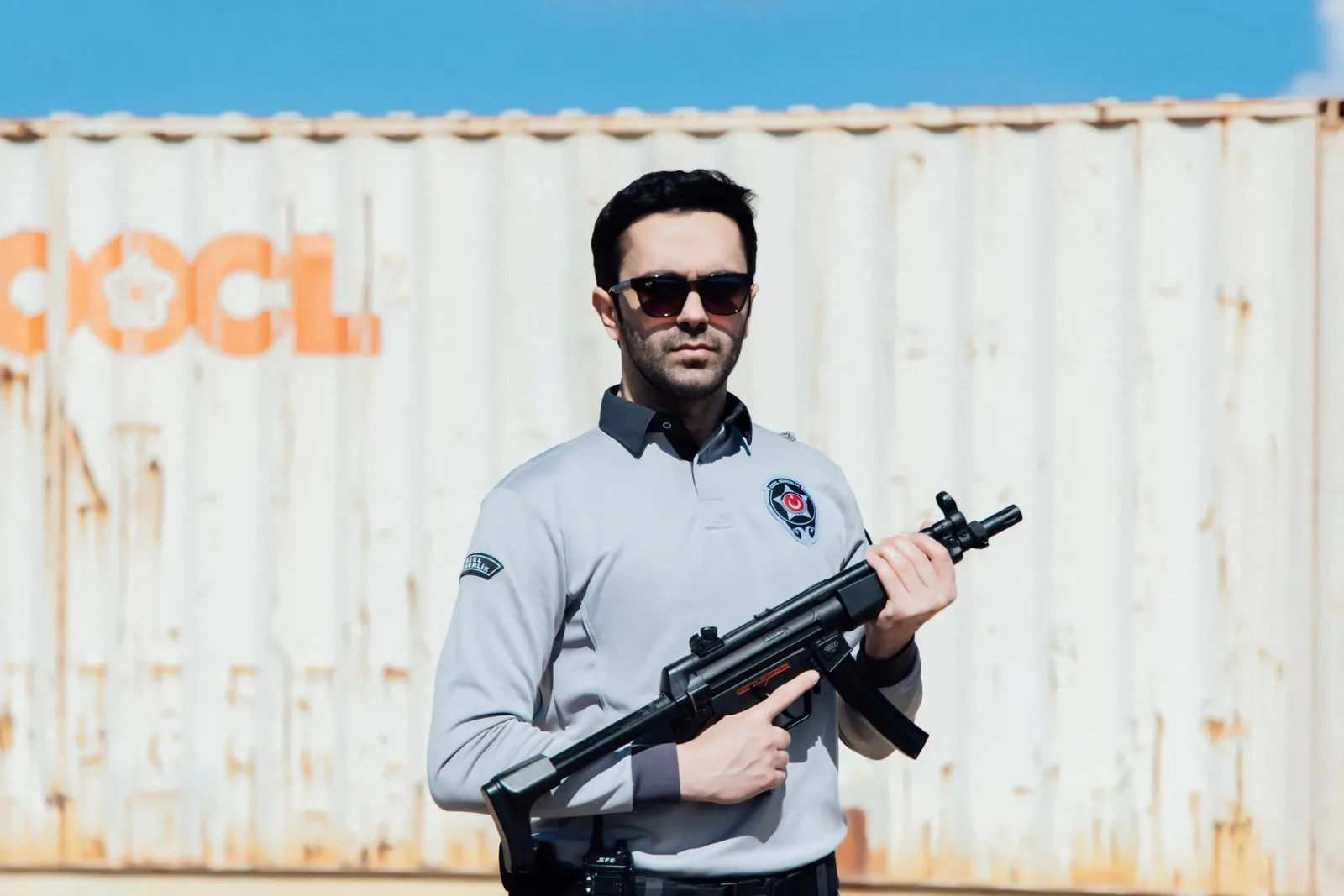
Short answer: In a small province such as Ardahan, the security of a bank or financial branch is decided less by the lunchtime queue than by the two ends of the day: the minutes before the doors open in the morning and the minutes after the shutters come down in the evening. Because closing time falls after dark on most winter days, the opening and closing steps should be written down, the area in front of the ATM kept lit and clear of snow, and the officer placed inside, where both the entrance and the ATM can be seen, rather than left standing outside in the frost. On cash-in-transit days, the officer's job is not to take part in the transfer but to keep the flow of customers inside the branch calm and predictable.
This article is general information, not legal advice.
A small-province branch: few people, written routines
According to the Social Security Institution (SGK) Statistical Yearbook 2025, Ardahan has 9,922 compulsorily insured employees (category 4/1-a) at 1,417 workplaces, the smallest registered workforce of any province in Türkiye by our ranking. Around 87% of workplaces employ between one and nine people. The same table shows 6 workplaces and 20 insured employees in financial service activities (NACE 64). Because the figures follow workplace registration, they may not capture everyone working in local branches; even so, the picture is clear: a financial branch in Ardahan usually runs with a small team and without a large organisation next door to call on.
For security, the consequence is simple. In a big city, crowds and activity nearby partly make up for a lapse; in a small province, what the first two people do in the morning and the order in which the last two leave in the evening are what count. Making every step written, repeatable and logged achieves more than adding people.
Ardahan's winter: early darkness, hard frost
Records from the Turkish State Meteorological Service for 1958–2025 put Ardahan's January average at −11.2 °C and its average January low at −16.5 °C; the coldest reading on record is −39.8 °C, and snow has lain as deep as 113 cm. Daylight is short as well: using the solar calculation method of the US National Oceanic and Atmospheric Administration (NOAA), we estimate that from mid-November to mid-January the sun sets in the town centre between about 16:40 and 17:05, and rises around 07:30 in late December. In other words, for much of the winter the branch closes, staff leave the building and the ATM sees its busiest evening use in the dark, while the morning opening happens close to dawn.
What does the research say?
1. Lighting: more than visibility
Thirteen before-and-after evaluations with comparison areas were combined in a Campbell review of street lighting; across them, brighter streets saw significantly less crime, and the British evaluations showed a larger effect than the American ones. Because offences after dark did not drop by more than daytime ones, the authors argue that light also tells passers-by that someone cares for the place, rather than simply helping people see (Welsh and Farrington, Campbell Systematic Reviews, 2008). None of the evaluations looked at bank frontages, yet they explain why keeping the ATM surroundings bright and tidy comes first on a street that is dark by half past four.
2. Cameras: watched, and never alone
Pooling four decades of CCTV evaluations, Piza and colleagues found cameras linked to a modest yet statistically significant reduction in crime. Actively monitored systems showed larger effects than passive, record-only ones, and schemes that combined cameras with other measures did better than cameras on their own (Piza et al., Criminology & Public Policy, 2019). For a branch, the lesson is that entrance and ATM cameras belong together with the officer's eyes, the lighting and the logbook; a camera feeding a screen nobody looks at will not do the job expected of it.
3. A practical guide for ATM sites
The ATM guide of the US Center for Problem-Oriented Policing lists concrete site measures: minimum lighting of roughly 108 lux within 1.5 metres of the machine and roughly 22 lux at 15–18 metres, measured about 90 cm above the ground; lights switched by photo sensors rather than by hand or timer; monitors that raise an alert when light levels drop; removing shrubs, bins and walls that block the view; mirrors so users can see behind them; and plainly visible, working cameras, with no dummy cameras unless real ones are also in place (Scott, Center for Problem-Oriented Policing, 2001). The guide reports no measured effectiveness for these measures and grounds its lighting and camera advice in wider crime-prevention research. The one thing to add for Ardahan is snow: a well-lit ATM with an icy approach still leaves its users exposed.
4. The weakest link at the door: persuasion
In a field experiment at one organisation, 31 people acting as "offenders" followed a script, visited the workrooms of 118 employees and asked for their room keys. Of employees who had received a short awareness intervention, 37.0% handed over their keys, against 62.5% of those who had not; the intervention made a significant difference (Bullée et al., Journal of Experimental Criminology, 2015). The study was not carried out in a bank and its sample is small, but it shows why a written rule and a short, regular reminder matter when someone knocks before opening time claiming to be a technician or an official.
5. The cost of working in the cold
A review of health problems in cold work links indoor and outdoor cold exposure with lower performance and productivity, more accidents and injuries and sick leave; breathing cold air can cause respiratory symptoms, and physical exertion in the cold can bring on cardiovascular complaints. According to the authors, the first step is awareness and the identification of workplace and individual cold risks (Mäkinen and Hassi, Industrial Health, 2009). The review is a general summary of the literature with no measurements on security officers, but it clearly supports the view that an officer kept for hours at a door in the frost will lose both health and alertness.
Opening routine: the ten minutes before the doors open
- The officer and the branch's key holder arrive in an agreed order and aware of each other; if one is late, the other does not go in alone.
- Before entering, a short walk round the building checks doors and shutters, the rear exit, the ATM front and the lighting. After overnight snow, tracks and ice at the entrance and the ATM are also noted.
- If the card slot, keypad or casing of the ATM shows an unusual part, tape or signs of tampering, nobody touches it; it is reported to the branch manager and the unit the bank designates.
- If everything is normal, staff go in; only an authorised employee disarms the alarm, and the "all clear" is then passed to colleagues using the bank's own procedure.
- Nobody is let in before opening hours, whoever they say they are; an unannounced maintenance or technical visit waits at the door until the branch manager confirms it.
- The opening time, the result of the checks and any fault are written briefly in the logbook.
Closing routine: the last exit in the dark
- Before closing, the last customer leaves, then the waiting hall, toilets, archive and rear corridor are checked one by one to make sure nobody remains inside.
- Once the shutters and doors are closed, an authorised employee sets the alarm while the officer watches the entrance and the outside area.
- Staff leave together where possible, follow a lit route to their cars or the nearby stop in the dark, and can ask the officer to walk with them.
- After leaving, the officer checks that the ATM lights are on and the camera is showing a picture; any fault is reported to the bank's technical unit the same evening.
- The closing time and the result of the checks go into the logbook, which the next morning's opening team reads.
Where should the officer stand in winter?
In hard frost, the most common mistake is to keep the officer outside the door for hours "so they are visible". A better arrangement is to station the officer in the draught lobby or entrance hall, at a point from which both the door and, through the glass, the ATM can be seen. Outside checks are short and regular, especially around dusk and just before closing. The officer is issued with a thick, layered winter uniform, gloves, non-slip footwear and a reflective vest for visibility in the dark. The ATM front and entrance steps are cleared of snow and ice; if this falls to the officer, it should be written into the post orders and planned so that it does not interrupt watching the branch. Before winter starts, test whether emergency lighting and camera recording continue during a power cut.
Inside the branch on cash-in-transit days
Cash-in-transit is a separate service with its own crew, subject to its own permits and rules; this article covers not the transfer itself but what should happen inside the branch on the days it takes place. The general framework is as follows:
- The day and time of a transfer are not discussed with customers, on the phone or on social media; the information stays with those who need it.
- The branch officer does not carry cash or interfere with the transit crew's work; the officer stays in the hall, keeps the customer flow calm and makes sure the route in and out is clear.
- To avoid crowding at the entrance during the transfer, customers are briefly guided to the waiting area, without explanation and without fuss.
- If anything unusual happens, the officer follows the reporting chain in the post orders and does not act alone.
Checklist: opening, closing and winter routines for an Ardahan branch
| Area | What to do | Why |
|---|---|---|
| Opening | Two people in an agreed order; walk round; ATM check; nobody admitted before hours. | The first minutes after the door opens are the most exposed of the day. |
| Closing | Sweep of inside areas, alarm, leaving together, lit route. | In winter, closing happens in the dark on most days. |
| ATM lighting | Photo-sensor lighting, low-light alert, evening check. | Brighter surroundings went with measurably less crime in the lighting review. |
| Cameras | Entrance and ATM front can be watched live; blind spots identified. | Active monitoring and combined measures work better. |
| Officer position | A point in the entrance hall covering door and ATM; short outside checks. | Long outdoor posts in the cold reduce health and alertness. |
| Snow and ice | ATM front and steps cleared each morning and during the day. | Ice means both falls and an ATM people avoid. |
| Technical visits | Unannounced visits wait until the manager confirms. | Entry by persuasion can drop markedly after a short reminder. |
| Transit days | Information kept confidential; officer in the hall; orderly flow. | The transfer is the crew's job; order inside is the officer's. |
| Records | Notes on opening, closing, faults and incidents; monthly review. | Only records show what works. |
Common mistakes
- Leaving the opening to one person, or skipping the outside check because "it is a small town".
- Letting in someone who says they are a technician before hours without confirmation.
- Leaving a failed ATM light or a camera with no picture unrepaired for weeks.
- Keeping the officer at a fixed post outside the door in the frost for hours, and leaving warm-up breaks to the officer to arrange.
- Not clearing ice and snow from the ATM front until midday.
- Talking openly about the transit day and time, or involving the officer in the transfer.
- Running cameras without deciding who keeps the recordings and for how long.
A note on practice in Türkiye
Under Law No. 5188, private security officers may use their powers only within their assigned area and during their duty hours (Article 9), so the officer's role at the ATM and around the branch should be clearly written into the definition of that area. Anything observed around the branch that goes beyond the officer's powers is reported to the police or gendarmerie. Camera recordings are personal data under the Personal Data Protection Law No. 6698, so retention periods, access and privacy notices should follow the bank's own policy. Cold-weather risk belongs in the risk assessment required by Occupational Health and Safety Law No. 6331, as a written winter routine. Banks often set their own internal security requirements as well, so post orders should be drafted alongside those requirements, the branch's emergency plan (fire, heavy snow, long power cuts) and the realities of winter.
The duties we cover at financial branches are listed under bank and financial institution security, and the way we work with public buildings, hospitals, campuses and construction sites in the province is described under private security company in Ardahan.
Titan Savunma is an Ankara-based private security company licensed by the Ministry of Interior under Law No. 5188 and certified to ISO 9001, 14001, 45001, 22301 and 28000. We work with international companies in English and Turkish, and our Ardahan City Manager, supported by our Eastern Anatolia Regional Directorate in Erzurum and our Ankara General Directorate, reviews your branch's opening and closing routine, ATM surroundings and winter post on site and writes post orders with you that fit your bank's own rules. To arrange a site visit, write to us via our contact page.
Sources and Further Reading
- Welsh, B. C. & Farrington, D. P. — Effects of Improved Street Lighting on Crime, Campbell Systematic Reviews 4(1) (2008)
- Piza, E. L., Welsh, B. C., Farrington, D. P. & Thomas, A. L. — CCTV surveillance for crime prevention: A 40-year systematic review with meta-analysis, Criminology & Public Policy 18(1):135–159 (2019)
- Bullée, J.-W. H., Montoya, L., Pieters, W., Junger, M. & Hartel, P. H. — The persuasion and security awareness experiment: reducing the success of social engineering attacks, Journal of Experimental Criminology 11(1):97–115 (2015)
- Mäkinen, T. M. & Hassi, J. — Health Problems in Cold Work, Industrial Health 47(3):207–220 (2009)
- Scott, M. S. — Robbery at Automated Teller Machines, Problem-Oriented Guides for Police No. 8, Center for Problem-Oriented Policing (2001)
- SGK — İstatistik Yıllığı 2025 (Sigortalı ve İşyeri İstatistikleri, Tablo 1.11, 1.14)
- Meteoroloji Genel Müdürlüğü — Resmî İl ve İlçe İstatistikleri: Ardahan (1958–2025)
- NOAA Global Monitoring Laboratory — Solar Calculator (gün doğumu/batımı hesaplama yöntemi)
- 5188 sayılı Özel Güvenlik Hizmetlerine Dair Kanun (md. 9), Mevzuat Bilgi Sistemi