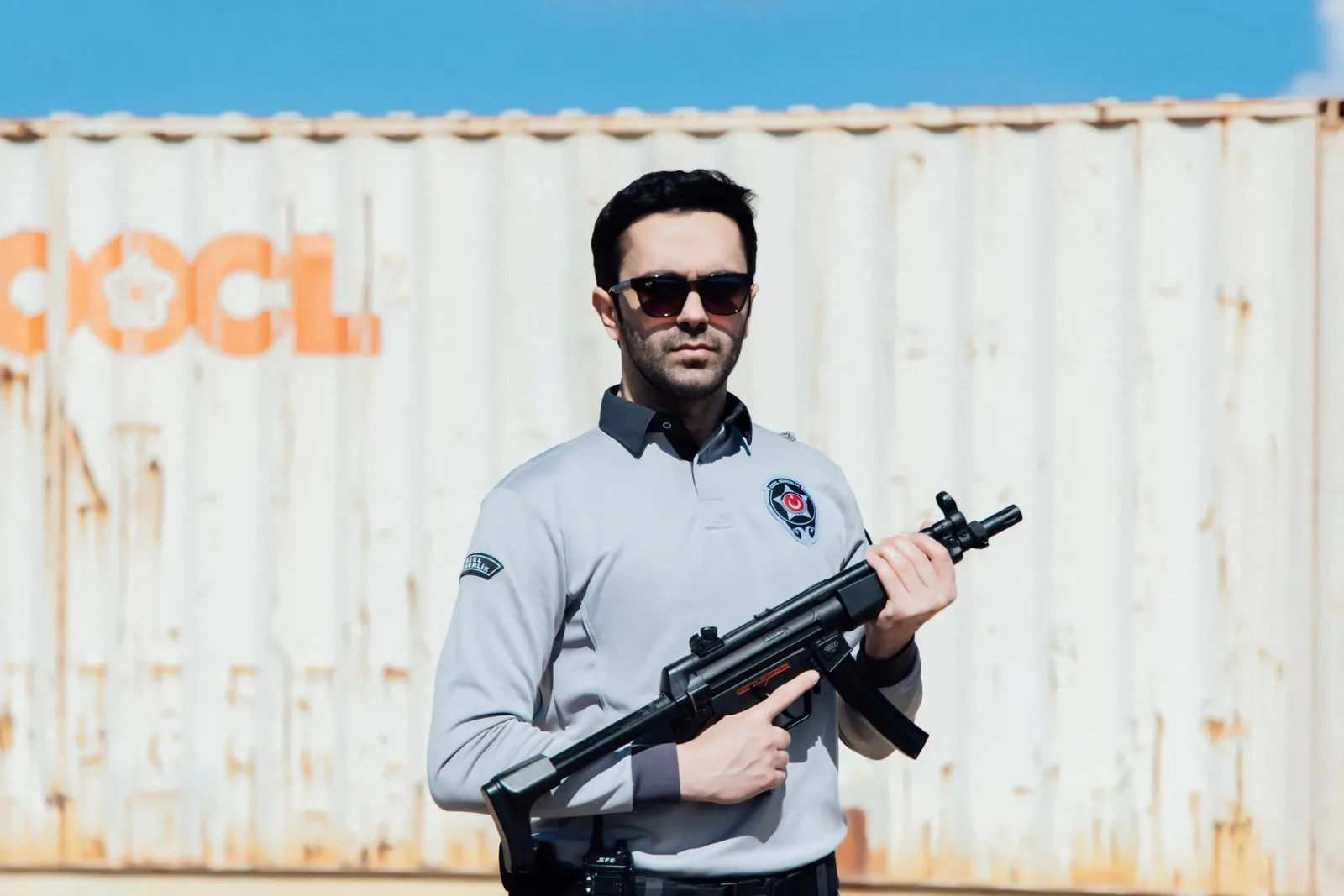
Short answer: At Kırşehir's busy public service buildings, the job of entry security is to get everyone inside within a reasonable time and with the same respect. That takes a well-designed line rather than a harsher gate: inform the queue from the start, keep the order fair with rules everyone can see, rotate the X-ray operator often at peak times, talk calmly and respectfully to a visitor who is getting tense, and have a written route ready for disabled and elderly visitors and for people with medical implants. In Turkey, the powers of a private security officer at that line are listed one by one in Article 7 of Law No. 5188, and the post orders should be written within those limits.
This article is general information, not legal advice.
Why public building entrances in Kırşehir deserve their own plan
According to the Social Security Institution (SGK) Statistical Yearbook 2025, 6,213 of the 29,571 compulsorily insured employees in Kırşehir (under category 4/1-a), about 21%, work in public-sector workplaces. The same yearbook lists 14,907 civil servants (4/c) in the province; taken together, by our own calculation, roughly one in three active insured people in Kırşehir works on the public side. Provincial directorates, municipal service buildings, the courthouse, hospitals, the tax office and the university campus are a large part of everyday life in the city.
Their entrances are not like factory gates. Most people coming through are not staff but citizens with business to do: someone hurrying to an appointment, someone worried about a result or an official notice, a first-time visitor, a parent with a child, a person with a walking stick or a wheelchair. Queues can build quickly at opening time and after the lunch break. The population is also ageing: a report on Turkish Statistical Institute (TÜİK) data puts the share of people aged 65 and over at 11.1% of Turkey's population in 2025. The officer at the door is the first face the institution shows a citizen, and an argument at the X-ray line can shape the impression of every service delivered inside.
The limits of authority: what Article 7 of Law No. 5188 says
The Private Security Services Law, Law No. 5188, enumerates in its Article 7 what private security officers are empowered to do. Those directly relevant to the entrance of a service building are:
- Walk-through detector, hand detector and X-ray (Art. 7(a)): having anyone who wants to get into the protected area walk through a sensitive arch, checking them with a hand-held detector, and running their bags and belongings through X-ray or comparable security systems.
- Taking items into safekeeping (Art. 7(g) and (h)): taking into safekeeping, on condition that the general law enforcement forces are informed immediately, items found during searches that constitute an offence, may be evidence, or, while not an offence, may cause danger; and taking abandoned and found items into safekeeping.
- Apprehension (Art. 7(c), (d), (ı), (j)): apprehension under Article 90 of the Code of Criminal Procedure; apprehending and searching people within the duty area who are subject to an arrest warrant or a conviction; apprehension to shield someone from a present threat to their physical safety or health; protecting the scene and evidence.
- Use of force (Art. 7(k)): only under Article 981 of the Civil Code, Article 52 of the Code of Obligations and Articles 24 and 25 of the Penal Code.
The same law draws the limits. Officers may use these powers only while on duty and within their duty area; incidents requiring force or apprehension are reported by the fastest means to the competent general law enforcement, and the person apprehended and any items seized are handed over to them (Art. 9). Sub-paragraph (a) of Article 7, which covers entry to the protected area, names the walk-through detector, the hand detector and X-ray. The implementing regulation contains no separate provision on registering visitors either; its Article 14 on preventive searches says a person may be body-searched only by an officer of their own sex, and items seized during a search to be handed over to general law enforcement with a written record. If your building registers visitors, settle the basis and procedure with your legal department alongside the institution's visitor rules, and write it into the post orders accordingly.
The practical consequence: the officer at the door does not need to win an argument. The job is to carry out the checks the law lists, take dangerous items into safekeeping properly, and, when faced with someone who refuses the check or poses a danger, follow the route in the post orders and inform the police where needed. The post orders should say in advance and in writing what happens to a visitor who refuses the check; making that decision at the door, in front of the queue, escalates tension.
What does the research say?
1. In a queue, a sense of unfairness may fuel anger as much as the wait
A 1987 discussion paper on the psychology of queueing, which its author describes as speculative, argues that people's attitudes to queues may be shaped more strongly by factors other than the wait itself: customers may become infuriated when first-in, first-out is violated, and the queueing environment and feedback on the likely length of the delay also influence attitudes (Larson, Operations Research, 1987). It is a framework built from cases, not an experiment. Our reading for the entrance: someone moved to the front without explanation can cause more tension than a few minutes' wait. If disabled, elderly or pregnant visitors get priority, a visible sign makes this look like a rule rather than a favour, and an approximate waiting time at the head of the queue reduces uncertainty.
2. Being treated fairly and with respect can leave citizens more content
Pooling police-led interventions, a systematic review with meta-analysis examined programmes in which officers' conversations with the public included one or more procedural-justice components: neutrality, dignity and respect, giving people a voice, and trustworthy motives. Every outcome measured moved in a positive direction, and effects were statistically significant for all outcomes except legitimacy itself; the authors conclude that the dialogue of front-line officers is an important vehicle for promoting citizen satisfaction (Mazerolle et al., Journal of Experimental Criminology, 2013). This evidence comes from policing rather than private security, and no study was conducted in Turkey. Still, they offer a core that transfers to the door: say what you are going to do and why, apply the rule to everyone, listen, and thank the visitor when the check is done.
3. De-escalation training is widespread, but the evidence is still thin
A systematic review of de-escalation training identified 64 evaluations conducted over about 40 years; most of them come not from policing but from nursing and psychiatry. The authors report few adverse consequences and some evidence of slight-to-moderate individual and organisational improvements, but they judge the quality of almost all evaluation designs questionable and say little is known about the effects on officers and police–citizen interactions (Engel, McManus and Herold, Criminology & Public Policy, 2020). Our conclusion: a one-off de-escalation course is not enough; practice at the door should be followed up regularly through supervisor observation and incident records.
4. Attention on a busy X-ray line can drop quickly
A four-month study of airport baggage screeners that tracked how well they detected fictitious threat items projected onto X-ray images of real passenger bags found that detection worsened on longer shifts with high baggage throughput, and that the decline appeared within the first 10 minutes of busy shifts. The authors recommend shorter rotations to maintain vigilance, while noting that this may be hard to implement in busy periods (Meuter and Lacherez, Human Factors, 2016). The study comes from an airport and cannot be transferred directly to a public service building. Our inference: when the morning queue grows, the X-ray operator is both under pressure and in conditions where the risk of error rises, so rotate the screen operator more often as the queue grows, and speed the line up through queue management, not at the screen.
5. Visitors with pacemakers and other implants
A laboratory study by researchers at the US Food and Drug Administration (FDA) tested 20 personal medical devices (6 pacemakers, 6 implantable cardioverter-defibrillators, 5 neurostimulators and 3 insulin pumps) in a simulator reproducing walk-through metal detector fields. At field strengths comparable to real detectors, electromagnetic interference appeared in 2 pacemakers and 1 neurostimulator; the effects were transient and the devices returned to normal within a few seconds after exposure ended. No interference was seen in the defibrillators or insulin pumps, and the authors note that they did not assess clinical implications (Guag, Addissie and Witters, BioMedical Engineering OnLine, 2017). Because it did not measure clinical effects, the study makes no judgement on whether walk-through detectors are dangerous for visitors; nor does the officer at the door make medical assessments or give medical advice. Our recommendation is simply this: a visitor who says they have an implant should not be kept waiting inside the arch, should not have their statement questioned, and should be taken to an alternative check defined in advance in the post orders.
Entry arrangements for disabled and elderly visitors
- Separate but equal: plan a check point next to the walk-through detector, independent of the queue, for visitors using wheelchairs or walking frames; the check is just as thorough but unhurried.
- Explain first, then act: before a hand-detector check the officer explains what will happen; walking sticks, crutches or prostheses are checked where possible without taking them from the person. If a body search becomes necessary, a staff member of the visitor's own gender carries it out.
- Different ways to communicate: a picture or written guidance card for deaf visitors; spoken directions for blind visitors, collecting their belongings from the belt together.
- Seating and help: a seat near the entrance for elderly visitors; help with putting belongings into trays is offered, never pressed.
- Privacy: medical conditions are not asked about loudly in front of the queue. Under Turkey's Personal Data Protection Law No. 6698, health information is special category personal data; the safest course is not to record it at the door.
A checklist for the X-ray and entrance line
| Area | What to do | Why |
|---|---|---|
| Queue information | A short, legible sign at the head of the queue: what goes through X-ray, prohibited items, priority groups. | Less uncertainty and fewer "why did they go first" disputes. |
| Preparation officer | At peak times one officer prepares visitors in the queue in advance (metal items, bags). | Shorter stops at the arch; the screen operator can concentrate. |
| Screen rotation | The X-ray operator is changed often at peak times; rotation times are written into the post orders. | Detection can fall quickly under heavy throughput. |
| Priority rule | Priority for disabled, elderly and pregnant visitors, written and visible. | Moving someone forward looks like a rule, not a favour. |
| Alternative check | A predefined route for wheelchairs, declared implants and special cases. | The decision is not made at the arch in front of the queue. |
| Safekeeping | A written record for items taken into safekeeping; immediate notice to the police for items that are an offence or dangerous. | Art. 7(g) of Law No. 5188 requires the notice. |
| Tension plan | A side area to talk with a tense visitor away from the queue; a code for calling the supervisor. | Tension grows in front of an audience. |
| Records and review | Each tense incident is written up briefly; the supervisor reviews them weekly. | Whether training works can only be followed on the ground. |
If tension rises: step by step at the entrance
- Keep your distance and lower your voice; address the visitor politely and listen first.
- Explain the reason for the check briefly and consistently: the rule applies to everyone.
- Offer options: leave the item in safekeeping, a check in the side area, a word with the supervisor.
- Gently move the person away from the queue; do not argue in front of the crowd.
- Call the supervisor; one officer should not carry an argument alone.
- If there is a threat, an assault or a dangerous item, inform the police by the fastest means. Physical intervention comes into question only within the legal framework of Art. 7(k) and as a last resort.
- Once it is over, log the incident in a few lines and hand the note to the next shift.
Common mistakes
- Assigning duties beyond those the statute enumerates, or writing post orders that leave the officer's powers unclear.
- Not deciding in advance what happens to a visitor who refuses the check, and deciding at the door, mid-argument.
- Taking an acquaintance or a VIP visitor to the front without explanation.
- Keeping the same officer at the X-ray screen for hours during the morning rush.
- Leaving a wheelchair user or a visitor with an implant waiting in the middle of the queue, or asking about their medical condition loudly.
- Running de-escalation training once and never following it up on the ground.
- Not recording items taken into safekeeping, or delaying notice to the police.
A note for Turkey
Under Law No. 5188, having a security company provide the service requires the provincial governor's permission, granted on the decision of the private security commission (Art. 3). Public bodies generally define what a contracted service covers in their own technical specification, so the entrance, X-ray and visitor flow should be designed alongside it, the visitor admission rules and the building's protection-and-security plan rather than in isolation. Spending a few days watching the line in person, at opening and when staff return from lunch, reveals details that a desk-drawn plan cannot show.
How we serve Kırşehir institutions is explained on our private security in Kırşehir page. For a self-check of the risks at your building there is a security risk assessment tool, and for rating the provider you have now, a security provider scorecard.
Titan Savunma is an Ankara-based private security company licensed by the Ministry of Interior under Law No. 5188 and certified to ISO 9001, 14001, 45001, 22301 and 28000. We work with international companies in English and Turkish, and our Kırşehir City Manager, supported by our Central Anatolia Regional Directorate, visits your building at its busiest hours to watch the entrance line, then sets up queueing, X-ray and reception together with your team so that they match your specification. Site surveys can be requested through our contact page.
Sources and Further Reading
- Meuter, R. F. I. & Lacherez, P. F. — When and Why Threats Go Undetected: Impacts of Event Rate and Shift Length on Threat Detection Accuracy During Airport Baggage Screening, Human Factors 58(2):218–228 (2016)
- Guag, J., Addissie, B. & Witters, D. — Personal medical electronic devices and walk-through metal detector security systems: assessing electromagnetic interference effects, BioMedical Engineering OnLine 16:33 (2017)
- Mazerolle, L., Bennett, S., Davis, J., Sargeant, E. & Manning, M. — Procedural justice and police legitimacy: a systematic review of the research evidence, Journal of Experimental Criminology 9(3):245–274 (2013)
- Engel, R. S., McManus, H. D. & Herold, T. D. — Does de-escalation training work? A systematic review and call for evidence in police use-of-force reform, Criminology & Public Policy 19(3):721–759 (2020)
- Larson, R. C. — OR Forum: Perspectives on Queues: Social Justice and the Psychology of Queueing, Operations Research 35(6):895–905 (1987)
- 5188 sayılı Özel Güvenlik Hizmetlerine Dair Kanun (md. 3, 7, 9), Mevzuat Bilgi Sistemi
- Özel Güvenlik Hizmetlerine Dair Kanunun Uygulanmasına İlişkin Yönetmelik (md. 14), Mevzuat Bilgi Sistemi
- SGK — İstatistik Yıllığı 2025 (Sigortalı ve İşyeri İstatistikleri, Tablo 1.6–1.7, 1.17)
- Milliyet — TÜİK İstatistiklerle Yaşlılar 2025 verileri (12.03.2026)