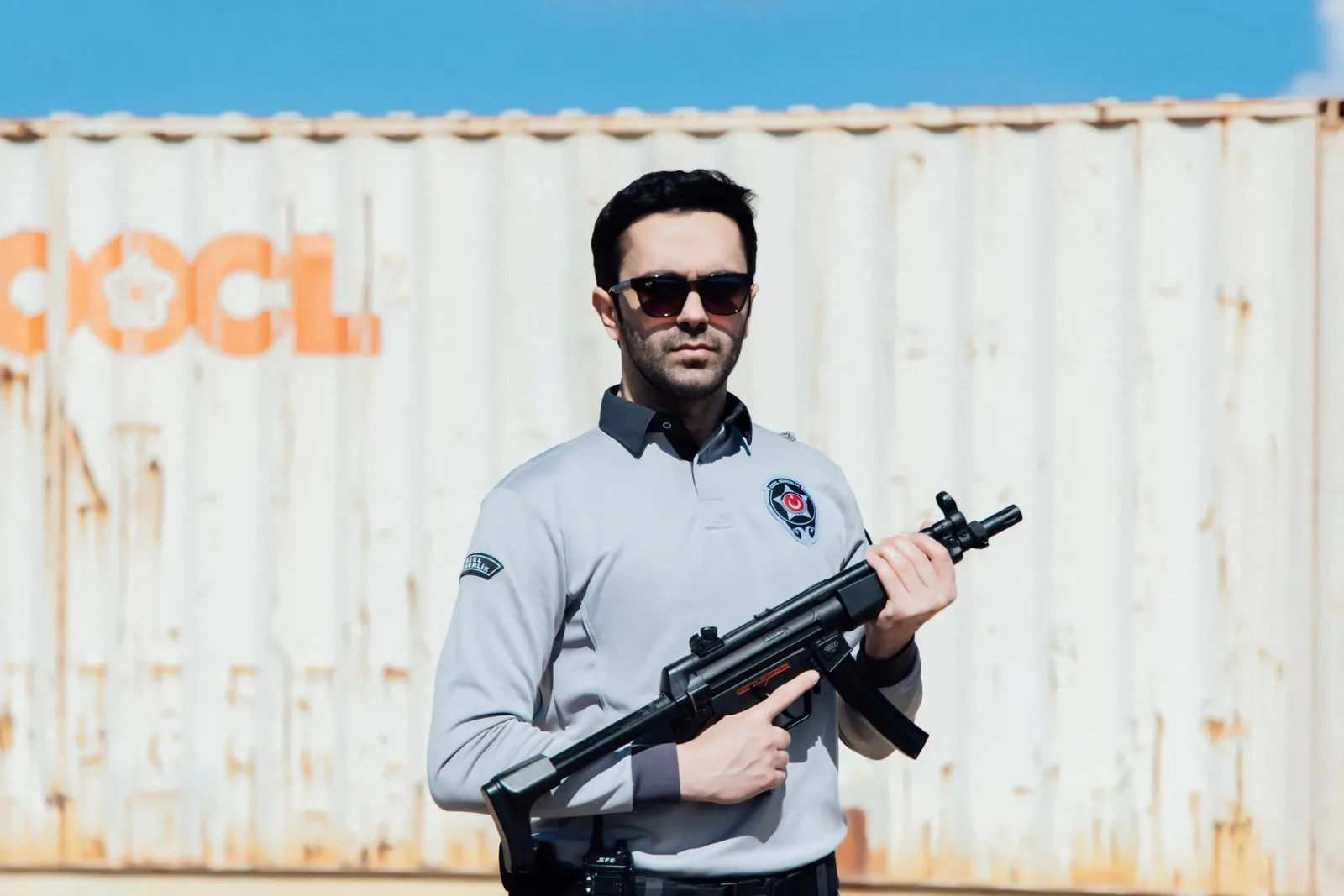
Short answer: Entry control in public and service buildings in Burdur is really three separate jobs: getting visitors to the right unit at the reception desk during the day, closing the building in a written sequence once working hours end, and knowing at every moment who holds which key. Treating all three as a single "door duty" leaves gaps, mostly in the evening. One point matters in particular: if visitors are registered, that is the institution's own entry rule; the officer applies the rule and does not present it as a personal legal power.
This article is general information, not legal advice.
Why public building security matters so much in Burdur
According to the Social Security Institution (SGK) Statistical Yearbook 2025, 9,370 of Burdur's 39,929 compulsorily insured employees under scheme 4/1-a work at public sector workplaces. That is about 23.5%, against 12.5% for Turkey as a whole. The yearbook also lists 15,833 civil servants (4/1-c) in the province. Adding the two groups, we estimate that about 45% of dependent employees in Burdur are on the public side, compared with roughly 28% nationally. Thousands of people work in public service buildings in Burdur every day, and many more walk in to get something done.
This shapes security in two ways. During the day the reception desk is the institution's shop window: visitors often ask the security officer first which floor or unit they need. In the evening the building empties and the risks shift to details that the daytime crowd hides: an unlocked archive room, a window left open, a spare key nobody can account for.
The limit of authority: the institution sets the entry rule
What an officer may do is set out as a list in Article 7 of Law No. 5188 on Private Security Services. For people entering a protected area, that list covers the walk-through detector gate, a hand-held detector search and screening bags by X-ray (7/a). Article 9 also confines these powers to the officer's duty hours and post.
In practice this means:
- Visitor registration is the institution's rule. An institution may decide who enters its building and on what terms through its own visitor admission procedure. Its legal basis and method are written by the institution's legal unit; the officer applies the written instruction.
- The officer does not say "the law requires it". "Our institution's entry rules ask us to register visitors" is an accurate and honest sentence; relying on a power that does not exist only escalates an argument with a visitor who objects.
- The route for someone who declines is written in advance. For example, a staff member from the relevant unit comes down to meet the visitor, or the matter is handled at the desk. Registration is never forced.
- A visitor log is personal data. Turkey's Personal Data Protection Law No. 6698 requires data to be processed for a specified, legitimate purpose, limited and proportionate to that purpose and kept only as long as necessary (Article 4); informing the data subject is a separate obligation (Article 10). The desk therefore displays a short privacy notice, records only the fields needed, and never lets the next visitor see the logbook or screen.
Daytime: setting up the reception desk
Reception is where visitors find their way; checking them is part of the job, not the whole of it. A well-run desk answers these questions in advance:
- Who meets whom? When a visitor with an appointment arrives, the relevant unit is called; it decides whether to receive the person and who will come down.
- Which areas are open to all? Cash desks, document intake and waiting rooms are listed separately from archives, server rooms and the management floor, and the escort rule for the second group is made explicit.
- How do visitor passes come back? The pass number goes into the log and the pass is collected on exit; missing passes at the end of the day go into the handover note.
- Where do couriers and contractors go? Parcels are received at the desk or the unit is notified; maintenance and cleaning contractors have their own list and working hours.
What does the research say?
1. Whoever asks for a key often gets it
In a field experiment at a workplace, 31 people followed a script, visited the rooms of 118 employees and asked for the keys to their workrooms. Before the visits, half of the employees were randomly given a short awareness intervention. Among those without it, 62.5% handed over their key; among those who received it, 37.0% did, a significant difference. Scripts that stressed authority showed no significant effect (Bullée et al., Journal of Experimental Criminology, 2015). The study took place in a single organisation and does not transfer directly to a public building. Our reading: a polite request from a stranger can be enough to obtain a key. Brief, regular awareness sessions can lower that rate, but the real answer is a system in which keys are issued from a key cabinet against a signature, not passed from hand to hand.
2. Cameras work better when watched and combined with other measures
Pooling four decades of camera evaluations, Piza and colleagues (Criminology & Public Policy, 2019) found that CCTV went along with a small yet statistically significant fall in crime, most clearly in car parks. Systems where someone watched the live picture did better than systems that only recorded, and cameras paired with other measures did better than cameras on their own. The authors advise pointing cameras at vehicle and property crime and never relying on them alone. For a service building after hours, a system that records but that nobody watches is useful mainly after the event. A routine that links the evening round, the alarm and the cameras is stronger.
3. Locks and external lighting come before the alarm
Working with 2008–2012 national victimisation survey responses from England and Wales, Tseloni and colleagues (Security Journal, 2017) estimated how much each home security device protects against burglary. Taken one at a time, the strongest performers were outdoor lighting and a second lock or deadlock on the door. Burglar alarms, real or dummy, looked weaker than having nothing installed. Pairing door and window locks with outdoor lighting or a door chain was linked to protection at least twentyfold greater than having no devices, for burglaries where the offender got inside. The findings come from homes and cannot be applied one-to-one to a public building. They still guide the closing round: before setting the alarm, confirm that doors and windows really are locked and that external lights are on.
Evening: closing the building step by step
- Last-out time: Staff staying after the time set by the institution are registered at the desk on their line manager's notice. Nobody is left in the building outside the round simply because they said they would stay a little longer.
- Floor-by-floor round: The officer follows the same order on every floor: corridors, washrooms, meeting rooms, archives and plant rooms. Doors that should be locked are tried one by one.
- Windows and roof access: Ground-floor and basement windows come first. According to the Turkish State Meteorological Service, the lowest temperature recorded in Burdur is −16.7 °C; on winter nights an open window is a frost and water damage risk as well as a security gap.
- Emergency exits: Emergency exit doors are left exactly as the building's fire and emergency plan defines; they are never chained or padlocked for security reasons. Anything stored in front of them is noted.
- Power and heaters: Heaters or kettles left plugged in are switched off and reported according to the facilities unit's instructions.
- Alarm and cameras: The alarm is set after the round; the officer checks that the cameras are sending images.
- Closing record: Time, any open doors or windows found, people still in the building and the state of the key cabinet are written down in a few lines and passed to the morning shift and the institution's contact.
Key control checklist
| Item | Practice | Why? |
|---|---|---|
| Key cabinet | Locked, at reception or in the security room; every key has a numbered hook. | A missing key is visible at a glance. |
| Issue log | Keys go only to people on the authorisation list, with time and signature; returns are logged too. | "Who had it?" is answered by the record. |
| Authorisation list | The institution decides who may take which key and gives the desk a signed list. | The officer does not decide; the officer applies the list. |
| Master keys | Few in number, holders on a separate list, copies only with written approval. | One loss can leave the whole building open. |
| Contractors and cleaners | Keys issued for the day and collected at the end of it; never kept overnight. | Staff change, the key stays in the building. |
| Lost keys | Logged the same day and reported to the institution; the decision to change locks is the institution's. | A lost key is an open door. |
| Periodic count | Keys in the cabinet and keys issued are checked against the list at set intervals. | Forgotten spares only surface in a count. |
Out-of-hours emergencies: who gets in, and how?
Burdur lies in an earthquake-prone region, so emergency and business continuity plans should treat out-of-hours periods separately. If the building has to be entered at night because of a water leak, a fire alarm or a damage assessment, the officer needs an up-to-date call list, a plan showing which key opens which section, and the building's assembly point. These lists should be reviewed at least once a year and again after staff changes.
Common mistakes
- Having officers apply entry rules "because the law requires it" and never putting the institution's own rule in writing.
- Asking visitors for more information than needed and leaving the logbook where anyone can read it.
- Handing out keys without a signature or time; skipping the list for "familiar staff".
- Letting cleaning and maintenance contractors take keys home.
- Running the closing round by the same shortcut every night and skipping basements and plant rooms.
- Setting the alarm without trying each door and window.
- Chaining emergency exits for security reasons.
- Not logging a lost key because "it will turn up".
A note on practice in Turkey
Before an institution can hand its security to a company, the provincial private security commission must decide on it and the governor must approve (Law No. 5188, Article 3). In public institutions the scope of the service is usually set by the tender specification; if reception, the closing round and key control are written as separate lines in it, the officer's daily tasks are no longer open to debate. Visitor admission rules, the key authorisation list and the privacy notice are the institution's own documents: the security team does not draft them, it applies them and reports gaps in writing.
You can read about our approach in Burdur on our private security in Burdur page, and about our work for public buildings and critical sites on our critical infrastructure security page. To review your building's risks yourself, try the security risk assessment tool.
Titan Savunma is an Ankara-based private security company licensed by the Ministry of Interior under Law No. 5188 and certified to ISO 9001, 14001, 45001, 22301 and 28000. We work with international companies in English and Turkish; our Burdur City Manager, together with our Mediterranean Regional Directorate and the Ankara General Directorate, puts your building's reception, closing and key routines in writing with your team, in line with your institution's rules. To arrange a site visit, contact us.
Sources and Further Reading
- Bullée, J.-W. H., Montoya, L., Pieters, W., Junger, M. & Hartel, P. H. — The persuasion and security awareness experiment: reducing the success of social engineering attacks, Journal of Experimental Criminology 11(1):97–115 (2015)
- Piza, E. L., Welsh, B. C., Farrington, D. P. & Thomas, A. L. — CCTV surveillance for crime prevention: A 40-year systematic review with meta-analysis, Criminology & Public Policy 18(1):134–159 (2019)
- Tseloni, A., Thompson, R., Grove, L., Tilley, N. & Farrell, G. — The effectiveness of burglary security devices, Security Journal 30(2):646–664 (2017)
- SGK — İstatistik Yıllığı 2025, Sigortalı ve İşyeri İstatistikleri (Tablo 1.7, 1.17)
- 5188 sayılı Özel Güvenlik Hizmetlerine Dair Kanun (md. 3, 7, 9), Mevzuat Bilgi Sistemi
- 6698 sayılı Kişisel Verilerin Korunması Kanunu (md. 4, 10), Mevzuat Bilgi Sistemi
- Meteoroloji Genel Müdürlüğü — Resmî İl ve İlçe İstatistikleri: Burdur (1931–2025)