For Burdur’s Marble Workings, Dairy Producers and Public Campuses · Turkey

Private Security Company in Burdur

Titan Savunma is an Ankara-based private security company holding an operating permit from the Ministry of the Interior under Law No. 5188; in Burdur it works at marble quarries, workshops that cut blocks and finish slabs, plants that collect and process milk, organised industrial zone plots, university units and hospitals. When choosing between the security companies in Burdur, the first thing an organisation needs to know is who will be facing it once the contract is signed. In this province that person is our Burdur City Manager: the City Manager comes to survey your site, chooses the officers, stands at the head of the team and takes on each day’s checks and the correspondence with you. The City Manager does not work alone: one level up is our Mediterranean Regional Directorate, with its seat in Antalya, and above that the Ankara General Directorate. Those levels share the planning load, carry out unannounced inspections and keep training topics and the report layout the same in every province. In short: quick decisions locally, institutional assurance behind them. The duty plan is shaped by Burdur’s own picture: stone workings spread across the countryside, food production that runs on morning and evening milk intake, a heavy public-sector share of employment and an inland Mediterranean climate with cold winters.

Private Security Company in Burdur

Service Scope

The Facilities We Cover in Burdur

Burdur has a small but clearly specialised economy. According to 2025 social security data, 1,754 insured people work in quarrying, the branch that includes marble; its share of local employment is about 13 times the national average, placing the province ninth in Turkey in this branch by insured headcount. Manufacture of non-metallic mineral products, with 3,395 insured employees, is the province’s largest manufacturing branch. Food manufacturing employs 2,501 insured people and carries about 1.9 times its national weight. The fact that 23.5% of compulsorily insured employees are at public-sector workplaces (Turkey: 12.5%) sets out the fourth heading on its own.

Marble Quarry and Block Yard Security in Burdur

At quarry faces far from settlements, block stacking areas and plant parks, we divide the site that empties at night into logged round points, match lorry movements to weighbridge tickets and assess every out-of-hours vehicle against the list the operator has approved.

Dairy and Food Plant Security in Burdur

We set up a routine that keeps the tanker queue orderly at milk intake times, stops unauthorised passage into production areas at the gate and patrols around cold stores at night; on large farms, barns, feed and equipment stores join the round plan too.

Factory and Industrial Zone Security in Burdur

At mineral products, concrete and wood products plants we take on the long perimeter line, vehicle traffic between raw material and product yards, and fuel and critical equipment areas; on organised industrial zone plots we handle gate and fence checks during the dark hours.

Campus, Hospital and Public Building Security in Burdur

We provide unarmed officers to university units, healthcare facilities and public buildings in line with Article 8 of Law No. 5188, and set the number of posts and the content of reports to the description in the tender specification.

A Planned Start

How the Service Is Planned

Before putting a figure on paper for a quarry, dairy or public campus in Burdur, we answer three questions together: which corner of the site goes completely unwatched at night, at what hours vehicle and visitor traffic peaks, and from which document you want to follow the checks that are made.

  1. Reading the Site by Day and by Night

    Our Burdur City Manager walks your site twice, once during working hours and once after dark, noting the number of entrances, unlit sections, stock areas, camera blind spots and yard roads that freeze in winter.

  2. Preparing the Application to the Governorship of Burdur

    You are the applicant: the application goes to the Governorship of Burdur in your organisation’s name. You gather the papers for the commission together with our City Manager, who checks the file item by item before the day it is handed in.

  3. Forming the Team and Writing Its Orders

    Who works which shift, and who leads each shift, is decided by our City Manager. The gate, patrol and incident-reporting instructions follow the milk intake hours or the quarry’s working calendar, and once the team is on site the City Manager remains at its head. Where the headcount reaches fifteen, the name of the statutory security supervisor is settled at this stage.

  4. Unannounced Inspection and a Monthly Review

    Each day’s roll-call is our City Manager’s work. Beyond that, inspectors from the upper tiers drop in sometimes by appointment and sometimes with no word at all. The review that reaches you in the last week of the month shows, in one place, the gaps found, which have been closed and which are still being worked on.

Your Sector’s Priorities

Decisions on the Spot in Burdur, Institutional Support from the Mediterranean Regional Directorate

The 2025 social security yearbook records 7,297 workplaces and 39,929 compulsorily insured employees in Burdur; since 2016 the number of workplaces has risen by 26.8% and insured employees by 18.3%, with insured employment up a further 4.6% in the latest year. At 90.4% of workplaces, nine people or fewer are employed. The 96 workplaces with fifty or more staff hold 30% of insured employees, and the 11 with 250 or more hold 10.5%; no workplace in the province exceeds 750 people. In a fabric made up of mid-sized plants and small sites scattered across the countryside rather than one giant employer, security runs best with a manager who tours sites regularly and can rearrange a post without delay. In Burdur that manager is our City Manager. The upper tiers draw the frame around that local management: the Mediterranean Regional Directorate in Antalya and, at the top, the Ankara General Directorate comment on the plan, dispatch their own inspectors without alerting the City Manager first, and keep the subjects officers are trained in and the headings reports follow identical everywhere.

Law Enforcement Background

The professional experience and security training of retired law enforcement personnel within our team contribute to our approach.

  • Quarry and Stock Yards That Empty at Night

    On open ground holding plant, fuel and stacked blocks, round points and times are put on record.

  • Separate Post Arrangements for Frost and Heat

    A heated booth and icing alerts for winter, shade and drinking water for summer, are written into the orders before the service begins.

  • Timely Notices to the Governorship of Burdur

    The contract copy and officer changes reach the governorship within the statutory periods; we keep the calendar.

For International Companies

For international brands in Turkey, we offer a single point of contact, a written scope and regular reporting. Work with us as your security partner

Expert View and Recommendations

The different needs of quarries, dairies and public campuses when choosing a security firm in Burdur

The questions an organisation seeking security in Burdur faces arise from the province’s pattern of production: at a marble quarry at the end of a village road, who watches the blocks and plant once work has stopped? At a plant taking in milk twice a day, how does gate control work without breaking hygiene rules? In a province where the public sector provides a large share of jobs, how is a team built to fit the tender specification? In a climate that has seen both minus sixteen and forty-one degrees, how are open-air posts planned? The six sections below address these questions on the basis of social security, meteorological and legislative records, within the limits of Law No. 5188.

Research we draw on (5)
  1. 5188 sayılı Özel Güvenlik Hizmetlerine Dair Kanun — Mevzuat Bilgi Sistemi
  2. Özel Güvenlik Hizmetlerine Dair Kanunun Uygulanmasına İlişkin Yönetmelik (Mevzuat Bilgi Sistemi, güncel metin)
  3. SGK İstatistik Yıllığı 2025
  4. Meteoroloji Genel Müdürlüğü — Burdur il istatistikleri
  5. Burdur Mehmet Akif Ersoy Üniversitesi — Güvenlik Hizmetleri MYO 2025 Birim Faaliyet Raporu

Quarrying and marble processing: scattered sites, block stacks and weighbridge records

According to 2025 social security data, 1,754 insured people work at 120 workplaces in Burdur in quarrying, the branch that includes marble. Measured against Turkey as a whole, quarrying is around thirteen times more concentrated here, and only eight provinces have more insured workers in it. Manufacture of non-metallic mineral products, which covers activities such as marble processing, cement and concrete, is the province’s largest manufacturing branch, with 3,395 insured employees at 174 workplaces. Together the two branches account for 5,149 insured employees, around 12.9% of the provincial total. A facility for micronising marble waste has been included among the Ministry of Industry and Technology’s Local Development Initiative projects.

We build security at these sites in three rings:

  • Quarry face and site: On rural ground that cannot be fully enclosed, separate checkpoints for the plant park, fuel tank and cabins; for operators with several quarries, a patrol at varying times
  • Block stacking area: Numbered blocks matched with plates and dispatch documents, and the gate record compared with weighbridge tickets at the end of the day
  • Processing workshop and plant: Visitors escorted onto cutting and polishing lines, slab store dispatches tied to the stock list, and a building and yard round out of hours

The rules on blasting, excavation and occupational health belong to the operator and the relevant public bodies; when our officer sees them being ignored, the operator is told in writing, and nobody without business at the quarry is let in.

Milk and food production: intake times, the hygiene gate and farm stores

In 2025 social security data, food manufacturing in Burdur employs 2,501 insured people at 205 workplaces; the branch’s weight in local employment is about 1.9 times the national average. Agriculture weighs even more heavily among the self-employed: 40.8% of those insured under the 4/1-b scheme are agricultural insured persons (Turkey: 20.3%). Veterinary services are also concentrated at about 2.3 times the national average. Taken together, these figures point to a broad production chain in the province built on milk collection, processing and livestock.

The routine we propose for food plants and large farms:

  • The officer keeps the tanker queue and weighbridge record at milk intake times, writing plate and time on the same line
  • Passage into the production area only through the gate the operator sets, following clothing and hand-hygiene rules; the officer supervises the outer line without entering the hygiene zone
  • Seal numbers matched with delivery notes on refrigerated dispatches
  • On farms, barns, feed stores, equipment and fuel areas brought into the night round

Product quality, cold-chain temperature monitoring and animal health belong to the operator and veterinary surgeons; the security team reports any fault it notices to the person the operator has named.

Mineral industry, wood products and industrial zone plots: long perimeters and forest neighbours

Alongside mineral products, Burdur’s manufacturing also stands out in wood products and forestry. According to 2025 social security data, 723 insured people work at 74 workplaces in the manufacture of wood and wood products, and 446 at 22 workplaces in forestry; the two branches carry about 4.6 and 4.7 times their national weight in local employment. Manufacturing as a whole, with 9,067 insured employees, makes up 22.7% of local employment. In a statement reported in the press in February 2026, the Burdur Chamber of Commerce and Industry also said it would speed up work on enlarging the 2nd Organised Industrial Zone.

What we focus on at plants and industrial zone plots:

  • Perimeter: Fences, lighting and camera blind spots at mineral and concrete sites with large grounds tied into the round plan
  • Vehicle traffic: Gate records for lorries shuttling between raw material and product yards, and separate lists for visitor and subcontractor vehicles
  • Critical areas: After-hours checks around equipment such as fuel tanks, transformers and compressors
  • Forest neighbours: At wood products plants and sites on the forest edge, the evacuation route, assembly area and alert chain to the fire service written down in advance

Fire prevention and fire fighting arrangements rest with the operator and the fire service; when the security officer sees smoke or sparks, the chain in the orders is set in motion and the site kept ready for evacuation.

The weight of the public sector: university units, hospitals and teams that fit the specification

Burdur is a province where public-sector employment weighs markedly heavily. According to 2025 social security data, 23.5% of compulsorily insured employees are at public-sector workplaces (Turkey: 12.5%); once 15,833 civil servants are counted, the public sector’s share of all dependent employment rises to about 45.2%, against roughly 28.1% nationally. The main campus of Burdur Mehmet Akif Ersoy University is in the provincial centre, and there are vocational schools in districts such as Bucak and Altınyayla. Human health services, for their part, employ 1,938 insured people.

At education and healthcare sites such as schools and hospitals, Article 8 of Law No. 5188 does not allow armed private security officers to be employed; none of our teams working there is armed. The main headings:

  • Main campus: Separate officers watching the vehicle barrier and the pedestrian turnstiles, walks around student halls after dark, and reinforcement at the start of term and in final exam week
  • District units: The same orders and report template for every vocational school, and written handovers in small teams
  • Hospital: An officer at the emergency entrance able to calm tense moments, a clear ambulance lane and guidance for visitors at visiting times
  • Construction phase: On public buildings under construction, posts that move to protect materials and plant

Because most public purchasing goes through tenders, we build our bid line by line from the specification: how many officers, at which post, at what hours and what the report covers. A task the specification does not describe is not handed to an officer until it has been agreed with the institution in writing.

An inland Mediterranean climate, construction sites and earthquakes: a two-season post plan and business continuity

Although Burdur lies in the Mediterranean Region, its climate is inland in character. According to the meteorological service’s readings for 1931–2025, the January mean in the provincial centre is 2.6 °C and the July and August mean 24.7 °C; the lowest temperature measured is −16.7 °C, the highest 41.8 °C, and the deepest snow cover 46 cm. Adding up the monthly means gives annual rainfall of about 428 mm, and summers are dry. The 2025 social security yearbook also shows 5,768 insured employees at 850 temporary workplaces, most of which are construction sites.

What we write into the orders for open-air posts:

  • For the cold months, a warmed guard hut, proper winter kit and a manual routine to fall back on when frost stops a barrier arm or a camera
  • Whom the officer on duty informs, and how they are supported, if snow and ice delay the handover
  • In summer, a shaded post, enough drinking water and shorter open-ground rounds in the hottest hours
  • On construction sites, posts that move as work progresses, with separate protection for material stocks, night parking for plant, and cable and fuel stores

Burdur is one of the Mediterranean provinces with earthquake risk, so the plan also has a business continuity section. What the security team is expected to do once the shaking stops is hold the gates, take staff to the agreed meeting point, leave the way open for rescue vehicles and make sure nobody goes back into cracked buildings. We tie that sequence to the clauses of the operator’s own plan, write down for each gate which role does what, and run through it together at the annual drill.

The Governorship of Burdur: permits and notices, and the roles of our City Manager and Mediterranean Regional Directorate

The request for a permit comes from the organisation buying the security service; under Article 8 of the Regulation, that organisation applies in its own name to the Governorship of Burdur. Under Article 3 of the Law, the permit is granted by decision of the provincial private security commission with the governor’s approval, and the Regulation expects applications to be concluded within ten working days. The list of papers is updated from time to time, so going over its latest version with the governorship a few days before filing saves time.

Once the contract is signed, the time-limited tasks are ours to follow:

  • A copy of the contract goes to the governorship during working hours on the first day of service (Law 5188, Art. 5; Regulation, Art. 10).
  • Staff movements: An officer who joins, leaves or moves to another site is reported to the governorship before a fifteen-day window closes (Law 5188, Arts. 11–12; Regulation, Art. 8).
  • Security supervisor: Where a site’s headcount reaches fifteen, a supervisor with an associate degree or higher is named (Law 5188, Art. 5).

Making sure none of these deadlines slips is the job of our Burdur City Manager. Since the person who surveys, builds the team, checks daily and corresponds with the client is the same, the manager who first sees a problem also holds the authority to fix it. In our organisation the City Manager sits under the Mediterranean Regional Directorate in Antalya, and that directorate under the Ankara General Directorate. These two tiers help finalise the plan, put inspectors on site without the City Manager being told and lay down the measure that training and reports must meet.

When looking for officers, we turn first to people living in Burdur. According to the 2025 social security yearbook, Burdur’s security and investigation branch counts 47 workplaces with 831 insured staff, a concentration roughly 1.4 times the Turkish norm. The figure is not the whole of the province’s security workforce: guards hired directly by a hospital or factory show up under that body’s branch, and staff working in Burdur for firms registered elsewhere may be left out of the count. We look at each candidate’s certificate and training record and go through the orders of their future site with them before the first shift. The proposal spells out how many times a month checks and surprise visits take place, and their results go into the monthly report.


Before We Speak

Frequently Asked Questions

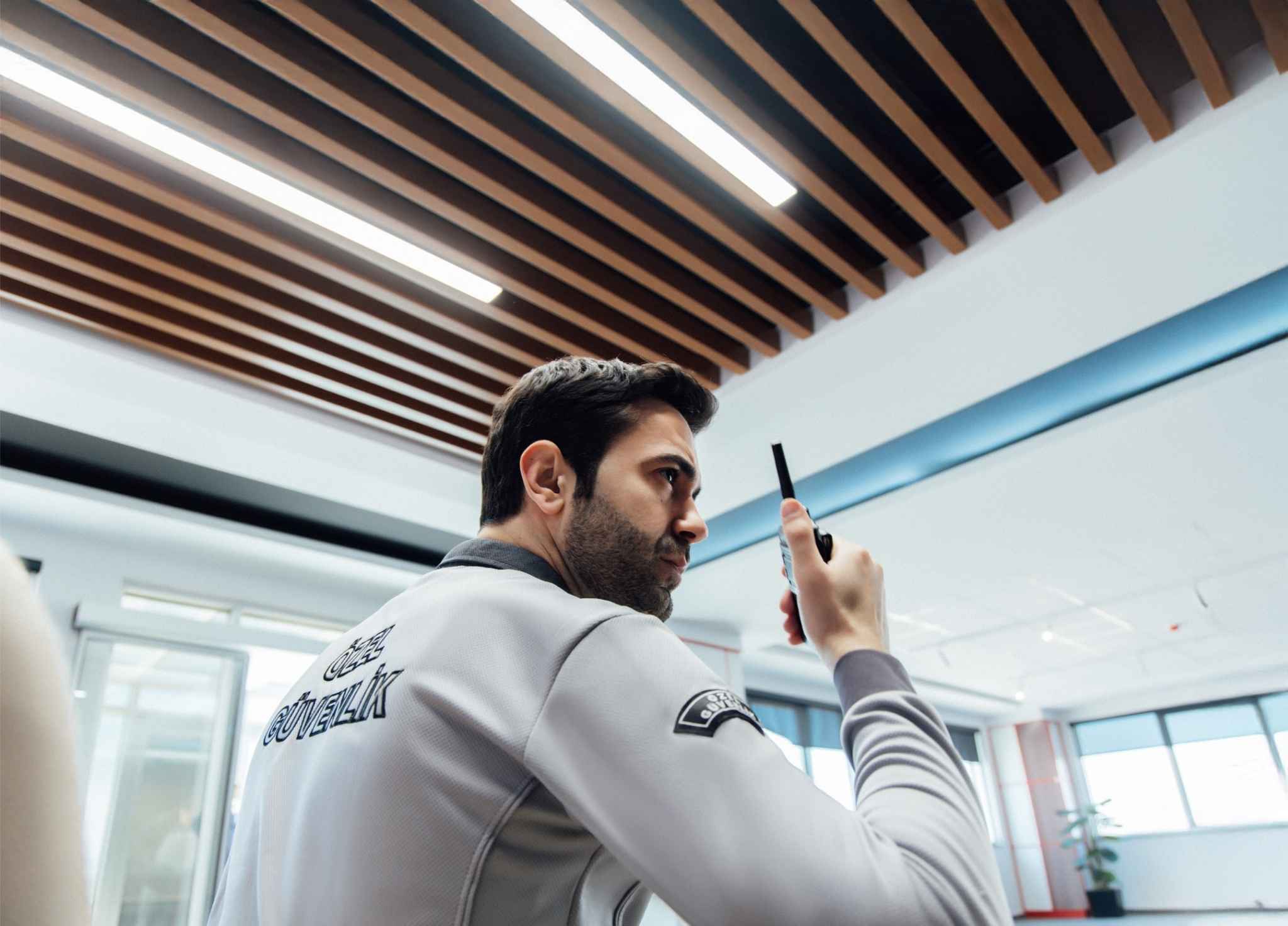
A Titan Savunma officer in a private security uniform communicating by radio inside a building.
Which documents should we ask for when comparing security firms in Burdur?

The first document to request is the operating licence issued by the Ministry of the Interior under Law No. 5188. After that, so that bids can be laid side by side, ask each firm for a written plan in the same format. It should state plainly who is in charge on site, at what intervals an inspector will turn up unannounced, how the gap is covered when an officer falls ill, the list of points to be walked after hours and which report you will receive each month. Our proposal fills in those headings from what we saw during the survey.

Who do we talk to about day-to-day matters at our site in Burdur?

Your contact is our Burdur City Manager: the same manager who inspects your site on day one, selects and heads the officers, checks every day and corresponds with you. If you want an extra post, are unhappy with an officer or want to know how an incident ended, the City Manager is the person you phone. Two tiers stand behind: our Mediterranean Regional Directorate in Antalya and, at the top, the Ankara General Directorate. They contribute to the plan, put their inspectors on site without announcing them and apply one yardstick to training and reporting alike.

What route does the governorship permit take for our quarry or dairy plant?

The organisation that will receive the security service applies to the Governorship of Burdur in its own name. The file is then ruled on by the provincial private security commission, and the permit takes effect when the governor endorses that ruling; the Regulation expects applications to be concluded within ten working days. The site may be a rural quarry, a food plant in the town or an industrial zone plot; the procedure is the same. Our City Manager works with you on preparing the paperwork.

How do I apply for a job as a private security officer in Burdur?

Applications are received through our Careers page. Recruitment for the teams in Burdur is run by our City Manager, who pairs each candidate with a suitable site and its shift pattern. To serve as an officer, Article 10 of the Law asks, among other things, for Turkish citizenship and a minimum age of eighteen. For a candidate who meets these conditions and has passed the basic private security training, the work permit and ID card are issued by the Governorship of Burdur (Law 5188, Arts. 11–12).

How is night security set up across scattered marble quarries?

Quarry sites are often at the end of village roads, on sloping ground that is hard to enclose fully. So we divide each quarry into zones: the face, the block stacking area, the plant park, the fuel tank and the site cabin are separate checkpoints. For operators with several quarries, a patrol route at varying times can work better than a fixed post; we weigh this up together during the survey. Plate, time and dispatch document are recorded for every block leaving the site. If the quarry keeps an explosives magazine, watching over that area gets its own heading in the post orders, based on the rules for explosives and the operator’s written request.

What is the security officer’s job at a milk collection and processing plant?

At morning and evening milk intake, the officer queues the tankers and enters plate, time and weighbridge record on the same line, and makes sure the production area is entered only through the gate the operator defines and in line with hygiene rules. The officer does not enter the hygiene zone but supervises the outer line. After hours, the surroundings of the cold store, packaging store and boiler room are checked by logged rounds. Milk quality, temperature monitoring and stock counts are the operator’s staff’s work; when the officer sees a fault, the person the operator has named is informed.

How do Burdur’s winters and summers affect open-air posts?

According to the meteorological service’s readings for 1931–2025, the January mean in the provincial centre is 2.6 °C; the lowest temperature on record is −16.7 °C and the deepest snow cover 46 cm. In July the mean maximum climbs to 32.1 °C, and the highest value measured is 41.8 °C. Because of these two extremes, we write two separate arrangements for quarry, farm and construction site posts: in winter a heated booth, reporting slippery ramps to the operator and a procedure if the handover is delayed; in summer a shaded post for the midday hours, drinking water and shorter open-ground rounds.

What part does the security team play in earthquake and forest fire planning?

Burdur is one of the Mediterranean provinces with earthquake risk, and some of its sites border forest land; responsibility for the emergency plan stays with the business itself, while our team handles the specific steps written in for security. After a tremor those steps are bringing the site entrance under control, directing staff to the assembly area, keeping the route for ambulances and fire engines clear and preventing unauthorised entry into damaged sections. At quarries and plants next to forest, the evacuation route, the muster point and the alert chain to the fire service are written down in advance. We tie each step to a role and try it out with the team during the operator’s exercises.

A Survey and Proposal for Your Quarry, Dairy or Campus in Burdur

A few lines on the form are enough to start: the district or zone where the site sits, its number of gates, whether anyone is there overnight and the hours when lorries and visitors come and go most. Our Burdur City Manager then rings to fix a date for the walk-round, and a written proposal setting out duties and cost for that specific site follows.

Request a Security Proposal

Contact

Request a Security Proposal for Your Organisation

Tell us your facility type, location and general requirements. Together, we can define a service scope that suits your organisation.

Tell Us What You Need

Fields marked * are required.

What Happens Next

  1. Initial DiscussionWe respond within 15 minutes and clarify your requirements and facility details together.
  2. Service ScopeWe assess staffing needs and the working arrangements.
  3. ProposalWe prepare our proposal for the agreed service scope.

General Directorates

Ankara · Çankaya
İstanbul · Levent

Nine regional directorates · 81 provinces

Looking for a role? Visit our careers page