This article is general information, not legal advice.
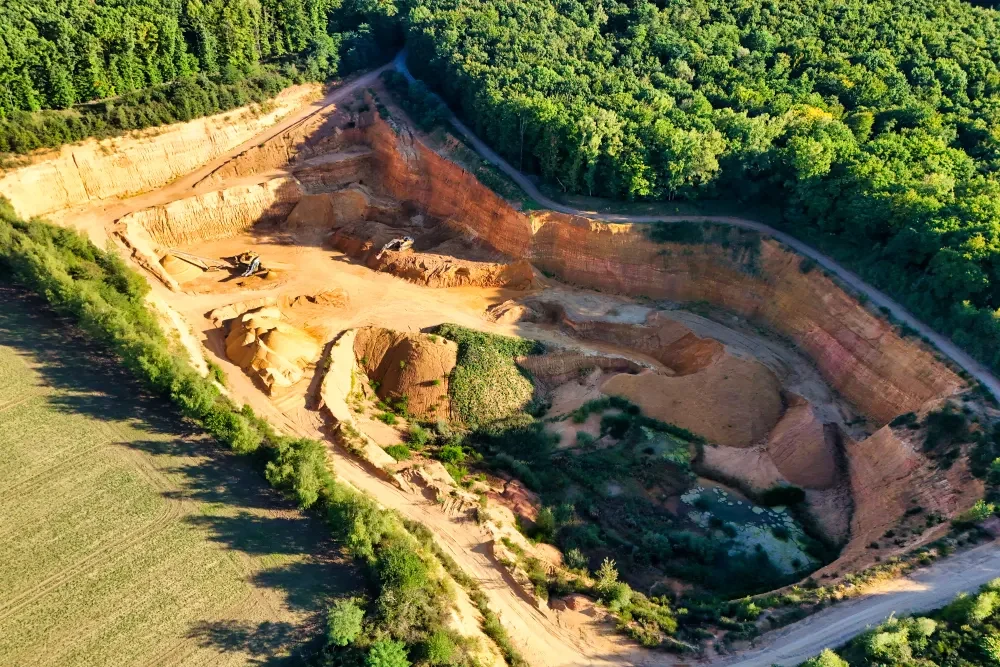
Mining site security means protecting explosives, fuel, cable and valuable ore across a large, often remote area while building a relationship of trust with neighbouring communities. Peer-reviewed research shows that conflict with local communities can impose heavy costs on mining projects through delays, blockades and management time. A sound plan therefore combines perimeter and access control, strict explosives accounting, insider-risk management and proportionate use of force.
This guide brings together layered recommendations, the indicators worth measuring and common mistakes for open-pit and underground mines, quarries and ore-processing plants. To discuss your site, see our mining facility security services.
The mining site security risk profile: what the research shows
Mines differ from other industrial sites in three ways: the area is very large and often far from towns; the site holds explosives, fuel and copper cable that are easy to turn into cash; and the project has to live alongside the same communities for many years. A risk assessment should start from these three features.
Community conflict: a heavy and often overlooked cost
A study by Franks and colleagues, published in PNAS in 2014, analysed 50 cases of prolonged or escalated company–community conflict around mining operations and held 45 in-depth interviews, mainly with people from mining and hydrocarbon companies. Half of the cases (25 of 50) involved a project blockade, 21 involved a fatality and 17 involved damage to private property. The most frequent cost interviewees identified was lost productivity from delay; the most often overlooked was the additional staff time needed, especially at senior management level. Interviewees described a major mining project with capital expenditure of US$3–5 billion losing roughly US$20 million per week of delayed production in net present value terms. The findings come from interviews and case analysis and should not be read as an average cost for every mine.
Conflict and security are linked. A study by Berman, Couttenier, Rohner and Thoenig in the American Economic Review (2017) combined georeferenced extraction data for 14 minerals with conflict events across Africa between 1997 and 2010. Using exogenous variations in world prices, the authors found a positive impact of mining on conflict at the local level and estimate that the commodity super-cycle price rise might explain up to one-fourth of the average level of violence across African countries over the period. The study concerns armed conflict in Africa and cannot be generalised directly to other countries, but it is a useful warning that pressure on a site can grow when prices rise.
Theft of valuable materials and the price effect
Copper cable, scrap metal, fuel and ore concentrate become theft targets as market prices move. A time-series analysis by Sidebottom, Ashby and Johnson in the Journal of Research in Crime and Delinquency (2014) examined 76 months of police-recorded copper cable thefts from the British railway network between 2006 and 2012 and found that changes in copper price were positively associated with changes in theft volume. The study concerns railways, not mines, but it supports the logic of tracking commodity prices as a risk indicator at mine sites with long runs of exposed cable.
Explosives and the insider threat
Explosives theft is rare but severe, and it can come from inside. A December 2024 safety bulletin from the Western Australian mines regulator reports that, in a theft of explosives from a mine site, the root cause was the illegal conduct of a trusted employee. Site records showed discrepancies between recorded and actual quantities, but the company had not investigated them. The lesson is plain: explosives security starts not with the lock but with investigating every reconciliation gap at once.
Security personnel can themselves be a risk
Excessive force by security teams can put a company's reputation and its licence to operate at risk overnight. Human Rights Watch's 2011 Porgera report documented serious abuses involving the mine's asset protection personnel at a gold mine in Papua New Guinea between 2008 and 2010. It found that all of the abuses it investigated occurred on or near the mine's sprawling waste dumps, that monitoring of these personnel was inadequate and that victims had no viable channel to lodge a complaint. This is an NGO report rather than academic research, but it shows clearly how unsupervised remote areas and the lack of a grievance mechanism combine to create risk.
Why community relations is a security issue
A longitudinal study by Moffat and Zhang in an Australian mining region (Resources Policy, 2014) found that building trust with local communities was crucial for obtaining and maintaining a social licence to operate. The operation's negative impacts on social infrastructure, the perceived quality of contact with company personnel and procedural fairness in dealing with them all significantly affected community acceptance through the company's inferred trustworthiness. In our experience, security officers are often the first "face of the company" that residents meet each day. An argument at the gate, a rude roadside check or an unexplained search can undo months of community relations work.
Drawing on a large-scale operation in West Africa, Kemp and Owen (Resources Policy, 2013) argue that although the industry presents corporate social responsibility as a "core competence", it has yet to make the community relations and development function part of "core business" in practice. In our assessment, the practical consequence for security is that when security and community relations teams work in separate silos, grievances are more likely to escalate before they are recorded.
The international framework: VPSHR and IFC Performance Standard 4
The Voluntary Principles on Security and Human Rights (VPSHR), launched in 2000 by governments, companies and NGOs, set out a risk-based due diligence approach for extractive companies' security arrangements, including a human rights risk assessment and community consultation, and are embedded as a requirement or benchmark in a number of global industry performance standards, including the ICMM Mining Principles.
For internationally financed projects, the decisive text is usually IFC Performance Standard 4. Its paragraphs 12–14 on security personnel require, in summary:
- An assessment of the risks security arrangements pose to people within and outside the project site.
- Proportionality and good international practice in hiring, rules of conduct, training, equipping and monitoring.
- Reasonable inquiries to ensure that security providers are not implicated in past abuses.
- No use of force except for preventive and defensive purposes, in proportion to the nature and extent of the threat.
- A grievance mechanism for affected communities about security arrangements and the acts of security personnel.
- An assessment and documentation of risks from the use of government security personnel.
- Consideration and, where appropriate, investigation of allegations of unlawful or abusive acts, with reporting to public authorities.
Layered mining security recommendations
| Layer | Recommendation | Basis |
|---|---|---|
| Perimeter | Plan the site not as one fence but as inner zones around critical assets: explosives magazine, fuel station, ore stockpile, workshop and offices. Mark remote, unsupervised areas (waste dumps, old portals) separately on the risk map. | IFC PS4 risk assessment; HRW 2011 (incidents concentrated on remote waste dumps) |
| Entry and access | Separate vehicle and pedestrian gates; define distinct permits for heavy vehicles, contractors and visitors. Link weighbridge, delivery note and number-plate records at the dispatch point. | Theft of valuable materials and the price effect (Sidebottom et al. 2014) |
| Explosives and critical materials | Limit magazine access to a small number of authorised people; reconcile quantities at every issue and return and investigate every discrepancy within the same shift. Have security and the shotfirer co-sign the records. | WA DMIRS Bulletin 0417 (2024) |
| People | Background checks, use-of-force training and training in conduct towards communities for security officers; paired patrols and regular supervision rather than lone posts at remote points. | IFC PS4 para. 12 (background inquiries, training); HRW 2011 (inadequate supervision of remote areas) |
| Technology | Use cameras, thermal imaging and motion detection across the wide perimeter, always with an alarm verification and response procedure; keep vehicle and patrol location logs. | HRW 2011 recommendations (tracking and monitoring systems) |
| Process and records | Keep incident, grievance and use-of-force records in a single system; hold a weekly joint review with the community relations team. | IFC PS4 paras 12–14; Kemp and Owen 2013 |
ISO 31000 offers a common language for prioritising risks, ISO 45001 for integration with occupational health and safety, and ISO 28000 for supply chain and dispatch security. For a first look at your own site, try our security risk assessment tool and security coverage planner.
Expert view: Titan Savunma's recommendations
The points below are our corporate recommendations, based on field experience and the evidence above:
- Bring the community into the risk assessment. Assess not only theft and intrusion but also how security arrangements affect neighbouring villages, grazing and water use.
- There is no "small gap" with explosives. Log every quantity discrepancy as an incident and track it until closed. The Western Australian case shows how uninvestigated gaps can hide insider theft.
- Increase supervision in remote areas. Waste dumps and side roads are where both intrusion and officer misconduct are least visible. Use paired patrols, location logging and random checks.
- Keep the use-of-force rule written and simple. Explain the principle of preventive, defensive and proportionate force through concrete scenarios officers recognise, and require a report for every use of force.
- Set up the grievance channel independently of security. Residents should not have to complain about officers to the security supervisor; offer an anonymous option and report back on outcomes.
- Introduce gate officers to the community relations team. Officers who know local leaders, sensitive dates and likely flashpoints handle contact at the gate far better.
- Watch commodity prices. When copper or gold prices rise markedly, review patrol frequency and controls for cable, scrap and concentrate stockpiles.
What to measure (KPIs)
- Intrusion and theft incidents, broken down by area and material type.
- Explosives and critical-material reconciliation discrepancies and the time taken to close them.
- Alarm verification and on-site response times; false alarm rate.
- Use-of-force incidents and the outcome of each review.
- Security-related community grievances: number, response time and repeat rate.
- Production hours lost to blockades, protests or stoppages.
- Training completion (use of force, human rights, explosives security) and the closure rate of audit findings.
Set targets from your own site's baseline data rather than copying figures from other sites.
Common mistakes
- Treating mine security as fences, cameras and headcount alone, leaving out the community dimension.
- Dismissing explosives record gaps as "counting errors".
- Leaving remote waste and stockpile areas unsupervised.
- Deploying officers without written use-of-force rules and scenario training.
- Keeping the grievance mechanism inside the security function.
- Coordinating with public security forces informally, without documentation.
- Running security and community relations teams with separate goals and no contact.
Notes for operating in Türkiye
In Türkiye, an organisation that contracts its security to a private security company needs the governor's permission, granted on the decision of the provincial private security commission under Article 3 of Law No. 5188 on Private Security Services. The commission may set the maximum number and type of personnel, weapons and equipment and, where necessary, other physical and technical measures. Private security officers' powers are listed in Article 7 of the Law and several of them are defined by reference to the officer's area of duty. At mine sites, the security plan should be aligned with obligations under Occupational Health and Safety Law No. 6331 and with emergency plans. The storage, transport and use of explosives fall under separate legislation; confirm current permits and magazine requirements with the competent authorities.
Frequently asked questions
What is the biggest risk in mining site security?
It depends on the site, but research shows community conflict can impose heavy costs. Half of the 50 cases studied involved a project blockade, and the most frequent cost was lost productivity from delay.
Are the VPSHR and IFC PS4 mandatory for mines in Türkiye?
They are not Turkish law in themselves. They can, however, become contractual requirements through international lenders, investors or buyers, and they are widely used as a good-practice framework.
How can explosives theft be prevented?
By limiting access to a small number of authorised people, reconciling quantities at every issue and return, and investigating every discrepancy immediately. A documented case shows that insider risk can be serious.
How do security officers affect community relations?
Officers are often the first company representatives residents meet. Research shows that the quality of contact and perceived fairness shape trust in the company and acceptance of the mine.
Titan Savunma is an Ankara-based private security company licensed by the Ministry of Interior under Law No. 5188 and certified to ISO 9001, 14001, 45001, 22301 and 28000. We work with international companies in English and Turkish. To build a risk-based security plan and a trained team for your site, see our mining facility security services or contact us.
Sources and Further Reading
- Franks, D. M., Davis, R., Bebbington, A. J., Ali, S. H., Kemp, D., Scurrah, M. — Conflict translates environmental and social risk into business costs, Proceedings of the National Academy of Sciences 111(21), 7576–7581 (2014)
- Berman, N., Couttenier, M., Rohner, D., Thoenig, M. — This Mine Is Mine! How Minerals Fuel Conflicts in Africa, American Economic Review 107(6), 1564–1610 (2017)
- Moffat, K., Zhang, A. — The paths to social licence to operate: An integrative model explaining community acceptance of mining, Resources Policy 39, 61–70 (2014)
- Kemp, D., Owen, J. R. — Community relations and mining: Core to business but not "core business", Resources Policy 38(4), 523–531 (2013)
- Sidebottom, A., Ashby, M., Johnson, S. D. — Copper Cable Theft: Revisiting the Price–Theft Hypothesis, Journal of Research in Crime and Delinquency 51(5), 684–700 (2014)
- International Finance Corporation — Performance Standard 4: Community Health, Safety, and Security (2012)
- Voluntary Principles Initiative — The Voluntary Principles on Security and Human Rights (2000)
- WorkSafe / Department of Mines, Industry Regulation and Safety, Western Australia — Dangerous Goods Safety Bulletin No. 0417: Security of explosives (2024)
- Human Rights Watch — Gold's Costly Dividend: Human Rights Impacts of Papua New Guinea's Porgera Gold Mine (2011)