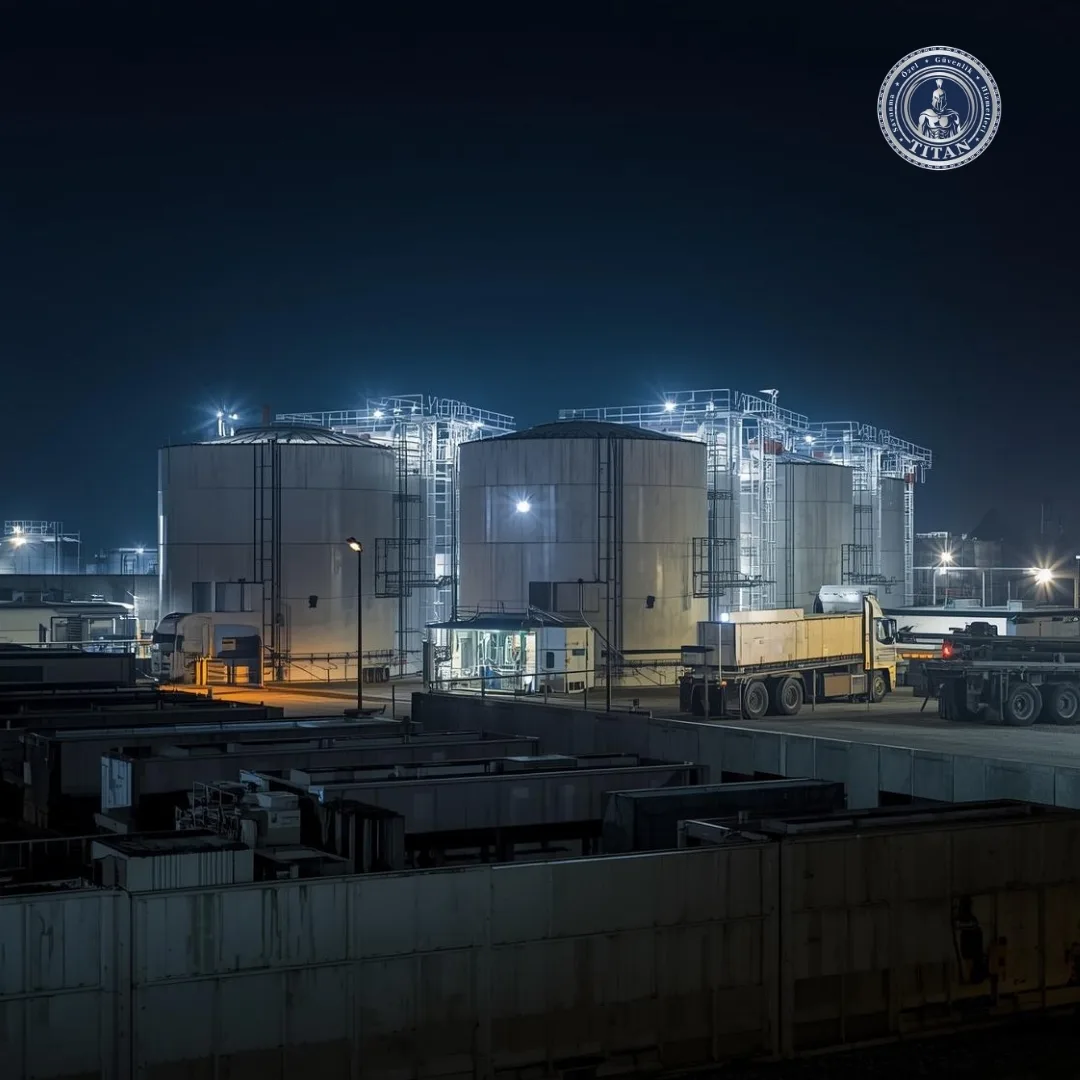
Security at a cement works or a steel plant is much broader than the gatehouse. Hundreds of trucks bring raw materials, scrap and fuel every day, and product leaves through the same gates. Kilns, melt shops and casting areas run at very high temperatures; a quarry often sits at one end of the site; during maintenance outages the contractor population multiplies. A heavy-industry security plan therefore has to deal with material flows, process-safety zones and the occupational health and safety (OHS) system together. Security does not replace OHS, but it can act as its eyes and ears.
This guide looks at integrated cement plants and steel plants with electric arc furnaces and rolling mills as a whole, rather than one process at a time such as the weighbridge or scrap removal.
Material flows and where losses happen
In heavy industry most losses come not from intruders over the fence but from gaps in paperwork and weighing within the flow. Start by mapping every flow in and out:
- Cement: limestone and clay (often from the company's own quarry), gypsum, additives, coal or petcoke, alternative fuels, spare parts and refractory come in; clinker, bagged and bulk cement go out.
- Steel: scrap, ferroalloys, electrodes, lime and refractory come in; billets, rebar or coil go out. Inside the plant, crop ends, mill scrap and maintenance waste are produced continuously.
Typical loss points include scrap or raw material whose grade or moisture differs from what was declared; the gap between what is loaded and what is invoiced at dispatch; small high-value items (ferroalloys, copper cable, electrodes, spares) disappearing from stores and workshops; and usable material or fuel leaving labelled as scrap.
Security's role at each point should be written down. Weighing and sampling belong to quality and logistics; the guard does not run them, but checks that no vehicle bypasses the weighbridge, that seal and plate records are kept and that nothing leaves without documents.
A research-based frame: situational crime prevention
Criminology's situational crime prevention approach is a practical way to sort heavy-industry losses. The twenty-five techniques of situational prevention, set out in their current form by Derek Cornish and Ronald Clarke (2003) and published by the Center for Problem-Oriented Policing at Arizona State University, group measures under five headings: increase the effort, increase the risks, reduce the rewards, reduce provocations and remove excuses. The grid makes you ask which kind of measure fits which loss before reaching for "more guards".
| Technique (from the 25) | Heavy-industry example |
|---|---|
| Control access to facilities | Separate goods and personnel gates; card access to ferroalloy and cable stores |
| Screen exits | No vehicle leaves without documents; exit paperwork checked for every scrap load |
| Assist natural surveillance | Lighting stockyards and reducing blind spots |
| Reduce anonymity | Visible contractor badges showing the employer; registered vehicle plates |
| Remove targets | No high-value material left out overnight; stripped cable moved to a recorded area the same day |
| Identify property | Marking valuable spares and equipment |
| Set rules / post instructions | A written scrap-release procedure; rules displayed at the gate |
| Reduce frustrations and stress | Managing truck queues to lower tension at the gate |
The last row matters more than it looks. Drivers who have waited for hours are more likely to argue with gate staff, try to skip checks or pressure guards to relax rules. Booked arrival slots and an organised holding area serve traffic safety and loss prevention at the same time.
Hot work and process-safety zones
The kiln, clinker cooler, coal mill, furnace, ladle line and casting bay are not places for a routine guard patrol. Security's role there must be narrow and explicit:
- Patrol routes are drawn with OHS. Which areas are off-limits, and which may be entered only with PPE and an escort, is written down.
- Observe the permit-to-work system, do not own it. Hot-work and confined-space permits are issued by operations and OHS. A guard who sees unpermitted work, movement in an area that should be closed, or welding continuing at night reports it.
- Dust and explosive atmospheres. Coal and petcoke preparation areas can be places where combustible dust may form an explosive atmosphere. Turkey's Regulation on the Protection of Workers from the Risks of Explosive Atmospheres (Official Gazette, 30 April 2013) requires the employer to classify such areas, post warning signs at their entrances and prepare an explosion protection document before work starts. Security's job is to enforce, at the gate and on rounds, the rule that devices capable of ignition are not taken into those areas.
The World Steel Association's safety and health principles guidance book states that the industry's commitment applies to employees, contractors, suppliers, customers and visitors alike, and that safety and health should be built into every business process, from managing assets to projects, and reassessed before any change. Changing the security scope is such a change: a new patrol route or gate layout should go through OHS review.
The quarry interface
An integrated cement plant usually draws its raw material from a licensed quarry owned by the same group, and some steel plants are linked to limestone or dolomite quarries. The quarry falls under separate legislation and often a separate organisation, but for security it is part of the same whole. Settle these points in planning:
- Whether the road between quarry and plant is public, and who controls what on it.
- How security supports road and perimeter closures during blasting. The storage and protection of explosives are governed by their own permit regime and its conditions; security instructions must match those conditions exactly.
- Signs and patrols to keep shepherds, hunters and curious visitors away from inactive benches and slope edges.
- Overnight protection of quarry plant: crushers, earthmoving equipment, fuel tanks.
Heavy traffic and contractor density
Scrap, coal and product trucks, loading ramps, mobile plant and pedestrians share the same site. The internal traffic plan itself belongs to OHS and logistics; security's contribution starts at the gate: booking and holding-area management, short safety briefings for drivers, vehicle and driver records, and reporting vehicles that leave the designated route.
During planned outages and kiln relines, contractor numbers jump within days. The usual problems are badge issuing that cannot keep pace with mobilisation, tools and equipment that are not counted in and out, and stripped copper, cable and parts leaving as "scrap". Having the contractor list, a tool declaration form and a recorded collection area for removed material ready before the outage prevents most of them.
Integrating with OHS: who does what
Law No. 6331 on Occupational Health and Safety requires employers sharing a work area to cooperate and coordinate (Article 23), requires emergency plans and drills (Article 11) and regulates the recording and notification of work accidents (Article 14). The security company is both an employer and a service provider in this structure. A clear split helps:
- Operations and OHS: risk assessment, permits to work, traffic plan, emergency plan.
- Security: access control, records, observation and reporting on rounds, gate and muster-point management in emergencies, guiding fire and ambulance crews.
- Shared: one incident log and a monthly joint review.
Article 7 of Law No. 5188 on Private Security Services lists guards' powers narrowly; sub-paragraph (e) allows entry to workplaces in the area of duty during fires and disasters. That supports security's role in the emergency plan, but gives it no authority to intervene in the process.
Common mistakes and a short checklist
- Looking for losses only at the gate, when most arise in paperwork, weighing and stores.
- Drawing patrol routes without OHS input.
- Running an outage with normal-operations security arrangements.
- Managing the quarry and the plant as two separate security worlds.
- Checklist: Is the flow map complete? Are high-value items in recorded areas? Are patrol routes approved by OHS? Are explosive-atmosphere rules enforced at the gate? Do incident logs feed into the OHS system?
See also our pages on industrial facility security and mining facility security.
About Titan Savunma
Titan Savunma is an Ankara-based private security company holding an operating licence from the Ministry of Interior under Law No. 5188, with ISO 9001, 14001, 45001, 22301 and 28000 certificates. It plans services for sites in different provinces with a single point of contact, a written scope and regular reporting, in English and Turkish. Our plant-level approach is outlined on the factory security page.
Sources and Further Reading
- Center for Problem-Oriented Policing, Arizona State University — Twenty Five Techniques of Situational Prevention (after Cornish & Clarke, 2003)
- World Steel Association — Safety and health principles: guidance book (hosted by the Australian Steel Institute)
- Resmî Gazete — Çalışanların Patlayıcı Ortamların Tehlikelerinden Korunması Hakkında Yönetmelik (30.04.2013, sayı 28633)
- T.C. Mevzuat — 6331 sayılı İş Sağlığı ve Güvenliği Kanunu (güncel metin)
- T.C. Mevzuat — 5188 sayılı Özel Güvenlik Hizmetlerine Dair Kanun (güncel metin)