This article is general information, not legal advice.
Data centre security means being able to prove, at any moment, who is inside the building, how far they are allowed to go and what they did there. Research shows that many of the weak points lie not in walls or locks but in people: talking someone into opening a door, skipping a procedure, or an authorised person misusing their access. A sound data centre security plan therefore combines layered physical protection, strict access processes, trained security officers and record-based auditing.
This guide brings together sector-wide risks, layer-by-layer recommendations, the indicators worth measuring and the Turkish legal context for colocation, enterprise and edge facilities. Our service scope is set out on our data centre physical security page.
The data centre risk profile: what the research shows
Most outages start with process
According to the Uptime Institute Annual Outage Analysis 2025 findings released in May 2025, power remains the leading cause of impactful outages. The same report states that nearly 40% of organisations suffered a major outage caused by human error over the past three years, and that 85% of those incidents stemmed from staff failing to follow procedures or from flaws in the procedures themselves. Outages caused by failure to follow procedures rose by ten percentage points year on year. Uptime also notes that third-party IT and data centre providers account for about two-thirds of publicly reported outages over its nine years of tracking, and that cyber security incidents are increasing. These figures come from surveys and a database of public incidents, so read them as sector trends rather than a risk score for any single site.
For security teams the lesson is plain: whether the officer's post orders, the white-space entry checklist and the loading-bay handover procedure are actually followed is part of outage risk.
Access by persuasion: social engineering
Gaining physical access often needs no force at all; persuading someone to open the door can be enough. In a field experiment at the University of Twente in the Netherlands (Bullée et al., 2015, Journal of Experimental Criminology), 31 different "offenders" visited the offices of 118 employees in two buildings and, following a script, asked for their office keys. Of employees who had not received an awareness intervention, 62.5% handed over their keys; among those who had, the figure was 37.0%. The effect of the intervention was statistically significant; using authority, however, had no significant effect in this study, which the authors suggest may reflect the university setting. A campus office is not a data hall, but the reflex to help someone who seems legitimate is the same at a data centre reception.
A second study (Bullée et al., 2018) analysed 74 successful attack scenarios taken from four books written by social engineers. Persuasion principles were used often, and authority was used considerably more than any other. The authors conclude that security mechanisms should include social as well as technical countermeasures. In a data centre that means nobody arriving in a hi-vis vest, carrying a printed work order or describing an "urgent fault" is let in without a booked visit and identity verification.
Insider threat and the cyber-physical link
Misuse of legitimate access is among the hardest risks to manage. A comprehensive survey in ACM Computing Surveys (Homoliak et al., 2019) describes insider threat as one of today's most challenging cyber security issues and proposes a taxonomy for classifying incidents. Carnegie Mellon University's Software Engineering Institute, in its Common Sense Guide to Mitigating Insider Threats (seventh edition, 2022), sets out 22 actionable best practices and lists physical security and human resources among the stakeholders.
In a data centre, physical and cyber risks are intertwined. A peer-reviewed paper presented at NDSS 2014 (Xu et al.) showed that power oversubscription, used to host more servers, leaves data centres vulnerable to malicious workloads that could cause power outages, and demonstrated the threat under three cloud service models. That is why the physical security team should sit inside the chain that monitors power and cooling alarms.
Layered recommendations for data centre security
The European standard EN 50600-2-5 (Security systems) assigns data centre spaces to four Protection Classes within a four-layer physical protection model, with separate requirements for protection against unauthorised access, intrusion, fires igniting inside the spaces, and environmental events inside and outside them. It defines an authorised person as someone who has been assessed and given access credentials to specific areas, a definition that underpins the access recommendations below.
1. Perimeter
- Treat the boundary, vehicle and pedestrian approaches, the loading bay and the generator and fuel area as distinct risk points.
- Design perimeter intrusion detection and CCTV to the standards EN 50600-2-5 refers to, such as EN 50131 (alarm systems) and EN 62676 (video surveillance), and route alarm transmission to a monitored centre.
- Do not treat cameras as a solution on their own. The systematic review and meta-analysis by Piza et al. (2019) found CCTV associated with a modest but significant reduction in crime; actively monitored systems produced larger effects than passive ones, and CCTV combined with other measures produced larger effects than CCTV alone. The review covers general crime prevention; the takeaway for data centres is to pair cameras with live monitoring and response.
2. Entry and access control
- Authenticate at every layer transition: reception, secure corridor, white space, cage or suite. Use multi-factor authentication (card plus PIN or biometrics) as the Protection Class rises.
- Prevent tailgating with mantraps (interlocking airlocks) and turnstiles that enforce single-person passage, and enable anti-passback.
- Build electronic access control in line with EN 60839-11-1 and keep every transaction as an individually attributable record.
- Admit visitors and contractors only against a pre-approved work order and appointment, check identity against the booking, and never leave them unescorted in the white space.
3. Interior
- In colocation, put tenant cages, shared areas and operator infrastructure (electrical rooms, UPS, cooling plant) into separate access groups.
- Track equipment movements, especially drives and servers, with asset-level records, tamper seals and a defined destruction procedure.
- Connect fire detection and suppression alarms to the security team's response orders; EN 50600-2-5 sets separate Protection Classes for internal fire.
4. People
- Give security officers focused, repeated training built on social engineering scenarios. A meta-analysis by Bullée and Junger (2020) pooled 37 effect sizes from 19 experimental studies (23,146 participants): effects varied widely, and intensive, narrowly focused interventions worked better. These studies drew on general staff and user samples rather than security officers, but they still indicate how training should be designed.
- Join human resources steps to the security process: pre-employment screening, access review on role change and same-day card revocation on departure. The SEI guide lists human resources and physical security among its stakeholders.
- Apply a two-person rule and segregation of duties for critical actions such as opening a cage or removing equipment.
5. Technology
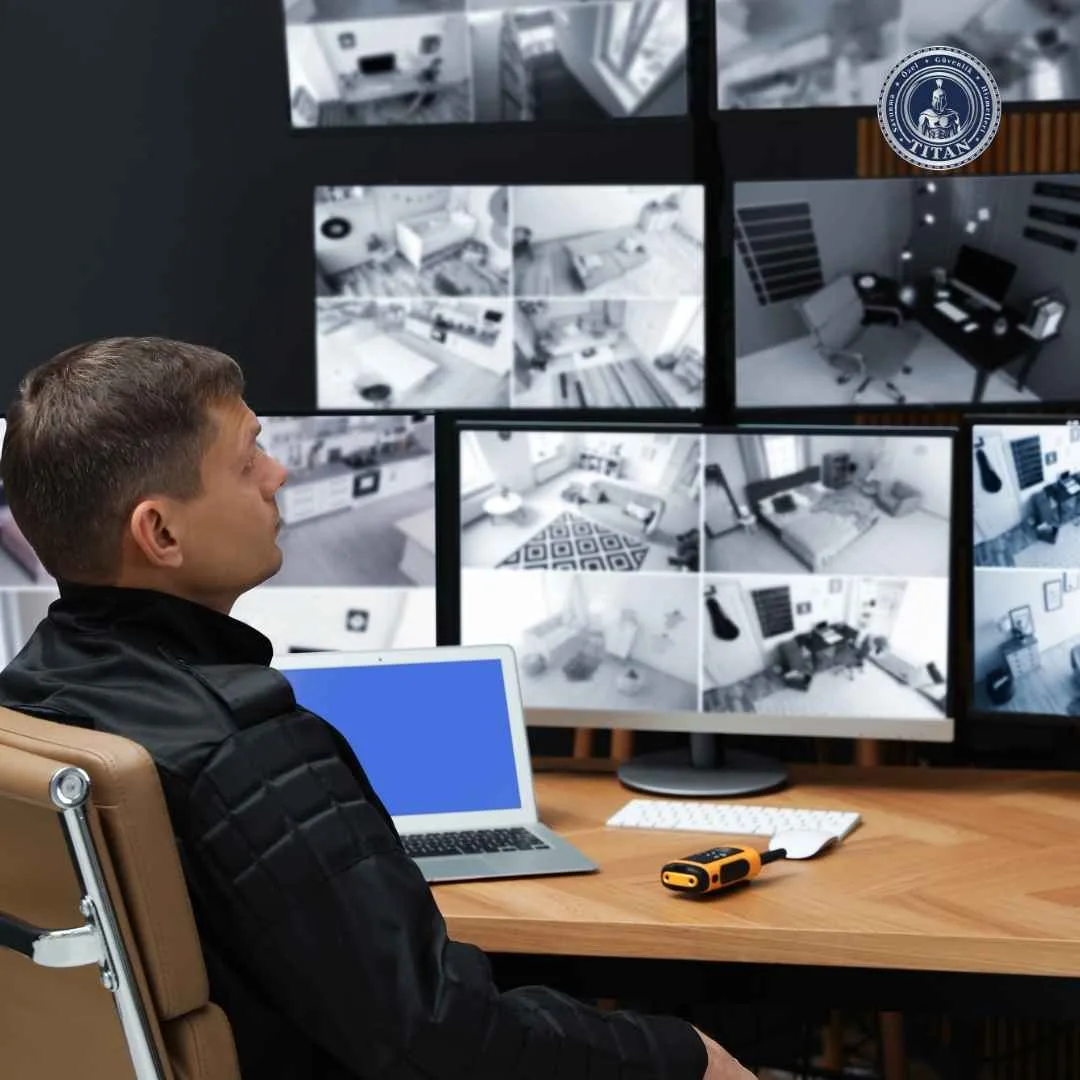
- Bring access control, CCTV, intrusion detection and building management alarms onto one monitoring screen, and include power and cooling alerts.
- Manage the security systems themselves as cyber assets: segregated network, privilege management, patching and log integrity.
6. Process and records
- Keep post orders short, workable on the floor and in checklist form. The Uptime data show that skipped and flawed procedures account for a large share of human-error outages.
- Review access rights regularly (for example quarterly) and remove unused privileges.
- Put the security team into the approval chain for change and maintenance work orders.
Expert view
Our corporate recommendations, drawn from Titan Savunma's field experience at critical sites:
- Test post orders on the floor. Use unannounced scenario tests to see whether an officer would admit an unbooked contractor, and use the results for training, not blame.
- Prepare for the "urgent fault" story. Write a verification step for genuine emergencies too: no white-space entry without a call-back to the on-duty engineer and a logged work order.
- Run the loading bay as a second front door. Book deliveries, record vehicles and match equipment to paperwork; never leave the dock as a direct route into the white space.
- Tie the life of a card to HR. Departures, role changes and long leave should reach security the same day.
- Read the logs together. Compare badge, CCTV and visitor records weekly; mismatches, such as a badge used while the camera shows someone else, are often the first warning.
- Treat power and cooling alarms as security duties. The night-shift officer should know whom to call and which areas not to enter when an alarm sounds.
- Put the colocation responsibility matrix in writing. Cage access, shared areas and requests for CCTV footage need clear tenant and operator roles in the contract.
To prioritise which areas need which level of protection, try our security risk assessment tool, and use the security provider scorecard when comparing guarding partners.
What to measure (KPIs)
| Indicator | What it tells you |
|---|---|
| Unauthorised access attempts and tailgating incidents | Whether the access layers work in practice |
| Compliance rate in scenario tests | Whether training changes behaviour |
| Time from alarm to response | Speed of the monitoring and response chain |
| Unbooked or unmatched visitor and contractor entries | Integrity of the visitor process |
| Time to revoke leavers' cards | How well HR and security are linked |
| Privileges removed in access reviews | Build-up of unnecessary access |
| Internal and external audit findings and closure time | Conformity and speed of corrective action |
| Uptime of CCTV and detection systems, blind-spot findings | Reliability of the technology |
Targets should follow the site's Protection Class and contractual obligations; what matters is measuring the same indicator regularly and in the same way.
Common mistakes
- Measuring security by the number of cameras and card readers instead of testing what happens on the floor.
- Admitting anyone in a hi-vis vest, with a printed work order or who "spoke to the manager" without verification.
- Leaving the loading bay and emergency exits outside the access control design.
- Revoking the cards of leavers and finished contractors late.
- Reviewing CCTV only after an incident, with no active monitoring or response link.
- Treating a single, generic awareness session as enough.
- Running security systems on the corporate IT network and neglecting software updates.
Applying this in Türkiye
In Türkiye, under Law No. 5188 on Private Security Services, an organisation can provide its own security through an in-house private security unit or contract a private security company licensed by the Ministry of Interior; either way, the work is done by officers holding a private security ID card. Under Article 3 of the Law, setting up an in-house unit or contracting a company requires the provincial governor's permission, granted on the decision of the provincial private security commission. CCTV footage and access control logs are personal data, so notice, retention periods and data security measures should be planned under Law No. 6698 on the Protection of Personal Data (KVKK). Occupational Health and Safety Law No. 6331 and Labour Law No. 4857 also apply to security staff. For sector- or client-specific obligations, such as audit requests from regulated industries, consult your legal adviser.
Frequently asked questions
What is the biggest risk in data centre security?
Research points to the human factor: access gained by persuasion, procedures not followed and misuse of legitimate access. Uptime Institute data show that most human-error outages stem from staff not following procedures or from flawed procedures.
How does EN 50600 differ from ISO/IEC 27001?
EN 50600-2-5 defines the physical security systems of the data centre facility through Protection Classes; ISO/IEC 27001 covers the information security management system and treats physical controls as one part of it. Many sites use both.
Is a mantrap really necessary?
A card-controlled door alone cannot stop tailgating. For entry to higher Protection Class areas, a device that enforces single-person passage plus anti-passback goes a long way towards ensuring each access record genuinely belongs to one person.
Does social engineering awareness training work?
In a field experiment with university staff in the Netherlands, 62.5% of employees without an awareness intervention handed over their keys, against 37.0% of those who received it. A meta-analysis found intensive, narrowly focused training more effective, so training should be scenario-based and repeated.
Titan Savunma is an Ankara-based private security company licensed by the Ministry of Interior under Law No. 5188 and certified to ISO 9001, 14001, 45001, 22301 and 28000. We work with international companies in English and Turkish. See our data centre physical security services for colocation and enterprise sites, or contact us to discuss your requirements.
Sources and Further Reading
- Bullée, J.-W. H., Montoya, L., Pieters, W., Junger, M., Hartel, P. H. — The persuasion and security awareness experiment: reducing the success of social engineering attacks, Journal of Experimental Criminology 11(1), 97–115 (2015)
- Bullée, J.-W. H., Montoya, L., Pieters, W., Junger, M., Hartel, P. — On the anatomy of social engineering attacks: A literature-based dissection of successful attacks, Journal of Investigative Psychology and Offender Profiling 15(1), 20–45 (2018)
- Bullée, J.-W., Junger, M. — How effective are social engineering interventions? A meta-analysis, Information and Computer Security 28(5), 801–830 (2020)
- Piza, E. L., Welsh, B. C., Farrington, D. P., Thomas, A. L. — CCTV surveillance for crime prevention: A 40-year systematic review with meta-analysis, Criminology & Public Policy 18(1), 135–159 (2019)
- Xu, Z., Wang, H., Xu, Z., Wang, X. — Power Attack: An Increasing Threat to Data Centers, NDSS Symposium (2014)
- Homoliak, I., Toffalini, F., Guarnizo, J., Elovici, Y., Ochoa, M. — Insight Into Insiders and IT: A Survey of Insider Threat Taxonomies, Analysis, Modeling, and Countermeasures, ACM Computing Surveys 52(2) (2019)
- Uptime Institute — Annual Outage Analysis 2025, press release of key findings (6 May 2025)
- CENELEC — EN 50600-2-5 Data centre facilities and infrastructures, Part 2-5: Security systems (prEN 50600-2-5:2020 preview; SIST EN 50600-2-5:2021)
- Carnegie Mellon University Software Engineering Institute (CERT) — Common Sense Guide to Mitigating Insider Threats, Seventh Edition (2022)