
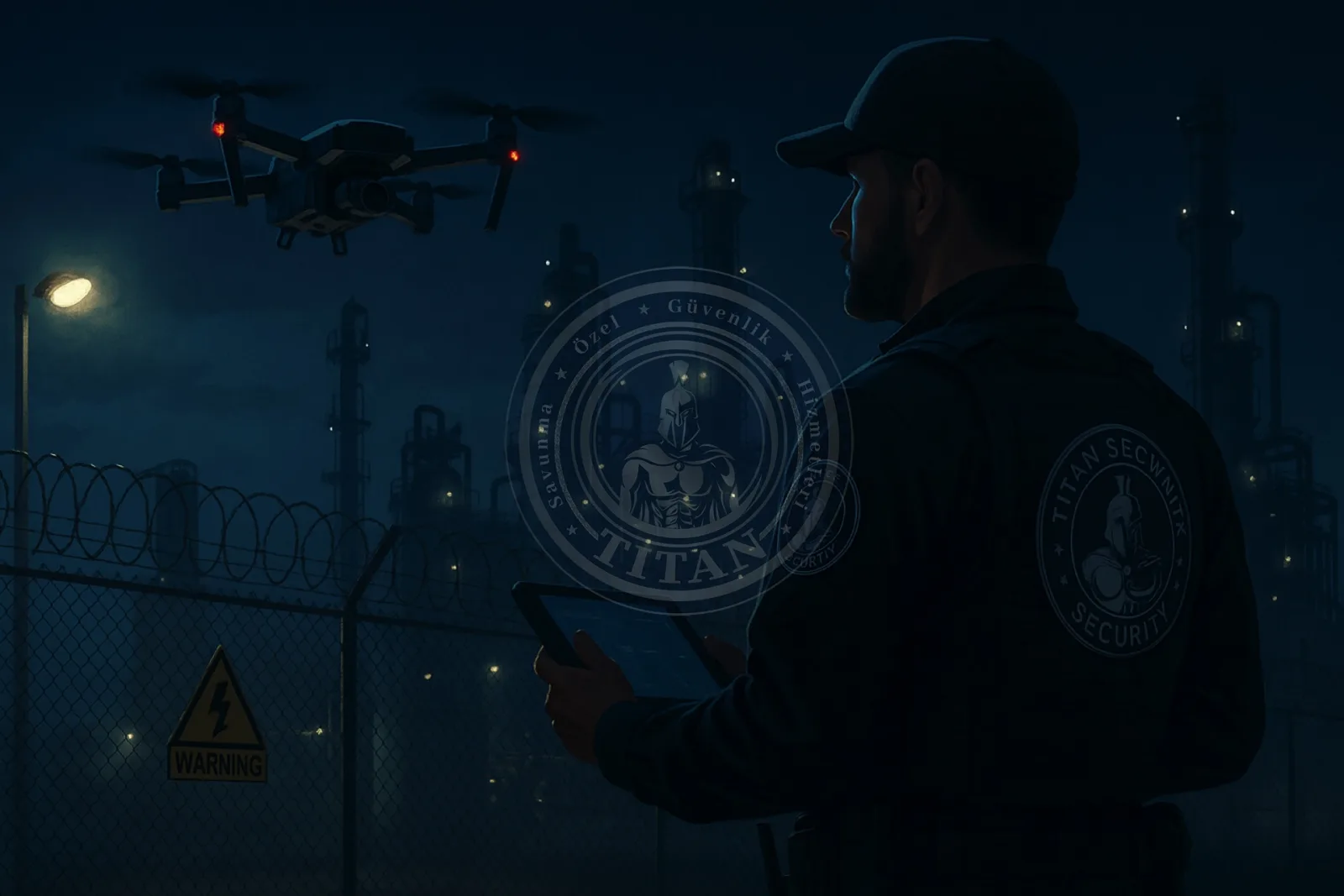
Yes, a company can fly its own security drone over its site in Turkey, but only within the framework set by the Directorate General of Civil Aviation (SHGM). Under the revised Unmanned Aircraft Systems Instruction (SHT-İHA) published in 2026, three things decide what you may do: whether the operator is registered, the pilot's licence level and the status of the airspace you want to fly in. Beyond-visual-line-of-sight and autonomous flights require the highest licence level and a separate authorisation. A drone is an eye; without an operator who verifies what it sees and a team that goes there, it adds little to security.
This article is general information, not legal advice. It is based on the SHT-İHA text as published on the SHGM website at the time of writing. Rules change, so check SHGM's current text and announcements before you plan flights.
We covered what a guard team can do when an unknown drone appears over a facility in a separate article. This one looks the other way: what should a solar plant, mine, logistics park or other large site know before using a drone of its own?
What the new SHGM instruction changed
In its announcement of the revised instruction, SHGM describes the main change as tying flight authority to the pilot's licence level rather than the aircraft's weight. Operations are assessed on two axes: the pilot's licence (P0, P1 or P2) and the status of the area on the map of İHATTYS, the national drone tracking and traffic management system.
The transition matters. Flight permits and authorisations issued under the old rules remain valid until 31 July 2027, and existing pilot certificates and licences stay valid if the conversion training is completed by that date. The instruction also says that until İHATTYS is activated and announced by SHGM, the relevant provisions of the old rules continue to apply to registration, notification and permit procedures. So the practical answer to "where do I apply?" may depend on SHGM's announcements on the day you apply.
Who may fly, with which licence?
Article 15 of the instruction defines three licence levels:
- P0 (amateur): for non-commercial flying only, in visual line of sight and in daylight, up to 120 metres height and 3,000 metres horizontal distance.
- P1 (commercial): for commercial operations, again in visual line of sight within the same limits; night operations are possible with suitable equipment.
- P2: the broadest level, covering high-risk operations such as beyond visual line of sight (BVLOS), autonomous flights and flights over crowds. P2 flights are carried out within a licensed very light aircraft operator or general aviation operator, and P2 requires a medical certificate.
A company protecting its own premises is unlikely to be flying for non-commercial leisure purposes, so it is sensible to plan on at least P1 and to confirm the required level with SHGM. Both P1 and P2 pilots must be at least eighteen. One detail is easy to miss: the diploma licence issued after training does not by itself authorise flights; a separate operational licence is required before anyone flies.
Registration, the zone map and flight permission
Except for very small "simple" toy-class drones, every user flying a drone must be registered with SHGM. Aircraft subject to registration must carry remote identification, have a working geofence function and hold SHGM software certification. Writing "documented compliance with SHGM requirements" into the purchase specification avoids ending up with a device that cannot legally fly.
Permission depends on the zone. Under Article 12:
- Green zones: P0 and P1 pilots need no separate operational permission within the set altitude and conditions.
- Red zones: areas closed by the competent authorities; permission is possible only with the consent of the authority that closed the area, and is refused if it does not consent.
- Orange zones: areas where someone else already holds a permit or airspace allocation.
- Everything else: flights need permission, which SHGM decides after obtaining the consent of the local civil administrator.
Energy sites, airport surroundings and areas near public buildings often fall into restricted airspace. P0 and P1 pilots must check the current zone status in the public İHATTYS airspace viewer before each flight; P2 users must file a flight notification before every operation with route, altitude and times. For daily patrol flights, that check belongs in the shift instructions.
Beyond line of sight and night flights: where the limits are
On large sites, the wish is usually for the drone to fly the perimeter on its own. The instruction is clear. Visual line of sight means the pilot keeps direct visual contact with the aircraft without optical or electronic aids, so the camera feed on the controller does not count. BVLOS flights fall only under P2, with the flight envelope defined by an allocated airspace volume or a drone corridor.
Drones that launch from a dock and fly a programmed route are "autonomous operations" in the instruction's terms. They are allowed only under P2 with an operational authorisation from SHGM, and the user's operations manual must document the mission profile, emergency scenarios and the conditions under which a human takes over. SHGM states that AI-assisted autonomous systems will be covered by a separate instruction.
Night flights are not allowed under P0; under P1 they are possible with suitable equipment, the key condition being that the aircraft is sufficiently visible, and SHGM may require an observer. If the control link is lost, the aircraft must return to a predefined recovery area or terminate the flight without crossing populated areas, and emergencies must be reported promptly and recorded.
Privacy: neighbours and Turkish data protection law
A security drone is a flying camera, and aerial footage easily crosses the fence line. Law No. 6698 on the Protection of Personal Data is listed among the legal bases of the SHT-İHA, and privacy is one of the stated reasons for restricted zones.
The Turkish Personal Data Protection Authority's public announcement of 8 June 2026 on workplace security cameras was written for fixed cameras, but its principles translate well: recording people is processing personal data; the purpose must be set clearly in advance; camera position, angle and zoom must be proportionate; employees must be informed; footage should be kept for the shortest reasonable time; and access must be limited to authorised people. In practice that means keeping routes over your own land, not pointing cameras at neighbouring gardens, windows or roads, mentioning drone recording in employee privacy notices and never copying footage to personal phones.
Where the drone fits in a security operation
A drone is very good at showing quickly why an alarm went off on a large site, checking fence lines that are hard to reach and documenting damage after an incident. It cannot stop anyone, talk to anyone or protect a scene. Under Article 7 of Law 5188, powers such as screening people at the entrance with walk-through and hand-held detectors, apprehension and protecting an incident scene and evidence belong to licensed security officers, and under Article 9 incidents requiring force or apprehension must be reported to the police or gendarmerie by the fastest means. The drone is the observing and recording link in that chain.
A working sequence looks like this: a perimeter alarm reaches the control room that runs the patrol plan; the operator launches the drone or asks the on-site pilot for a view; the operator assesses the picture, directs the response team and calls the police if needed. Post orders should state who flies, in which weather flights stop, who takes over when the battery runs out and where footage is stored. On rural sites such as solar power plants, the real value is fewer wasted trips to false alarms and a better approach to real incidents.
Questions for a pilot project
- Which İHATTYS zone is our site in, and does permission need the consent of the civil administrator or another authority?
- Can the task be done in visual line of sight, or do we want BVLOS or autonomous flights, which means P2 and an operator structure?
- Does our pilot hold an operational licence, and who is the backup at shift change?
- Is the aircraft registered, and do remote ID and geofencing work?
- Are visibility equipment and, if required, an observer planned for night flights?
- Are camera angles, retention and access rights written down in line with data protection principles?
- When the drone sees something, who goes, by which route and how fast?
Common mistakes
- Treating the controller screen as "line of sight" and in effect flying BVLOS.
- Buying a docked autonomous system before solving the licence and authorisation question.
- Replacing patrols with the drone so that nobody is left to respond to what it sees.
- Leaving footage ownership and retention undefined.
- Not putting the transition deadlines in the calendar.
How a professional security partner helps
Titan Savunma is an Ankara-based private security company operating under a Ministry of Interior licence under Law 5188, certified to ISO 9001, 14001, 45001, 22301 and 28000, and working with international companies in English and Turkish. We plan guarding together with your technology, writing into post orders who verifies what the drone sees and who goes to the scene. You can test post positions for large sites with our security digital twin or read about our critical infrastructure security work.
Sources and Further Reading
- SHGM — İnsansız Hava Aracı Sistemleri Talimatı (SHT-İHA) (2026)
- SHGM — İnsansız Hava Aracı Sistemleri Talimatı (SHT-İHA) yayımlanmıştır, duyuru (2026)
- KVKK — İş Yerlerinde Güvenlik Kamerası Sistemi Kullanımında Dikkat Edilecek Hususlara Dair Kamuoyu Duyurusu (2026)
- mevzuat.gov.tr — 5188 sayılı Özel Güvenlik Hizmetlerine Dair Kanun


