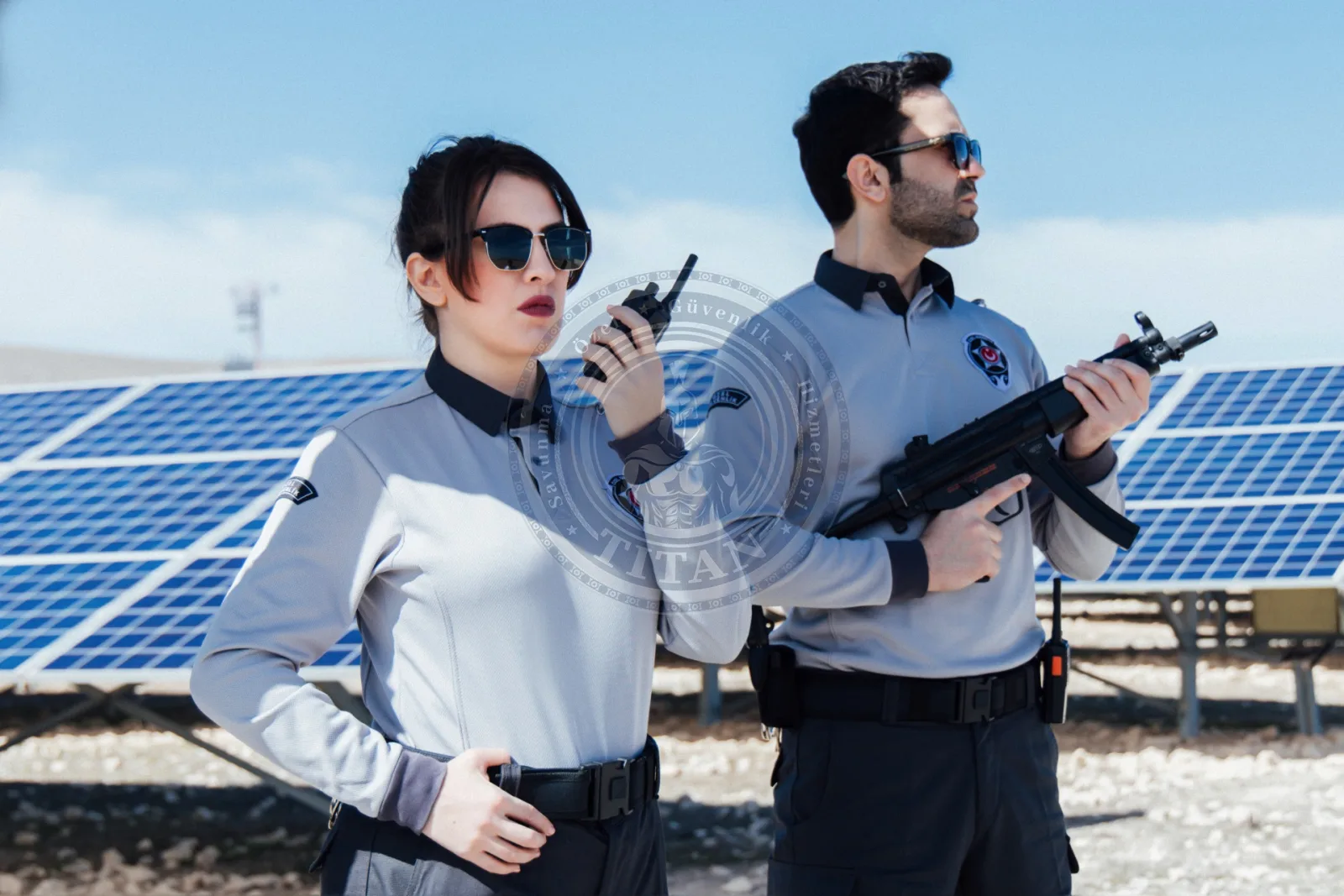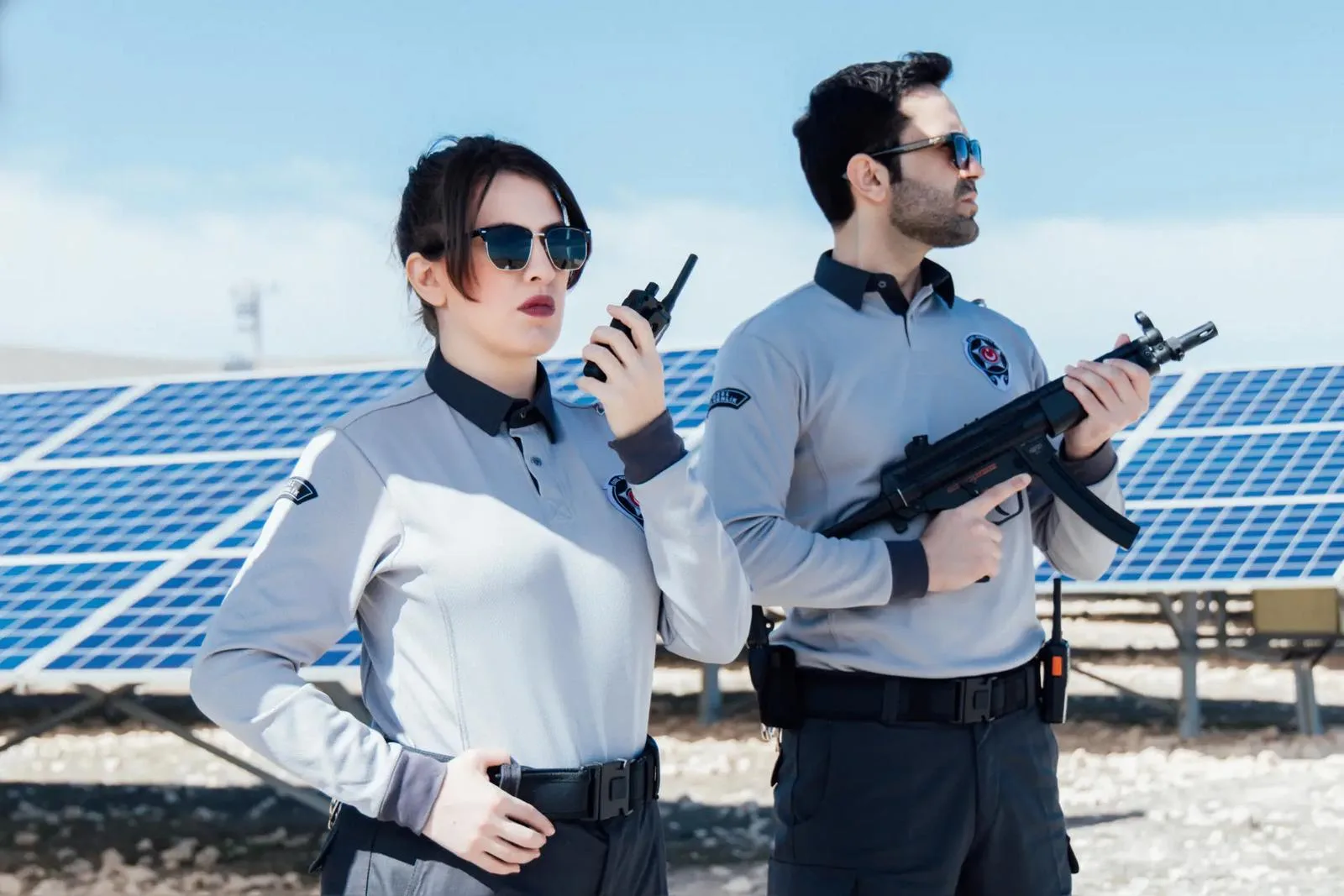
Short answer: On rural solar farms in Erzincan, security starts from the fact that, for most of the time, nobody is on site. Cables, panels and the equipment around the inverters sit in the middle of an empty field, and in winter snow affects the access road, the cameras and the panels alike. What works is therefore not a single measure but four linked parts: a sound, lit perimeter fence with cameras that raise alarms; a remote monitoring desk that sorts those alarms; a patrol that goes out when needed and walks the site after snowfall; and a gate log that records every arrival and departure of maintenance crews.
This article is general information, not legal advice.
Why does a solar site in Erzincan need its own thinking?
The Erzincan Investment Guide prepared by the Northeast Anatolia Development Agency lists renewable energy (solar, hydro and wind) among the province's prominent investment areas. According to the guide, Erzincan produces 46 MWe of solar power from three plants together with unlicensed solar installations totalling 43 MW, and it is one of the provinces among the 59 solar Renewable Energy Resource Areas (YEKA) that the Ministry of Energy and Natural Resources has declared in 18 provinces. The same document gives average daily sunshine of 6 hours and annual rainfall of 376 mm, and describes Erzincan as one of the mildest provinces in Eastern Anatolia.
That most of the capacity comes from unlicensed plants suggests, on our reading, many village- and field-scale sites rather than one very large farm. For security, that means small, separate islands, each with its own fence, gate and grid connection point.
The second dimension is winter. Data from the Turkish State Meteorological Service for 1928–2025 give a January mean of −2.8 °C in central Erzincan and an average January minimum of −6.8 °C; the lowest temperature recorded is −31.2 °C and the greatest snow depth 74 cm. Even in this relatively mild province, winter on a rural site means closed dirt roads, snow banked against the fence, fogged or iced camera housings and a patrol that cannot stay outside for long.
What does the research say?
1. Cable risk moves with the value of the metal
A study of copper cable theft on Britain's railway network found a significant positive relationship between lagged rises in the copper price and cable theft, while rival explanations such as unemployment levels or the general popularity of theft were not supported by the data (Sidebottom et al., Journal of Research in Crime and Delinquency, 2011). We have read only the abstract; the research concerns railways rather than solar farms, and the relationship it shows is not proof of causation on its own. The practical point is still simple: when copper becomes more valuable, monitoring around cable routes and spare cable stock deserves a fresh look.
2. Fences and cameras do not simply push crime next door
The most common objection to perimeter measures is that they only send the thief to the next site. A review of 102 evaluations of situational crime prevention drew 574 observations from studies that looked at displacement and diffusion. Displacement appeared in 26% of observations, while the opposite, a diffusion of benefits to surrounding areas, appeared in 27%. In 13 studies where the overall effect could be measured, spatial displacement, when it happened, was generally smaller than the treatment effect, suggesting that the interventions were still beneficial (Guerette and Bowers, Criminology, 2009). The review is not specific to solar sites, but it is a sound reason not to postpone fencing, lighting and cameras on the grounds that "the thief will just go elsewhere".
3. Snow losses can be told apart in monitoring data
Using five years of operating data from a commercial PV system in Norway, one study stresses that snow on modules causes significant production losses and that separating these from other faults is needed for sound maintenance routines. The authors compared four snow loss models; when they extended the strongest-performing one to account for system design and snow depth, the error in modelled absolute snow loss for the tested system fell from 23% to 3%. Using the snow signatures in the data, 97% of snow losses in the dataset were detected (Øgaard et al., Solar Energy, 2021). The study is not about security, but it opens a useful door: being able to tell remotely whether a drop in output is snow or a cut string cable means not sending a patrol out on a snowy night for nothing, and not missing a real loss either. That link is our own inference.
4. Cold also lowers a patrol's performance
A review of the health effects of cold work explains that health problems caused by cold work can reduce performance and productivity and increase the occurrence of accidents and injuries; breathing cold air can cause respiratory symptoms, and cardiovascular complaints can become pronounced during physical work. According to the authors, the first step in effective risk management is to identify workplace- and person-related cold risks, followed by customised advice on prevention and protection for susceptible groups (Mäkinen and Hassi, Industrial Health, 2009). A night patrol on a rural solar farm happens in exactly these conditions: a long, often solitary walk exposed to the wind.
Perimeter fence and cameras: who will see the alarm?
On a rural site, a fence exists less to stop an intruder than to slow them down and make their entry visible. Its value therefore depends on the detection and response chain behind it:
- Fence line: no gaps near the ground, a locked gate and known spots where snow drifts. Corners where snow piles up can turn into steps over the fence in winter.
- Cameras and detection: along the fence, especially at the gate, inverter and transformer kiosks, cable duct crossings and the spare parts container. A camera that only records will show the time of the loss in the morning and little else; it has to pass alarms live to a monitoring desk.
- Lighting: motion-activated lights at the gate and equipment kiosks help the cameras and show that the site is looked after.
- Power and communications backup: everyone should know that the site goes blind when the cameras and router lose power; a written rule should require the monitoring desk to notice and report this during a long power cut.
Checking the site after snowfall
Heavy snow is the most frequent unusual event on a rural site in Erzincan. Once the snow has stopped and the road is safe, a site check can follow this order:
- Remotely first: camera images, recorder status and production data. An even drop across the whole site points to snow cover; a sharp drop in a single string suggests another cause.
- Gate and fence line on foot: sections buried in snow or bent under its weight, fresh footprints or tyre tracks, an iced gate lock.
- Cable ducts and junction boxes: are the covers in place, are there signs of digging or dragging in the snow?
- Camera housings and brackets: snow and ice build-up, angles shifted by wind.
- Findings are photographed and logged; snow on the panels and any structural damage are reported to the operator's technical team. The officer does not climb onto panels or clear snow; that is the technical team's job.
Maintenance crew access
Most traffic on a rural solar farm comes from maintenance and cleaning crews, and nothing raises theft risk more easily than an unclear gate routine. A simple arrangement is enough: a crew list, vehicle plates and working hours notified in advance by the operator; a log on arrival and departure; cables, panels and spare parts going in or out recorded on a handover form; and a clear record of who holds keys and gate codes, which are changed when crews change. When a crew not on the list arrives, the officer does not open the gate on their own judgement but calls the operator's contact and records the instruction given. Maintenance visits become rarer in winter; if the visit calendar is shared with the monitoring desk in advance, unplanned movement is easier to spot.
Balancing remote monitoring and patrols
On scattered small sites, a permanent officer at every location is often unrealistic, and relying on cameras alone can produce a system whose alarms nobody answers. The balance depends on the type of event:
| Event | First step | Going to site |
|---|---|---|
| Motion alarm on the fence line | The monitoring desk verifies the image and, if needed, issues a loudspeaker warning. | For a confirmed intrusion, the gendarmerie is informed and a patrol is sent. |
| Even output drop across the site on a snowy day | Snow cover confirmed with camera and weather data. | Planned site check once the road is open. |
| Sudden loss in a single string | Camera footage of that area is reviewed. | Same-day check; if a cable has been cut, the scene is preserved. |
| Camera or router connection lost | Power cut, fault or tampering is distinguished. | If the blind period lasts, a patrol checks the site. |
| Maintenance crew not on the list | The operator's contact is called. | Without approval there is no entry, and the event is logged. |
This table is not a rulebook but a starting framework to be adapted to each site. Varying patrol times from day to day, building warm-up breaks in the vehicle into winter night patrols and holding regular "all clear" calls with lone officers complete the framework.
Common mistakes
- Connecting cameras to a recorder and passing alarms to nobody.
- Leaving fence sections buried in snow unchecked until spring.
- Treating output drops as purely technical and camera alarms as purely security matters, instead of bringing both data streams to one desk.
- Giving maintenance crews permanent gate codes and leaving spare cables and panels unlocked inside the fence.
- Running winter patrols on the summer route; giving lone officers no warm-up point, suitable clothing or regular call schedule.
- Installing cameras without deciding who holds the footage and for how long.
A note on practice in Türkiye
Under Article 3 of Law No. 5188, employing private security officers at a site begins with a decision of the provincial private security commission and the governor's permission; the organisation may have the service provided by a licensed private security company. On a rural site, suspected intrusion or theft is reported by the officer to the gendarmerie without delay, and the scene is preserved. Cold and lone working risks should be written into the risk assessment required under Occupational Health and Safety Law No. 6331. Because fence-line cameras may also record passers-by and maintenance crews, the purpose, retention period and privacy notice should be set in advance under Personal Data Protection Law No. 6698.
The duties we cover on solar sites are listed under solar power plant security, and the way we work with hospitals, public buildings and industrial sites in the province is described under private security company in Erzincan.
Titan Savunma is an Ankara-based private security company licensed by the Ministry of Interior under Law No. 5188 and certified to ISO 9001, 14001, 45001, 22301 and 28000. We work with international companies in English and Turkish, and our Erzincan City Manager, supported by our Eastern Anatolia Regional Directorate in Erzurum and our Ankara General Directorate, inspects your site's fence, gate and winter patrol in person and sets the balance between remote monitoring and patrols together with you. To arrange that survey, write to us via our contact page.
Sources and Further Reading
- Sidebottom, A., Belur, J., Bowers, K. J., Tompson, L. & Johnson, S. D. — Theft in Price-Volatile Markets: On the Relationship between Copper Price and Copper Theft, Journal of Research in Crime and Delinquency 48(3), 396–418 (2011)
- Guerette, R. T. & Bowers, K. J. — Assessing the Extent of Crime Displacement and Diffusion of Benefits: A Review of Situational Crime Prevention Evaluations, Criminology 47(4), 1331–1368 (2009)
- Øgaard, M. B., Aarseth, B. L., Skomedal, Å., Riise, H. N., Sartori, S. & Selj, J. — Identifying snow in photovoltaic monitoring data for improved snow loss modeling and snow detection, Solar Energy 223, 238–247 (2021)
- Mäkinen, T. M. & Hassi, J. — Health Problems in Cold Work, Industrial Health 47(3), 207–220 (2009)
- Kuzeydoğu Anadolu Kalkınma Ajansı — Erzincan Yatırım Rehberi (2025 verili)
- Meteoroloji Genel Müdürlüğü — Resmî İstatistikler: Erzincan (1928–2025)
- 5188 sayılı Özel Güvenlik Hizmetlerine Dair Kanun (md. 3), Mevzuat Bilgi Sistemi