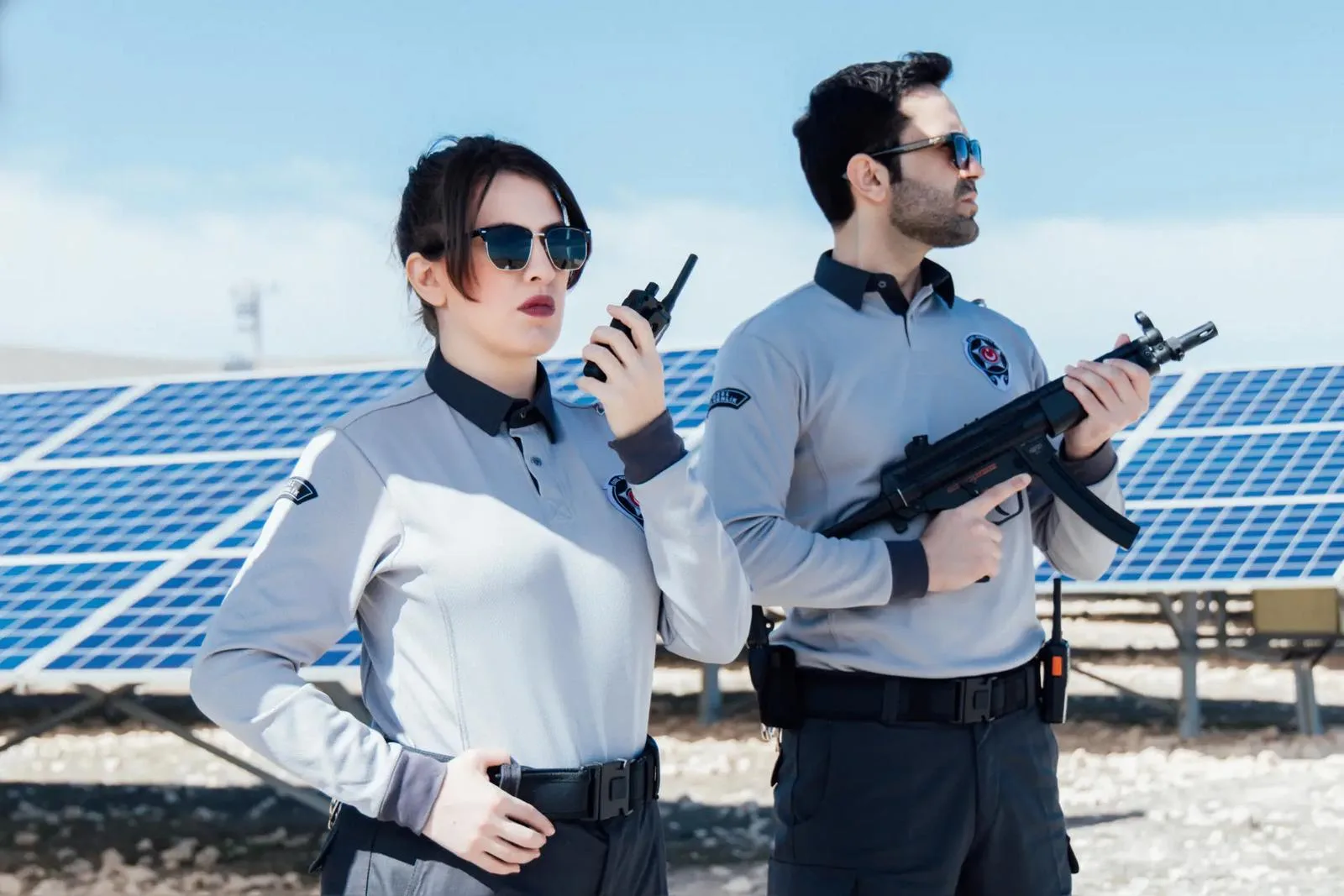
When a foreign investor buys an operating solar, wind or hydro plant in Turkey, security due diligence answers three practical questions: is the site legally guarded today, what has actually happened there, and what has to change on the day the shares or assets move. The work sits inside technical and environmental and social (E&S) due diligence, but it needs its own document list, its own site walk and its own legal check under Turkey's private security law.
In short: ask for the private security permit and the guarding contract, read the incident and insurance history line by line, walk the fence and the substation with the guard on shift, confirm how the permit will survive the transaction structure, and agree a day-one plan before signing. The rest of this guide explains each step and the red flags that should change your price discussion, your conditions precedent or your 100-day plan.
This article is general information, not legal advice.
Why security belongs in renewable-asset due diligence
Operating renewables are spread-out, lightly staffed sites with valuable, removable equipment: cable, inverters, transformers, spare modules and tools. Security failures show up later as lost generation, insurance disputes and community complaints, which is exactly what an acquirer inherits. International frameworks treat this as a buyer's concern, not only a seller's. IFC Performance Standard 4 (paragraph 12) expects a company that uses direct or contracted guards to assess the risks its security arrangements create, to make reasonable inquiries that guards are not implicated in past abuses, and to provide a grievance mechanism for affected communities.
IFC's Good Practice Handbook on the Use of Security Forces is blunt on the contractor point: even when a security contractor carries out hiring, training and monitoring, the company retains oversight responsibility. If the target relies on a guarding company, you are buying that relationship and its history. Where acquisition finance is involved, the Equator Principles (EP4) now cover project-related refinance and acquisition finance, and Principle 8 says lenders will take reasonable measures to keep existing E&S obligations in the new financing documents. Security commitments made to the previous lenders will usually follow the asset.
Data-room requests: what to ask the seller for
Turkish private security is regulated by Law No. 5188 on Private Security Services and its Implementing Regulation. Several of the documents below exist because the Regulation requires them, so their absence is itself a finding.
- Private security permit (Özel Güvenlik İzin Belgesi). Under Article 3 of Law 5188, using private security, whether an in-house unit or a contracted company, requires the governor's permission on the decision of the provincial private security commission. Article 8 of the Regulation says the application states the scope, the method and the maximum number of personnel, and that a permit certificate is issued. Check the name of the permit holder, the address and the approved method against reality.
- Guarding contract. Article 10 of the Regulation requires a written contract stating the client, address, scope of service, number of personnel and duration, and a copy is filed with the governorship by the end of the working day on which the service starts. Ask for the filed version, not only the commercial one.
- Personnel list and liability insurance. Article 8 of the Regulation requires the list of guards and copies of their private security financial liability insurance policies to be given to the governorship within fifteen days of the guards starting work. Article 21 of the Law makes this insurance compulsory.
- Protection and security plan. Article 12 of the Regulation requires the security company or in-house unit to prepare a plan for the site within thirty days of the service starting and keep a current copy ready for inspection.
- Alarm monitoring arrangements. If a remote monitoring centre watches the cameras or intrusion alarms, Article 5 of the Law requires a qualification certificate from the governorship to establish and operate an alarm monitoring centre. Ask who holds it.
- Incident and occurrence logs for at least the last three operating seasons, with police or gendarmerie report references where the authorities were called.
- Insurance claims history for theft, vandalism, fire and business interruption, and the insurer's survey recommendations with their closure status.
- Grievance and complaints records from neighbours, landowners and local administrations, and any security risk assessment or security management plan prepared for lenders.
The site visit: what to observe on the ground
The IFC Handbook describes the onsite part of a security assessment as observing the guard force's appearance, professionalism and conduct, reviewing their knowledge and training, and looking at the incident-reporting system and how allegations or incidents are recorded. On a renewable site, add the physical picture:
- Fence condition along the whole perimeter, not just near the gate; signs of repaired cuts, ground erosion under the mesh and vegetation that hides the line.
- Coverage and recording of cameras at the gate, inverter or transformer stations, the substation and the spare-parts store, and whether anyone actually reviews alarms at night.
- Key and access-card control: who holds keys to the substation, control room and containers, and whether former contractors still have codes.
- The guard's own understanding of their duty area and limits. Under Article 9 of the Law, guards may use their powers only during duty hours and within their duty area, and Article 12 requires the identity card to be worn visibly; a guard without the card cannot use those powers.
- Contact with the community: who neighbours call when something happens, and whether the guard post knows the local gendarmerie station and the village headman (muhtar).
The private security permit and the transaction structure
The permit is granted to the person or organisation that applied, for the stated place. That makes the deal structure matter. In a share deal, the project company that holds the permit normally stays the same legal entity, so the permit, the filed contract and the personnel notifications continue; you still need to check that names, addresses and the method on the certificate match what is actually on site. In an asset deal, or where the plant is moved into a new special-purpose company, the new owner is a different organisation and should plan its own permit application through the governorship.
We found no dedicated "transfer of permit" procedure in Law 5188 or its Regulation, so treat a change of the permit-holding entity as a point to clarify with the provincial security authorities well before closing, and record the plan in the transaction timetable. Two provisions help with timing. Article 8 of the Regulation says permit applications are concluded within ten working days at the latest, and Article 10 says an organisation that wants to end its private security arrangement applies at least one month in advance and ends it with the commission's decision and the governor's approval. Do not let the seller terminate its arrangement before the buyer's is in place: Article 19 of the Law makes employing private security guards without the Article 3 permit a criminal offence for the managers concerned.
Red flags and mitigation options
| Red flag | Why it matters | Mitigation options |
|---|---|---|
| No permit certificate, or a certificate for a different address or method | Guarding may be unlawful and the client's managers are exposed | Condition precedent or pre-closing covenant to regularise; confirm with the governorship |
| Guards also clean panels, cut grass or run errands | Article 16 of the Law bars employing security personnel in work outside protection and security | Separate O&M tasks from guarding in the new contracts |
| Incident log is empty or only shows "no event" | Usually means poor reporting, not a quiet site; claims history may contradict it | Reconcile logs with insurance claims and police references; set a reporting standard from day one |
| Repeated cable or copper theft with no design change | Points to a systemic weakness that will recur | Commission a targeted risk review of perimeter, detection and response |
| Unresolved community complaints about guards | A PS4 and lender issue as well as a reputational one | Review the grievance mechanism; agree corrective actions with the seller |
| Remote monitoring by an unidentified provider | Alarm monitoring centres need a governorship qualification certificate | Verify the certificate or replace the provider |
Most of these are fixed through the share purchase agreement (conditions precedent, specific indemnities, pre-closing undertakings) or through the first months of the new owner's security plan. The point of the table is to make the issue visible early enough to choose.
Day-one transition
Closing day is when access risk peaks: the seller's people still have keys and codes, and the buyer's people are not yet on any list. Our existing bulletin on physical access handover on acquisition day one covers the sequence in detail. For a renewable plant, make sure the day-one plan names who changes substation and control-room access, who updates the alarm call list and the gendarmerie contact sheet, who briefs the guards on the new reporting line, and who confirms the governorship notifications that the new structure requires.
Reporting to the asset manager after closing
Due diligence findings are only useful if someone tracks them. Agree from the start what the asset manager will receive each month: incidents by type, open actions from the due diligence with owners and dates, insurance-relevant events, changes in guard deployment or technology, and community issues. Keep personal data out of investor reports; a guard's name or a suspect's identity is rarely needed at portfolio level. If the asset is lender-financed, align this report with the periodic E&S reporting that EP4 Principle 8 requires, which is not less than annual, so the same facts are not described in two different ways.
Working with Titan Savunma
Titan Savunma is an Ankara-based private security company holding an operating licence from the Ministry of Interior under Law No. 5188 and certified to ISO 9001, 14001, 45001, 22301 and 28000. We work with international companies in English and Turkish and plan services for sites in different provinces with a single point of contact, written scope and regular reporting. If you are reviewing an energy acquisition, see our approach to solar power plant security and our page for international companies in Turkey.
Sources and Further Reading
- IFC — Good Practice Handbook: Use of Security Forces: Assessing and Managing Risks and Impacts (2017)
- IFC — Performance Standard 4: Community Health, Safety and Security (2012)
- Equator Principles Association — The Equator Principles EP4 (July 2020)
- T.C. Mevzuat Bilgi Sistemi — Law No. 5188 on Private Security Services (Özel Güvenlik Hizmetlerine Dair Kanun)
- T.C. Mevzuat Bilgi Sistemi — Implementing Regulation of Law No. 5188 (Yönetmelik, MevzuatNo 7190)