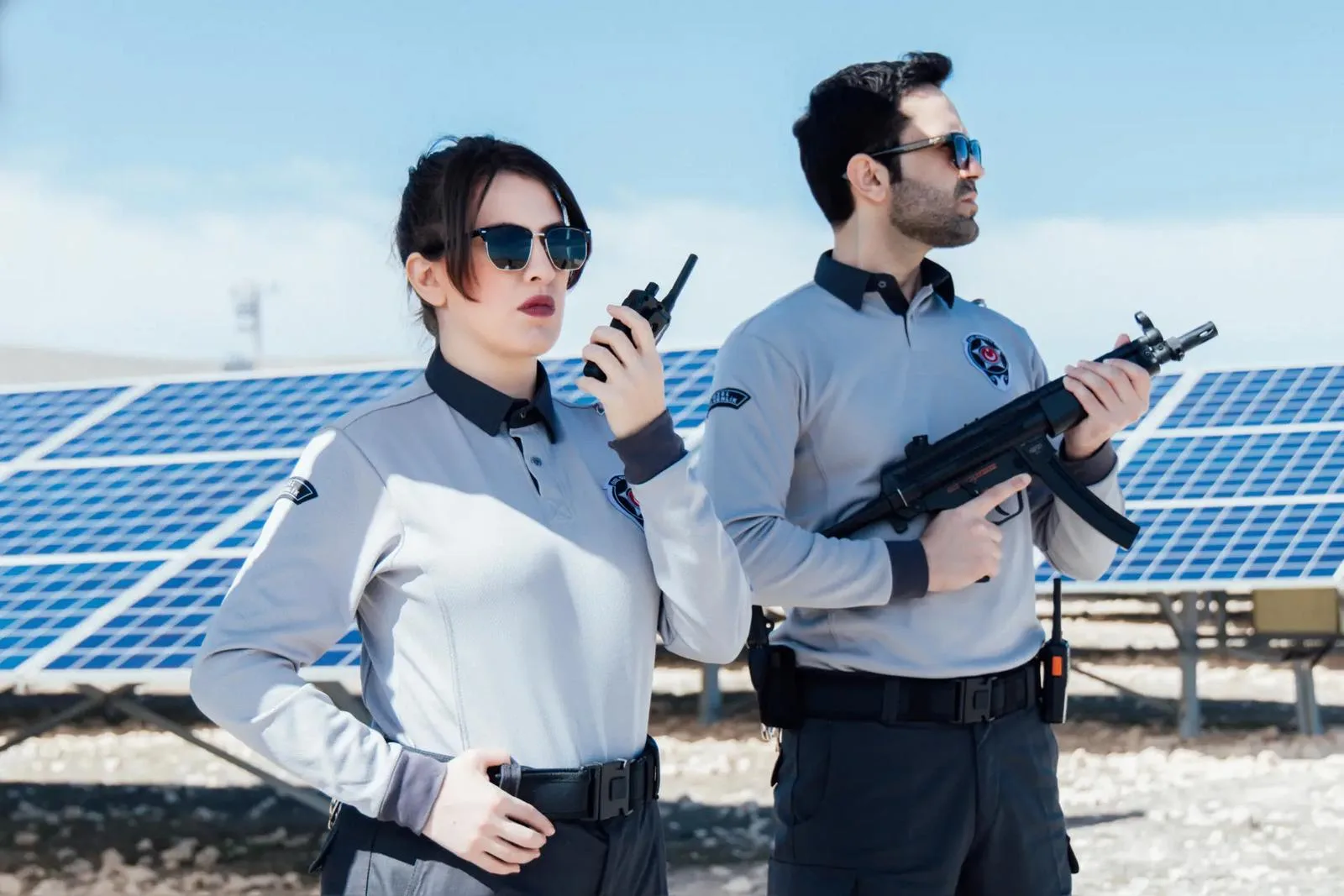
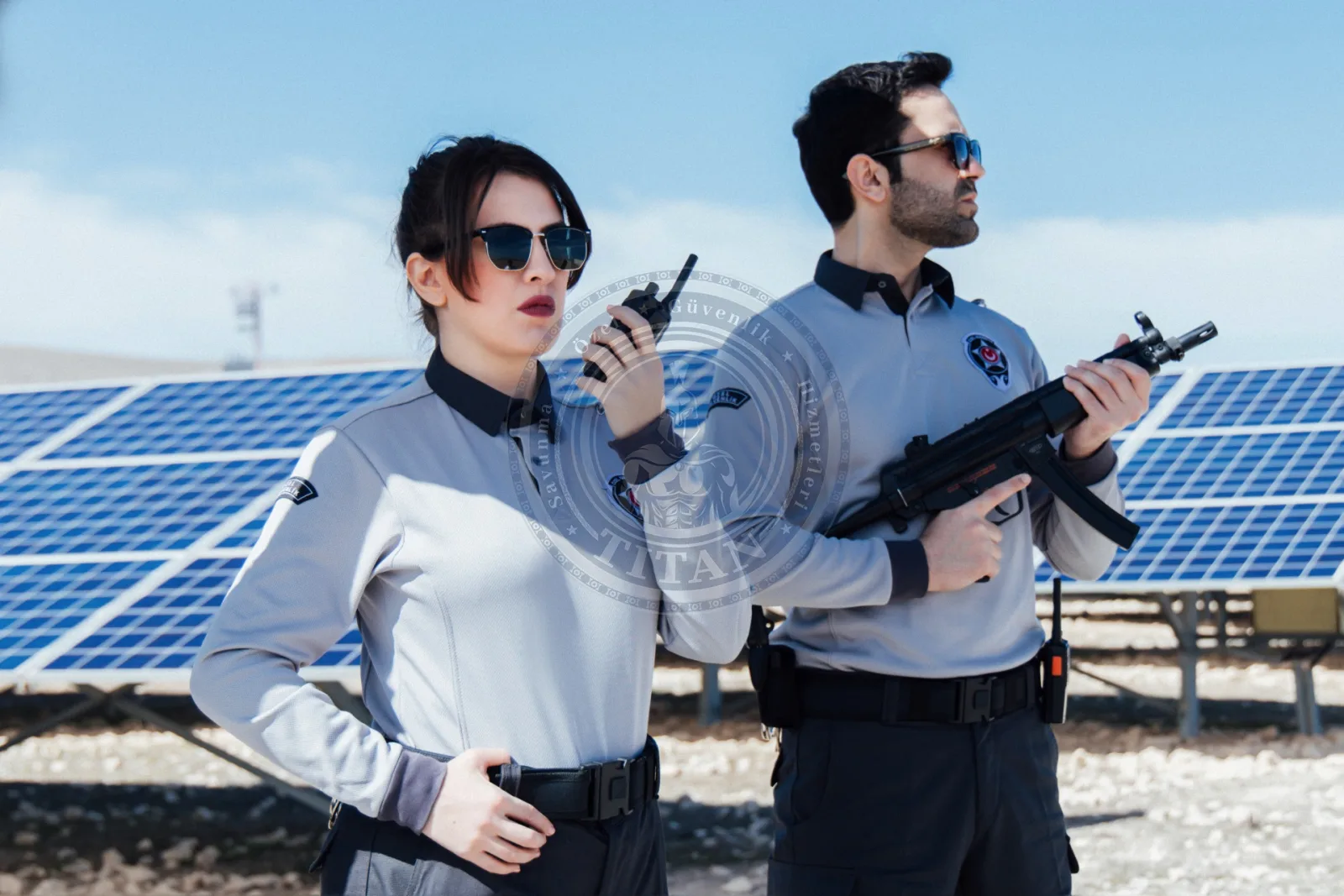
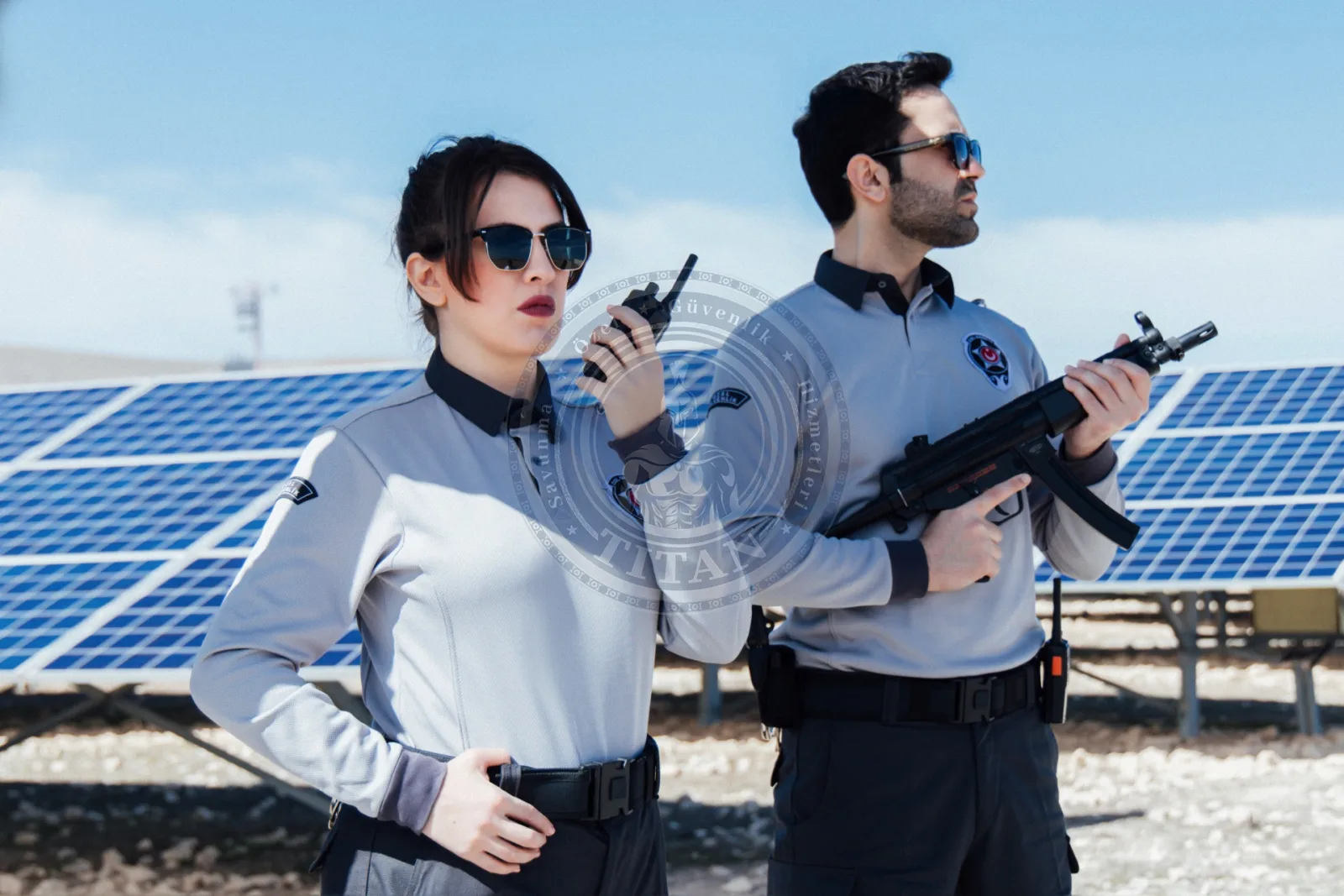
Short answer: At Konya's large solar power plants, the main risk is that someone enters at an unwatched point on a perimeter that runs for kilometres and takes copper cable, equipment around the inverters and transformers, or panels from the store. At this scale, protecting a site with officers alone, or with cameras alone, is not realistic. What works is four elements built together: a camera layer that detects intrusion at the perimeter and is actively monitored, a vehicle-based response and patrol team that reaches the alarm point quickly, strict logging of people and materials at the gate, and patrol routes drawn around the ground, the climate and communications coverage.
This article is general information, not legal advice.
Why solar security is a distinct issue in Konya
According to the Mevlana Development Agency's Konya investment environment presentation, Konya has the highest installed solar capacity of any Turkish province, given as more than 1,900 MW. The same presentation puts annual solar radiation in the province at 2,100 kWh/m² and annual sunshine at about 3,000 hours. It presents the 60 million m² Energy Specialised Industrial Zone at Karapınar, and the solar field there, as "Europe's largest single-piece solar field". This is an undated investment promotion document and its figures are rounded, but the picture is clear: solar in Konya is not limited to rooftop systems and includes large open-ground sites.
Three features set such a site apart from a factory:
- Scale: The area is many times larger than a plot in an industrial zone. No one can see every point of the perimeter at once; a gate officer protects only the entrance.
- Isolation: Sites are often flat, open ground far from settlements. At night nobody is working on site and there is little traffic on nearby roads, so there are no natural eyes to notice an intrusion.
- Materials: The cables running across the site, combiner boxes, inverters, transformer stations and spare panels in storage are portable and saleable. Nor is the loss limited to what is stolen: a panel string with a cut cable produces nothing until it is repaired.
What does the research say?
1. Cable theft can rise with the copper price
Research into copper cable stolen from Britain's railways showed cable theft rising in significant, positive step with earlier (lagged) increases in the copper price; competing accounts, such as the level of UK unemployment or how common theft was as a crime overall, found no support in the data (Sidebottom et al., Journal of Research in Crime and Delinquency, 2011). When the team returned to the topic with 76 months of police records covering 2006–2012, the pattern held: thefts of energised ("live") copper cable moved up and down in line with copper price movements. What drove the later decline in such thefts, they noted, could not be pinned down (Sidebottom, Ashby and Johnson, Journal of Research in Crime and Delinquency, 2014).
Neither study looked at solar plants; both deal with British railways, and a correlation of this kind does not by itself establish cause and effect. The practical lesson we draw for a solar operator is this: when metal prices rise sharply, cable risk may rise too. Rather than treating the security level as a fixed package all year, it makes sense to review patrol frequency, monitoring and store checks in such periods.
2. Industry data: theft can be organised and fast
Peer-reviewed work on this specific question is limited, so we also look at industry data. A November 2023 PV Tech report, citing a security company's paper, states that recorded thefts at solar sites rose fourfold from 2021 to 2022 and cable thefts by 48%. In the report, a representative of the same company says that most solar project theft, notably in the UK and the Netherlands, is committed by organised crime groups; in his view the same people also steal cable from telecoms sites and alongside railways, and take as much as they can carry. He also describes seeing a 5 MW site that had lost three quarters of its panels.
These figures rest on one company's paper and one representative's observations, are not peer-reviewed and cannot be applied directly to Turkey. Still, they point to two things: a single night can bring a large loss, and the people responsible may know the site in advance. Our takeaway: watch the site more closely in the weeks following any cable or panel replacement, and review what an outsider can see of it during the day.
3. Cameras work better when actively monitored and combined with other measures
Drawing together some forty years of evaluations, one systematic review and meta-analysis tied closed-circuit cameras to a statistically significant yet modest drop in crime, strongest and most consistent in car parks. Live-monitored set-ups produced larger effects than record-only ones, and cameras paired with other measures did better than cameras on their own; the authors advise aiming CCTV specifically at vehicle and property crime rather than relying on it in isolation (Piza et al., Criminology & Public Policy, 2019). The review is not specific to solar sites, but on property crime and the logic of "camera plus response" it gives a clear direction: on a remote site, a camera that records but that nobody watches often tells you only when the loss happened. The camera should be built as the first link in a response chain.
4. On open ground, extreme heat is also a risk for officers
A systematic review and meta-analysis of extreme heat and occupational injuries pooled 22 studies. Each 1 °C rise above reference temperatures was associated with an increase of about 1% in injury risk (relative risk 1.010), and heatwave periods with an increase of about 17% (relative risk 1.174); workers under 35, male workers and workers in agriculture, construction and manufacturing were at higher risk (Fatima et al., Environment International, 2021). Security staff were not examined as a group of their own; even so, someone walking a patrol along unshaded panel rows is hardly exempt from this pattern.
Konya's climate is demanding at both ends. Turkish State Meteorological Service statistics for 1927–2025 put the provincial record high at 40.9 °C and the record low at −28.2 °C, with an average January minimum of −4.1 °C and a maximum measured snow depth of 66 cm. Patrol planning therefore has to build in water, shade and rest breaks for summer, and a heated vehicle or shelter for winter.
Officers and technology: which layer does what?
On a large open site the question is not "officers or technology?" but how to divide the work between them. The table below summarises each layer and the officer's role in it. Read it as a first draft to be shaped around each site during the survey, not as fixed rules.
| Layer | What it does | The officer's role |
|---|---|---|
| Perimeter detection | Detects intrusion attempts along the fence, around transformers and stores, using video analytics, thermal cameras or fence sensors. | Verifies alarms and logs false-alarm causes (animals, wind, snow) so the system can be tuned. |
| Active monitoring | Cameras are watched around the clock from a monitoring point; footage opens as soon as an alarm arrives. | Assesses the event, directs the response team and alerts the police or gendarmerie where needed. |
| Vehicle patrol and response | Patrols the perimeter at unpredictable times and goes to alarm points. | Physical checks, spotting cut fencing or opened boxes, incident reports with photographs. |
| Gate and entry log | Logs entry and exit of contractors, maintenance, panel-cleaning and farming crews. | Entry-list and work-order checks, vehicle checks, matching every outgoing item to a document. |
| Stores and transformers | Protects spare panels, cable drums and equipment stores with locks, seals and cameras. | Regular counts, seal checks, key hand-over log. |
| Liaison with law enforcement | A communication line agreed in advance with the law-enforcement unit responsible for the site. | Fast, accurate information during an incident; preserving evidence. |
A checklist for remote-site patrols
- Routes and ground: A news report (NTV/İHA, 17 August 2026) drawing on data from Konya Technical University's Sinkhole Application and Research Centre says the number of sinkholes in the Konya Closed Basin has passed 740, about 700 of them in Konya province, and that around Karapınar the number has risen from about 500 in 2020 to about 600 today. Patrol routes should follow the service roads the operator has designated on the basis of its ground survey; officers should not leave them, and new signs of subsidence or cracking should be reported at once.
- Unpredictable timing: Rounds that repeat an identical hour and direction night after night are easy for outsiders to learn. Vary times and direction, and record rounds with an electronic guard-tour system.
- Communications: Map weak mobile coverage during the survey and set up radio accordingly. Lone patrolling officers should check in with an "all well" call at set intervals, and the steps to take when a call is missed should be in writing.
- Climate: Drinking water, shade and shorter foot checks in the hottest hours in summer; a heated vehicle, road-condition checks in snow and ice, and lighting and torches for the dark hours in winter.
- Metal prices and replacement periods: Reassess risk when the copper price rises sharply and in the weeks after cable or panels are replaced.
- Materials register: Keep records of panel serial numbers, cable drums and spare equipment in storage; every item leaving the site should match a document.
- Construction and expansion: During construction, many contractors and much exposed material are on site. Write a separate security plan for this phase rather than reusing the operating-phase plan.
- Meet law enforcement early: Response comes faster when the responsible police or gendarmerie unit has met you before anything happens and already holds the site plan, entry points and contact details.
Common mistakes
- Installing cameras that nobody actively watches; closing alarms without verifying them, so that frequent false alarms teach everyone to ignore the system.
- Assuming a fixed officer at the gate protects the whole site.
- Patrolling at the same time and on the same route every night.
- Not logging contractor, maintenance and cleaning crews, and not matching outgoing materials to documents.
- Not recording who holds the store keys.
- Letting the patrol vehicle leave the service roads to take short cuts.
- Leaving summer heat and winter cold out of the contract and post orders altogether.
- Treating the construction phase and the operating phase as if they had the same security needs.
A note for Turkey
Law No. 5188, in Article 3, ties the contracting of security to a company subject to a decision of the private security commission followed by the provincial governor's permission; Article 5 requires the company itself to hold a Ministry of Interior operating licence. Under the implementing regulation, a protection and security plan is drawn up for the area served, and that plan is the natural place to set out perimeter detection, monitoring, patrol and response. Footage from the cameras and the records kept at the gate are personal data: as data controller under Personal Data Protection Law No. 6698, the operator decides why they are processed, how long they are kept and how the people recorded are informed. Separately, Article 10 of Occupational Health and Safety Law No. 6331 obliges the employer to have a risk assessment done, either in-house or by a third party; lone work on open ground and exposure to extreme heat and cold belong in it.
Our way of working at sites throughout Konya province is described on our private security in Konya page; the plan we use for solar plants is on our solar power plant security page. If you would like an initial view of the risks on your own site, start with our security risk assessment tool.
Titan Savunma, a private security firm headquartered in Ankara, holds an operating licence from the Ministry of Interior under Law No. 5188; its certifications span ISO 9001, 14001, 45001, 22301 and 28000. We serve international clients in English as well as Turkish. Our Konya City Manager, backed by the Central Anatolia Regional Directorate, visits your site and works out the perimeter, monitoring, patrol routes and gate routine together with you. Requests for a site visit are welcome via our contact page.
Sources and Further Reading
- Sidebottom, A., Belur, J., Bowers, K. J., Tompson, L. & Johnson, S. D. — Theft in Price-Volatile Markets: On the Relationship between Copper Price and Copper Theft, Journal of Research in Crime and Delinquency 48(3), 396–418 (2011)
- Sidebottom, A., Ashby, M. & Johnson, S. D. — Copper Cable Theft: Revisiting the Price–Theft Hypothesis, Journal of Research in Crime and Delinquency 51(5), 684–700 (2014)
- Piza, E. L., Welsh, B. C., Farrington, D. P. & Thomas, A. L. — CCTV surveillance for crime prevention: A 40-year systematic review with meta-analysis, Criminology & Public Policy 18(1), 135–159 (2019)
- Fatima, S. H., Rothmore, P., Giles, L. C., Varghese, B. M. & Bi, P. — Extreme heat and occupational injuries in different climate zones: A systematic review and meta-analysis of epidemiological evidence, Environment International 148, 106384 (2021)
- Mevlana Kalkınma Ajansı, Konya Yatırım Destek Ofisi — Konya Yatırım Ortamı (sunum)
- Meteoroloji Genel Müdürlüğü — Konya il istatistikleri (1927–2025)
- PV Tech (W. Norman) — 'A perfect environment for criminals': crime and security for solar PV sites (15.11.2023)
- NTV / İHA — Konya Ovası'nda alarm: obruk sayısı 740'ı aştı (17.08.2026)