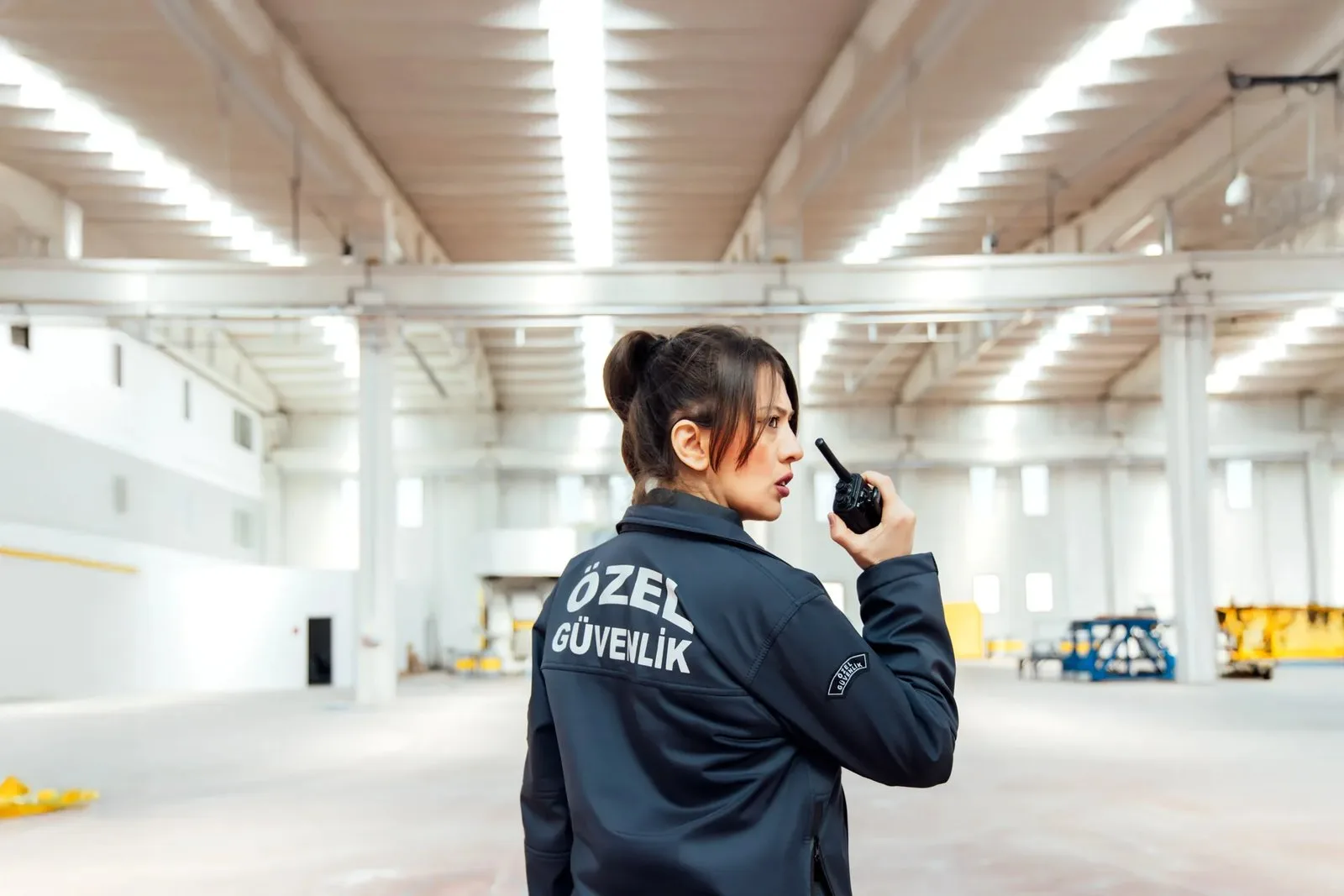
Short answer: In a large organised industrial zone, one of the weakest moments for gate security is the shift change. Hundreds of employees enter and leave within the same few minutes, shuttle buses and lorries queue at the gate, visitor and supplier checks get rushed, and the officers on duty are often the team that has been awake all night. The core of the answer is a better routine: separate the flows of vehicles, pedestrians, visitors and deliveries, hand the gate over face to face and in writing, manage the hours when fatigue peaks, and back cameras with active monitoring.
This article offers general information only and should not be read as legal advice.
Why the gate matters at Eskişehir OSB's scale
According to a January 2026 report, Eskişehir OSB covers 34 million m², making it Turkey's second-largest organised industrial zone. It hosts 916 companies and more than 53,000 employees, and about 80% of the province's industry is located there (Ekonomi Gazetesi, 28 January 2026). Defence, aerospace, machinery, rail systems, household appliances and automotive manufacturing and supply sit side by side: sectors that run in shifts and are sensitive about their supply chains.
The provincial picture is similar. The Social Security Institution (SGK) Statistical Yearbook 2025 lists 462 registered workplaces in Eskişehir with 50 or more employees and 72 with 250 or more. At that scale a shift change creates real traffic at the gate. Within the same half hour, the outgoing shift, the incoming shift, shuttle buses, lorries waiting for the morning delivery window and the day's visitors all try to use the same turnstiles and barriers. Under that pressure, gate officers are tempted to skip pass checks, shorten vehicle inspections or wave a waiting lorry in to deal with later. Losses, unauthorised entries and supplier complaints can come out of those few minutes.
What does the research say?
1. Sleep loss hits simple attention hardest
A meta-analysis of the cognitive effects of short-term sleep deprivation pooled 147 cognitive tests from 70 articles and found the largest effect on simple attention, the kind of vigilance needed for monitoring tasks, while the effect on reasoning accuracy was small and not statistically significant (Lim and Dinges, Psychological Bulletin, 2010). The authors suggest that, in industries where sleep loss poses a significant safety risk, countermeasures aimed at this type of attention may be the most efficient way to prevent accidents. Gate control is exactly this sort of work: watching screens, matching number plates, matching a pass to a face. The meta-analysis covers experiments on healthy adults with total sleep deprivation of no more than 48 hours and is not specific to security officers or gate checks. Even so, it is a reminder that a team that has been awake all night needs, at the morning changeover, exactly the skill that sleep loss affects most.
2. Risk rises over successive nights and long stretches without a break
A 2003 review of safety and productivity in shift work reports that safety declines over successive night shifts, with increasing hours on duty and with longer intervals between rest breaks (Folkard and Tucker, Occupational Medicine, 2003). The authors stress that these factors must be considered together: a long night shift with frequent breaks may prove safer than a shorter one with fewer breaks. Our practical reading is this: the most critical checks at the gate should not be left to the last hour of the night team; the gate team's own handover should be completed before the plant's shift change, so that a rested, briefed team does the checking in the busiest minutes.
A field trial with security officers adds to the picture. In a randomised cross-over trial with 86 civilian security guards working night shifts for the Dutch armed forces' surveillance and security organisation, blue-light-emitting glasses had no directly measurable effect on need for recovery, general fatigue or stress (Helmhout et al., Clocks & Sleep, 2022). The authors add that the glasses were worn on fewer than half of the planned night shifts and that the sample was smaller than intended. Citing an unpublished internal inventory, the same paper reports that work stress, fatigue and need for recovery are a burden for this group, which it attributes to the combined impact of rapidly rotating night shifts and staff shortages. Our reading: a single gadget may not solve fatigue on its own; look at the shift pattern itself first.
3. Handover is a security procedure
The UK Health and Safety Executive (HSE) defines the purpose of shift handover as accurate, reliable communication of task-relevant information, and recommends that it is face to face, two-way, both verbal and written, and given as much time and resource as necessary (HSE, Shift handover). HSE's examples come from process and maintenance work, but the same logic applies at the gate: a visitor still on site, an open vehicle record, an expected delivery or a faulty barrier does not exist for the new team unless it is handed over.
4. Waiting lorries are at risk in unsecured areas
Researchers examining cargo thefts logged in an industry incident database for Europe, the Middle East and Africa (EMEA) found that 97% of attacks on stationary vehicles took place at unsecured parking sites. These incidents were mostly volume crimes rather than high-value thefts, and the typical case was an unauthorised entry on a winter weekday (Ekwall and Lantz, International Journal of Retail & Distribution Management, 2015). Because the findings rest on the database's own categories and were not drawn from Turkey, they are indicative only; still, they show why lorries parked at the roadside in front of a gate deserve a dedicated waiting and registration routine.
5. CCTV pays off when someone watches and other measures back it up
Drawing together forty years of evaluations, one meta-analytic review tied CCTV to a modest yet significant drop in crime, with car parks showing the strongest and most consistent results. Live-monitored set-ups beat record-only ones, and cameras paired with other interventions beat cameras left to work by themselves (Piza et al., Criminology & Public Policy, 2019). The authors advise deploying cameras for narrow, well-defined purposes rather than relying on them alone. The underlying studies were not drawn from industrial sites, so their results do not carry over one-to-one to a factory gate; they nonetheless point the way for gates, car parks and lorry yards: cameras complement the gate procedure rather than replace it.
A practical checklist for the gate at shift change
| Area | What to do | Why |
|---|---|---|
| Separate the flows | Pedestrians, shuttles, staff cars, visitors and lorries use separate lanes or separate time windows. | Reduces the risk of checks being skipped at peak times. |
| Delivery slots | Agree booked delivery times with suppliers and move any that clash with the shift change. | Shorter lorry queues at the busiest minutes. |
| Lorry waiting area | Provide a lit, camera-covered, registered waiting area for early arrivals. | The EMEA cargo-theft data placed almost every attack on a stopped vehicle at an unsecured parking site. |
| Handover | Hand the gate over face to face and in writing: visitors on site, open vehicle records, expected deliveries, faults. | What is not handed over does not exist for the new team. |
| Fatigue | Give critical checking at changeover to the rested team; plan regular breaks on night duty. | Sleep loss hits simple attention hardest; risk rises over long stretches without a break. |
| Visitor records | Pre-registration, escort rule, area-based rights, pass returned on exit; check the list of visitors still on site at the end of the day. | Confidentiality matters at R&D and defence suppliers. |
| Cameras | Gate, car park and lorry yard cameras are actively watched during the changeover. | The review found stronger effects where footage was watched live. |
| Winter | Heated gatehouse, barrier and turnstile maintenance in snow and ice, lighting for dark mornings. | Cold and darkness can degrade the quality of checks. |
Supplier sensitivity: the defence and aerospace supply chain
Aerospace, rail and defence suppliers carry real weight in Eskişehir's industry. Customers of such sites may expect a written access policy, visitor registration and area-based authorisation from their suppliers. If these rules slip at shift change, it is not only a security gap; it can also show up as a finding in a customer audit. The gate procedure should therefore be written together with the site's own security policy and taught in exactly the same way to night and day teams.
Gate logs of visitors and vehicles hold personal data, so why they are kept, how long they are retained and how people are informed must follow the rules the site lays down as data controller under Law No. 6698 on the Protection of Personal Data (KVKK).
Common mistakes
- Scheduling the gate team's own changeover at the same minute as the plant's shift change, so that at peak time the gate is staffed by either a tired team or a newly arrived, unbriefed one.
- Handing over verbally and on the move, so a visitor still on site or an open vehicle record is forgotten.
- Tolerating early lorries waiting unregistered at the roadside outside the gate.
- Suspending card checks "just for today" when shuttles are busy, or letting several people through on one pass (tailgating).
- Using cameras only for after-the-event footage, with no one watching at the critical times.
- Teaching supplier and visitor rules only to the day team.
- Leaving winter out of the plan: barriers that freeze, mornings that start in darkness, a gatehouse with no heating.
A note for Turkey
In Turkey, Article 3 of Law No. 5188 makes outsourcing security to a company subject to the provincial governor's approval, which follows a decision by the private security commission. The implementing regulation further expects the protected site to have its own protection and security plan, and it is sensible to draw up the gate and visitor procedure as part of that plan. Inside an organised industrial zone, your own gate routine should also fit any shared entry and traffic rules set by the zone management. Before designing the routine, observing the gate on site at shift-change times over several days tells you far more than any plan on paper.
Our plan for Eskişehir sites is described on the private security in Eskişehir page; for industrial estates specifically, see our organised industrial zone security page. To review your current provider, try our security provider scorecard.
Titan Savunma is an Ankara-based private security company licensed by the Ministry of Interior under Law No. 5188 and certified to ISO 9001, 14001, 45001, 22301 and 28000. We work with international companies in English and Turkish, and our Eskişehir City Manager, supported by our Central Anatolia Regional Directorate, reviews your gate on site at shift-change times and builds the entry, vehicle and visitor routine with you. To request a site survey, please use our contact page.
Sources and Further Reading
- Lim, J. & Dinges, D. F. — A meta-analysis of the impact of short-term sleep deprivation on cognitive variables, Psychological Bulletin 136(3) (2010)
- Folkard, S. & Tucker, P. — Shift work, safety and productivity, Occupational Medicine 53(2) (2003)
- Helmhout, P. H., Timmerman, S., van Drongelen, A. & Bakker, E. W. P. — The effectiveness of blue-light-emitting glasses in security guards exposed to night shift work on work-related and general fatigue: a randomised controlled cross-over study, Clocks & Sleep 4(4) (2022)
- Ekwall, D. & Lantz, B. — Cargo theft at non-secure parking locations, International Journal of Retail & Distribution Management 43(3) (2015)
- Piza, E. L., Welsh, B. C., Farrington, D. P. & Thomas, A. L. — CCTV surveillance for crime prevention: A 40-year systematic review with meta-analysis, Criminology & Public Policy 18(1) (2019)
- Health and Safety Executive (UK) — Human factors: Shift handover
- SGK — İstatistik Yıllığı 2025 (Tablo 1.15–1.16)
- Ekonomi Gazetesi — Eskişehir OSB, Türkiye'nin sanayi gücüne yön veriyor (28.01.2026)