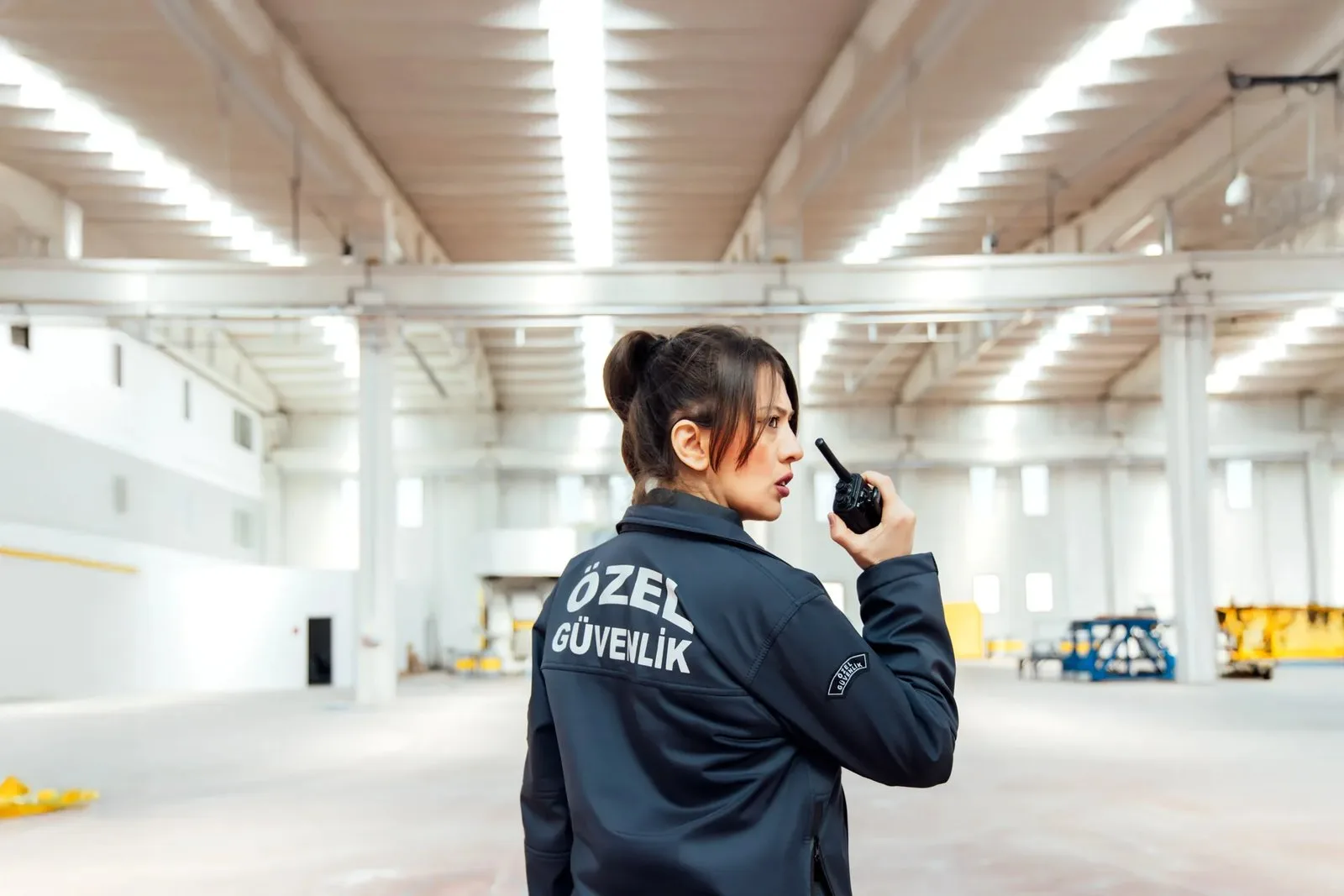
Short answer: In the yarn and carpet raw material stores of Gaziantep's organised industrial zones (OSBs), the weakest moment for security is the hour the last shift walks out. Bales, bobbins and rolls stay where they are; the eyes watching them do not. A working routine stands on three legs: stacking and waste discipline that keeps the fire load in check, a closing round walked with the store supervisor and written into the log, and a traffic plan that keeps lorries, forklifts and pedestrians on separate paths within the plot. The security officer watches, records and raises the alarm in time; work on electrical panels, suppression systems or production machinery belongs to the site's technical team and the fire service.
This article is general information, not legal advice.
Why the question in Gaziantep comes down to the store
According to the Social Security Institution (SGK) Statistical Yearbook 2025, Gaziantep's textile manufacturing sector employs 61,811 people insured under category 4/1-a at 1,241 workplaces, which, by our ranking of the yearbook's provincial table, puts the province first in Türkiye for textiles. A simple ratio we worked out shows textiles accounting for about 16% of all insured employees in the province, and their weight in local employment at roughly 7.9 times the national level. The small size of the clothing sector suggests that the province's textile industry rests on yarn, weaving and carpets rather than garment making. In practice, the largest combustible mass on a Gaziantep factory plot is often not in the production hall but in the raw material and finished goods store.
The second fact is traffic. In a statement to the newspaper Ekonomi Gazetesi, the management of Gaziantep OSB said that around 4,000–5,000 heavy goods vehicles enter and leave the zone every day and that the zone consumes about 5% of the industrial electricity used in Türkiye. The same statement notes that some 500 industrial sites in the zone draw part of their power from the sun, so many warehouse roofs now carry panels and cable runs as well. These are management figures, but they are enough to picture a plot gate with trailers arriving all day and traffic falling away suddenly in the evening.
The third fact is the weather. Records kept by the Turkish State Meteorological Service for 1940–2025 give an average maximum of 35.4 °C in July and August, with a highest recorded temperature of 44.0 °C. Snow is infrequent but can be heavy: the deepest snow on record is 100 cm. A hot summer calls for attention to ventilation and roof equipment; a hard winter calls for attention to plot roads and to keeping the fire access route open.
What does the research say?
1. Warehouse fires are rarer at night, but costlier
A warehouse fire report from the US National Fire Protection Association (NFPA), based on local fire department records for 2018–2022, estimates an average of 1,508 warehouse fires a year. Fires between midnight and 6 a.m. made up only 18% of the total but 38% of direct property damage. Some 38% of fires began in storage areas, and these accounted for 72% of the damage. Electrical distribution and lighting equipment was involved in 19% of fires, and arcing from operating equipment alone was the heat source in about 14%. Rubbish and waste was the item first ignited in 15% of fires. The limits are plain: the data are from the United States and exclude warehouses that form part of manufacturing sites. The report does not examine why; even so, the picture shows why an emptied store needs its own night plan: night fires are few in number but disproportionate in damage.
2. Polypropylene fibre is inherently flammable
Polypropylene is a polymer widely used in fibres, textiles and packaging. A review of flame retardant polypropylenes states that the limiting oxygen index (LOI) of pure polypropylene is around 17 and that, because of its inherent flammability, additives are needed to reduce fire risk (Seidi et al., Polymers, 2020). As air contains about 21% oxygen, a material with an LOI below that figure can keep burning in normal air. An earlier review devoted to polypropylene fibres examines five main families of flame retardants that can be built into such fibres; the fact that this is a research field of its own is a reminder that flame retardancy in fibre form cannot simply be assumed (Zhang and Horrocks, Progress in Polymer Science, 2003). These studies come from materials laboratories, not warehouse field measurements. The practical lesson: find out how the yarn and fibre in your store behave in a fire from the supplier's technical data sheet, write that into the risk assessment, and give the officer a clear answer to the question of what is stored where.
3. In rack storage, fire growth accelerates
A doctoral thesis that studied rack storage fires through large- and reduced-scale experiments reports that their growth is usually described as proportional to time cubed, while in the large-scale test the initial growth fitted an exponential function better (Ingason, Lund University, 1996). The tests used a particular commodity and rack geometry, but the message is general: in high stacks, fire does not grow at a steady rate but speeds up. That is why putting off a smell of smoke, unusual warmth or an odd noise until the next round is a costly habit.
4. Separating vehicles from pedestrians pays off
A before-and-after case study at two manufacturing sites in Victoria, Australia, combined traffic engineering measures that separated forklifts from pedestrian workers with intelligent warning systems fitted to the forklifts. The authors report positive safety results for the traffic engineering measures, and that the forklift warning systems were broadly acceptable in operational conditions, with drivers understanding their safety purpose well (Horberry et al., Applied Ergonomics, 2004). It is a study of two sites without a control group, but it points the same way as the UK Health and Safety Executive's workplace transport guidance, which recommends separate routes for pedestrians and vehicles where possible, a one-way system where practicable, avoiding reversing where possible, safe loading and unloading areas, separate parking for visitors who may not know the site, and supervision of all drivers, including those visiting.
The closing round: who, when and what to check
The closing round is the bridge between the store supervisor saying "I've closed up" and security saying "I've taken over". Without a written bridge, everything that happens at night starts with "nobody told me". We suggest this order:
- Walk it together. The last shift's store supervisor and the officer on duty walk the round together; it ends with two signatures and the time.
- Doors and shutters. Loading bay doors and shutters closed; fire doors clear, not wedged open with a chock or pallet.
- Aisles and sprinkler clearance. Any bales or pallets left in an aisle during the day? Has stacking crept too close to ceiling sprinkler heads or light fittings? The officer does not move it, but logs it and shows the supervisor.
- Waste point. Have yarn trimmings, packaging film and cardboard been taken to the waste area outside the building by the end of the day? A full waste cage should not stand against the store wall.
- Charging area. The forklift charging point kept apart from stock, its surroundings clear; the position and number of vehicles on charge logged.
- Equipment to be switched off. Are the heaters, compressors or machines on the site's night shutdown list off? The switching is done by the authorised person on the list, not by the officer.
- Fire alarm panel. Any fault or disabled zone showing? If so, who knows about it and what is planned for the night is written down.
- Roof and external runs. On roofs with solar panels, the visible parts of inverters and cable routes are added to the round for any smell of burning or unusual noise.
- The first hour after closing. A second round shortly after the store empties is as valuable as the first; later rounds follow a schedule that changes every night.
Vehicle routine within the plot
By day an OSB plot works like a junction: lorries bringing raw material, containers collecting finished goods, forklifts, staff buses, visitors' cars and staff on foot all share the same tarmac. In the evening the problem flips: a loaded trailer left at the bay, vehicles parked against the store wall and a lorry pulled up across the fire access route all add to the fire load and make it harder for the fire service to get close if a fire starts at night. The gate officer's tools are simple:
- Direction on arrival: a driver new to the site is shown the waiting bay, the loading bay to use and the pedestrian routes on a simple sketch, so the area they walk in after leaving the cab is clear.
- Waiting bay: vehicles waiting their turn stop in a marked bay, not in front of the store.
- Pedestrian line: where the walkway crosses the forklift route at shift change, forklift movement stops at that time or an officer controls the crossing.
- Overnight parking: places for trailers and vehicles staying overnight are agreed with site management in advance; parking at the bay or against the store wall is not accepted without a written exception.
- Fire access route and hydrants: checked as clear on every closing round; after heavy snow and clearing, the visibility of markings is checked again.
- Forklift keys: collected at a set place at the end of the working day; any forklift moving at night is logged.
Checklist
| Area | Check | Why |
|---|---|---|
| Closing handover | Store supervisor and officer walk the round together; two signatures and the time. | Night fires are fewer but cause disproportionate damage. |
| Stacking and aisles | Aisles clear; stacks kept back from sprinkler heads and light fittings. | Most damage comes from fires that start in storage areas. |
| Waste | Trimmings, film and cardboard outside the building at the end of the day. | Rubbish and waste is a frequent item first ignited. |
| Electrical | Shutdown list applied; any panel warning logged. | Electrical distribution equipment and arcing play a frequent part in warehouse fires. |
| Material knowledge | The officer knows the fibre types stored and where the data sheet is. | Fibres such as polypropylene can keep burning in normal air. |
| Vehicles and pedestrians | Separate walkway, waiting bay and, where possible, one-way traffic. | Separation stands out in both the case study and the HSE guidance. |
| Overnight parking | No vehicles at the bay or against the store wall; access route clear. | The fire load stays lower and the fire service can get close. |
| Emergency plan | The officer's place and call chain written down for fire, flooding, heavy snow and long power cuts. | The night team is small; who calls whom must be known in advance. |
Common mistakes
- Leaving closing to one person's "done" message, with no written handover.
- Leaving a bale put in the aisle during the day there all night because "it will be moved in the morning".
- Piling trimmings and packaging waste inside the store, by the door.
- Walking the night round at the same time and on the same route every day.
- Letting a loaded trailer wait at the bay until morning; tolerating parking across the access route.
- Expecting the officer to work on electrical panels or machinery, and not writing down the call chain.
- Releasing pedestrian flow and forklift traffic at the same time at shift change.
A note on practice in Türkiye
The private security officer's role in the store and on the plot is to observe, record and raise the alarm. At any sign of fire, the first step is to call 112 and the site's emergency team; officers should not be directed into action that puts their own safety at risk. Article 9 of Law No. 5188 requires incidents calling for force or an arrest to be reported by the fastest available means to the general law enforcement agencies, and the same route applies to unauthorised entry into a store. Fire load, stacking, waste management and plot traffic, meanwhile, fall within the risk assessment and emergency plan required under Occupational Health and Safety Law No. 6331 and are the employer's responsibility. Security post orders should speak the same language as those documents: the items on the closing round come from the risk assessment, and the call chain comes from the emergency plan.
The duties we cover on industrial zone plots are listed under organised industrial zone security, and the way we work with the city's yarn, carpet, food and healthcare sites is described under private security company in Gaziantep; either page is a practical place to begin when you adapt the closing round to your own store.
Titan Savunma is an Ankara-based private security company licensed by the Ministry of Interior under Law No. 5188 and certified to ISO 9001, 14001, 45001, 22301 and 28000. We work with international companies in English and Turkish, and our Gaziantep City Manager, supported by our South-eastern Anatolia Regional Directorate, which is also based in Gaziantep, and our Ankara General Directorate, sees your store at closing time, maps the vehicle routine on your plot with you and writes it into the post orders. To arrange that visit, write to us via our contact page.
Sources and Further Reading
- Seidi, F., Movahedifar, E., Naderi, G., Akbari, V., Ducos, F., Shamsi, R., Vahabi, H. & Saeb, M. R. — Flame Retardant Polypropylenes: A Review, Polymers 12(8):1701 (2020)
- Zhang, S. & Horrocks, A. R. — A review of flame retardant polypropylene fibres, Progress in Polymer Science 28(11):1517–1538 (2003)
- Horberry, T., Larsson, T. J., Johnston, I. & Lambert, J. — Forklift safety, traffic engineering and intelligent transport systems: a case study, Applied Ergonomics 35(6):575–581 (2004)
- Ingason, H. — Experimental and Theoretical Study of Rack Storage Fires, doktora tezi, Lund Üniversitesi Yangın Güvenliği Mühendisliği Bölümü (1996)
- McGree, T. — Warehouse Structure Fires, NFPA Research, National Fire Protection Association (Şubat 2025)
- Health and Safety Executive (UK) — Introduction to workplace transport safety
- SGK — İstatistik Yıllığı 2025, Sigortalı ve İşyeri İstatistikleri (4/1-a, Tablo 1.11)
- Ekonomi Gazetesi — Gaziantep 6. OSB'de yatırımlar başladı (02.01.2025; Gaziantep OSB yönetiminin açıklamaları)
- Meteoroloji Genel Müdürlüğü — Resmî İstatistikler: Gaziantep (1940–2025)
- 5188 sayılı Özel Güvenlik Hizmetlerine Dair Kanun (md. 9), Mevzuat Bilgi Sistemi