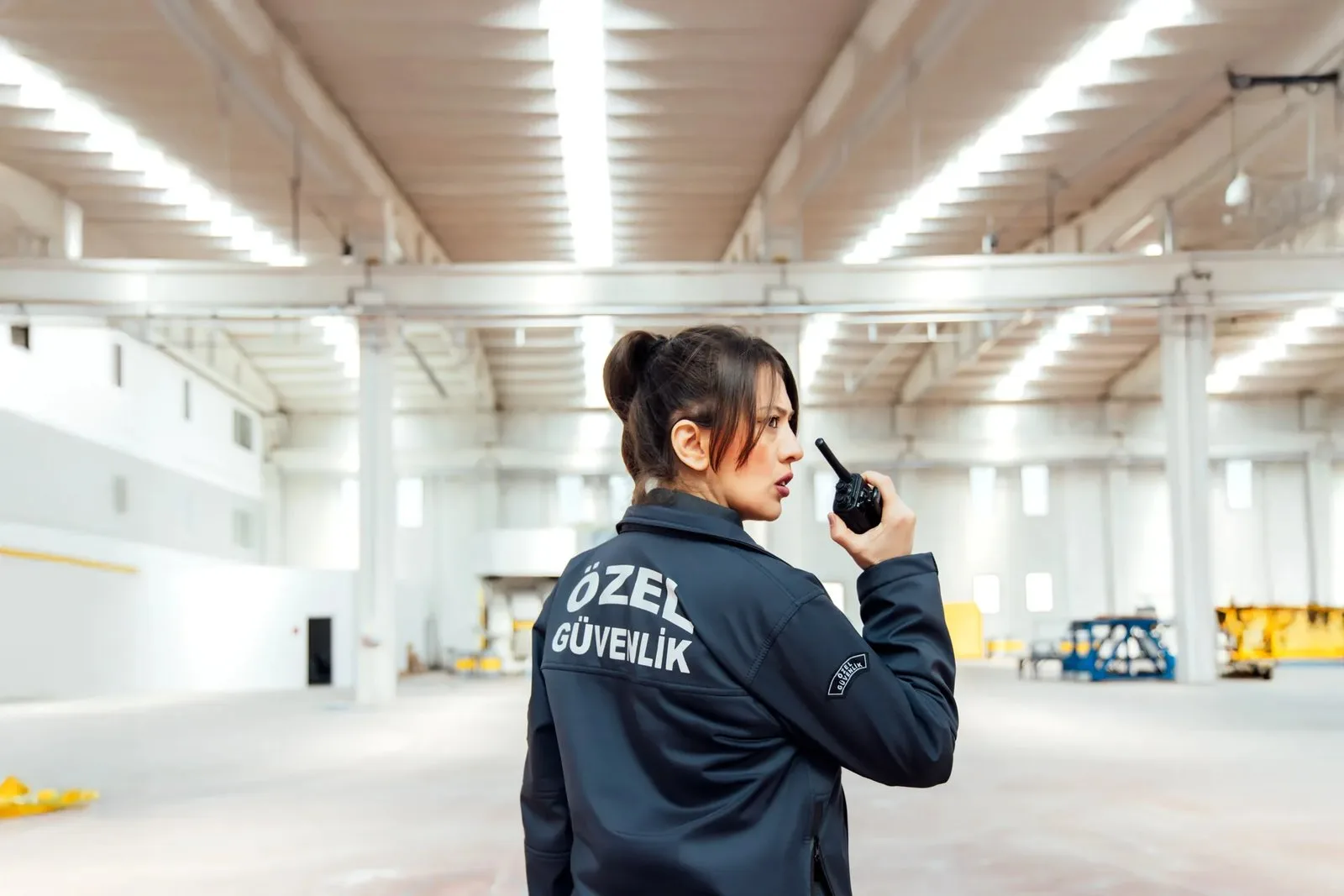
Short answer: At a factory supplying parts, machining or assembly to the defence industry, site security is more than opening and closing the barrier at the gate. Who comes in, how far into the site they can go, what they bring in and take out, and how all of this is recorded are links in the same chain. Research suggests the chain most often breaks on the human side: a reasonable-sounding request can get a door opened for someone with no authority, and a large share of insider risk comes from carelessness rather than malice. The practical answer comes under four headings: pre-register visitors and contractors and admit them with distinct passes and escorts; divide the site into zones and allow entry to each only on written authorisation; control how information, drawings and samples move in and out; and review the records regularly.
This article is general information, not legal advice.
Why this deserves its own heading in Kırıkkale
Kırıkkale's industrial identity is bound up with defence manufacturing. A 2021 pre-feasibility report by the Ahiler Development Agency notes five state-owned defence production plants in the province (ammunition, gunpowder, brass, weapons, and heavy weapons and steel) and close to 40 micro and medium-sized firms in defence and machinery. According to the same report, the specialised organised industrial zone set up in the province for the weapons industry is the country's first and only zone of its kind: it was registered in 2013 on a 50-hectare site, and plot allocations began in 2017. The 2025 Turkish Social Security Institution yearbook shows the same picture from the workforce side: counting compulsorily insured employees under Article 4/1-a, the manufacturing branch with the most insured employees in Kırıkkale is fabricated metal products, a branch that includes weapons and ammunition, with 4,163 insured employees at 95 workplaces.
What this means for security is that, as the report notes, the supplier firms in the province are mostly micro and medium-sized businesses. They may work to their own customers' security requirements, may hold sensitive assets such as drawings, prototypes, test samples and moulds, and may not always have a large in-house security team. Every day their gates see staff, contractor crews, maintenance technicians, couriers and hauliers, customer auditors and visitors. This article does not describe any particular site's rules; it sets out general principles that apply to plants of this kind.
What does the research say?
1. A gate can be talked open
In a field experiment run by a Dutch university team, 31 people followed a script, visited the offices of 118 employees and asked them to hand over their office keys. Half of the requesters used language appealing to authority, and half of the employees were randomly given an awareness briefing beforehand (Bullée et al., Journal of Experimental Criminology, 2015). In the group without the briefing, 62.5% of employees handed over their keys; in the briefed group the figure was 37.0%. Appealing to authority had no significant effect. The experiment took place in an office setting with a request for keys, so its results cannot be transferred directly to a factory gate. Still, it offers two lessons: a good share of well-meaning employees find it hard to say no to a plausible request, and awareness-raising about the dangers, signs and countermeasures of social engineering can bring that share down significantly.
2. Authority is the principle used most in attack scenarios
The same research group took 74 successful attack scenarios from four books written by social engineers and broke them down step by step. It found that persuasion principles were used often, and that authority was used considerably more than any other principle (Bullée et al., Journal of Investigative Psychology and Offender Profiling, 2018). The authors conclude that security should include social as well as technical countermeasures. The sample consists of scenarios told in books, not a systematic record of real incidents, so the frequency finding should not be read as a general attack statistic. Read alongside the field experiment, the practical rule we draw is this: for someone who says "I'm the customer's auditor", "I'm from head office" or "I've been called out for urgent maintenance", the rule does not change. Authority is checked against a record written in advance, not against what the person says.
3. Insider risk is not only about employees, and it is often unintentional
An insider-threat framework developed by researchers at the universities of Oxford and Leicester, grounded in case studies, the literature and psychological theory, defines an insider as a past or present employee, contractor or other trusted third party; its list of actor types also includes consultants, vendors and joint venture partners (Nurse et al., IEEE Security and Privacy Workshops, 2014). The paper notes that accidental, non-malicious insider threat is reckoned to be the most common type. Across the 179 cases the authors collected, information on the attack and the organisation was present in over 90% of cases, while information on observed physical behaviour was present in only 37%. The authors also stress that precursor behaviours observed in isolation may not necessarily indicate an attack. Our takeaway: gate and zone records are not kept to accuse anyone, but as a routine source that can show what happened and when if something goes wrong. A record that was never kept cannot be produced afterwards.
4. An institutional framework: authorisation, escorts and visitor records
The control catalogue of the US National Institute of Standards and Technology (NIST) lists the basic steps for physical access: verify a person's access authorisation before admitting them, keep physical access logs at entry and exit points, escort visitors and control their activity, secure keys and cards, and change keys and combinations when keys are lost or when the people holding them are transferred or leave (NIST SP 800-53 Rev. 5, PE-3 and PE-8). Visitor records are described as including the visitor's name and organisation, date of access, entry and departure times, purpose of the visit and the person visited; the records should be reviewed at set intervals and anomalies reported. The catalogue also defines a control enhancement for limiting personal data in visitor records to what is needed. It is a US catalogue written for facilities that house information systems and is not binding in Türkiye, but it makes a sound checklist for gate routines.
Site security under four headings
Admitting visitors and contractors
- Pre-registration: The host department registers visitors and contractor crews in advance with name, organisation, purpose and the zone they will visit. Anyone not on the list waits in the reception area until the host comes to the gate and gives written approval.
- Distinct passes: Staff, contractor and visitor passes differ by colour or design; visitor passes are valid for that day only and are collected on exit.
- Escorts: In production and test areas, visitors move with their host. The post orders state that the host collects the visitor at the gate and hands them back at the gate.
- Contractor crews: Maintenance and building crews' name lists, work orders and work areas are notified in advance; a crew member not on the list, or anyone heading to an area outside the work order, is reported to the shift supervisor.
- Claims of authority: The same rule applies to someone who says they are an auditor, a customer representative or a senior manager but is not on the list; the gate officer politely calls the host.
Zone-based access
It helps to divide the site into at least three layers: public areas (reception, waiting room), general working areas (offices, canteen) and restricted areas (production lines, test areas, sample and mould stores, archives). For each restricted area, a written list sets out who may enter and at what times; if there is a card access system, its permissions are matched to that list. At restricted-area doors a one-person-per-entry rule guards against tailgating, and doors left open are checked on patrol. When someone leaves, changes role or reaches the end of a contract, their card is deactivated the same day and their keys are collected.
Information and sample security
- The site sets the rules on cameras, phones and removable storage; the officer explains them at entry, manages the lockers and records how the rules were applied.
- Samples, prototypes, moulds and drawings leave the site only with a written release note; the officer checks the items and quantities on the note against what is leaving.
- The route for scrap and rejected parts, whether destruction or sale, is also kept under control; a sensitive part can leave in a scrap skip too.
- Meeting rooms, whiteboards and printer areas are checked on the end-of-day patrol, and any document left behind is handed to the department concerned with a written note.
Document and record discipline
The visitor book, key log, incident reports and patrol reports follow a single format: date, time, person, area and signature. The records are reviewed weekly with the host department or the site manager responsible for security, and anomalies such as visitors with no exit time, unreturned passes or out-of-hours entries are reported. Well-kept records are also the most concrete evidence you have when preparing for a customer audit.
A practical checklist
| Area | What to do | Why |
|---|---|---|
| Pre-registration | The visitor and contractor list comes from the host department in advance; anyone not on it waits in reception. | Authority rests on a written list, not on what a person says. |
| Distinct passes | Staff, contractor and visitor passes look different; visitor passes last one day and are returned on exit. | On site, it is clear at a glance who is who. |
| Escorts | Visitors move with their host in restricted areas; collection and hand-back happen at the gate. | NIST PE-3 lists escorting visitors and controlling their activity. |
| Short briefing | Officers and staff are taught the "not on the list, not coming in" rule with concrete examples, repeated at intervals. | In the field experiment, 37.0% of briefed employees handed over their keys, against 62.5% of those not briefed. |
| Zone list | A list of authorised people and hours for each restricted area; card permissions match it. | Authorisation is verified before entry. |
| Deactivating passes | The card of anyone who leaves or changes role is deactivated the same day and keys are collected. | NIST PE-3 calls for changing keys and combinations when holders leave. |
| Release notes | Samples, prototypes, moulds and drawings leave only with a written note; items and quantities are checked. | Sensitive assets do not leave unrecorded. |
| Record review | Visitor and access records are reviewed weekly; anomalies are reported. | NIST PE-8 calls for regular review and reporting of anomalies. |
Common mistakes
- Leaving familiar faces, the regular courier or a long-standing contractor off the record.
- Handing a visitor a pass at the gate and leaving them to it; hosts leaving visitors alone in production areas.
- Opening the door without checking the list for someone who says "I'm from head office" or "there's a customer audit".
- Leaving the pass of a departed contractor or employee active for weeks.
- Relying on a driver's word for samples and moulds leaving the site; never checking the scrap route.
- Keeping a visitor book that nobody reads; failing to close entries with no exit time at the end of the day.
- Writing more personal data into records than needed, or keeping records indefinitely.
Notes for Türkiye
Under Law No. 5188, having security at a site provided by a private security company requires the governor's permission on the decision of the provincial private security commission (Article 3). At defence industry suppliers, access, device and document rules may also depend on the security requirements of the site's customer or on other obligations specific to the site; setting those rules is for the site and the parties concerned, while the security team applies them in full at the gate and on site and records them. Because visitor records and camera footage contain personal data, they fall under Law No. 6698 on the Protection of Personal Data: data must be relevant, limited and proportionate to the purpose for which it is processed and kept only for the period laid down in the relevant legislation or required for that purpose (Article 4), and the people concerned must be informed when the data is collected (Article 10). Work with your own legal adviser on the details.
You can read how we organise service for sites in the province on our private security in Kırıkkale page, and our general approach to gates, patrols and restricted zones at plant scale on our factory security page. To review your own site's risks, try our security risk assessment tool.
Titan Savunma is an Ankara-based private security company licensed by the Ministry of Interior under Law No. 5188 and certified to ISO 9001, 14001, 45001, 22301 and 28000. We work with international companies in English and Turkish, and our Kırıkkale City Manager works with you to turn your site's visitor, contractor and zone access rules into a daily gate routine backed by consistent records. To arrange a conversation, please use our contact page.
Sources and Further Reading
- Bullée, J.-W. H., Montoya, L., Pieters, W., Junger, M. & Hartel, P. H. — The persuasion and security awareness experiment: reducing the success of social engineering attacks, Journal of Experimental Criminology 11(1):97–115 (2015)
- Bullée, J.-W. H., Montoya, L., Pieters, W., Junger, M. & Hartel, P. — On the anatomy of social engineering attacks: A literature-based dissection of successful attacks, Journal of Investigative Psychology and Offender Profiling 15(1):20–45 (2018)
- Nurse, J. R. C., Buckley, O., Legg, P. A., Goldsmith, M., Creese, S., Wright, G. R. T. & Whitty, M. — Understanding Insider Threat: A Framework for Characterising Attacks, IEEE Security and Privacy Workshops, pp. 214–228 (2014)
- NIST — SP 800-53 Rev. 5, Security and Privacy Controls for Information Systems and Organizations: PE-3 Physical Access Control, PE-8 Visitor Access Records (2020)
- Ahiler Kalkınma Ajansı — Kırıkkale İli Silah Parçaları Üretim Tesisi Ön Fizibilite Raporu (2021), Yatırım Destek
- SGK — İstatistik Yıllığı 2025 (4/1-a, Tablo 1.11)
- 5188 sayılı Özel Güvenlik Hizmetlerine Dair Kanun — Mevzuat Bilgi Sistemi
- 6698 sayılı Kişisel Verilerin Korunması Kanunu — Mevzuat Bilgi Sistemi