
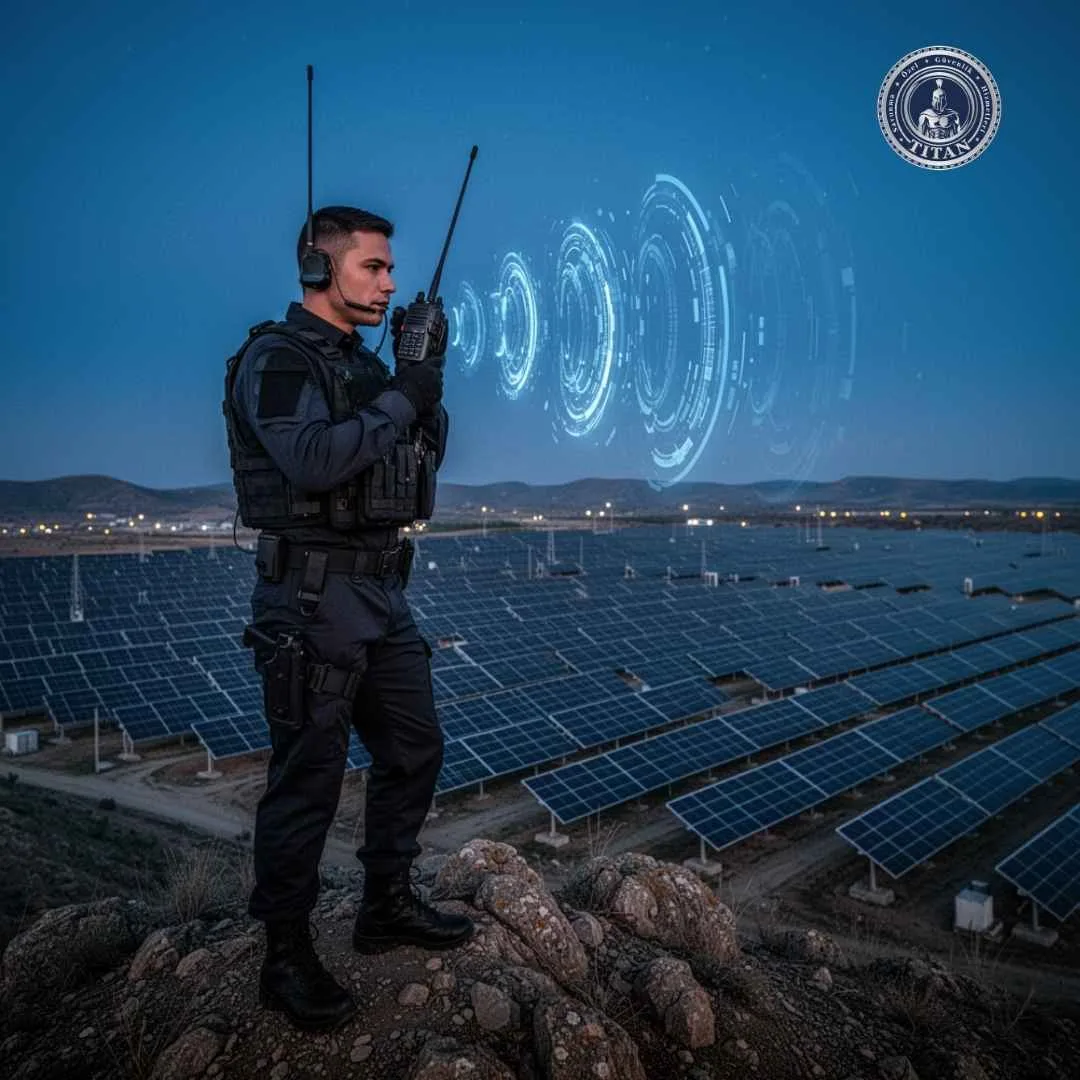
Ground surveillance radar watches wide open ground by sending out radio waves and measuring what bounces back, so it can report that something is moving, where it is and how fast, across areas too large for fence sensors or cameras alone. On a solar farm, a logistics yard or a quarry it is an early-warning layer: the radar finds and tracks, a camera shows the operator what was found, and a trained person decides whether to send someone. Radar never tells you who or why; that judgement stays with people.
This article is general information, not legal advice. It explains the technology class without naming products: how it works, how it pairs with cameras, why response distance matters more on remote sites, what to check about radio-frequency permission in Turkey, and when radar is worth it.
How ground surveillance radar works
A surveillance radar transmits radio energy across an area and listens for reflections. From the timing and direction of each echo it calculates distance and bearing; from changes between sweeps it works out movement and speed. Software turns repeated echoes into tracks, so the control room sees a moving point with a history rather than a single beep. Zones and rules then decide which tracks raise an alarm, for example movement inside a fenced array at night, while ignoring traffic on a public road outside it.
The UK National Protective Security Authority (NPSA) describes this family as wide-area detection in its perimeter intrusion detection guidance: systems that cover open space inside and outside a perimeter for detection and tracking, rather than sensing contact with a fence line. That is the key difference from a fence-mounted sensor covered in our PIDS encyclopedia entry: radar can see someone approaching before they touch anything.
Researchers studying radar for surveillance note its main strength: radar keeps working in darkness and poor weather where cameras struggle. The same research group also shows its main weakness. In a 2022 peer-reviewed study in Sensors, Buchman and colleagues worked on telling pedestrians from animals using radar echoes and stress that the two look similar in radar returns; their classifiers performed well on one test set and noticeably worse on another, which the authors themselves describe as overfitting. For a site manager the lesson is simple: automatic classification helps prioritise, but it does not replace a person looking at a picture.
Radar and cameras: find, then look
Radar on its own produces a dot on a map. What turns that dot into a decision is visual verification. The common integration is often called slew-to-cue: when radar raises an alarm, the video system automatically turns a pan-tilt-zoom or long-range camera, often thermal for night work, to the reported position and keeps following the track. The operator then sees whether it is a person, a vehicle, a deer, a stray dog or a maintenance crew that forgot to call in.
NPSA's guidance is clear that alarms should be verified quickly by the security control room before any response is initiated, with CCTV as the usual means, and that camera placement and lighting have to be designed together with the detection zones. In practice that means three planning questions:
- Can every radar zone be seen? A radar that covers ground no camera can view gives you alarms nobody can verify.
- Is the picture good enough at that distance and at night? Verification needs enough detail to tell a person from an animal; see our thermal camera entry.
- Who is watching when the cue arrives? Slew-to-cue on an unwatched screen is a recording, not a response.
The remote-site question: detection far away, help far away
Solar and wind sites, quarries and outer logistics yards share a problem: they are big and often far from the nearest guard post, town or gendarmerie station. Radar's early warning is valuable only if it buys time that somebody uses. Before buying, write down honestly:
- Who receives the alarm? An on-site control room, a remote monitoring centre, or a phone in a guard's pocket.
- Who verifies? A named operator role with the authority to call it a real event.
- Who goes, from where, and how long does it take? A patrol inside the site, a mobile unit on another site, or the police or gendarmerie called by the operator.
- What happens in the meantime? Keeping the camera on the track, recording, lighting, a talk-down announcement if lawful and planned, and a log of every step.
If the honest answer is that nobody can reach the far corner of the site for a long time, radar still has value as evidence and as a trigger for police notification, but expectations and post orders must say so. Our digital twin for solar sites lets you sketch posts, patrol routes and response paths before deciding on sensors.
Environment and site conditions
Radar is affected by what is in its field: vegetation that moves in the wind, standing or moving water, metal structures, embankments and terrain that create shadowed ground. Solar arrays add long rows of metal frames; logistics yards add parked trailers that move every day. These are not reasons to avoid radar, but reasons for a careful site survey, commissioning with realistic tests, and periodic review as the site changes. Vegetation control and wildlife management become part of the security plan, not just landscaping.
Planners should also ask what the radar must not see. Zones that spill over a public road, a neighbour's land or a village path create nuisance alarms and possible privacy concerns when cameras follow those tracks. Masking those areas is a design decision to document, not an afterthought.
Radio frequency use and permission in Turkey
A radar is a radio transmitter, so spectrum rules apply. Under Electronic Communications Law No. 5809, Article 36 says those who wish to install and operate radio equipment or systems must have the frequency assignment and registration done by the Information and Communication Technologies Authority (BTK). Article 37 adds that users of radio equipment needing a frequency assignment must obtain a radio installation and use permit and a radio licence, while BTK-approved equipment operating in bands and at output powers set aside by BTK regulations for special purposes may be used without such a permit or licence.
Which of these applies to a particular radar depends on the device's band, output power and approval status, and that is a question for BTK's current regulations and the supplier's conformity documents, not for a blog post. Put it in the tender: the bidder must state the frequency status of the equipment and who is responsible for any BTK application. Interference with other communications is a matter for the competent authorities only.
When radar is too much, and when it fits
Radar tends to be overkill for a compact site with a sound fence, good lighting and a guard post that can see most of the boundary. A well-commissioned fence-mounted system plus cameras is usually easier to verify there.
It starts to make sense when:
- the area is large and open, and fencing every approach is impractical or unwanted;
- you want warning before someone reaches the fence or the asset, such as transformer stations, cable routes or stored equipment;
- fog, darkness or long distances limit what cameras can detect on their own;
- there is a monitored control room and a realistic response plan to use the extra time.
Quick checklist before buying
- A written operational requirement: what must be detected, where, and what response follows.
- Camera coverage for every alarm zone, day and night.
- Named roles for monitoring, verification and response in post orders.
- Frequency and permission status confirmed in writing.
- Commissioning tests on your own ground, and a maintenance and review schedule.
- An alarm log that is reviewed, so nuisance sources are fixed rather than ignored.
Working with a security partner
Titan Savunma is an Ankara-based private security company operating under a Ministry of Interior licence under Law 5188, with ISO 9001, 14001, 45001, 22301 and 28000 certificates. We work with international companies in English and Turkish and plan sites in different provinces with a single point of contact, written scope and regular reporting. We plan manned guarding together with your technology: who watches the radar picture, who verifies, and how far and how fast someone can respond. Read more about our critical infrastructure security approach.


