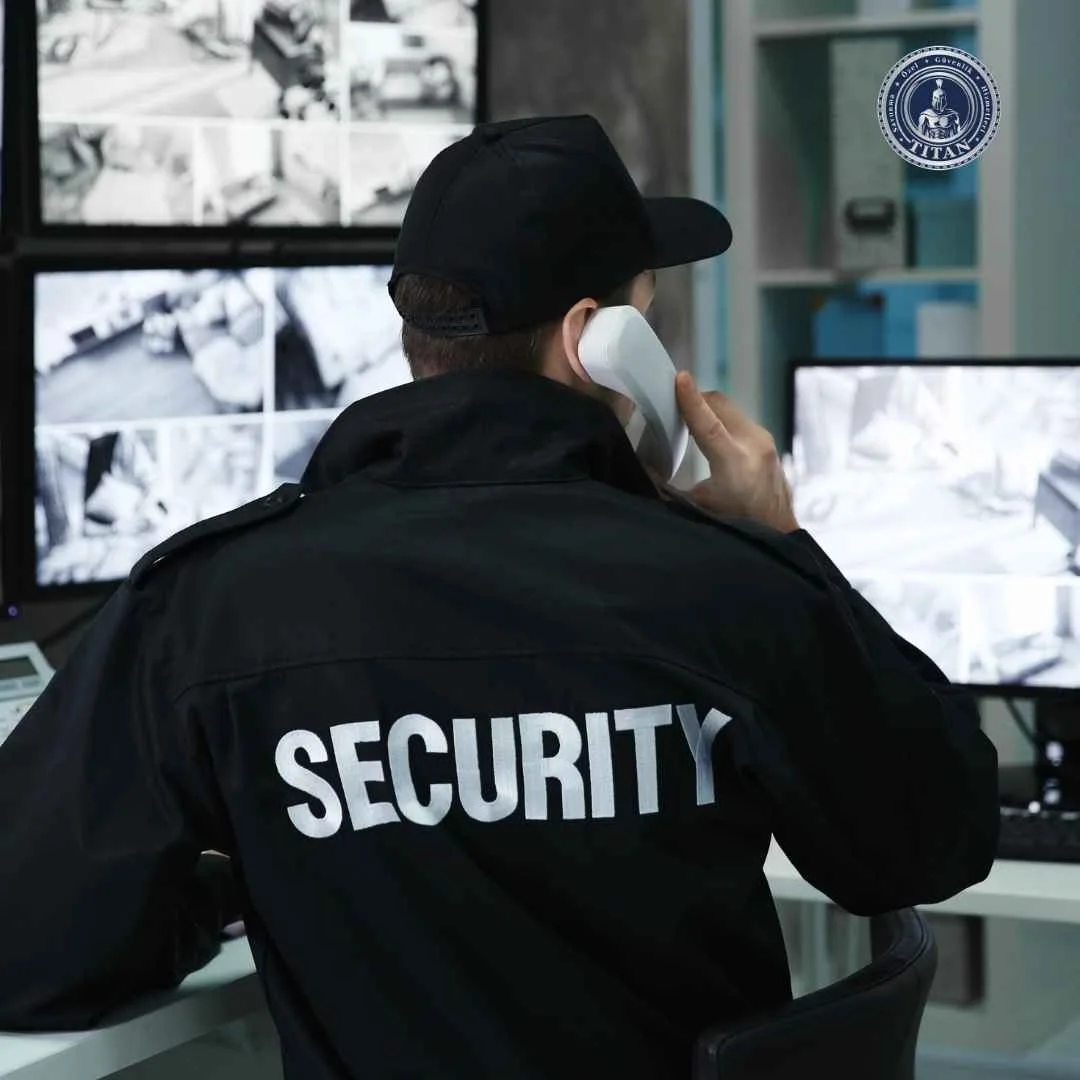
In a single-tenant warehouse, the owner of security is obvious: the company running the building. In a logistics park built by an investor and leased to several third-party logistics providers (3PLs), the picture blurs. Who checks the truck at the main gate? Who holds the record of an attempted theft in the truck holding yard at night? When one tenant wants TAPA certification, where does it get evidence for a perimeter fence and gate procedure it does not own? If the lease does not answer these questions, the parties will point at each other after the first serious incident.
The short answer: security in a multi-tenant logistics park should be split into two layers. The park layer belongs to the park operator: perimeter, main gate, internal roads, truck holding yard and common areas. The tenant layer belongs to each tenant: its building, docks, cargo, stock areas and people. The boundary between the layers goes into a security annex to the lease, the shared rules into a park security manual, and day-to-day operation into a security coordination committee that meets on a fixed schedule.
This article is general information, not legal advice.
Separating the park layer from the tenant layer
The cleanest way to allocate responsibility is a matrix by area and process. The table below is a typical starting point. Every park has a different layout and lease model, so adapt it rather than copy it.
| Area or process | Park operator | Tenant |
|---|---|---|
| Perimeter fence, lighting, perimeter cameras | Installs, operates, maintains, responds to alarms | Reports weak points near its building |
| Main gate and vehicle admission | Gate procedure, plate and driver registration, visitor reception | Sends expected vehicle and visitor lists in advance |
| Internal roads and traffic | Speed, direction and parking rules; patrols | Makes sure its drivers follow the rules |
| Truck holding yard | Yard layout, cameras, patrols, records | Requests extra controls for its own loads in writing |
| Building, docks and stock areas | No authority; only coordinated response with the tenant in an emergency | Access control, dock security, cargo and stock control |
| Incident records and reporting | Common-area incidents, park-level analysis | Incidents in its own area; reports those that affect the park |
| Emergency and evacuation | Park-level plan, assembly areas, coordination with public responders | Building plan aligned with the park plan; joins drills |
The weak points of any such matrix are the interfaces: the time between a truck clearing the park gate and reaching a tenant's dock, a trailer waiting overnight in front of a dock, the shared road around a tenant building that is closed at night. Write separately who does what in those places.
Shared gate and yard management
The main gate carries the heaviest workload in the park and serves tenants with different expectations. One tenant may admit every vehicle by appointment while another takes unscheduled parcels all day. The gate procedure should be written with the tenants and should define at least: how and by when tenants send expected-vehicle lists; how a vehicle not on the list is confirmed with the tenant, and by whom; what driver and plate data is recorded; the maximum time a vehicle may stay in the park; and what document is checked on exit.
The holding yard deserves attention because a stationary truck is where cargo is most exposed. An analysis by Ekwall and Lantz of incidents reported to TAPA EMEA's incident database found that 97% of attacks on cargo during a stop took place at non-secure parking locations, and that these thefts were more a volume crime than high-value theft. The data cover the wider Europe, Middle East and Africa region rather than Turkey alone, but the message for a park yard is clear: an unguarded wait is the weak link.
For the truck holding yard, the European Union's rules on secure parking are a useful benchmark. Commission Delegated Regulation (EU) 2022/1012 sets four security levels for safe and secure parking areas (bronze, silver, gold and platinum), with graded requirements for the perimeter, entry and exit, surveillance checks and CCTV. Certificates last three years, with at least one unannounced audit during their validity. The regulation does not bind Turkish sites, but tenants hauling to Europe, and their customers, may compare a park's yard against such criteria. TAPA EMEA's Parking Security Requirements (PSR) is likewise a scalable standard for parking places used by road transport; its 2018 version provides for certification by independent audit bodies at levels 1, 2 and 3 and for self-certification at level 3 only. Truck parking deserves its own article; the point here is that the yard is the park operator's responsibility and should be run so the operator can give tenants evidence.
The lease security annex
Security cannot be left to a general clause saying "the tenant is responsible for its own security". A security annex to the lease should cover at least:
- The responsibility matrix and a definition of interface areas.
- The minimum service the park operator provides: gate hours, patrols, camera coverage, footage retention, incident notification.
- What tenants may do for their own security: install cameras and alarms on their building, use their own security company, and the approval route for extra fencing or barriers.
- Tenant access to park-level records: gate logs for its own vehicles and footage requests for cameras that view its building.
- Card and permission cancellation and key return when a tenant leaves.
- Audit rights: the route to follow when a tenant's customer or certification auditor wants to visit the park.
We covered how to align such an annex with head-office expectations for foreign-owned tenants of office buildings in our article on the office lease security annex for foreign tenants; the same logic applies in logistics parks.
Standards tenants may require: TAPA and others
Tenants handling high-value, theft-targeted cargo may be asked by their customers for TAPA certification. TAPA EMEA publishes three core standards: the Facility Security Requirements (FSR) for warehousing and in-transit storage, the Trucking Security Requirements (TSR) for road transport, and the PSR for parking places. TAPA reviews its standards as needed every three years, so agree at the outset which version a tenant will be certified against.
The real difficulty in a multi-tenant park is this: when a tenant's warehouse is audited, the auditor will also look at the controls around the building, and some of them (perimeter fence, main gate, common-area cameras) belong to the park operator. The tenant can only offer a written commitment and evidence: maintenance records, a camera coverage plan, the gate procedure, incident records. If the park operator prepares that evidence as a standard pack, the tenant benefits and the park becomes a preferred location for certified tenants. The same applies to tenants certified to ISO 28000 for supply chain security management: their management system has to reach external parties such as the park operator.
Sharing incident data
Incidents in logistics parks usually concern the whole park rather than one tenant: a suspicious vehicle circling the perimeter, a driver trying to collect a load with false documents, a cut found in the fence at night. One tenant's incident is an early warning for the others; if it is not shared, everyone can be targeted one by one with the same method. Three levels of sharing work well:
- Immediate alert: incidents affecting the park are sent to the park security centre and all tenant security leads at once.
- Monthly summary: a park incident report by category, location and time, with no personal data.
- Joint review: for serious incidents involving several tenants, a joint assessment and coordinated reporting to the police or gendarmerie.
Plates, driver names and camera images are personal data. Law No. 6698 on the Protection of Personal Data (KVKK) prohibits transfers without explicit consent as a rule and allows them without consent only where one of the conditions in Article 5(2) applies or, for special-category data and with adequate measures, one of those in Article 6(3) (Article 8). Transfers to a head office abroad are subject to the separate conditions of Article 9, amended in 2024. Sharing rules should therefore sit in a written protocol stating which data goes to whom, for what purpose and on what legal basis, with the park operator and each tenant acting as controller for the data in its own systems. The controller's duty to take technical and administrative measures for an appropriate level of security (Article 12) extends to who can access a shared camera system.
The legal frame and governance
Anyone wanting private security in the park goes through the permission process in Law No. 5188 on Private Security Services: the service requires the governor's permission on the decision of the provincial private security commission (Article 3). The park operator's permission covers the areas it is responsible for; a tenant that wants its own guarding for its building runs its own permission process. Because officers may use their powers only during duty hours and within their assigned area (Article 9), a park officer cannot exercise powers inside a tenant building, and a tenant's officer cannot do so in common areas, unless that area is also part of their permitted duty area. A clear definition of each team's area at the interfaces is therefore a legal necessity, not just good practice.
On occupational safety, Law No. 6331 on Occupational Health and Safety requires employers sharing a work area to cooperate and coordinate. It also provides that in places with several workplaces, such as business centres, industrial zones or sites, coordination is provided by the management, which warns employers about hazards affecting other workplaces and reports those that do not comply to the Ministry (Article 23). Whether a given logistics park falls within that description depends on its structure and needs legal assessment; either way, it is sensible to centralise coordination on park traffic and evacuation with park management.
A simple governance structure works: a security coordination committee chaired by the park operator's security lead, attended by each tenant's security lead, meeting at fixed intervals. Its agenda covers incident summaries, gate and yard performance, onboarding new tenants, joint drills and changes to the manual. Decisions should be minuted, and the manual reissued with a version number after every change. For a similar shared-management model, see our page on organised industrial zone security; for warehouse-level practice, see logistics and warehouse security.
Common mistakes
- Leaving security to the tenant in one sentence of the lease, then arguing over responsibility after a gate incident.
- Not defining tenants' right to footage, then leaving a footage request unanswered for weeks after an incident.
- Not cancelling cards and permissions when a tenant leaves.
- Not writing duty boundaries in a park where each tenant uses a different security company.
- Sharing incident information by word of mouth, or circulating plate lists in messaging groups with no thought for data protection.
About Titan Savunma
Titan Savunma is an Ankara-based private security company licensed by the Ministry of Interior under Law No. 5188 and certified to ISO 9001, 14001, 45001, 22301 and 28000. We work with international companies in English and Turkish, and plan services for sites in different provinces with a single point of contact, a written scope and regular reporting. See our approach as a security partner for international companies in Turkey.
Sources and Further Reading
- Ekwall & Lantz — Cargo theft at non-secure parking locations, International Journal of Retail & Distribution Management 43(3) (2015)
- European Union — Commission Delegated Regulation (EU) 2022/1012 on standards for safe and secure parking areas and their certification (2022)
- TAPA EMEA — Security standards (FSR, TSR, PSR) overview
- TAPA EMEA — Parking Security Requirements (PSR) 2018
- Mevzuat Bilgi Sistemi — 6331 sayılı İş Sağlığı ve Güvenliği Kanunu
- Mevzuat Bilgi Sistemi — 6698 sayılı Kişisel Verilerin Korunması Kanunu
- Mevzuat Bilgi Sistemi — 5188 sayılı Özel Güvenlik Hizmetlerine Dair Kanun