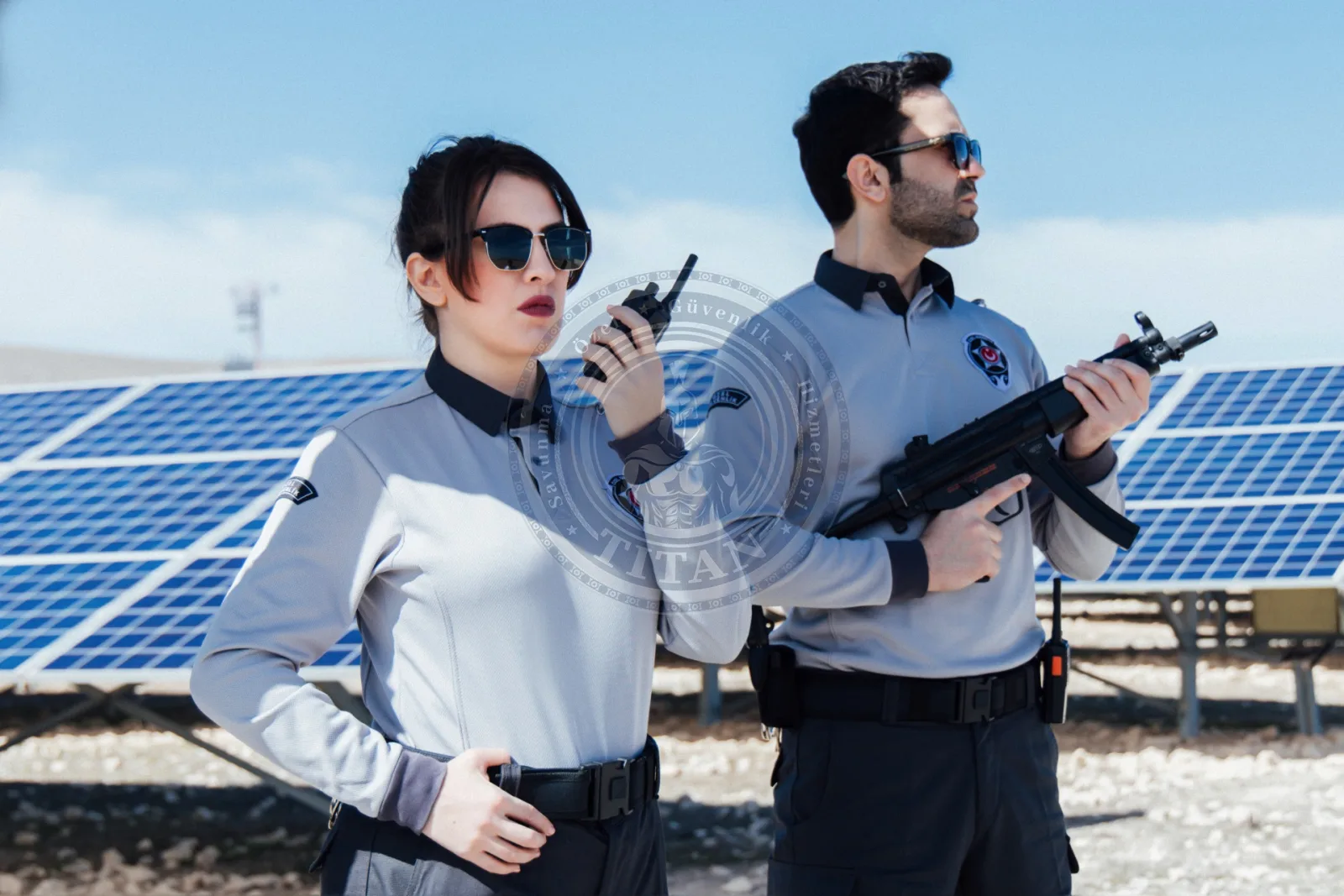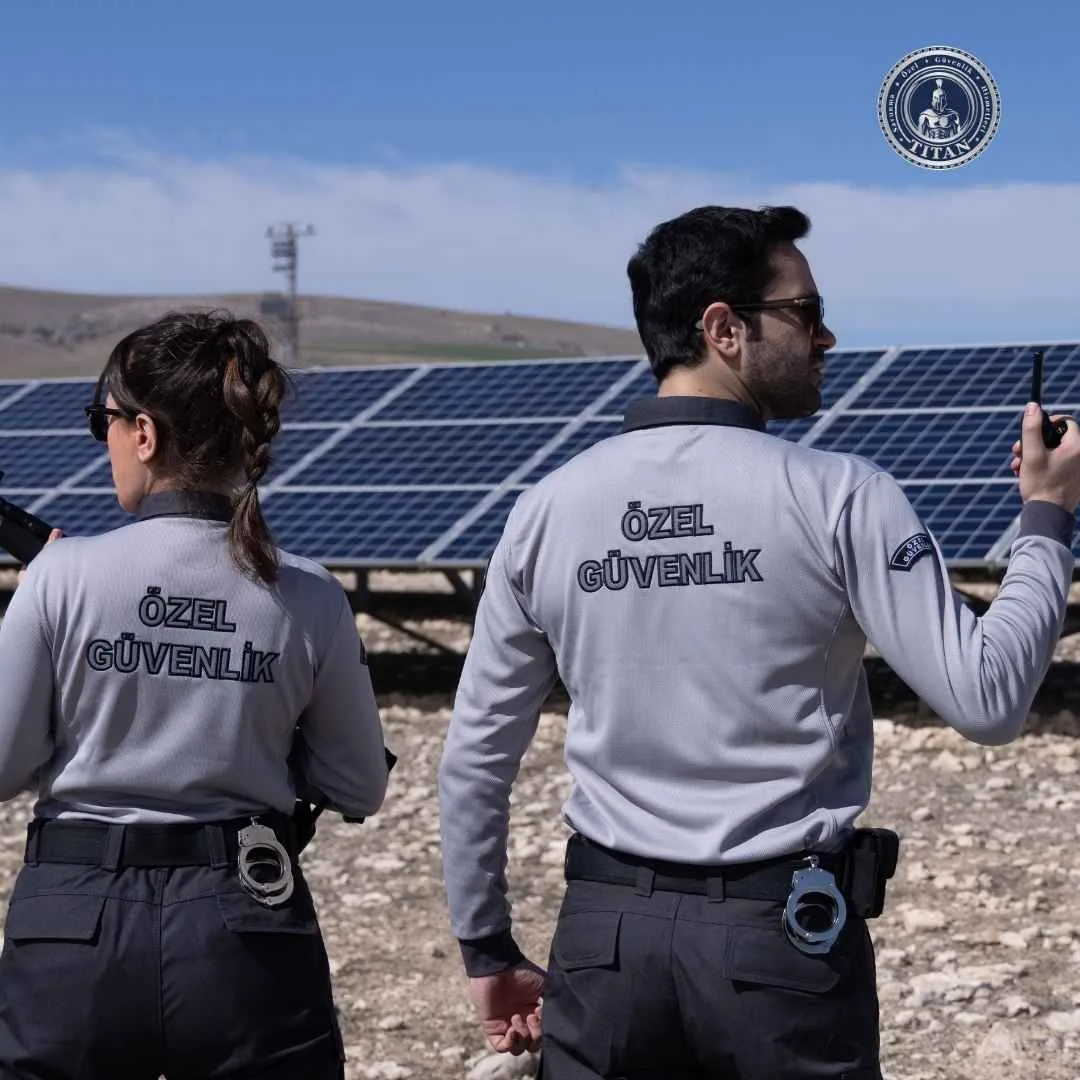
Owners of solar and wind plants in Turkey usually buy security in one of two ways: as a line inside the operation and maintenance (O&M) contract, with the O&M contractor subcontracting a guarding company, or as a separate guarding contract signed directly by the owner. Both can work. What fails is the interface: alarms that nobody is clearly responsible for verifying, O&M crews arriving at night without the guard knowing, incidents reported to the insurer late or twice in different versions, and liability that falls between two contracts.
This guide sets out the clauses that close those gaps. It deliberately leaves out commercial terms. It focuses on who does what, the Turkish licensing rule that shapes both models, and a clause checklist you can hand to your lawyers and asset managers.
This article is general information, not legal advice.
The licensing rule that applies to both models
Whatever the contract chain, the people who actually guard the site must be private security officers employed by a company licensed under Law No. 5188 on Private Security Services. Article 5 of the Law makes private security activity subject to the permission of the Ministry of Interior and requires that the licensed company's field of activity be exclusively protection and security. An O&M company therefore cannot hold that licence and keep doing maintenance. If security sits inside the O&M contract, the O&M contractor must subcontract a licensed security company, and the owner should see that subcontract.
Three other provisions shape the contract language. Article 3 makes the use of private security at a site subject to the governor's permission on the provincial commission's decision. Article 10 of the Implementing Regulation requires a written contract between the security company and the client stating the scope, number of personnel and duration, filed with the governorship when the service starts. And Article 16 of the Law states that private security personnel cannot be employed in any work other than protection and security. That last rule is the one O&M-bundled contracts most often break in practice, when a guard is asked to wash modules, read meters or run errands for the maintenance team.
Two contracting models compared
| Question | Security inside the O&M contract | Separate guarding contract |
|---|---|---|
| Who directs the guards day to day? | O&M contractor, through its security subcontractor | Owner or its asset manager, directly with the security company |
| Single point of accountability | Strong for availability; weaker for security quality | Clear for security; the owner must manage the interface |
| Risk of guards drifting into O&M tasks | Higher, as both report to the same manager | Lower, if the contract repeats the Article 16 limit |
| Incident information to owner | Filtered through the O&M report | Direct from the security company |
| Change of O&M contractor | Security may change with it | Security continuity is preserved |
IFC's Good Practice Handbook on the Use of Security Forces makes two points, written for construction contractors, that carry over directly. When contractors deploy security, the company must still maintain oversight, because communities typically do not distinguish between guards managed by a contractor and those managed by the owner. And security must be coordinated between the company and the contractor "to prevent gaps, confusion, and loss of accountability". The Handbook also suggests that, ideally, all contractors use the same guard provider to avoid uneven standards. For a portfolio with several O&M contractors, that argues for a separate guarding contract or at least a common security specification.
Alarm response and verification
Most disputes start with an alarm at 03:00. The contract should answer, in writing, the following:
- Who watches the alarms. If cameras and intrusion sensors are watched remotely, Article 5 of Law 5188 requires a governorship qualification certificate to establish and operate an alarm monitoring centre. An O&M control room that watches inverter data is not automatically an alarm monitoring centre in this legal sense; name the certified provider.
- Who verifies. Specify whether verification is by camera, by an on-site guard or by a patrol, and the sequence when one fails.
- Who calls the authorities. Guards may use their powers only within their duty area and during duty hours (Law Article 9), and events requiring force or apprehension must be reported to the police or gendarmerie by the fastest means. The contract should state who makes that call and who informs the owner.
- Who does not respond. O&M technicians should not be sent alone to investigate intrusion alarms. It is not their role and it is an occupational safety risk that the employer must assess under Law No. 6331 on Occupational Health and Safety.
- Technical versus security alarms. Separate equipment faults (which go to O&M) from security events (which go to the security company), and define what happens when one looks like the other, such as a string dropping out because a cable has been cut.
Our bulletin on solar plant security officer duties and limits explains what an officer may and may not do once on scene.
Access for O&M crews and their subcontractors
O&M work brings a changing population to the site: the main contractor's technicians, module cleaners, vegetation crews, inverter manufacturers' engineers, grid company staff. Each is a possible gap. Write into both contracts that:
- The O&M contractor sends a daily or weekly list of named workers and vehicles, and unannounced arrivals are held at the gate until confirmed by a named person.
- Night and weekend work is announced in advance, so that a light in the field is not treated as an intrusion, or worse, ignored.
- Keys and codes for substations, containers and the control room are issued and logged by one party, with a rule for returning them when a subcontractor leaves.
- Permit-to-work remains with O&M; security only checks that the person entering is on the list, without becoming the safety gatekeeper for electrical work.
Article 23 of Law 6331 requires employers sharing the same work area to cooperate on health and safety measures, coordinate risk prevention and inform each other about risks. A short coordination annex signed by the owner, the O&M contractor and the security company is a simple way to evidence that.
Incident reporting to the owner and the insurer
Insurers decide claims on records. Agree a single incident report format used by both contractors, with time of detection, time of notification, what was verified, which authority was called and the report reference, and what was damaged or missing. Article 16 of the Regulation tasks private security officers with protecting the scene and evidence and handing over to the general law enforcement; the O&M contractor should not start repairs at a theft scene before the authorities have finished, unless safety requires it, and the contract should say so. Define the deadline for notifying the owner and who notifies the insurer. Our bulletin on solar plant insurance and security records covers what loss adjusters typically ask for.
Liability gaps to close
Without discussing commercial terms, several liability points are worth mapping. Article 21 of Law 5188 obliges private legal entities and security companies to take out private security financial liability insurance for damage their officers cause to third parties; ask for evidence that the guarding company actually employing the officers holds it. Decide who is responsible for loss when the O&M contractor leaves a gate open, and when a guard fails to report. Make sure the O&M contract's availability guarantees do not penalise the O&M contractor for downtime caused by theft that the security contract was meant to prevent, or the reverse, without clear rules. The US National Renewable Energy Laboratory (NREL), in its O&M best-practice guide, presents a more standardised approach to O&M as a way to make costs more predictable and to improve asset transparency for investors; the security interface deserves the same standardisation.
Clause checklist
- Guarding performed only by a company licensed under Law 5188; subcontract disclosed to the owner.
- Written guarding contract consistent with Regulation Article 10 and the site's private security permit.
- Explicit statement that security officers perform no O&M or other non-security work (Law Article 16).
- Alarm monitoring provider named, with its governorship qualification certificate.
- Alarm verification sequence and the party that contacts police or gendarmerie.
- Rule that O&M staff do not investigate intrusion alarms.
- Access list, night-work notice, key and code control, and subcontractor exit procedure.
- Health and safety coordination annex under Law 6331 Article 23.
- Single incident report format, notification deadlines, evidence preservation.
- Insurance evidence for the guarding company under Law Article 21.
- Business continuity: who keeps security running if either contractor changes or fails.
- Regular joint review of incidents and open actions between owner, O&M and security.
About Titan Savunma
Titan Savunma is an Ankara-based private security company licensed by the Ministry of Interior under Law No. 5188 and certified to ISO 9001, 14001, 45001, 22301 and 28000. We work with international companies in English and Turkish, and plan services for sites in different provinces with a single point of contact, written scope and regular reporting. See our manned guarding and solar power plant security pages.
Sources and Further Reading
- IFC — Good Practice Handbook: Use of Security Forces: Assessing and Managing Risks and Impacts (2017)
- NREL (Walker, H.A.) — Best Practices for Operation and Maintenance of Photovoltaic and Energy Storage Systems, 3rd Edition (2018)
- T.C. Mevzuat Bilgi Sistemi — Law No. 5188 on Private Security Services
- T.C. Mevzuat Bilgi Sistemi — Implementing Regulation of Law No. 5188 (MevzuatNo 7190)
- T.C. Mevzuat Bilgi Sistemi — Law No. 6331 on Occupational Health and Safety