
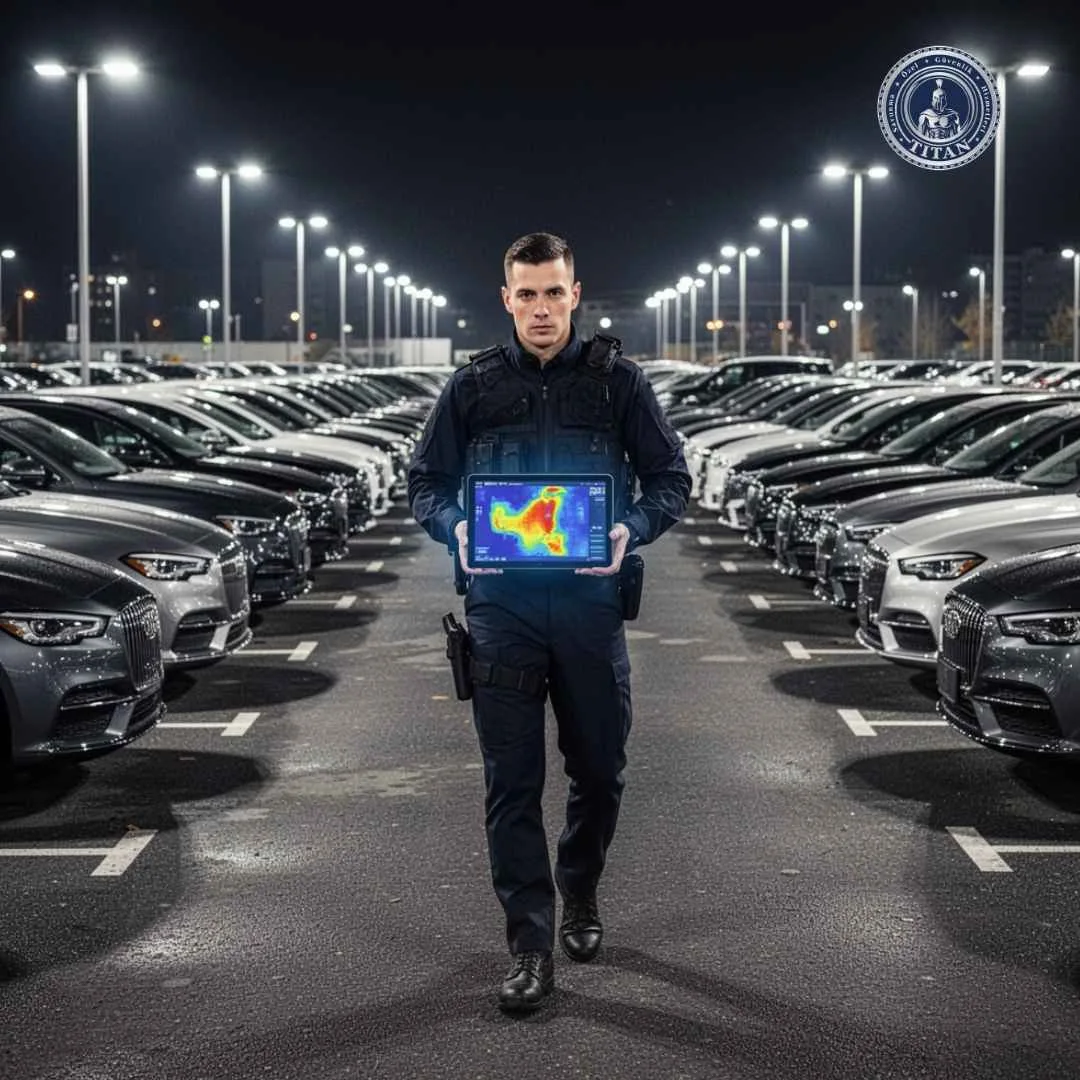
A night-vision (infrared-illuminated) camera lights the scene with invisible near-infrared light and records what is reflected; a thermal camera needs no light at all and detects the heat radiation that objects emit themselves. That makes thermal strong at detecting people or vehicles in darkness, but it does not show identifying detail such as faces or number plates. Night vision gives a more familiar picture, but its range and quality depend on its illumination. On large sites, the best results usually come from planning both together with a team that can go to the scene.
This article is general information, not legal advice.
How each technology works
Night vision: reflected light
An ordinary security camera forms an image from light reflected off objects. When light falls, "night-vision" cameras switch on their own infrared illuminators. According to a widely cited survey of thermal cameras by researchers at Aalborg University, such active infrared cameras illuminate the scene with near-infrared radiation of roughly 0.7 to 1.4 micrometres and capture both visible and near-infrared reflection (Gade and Moeslund, 2014). The image is usually black and white; clothing, shape and sometimes faces can be made out.
That is also the limit: the camera sees well only where it can illuminate. The illuminator's power and angle, raindrops, and reflections from nearby surfaces all affect the picture directly.
Thermal: emitted heat
The same survey explains that every object above absolute zero emits infrared radiation; in the mid- and long-wave infrared band (about 3 to 14 micrometres) that radiation comes from the object itself, with intensity depending on temperature. A thermal camera is a passive sensor that measures this radiation and needs no external light source. The survey notes that thermal sensing removes the changing-illumination problem of normal cameras and the need for active lighting in the dark, and that people are much easier to distinguish in a thermal image.
For a basic definition, see our encyclopedia entry on the thermal camera.
Where thermal is strong, and where it is weak
Strengths
- Detection in darkness: because it needs no light, it suits unlit fence lines, open storage yards and large sites such as solar plants for noticing the presence of a person or vehicle.
- Separation from the background: a warm body stands out against a cooler ground, which helps automatic detection software. The survey reports that for general-purpose human detection, thermal cameras are often a better choice than normal cameras.
- Independence from changing light: headlights, shadows or sunset affect a thermal image far less than a normal one.
Weaknesses
- Identification: the survey notes that the lack of texture information can be a disadvantage. Faces, plates, colours and clothing detail are not visible at identification level. A thermal camera says "someone is there", not "who".
- Reflections: according to the survey, reflections of thermal radiation can be a problem on highly reflective surfaces, which can produce misleading images.
- False alarm sources: animals, surfaces that warm in the sun and cool at dusk, or warm objects moving in the wind can trigger detection software. That is why every alarm needs human verification.
- Weather and season: like any sensor, thermal can be affected by precipitation, humidity and seasonal temperature differences. Judge performance from tests on your own site in different conditions, not from a datasheet.
The detection and verification chain on a perimeter
A thermal camera shows its real value as the first link in a chain. On a large site, a typical chain looks like this:
- Detect: the thermal camera (or a perimeter intrusion detection system) detects movement in a defined zone and raises an alarm.
- Verify: the operator in the monitoring centre sees the alarm, reviews the alarm image and, where needed, points a visible-light or infrared camera, for example a movable one, at the spot. The aim is to tell whether it is a real person, an animal or an environmental effect.
- Decide: following the criteria in the post orders, the operator closes the event, directs the on-site patrol or calls the police or gendarmerie.
- Respond: the patrol goes to the area while keeping radio contact with the operator, and the event is logged.
- Record and learn: false alarms are logged with their causes; recurring sources are passed to the maintenance and configuration team.
The international application guideline IEC 62676-4 contains a normative annex on detection response testing, false and nuisance alarms and testing a live system, and treats illumination as a topic of its own (IEC 62676-4:2025 contents). In other words, detection should be measured through acceptance testing and regular checks.
If any link is missing, the system either produces alarm fatigue or piles up recordings nobody looks at. Without a second image to verify what the thermal camera saw and a team to go there, detection does not become protection.
To see how cameras and guard posts fit together on a large site such as a solar plant, try the free solar plant security digital twin.
Privacy: can a thermal image be personal data?
The academic survey notes that thermal imaging raises fewer privacy concerns in surveillance than visual imaging, because details such as faces and colours are not visible. That does not place thermal images outside data protection law.
- Turkey's Law No. 6698 defines personal data as any information relating to an identified or identifiable natural person (Article 3) (Law No. 6698). If a thermal image can be linked to a person, for example through time, location, a shift roster or a normal camera recording next to it, it may fall within that definition.
- Article 6 of the Law lists health data among special categories of personal data. If a thermal camera is to be used for a health-related purpose, such as assessing body temperature, treat that as a separate legal question from security detection.
- Because thermal cameras usually work alongside normal cameras, plan notices, retention periods and access rights for the whole camera system together. Ask your legal team about your specific installation.
Questions to ask before choosing
- Purpose: is detection enough at this point, or is identification needed? If identification is needed, thermal alone will not do.
- Verification: which second camera or which officer verifies a thermal alarm? Is that camera's night image good enough?
- Monitoring: which monitoring centre receives the alarms, and who watches at night?
- Response: on a verified alarm, who goes, by which route, and how quickly? When are the police or gendarmerie called?
- False alarm management: how will acceptance testing cover animals, vegetation and environmental effects, and who reviews false alarm counts, how often?
- Illumination: if night-vision cameras are used, does the infrared range cover the real distance, and are there reflective surfaces?
- Maintenance: who is responsible for lens cleaning, angle checks and software updates?
- Privacy: is the field of view limited to the area to be protected, and are the notice and retention period settled?
Common mistakes
- Expecting a thermal camera to identify people.
- Treating the datasheet figure as the night-vision camera's real range; real range is set by on-site illumination and reflections.
- Installing detection without deciding who verifies the alarms.
- Running acceptance tests on a single night in a single weather condition.
Conclusion
Night vision sees reflected light; thermal sees heat. Thermal is strong at detection in darkness but does not identify; night vision gives a familiar image but depends on its illumination. Both detect and record; trained people decide whether an alarm is real, verify it with a second image and go to the scene.
Titan Savunma is an Ankara-based private security company operating under a Ministry of Interior licence granted under Law 5188, with ISO 9001, 14001, 45001, 22301 and 28000 certificates. We work in English and Turkish, plan sites in different provinces with a single point of contact, and plan guarding together with your technology, setting out monitoring, verification and response duties in a written scope with regular reporting. See our critical infrastructure security page.
Sources and Further Reading
- Machine Vision and Applications — Gade & Moeslund, Thermal cameras and applications: a survey (2014)
- Aalborg University repository — Gade & Moeslund, Thermal cameras and applications: a survey, accepted manuscript (2014)
- IEC 62676-4:2025 — Video surveillance systems for use in security applications, Part 4: Application guidelines, preview pages (2025)
- Mevzuat Bilgi Sistemi — 6698 sayılı Kişisel Verilerin Korunması Kanunu


