For Amasya’s Factories, Food Producers and Institutions · Turkey

Private Security Company in Amasya

Titan Savunma is a private security company holding an operating licence from the Ministry of the Interior under Law No. 5188, serving industrial-zone factories, food and farming businesses, mining and construction sites, hospitals and campuses in Amasya. If you are choosing between security companies in Amasya, the question to ask is who will actually have your site in hand; with us, that is our Amasya City Manager, based in the province, who walks the site first, picks and runs the officers, and takes on the daily checks and liaison with your organisation. Behind this local management sit our Samsun-based Black Sea Regional Directorate and our Ankara head office, which contribute to planning, audit sites without notice and hold training and reporting to a single standard. We shape duty routines around the production rhythm in Merzifon and Suluova, the hot summers of the Yeşilırmak valley and sites spread across the districts.

Private Security Company in Amasya

Service Scope

How We Set Up Security in Amasya, Site by Site

According to the 2025 social security yearbook, 47,393 compulsorily insured employees work at 7,672 workplaces in Amasya. The province’s share of jobs is about 2.2 times the Turkish average in food manufacturing, about 2.8 times in electrical equipment manufacturing and about seven times in lignite mining (our calculation from the yearbook tables). Because a factory, a livestock unit, a mine and a hospital carry quite different risks within the same province, we prepare a separate duty plan for each type of site.

Factory and Industrial Zone Security in Amasya

According to figures reported in the press in 2022, Merzifon OSB then had 66 companies and about 6,400 employees on 156 hectares. In the province’s industrial zones and estates, we bring staff entry, visitor reception and dispatch control together in one plan for plants in its leading sectors, such as electrical equipment, plastics and building materials.

Food Plant and Warehouse Security in Amasya

According to 2025 social security data, food manufacturing is the province’s largest industrial employer, with 3,500 insured workers at 236 workplaces. At food plants, warehouses and livestock sites such as the dedicated livestock industrial zone in Suluova, we organise vehicle, raw material and product movements around harvest and dispatch periods.

Mining, Energy and Construction Site Security in Amasya

According to 2025 social security data, 674 insured employees work in lignite mining and 550 in electricity and gas in the province, and 949 temporary workplaces are registered. At mines, energy facilities and construction sites we focus on perimeter patrols, logs of plant machinery and fuel, and rules for out-of-hours access.

Hospital, Campus and Hotel Security in Amasya

At hospitals, care homes, Amasya University’s campuses and licensed accommodation we set up posts around the flow of visitors, patients’ relatives and guests; as Law No. 5188 requires, our officers at education and healthcare facilities are unarmed.

A Planned Start

How the Service Is Planned

For a site in Amasya, we set out in writing before the contract how the service will be set up, who is responsible at each stage and what information we will need from you.

  1. On-Site Survey

    Our Amasya City Manager inspects your site in person, noting each entry point, shift and dispatch times, open areas and the parts that are at risk at night.

  2. Application to the Governorship of Amasya

    You, as the organisation receiving the service, submit the permit application to the Governorship of Amasya; our City Manager stays alongside you while the file for the provincial private security commission is put together.

  3. Staffing and Post Instructions

    Our City Manager selects the team, writes instructions for every post and runs the shifts; where a site will need fifteen officers or more, we name the security supervisor that Article 5 of the Law requires at the outset.

  4. Unannounced Audits and Reporting

    Our City Manager carries out the daily checks; our Black Sea Regional Directorate and head office test them separately through unannounced audits and send you the results in a written report.

Your Sector’s Priorities

On-the-Ground Management in Amasya, Audits from Region and Head Office

According to 2025 social security data, about 89% of workplaces in Amasya have between one and nine employees, while the 113 workplaces with 50 or more staff employ more than a third of compulsorily insured workers, and no workplace in the province exceeds 1,000 employees. In a province of this scale, the quality of the service depends on a manager who knows the site and watches it every day: with us, that is our Amasya City Manager, who is the person you deal with when you contact us. Alongside this, our Black Sea Regional Directorate and Ankara head office help with planning, check the site on their own account rather than through the City Manager, and fix the standards for training and reports. Local management and corporate oversight thus come together in a single contract.

Law Enforcement Background

The professional experience and security training of retired law enforcement personnel within our team contribute to our approach.

  • Posts That Hold Up in the Heat

    Shade, drinking water and a rotating duty plan for outdoor posts in summer are written in from the start.

  • Tracking Governorship Deadlines

    Contract and officer notifications are made to the Governorship of Amasya within the statutory deadlines and documented.

  • Staffing That Follows Dispatch and Harvest

    In busy dispatch and harvest weeks, the gate team is strengthened according to a plan agreed in advance.

For International Companies

For international brands in Turkey, we offer a single point of contact, a written scope and regular reporting. Work with us as your security partner

Expert View and Recommendations

What to weigh when choosing a security firm in Amasya: six local factors

The questions a business buying security in Amasya should ask come from the province’s own make-up: Is the site in Merzifon, in Suluova or in the provincial centre? Does production run at the same pace all year, or does it peak at harvest and dispatch time? Is the site a large open area such as a mine, an energy facility or a construction site? How will an officer at an outdoor post be protected in the summer heat? The six sections below look at Amasya’s workplaces, industry, farming and mining sites, healthcare and education buildings, climate and natural hazards together with the rules of Law No. 5188.

Research we draw on (6)
  1. 5188 sayılı Özel Güvenlik Hizmetlerine Dair Kanun — Mevzuat Bilgi Sistemi
  2. Özel Güvenlik Hizmetlerine Dair Kanunun Uygulanmasına İlişkin Yönetmelik (Mevzuat Bilgi Sistemi, güncel metin)
  3. SGK İstatistik Yıllığı 2025
  4. Meteoroloji Genel Müdürlüğü — Amasya il istatistikleri
  5. Kültür ve Turizm Bakanlığı — Bakanlık Belgeli Tesis İstatistikleri
  6. ThinkHazard — Amasya doğal tehlike değerlendirmesi

Amasya’s workplace map: many small firms, 113 larger employers

According to the 2025 social security yearbook, 47,393 compulsorily insured employees work at 7,672 workplaces in Amasya. Since 2016 the number of workplaces has risen by about 35% and the number of insured employees by about 25%; insured employment peaked at 50,431 in 2022 before easing back to around 47,000. About 89% of workplaces have between one and nine employees. The 113 workplaces with 50 or more staff, however, employ about 36% of insured workers; 15 of them have 250 or more employees, and no workplace falls in the 1,000-and-over size band.

Public employers carry real weight too: 16.4% of compulsorily insured employees are on public payrolls, and adding civil servants brings the public share of all employees to about 40% (our calculation).

This picture shows that the province needs arrangements sized to each site rather than a single security package:

  • Sites with 50 to 249 employees: There are 98 workplaces of this size in the province. Most have one main entrance and one loading area; what matters most is disciplined logging at the gate and night-time check rounds.
  • Sites with 250 or more employees: Where hundreds of people pass through the same gate at shift change, staff entry, visitor reception and the vehicle gate should be planned as separate posts.
  • Small businesses: If round-the-clock cover is not justified, a slimmer service limited to nights and holidays is worth weighing.
  • Public bodies: The scope of the service is drawn by the tender specification, and the post orders should match every post and hour it sets out.

Stating your headcount, shift pattern and daily visitor numbers when you ask for a proposal ensures that the team offered is measured against your real needs.

Amasya’s industry: electrical equipment, plastics, building materials and industrial zones

By our calculation from the 2025 social security tables, Amasya’s share of jobs is about 2.8 times the Turkish average in electrical equipment manufacturing (32 workplaces, 1,424 insured employees), about twice the average in rubber and plastic products (1,182) and about 1.7 times in non-metallic mineral products (1,053). Clothing manufacturing employs 1,948 insured workers and furniture 870; manufacturing as a whole accounts for about 26% of compulsorily insured employees.

A large part of this industry is concentrated in organised industrial zones (OSBs). According to zone figures reported in the press in 2022, Merzifon OSB then had 66 companies and about 6,400 employees on 156 hectares, and the Merzifon and Suluova zones together employed about 7,000 people. At the same time an extension of about 144 hectares with 70 industrial plots was added to the investment programme for Merzifon OSB. These figures date from 2022, and the current position should be confirmed with the zone management concerned.

The points that shape a security plan at these sites:

  • Valuable inputs: In electrical equipment manufacturing, small but valuable materials such as copper, cable and electronic components leaving the site should be matched against delivery notes and stock counts.
  • Plastic raw materials and flammable stock: Where pellets, packaging and finished goods are stored, night rounds, enforcement of the smoking ban and keeping emergency exits clear go into the post orders.
  • Heavy loads and open storage: At building materials plants, lorry traffic, the weighbridge and the open stockyard are planned together, and lighting and camera angles should match the patrol route.
  • Expanding zones: On new plots, construction and production run side by side for a while, so contractors’ vehicles and staff should be logged separately.
  • Zone rules: The zone management’s entry, traffic and emergency rules are written into the post orders.

Working out your shift times, daily vehicle numbers and where your storage areas are before the survey makes it easier to discuss why each proposed post is needed.

From the plain to the pit: food, livestock, mining, energy and construction sites

Amasya’s economy is closely tied to the land. By our calculation from 2025 social security data, the province’s share of jobs is about 3.5 times the Turkish average in crop and livestock production and about 2.3 times in forestry. Food manufacturing is the largest industrial sector, with 3,500 insured employees at 236 workplaces, and its concentration is about 2.2 times the Turkish average. Suluova has a separate industrial zone set aside for livestock; according to figures reported in the press in 2022, 32 livestock and 3 industrial plots there were in operation.

Mining and energy show a clear concentration too: lignite mining employs 674 insured workers at six workplaces, and the province’s share of jobs in this sector is about seven times the Turkish average. Other mining, including quarrying, employs 259, and electricity and gas 550 at 58 workplaces. In addition, 7,083 insured employees work at 949 temporary workplaces, about 15% of compulsorily insured workers; in the social security system, “temporary” workplaces are time-limited jobs, building sites among them.

The main rules we recommend for these sites:

  • Food plants and warehouses: Raw material intake, access rights to sensitive areas such as cold stores and product dispatch are tracked in separate logs, and the gate team is strengthened in harvest weeks.
  • Livestock sites: Night patrols along a long perimeter, logs of animal and feed vehicles and visitor entry in line with the operator’s hygiene rules are planned.
  • Mines and quarries: Critical points such as plant machinery, fuel and materials stores are handled together with the operator’s occupational safety rules, and it is written down who approves access to the pit.
  • Energy facilities: Locks, seals and camera checks guard against unauthorised entry to areas such as transformers and control buildings.
  • Construction sites: Entry and exit logs are kept for materials such as rebar, cable and formwork, and posts are updated as the build moves through its phases.

Because most of these sites lie outside built-up areas and cover large grounds, the length of the perimeter, lighting and camera coverage should be assessed together before officer numbers are set.

Hospitals, care homes, campuses and hotels: security among people

According to 2025 social security data, 2,520 insured employees work at 150 workplaces in human health services in Amasya. Residential care such as care homes for the elderly employs 365, and the province’s share of jobs in this sector is about 2.4 times the Turkish average (our calculation). Education employs 2,048 insured workers, and Amasya University has campuses in the province. Public administration’s share of local jobs is also about 1.45 times the Turkish average.

On the accommodation side, the Ministry of Culture and Tourism’s provisional figures for August 2026 show 830 rooms and 1,679 beds at 34 establishments with a tourism operating licence, and 984 beds at 43 simple accommodation establishments.

Article 8 of Law No. 5188 rules out armed private security officers at education institutions and healthcare facilities, so our team carries no weapons in these buildings. Priorities differ in each type of building:

  • Hospitals: The emergency entrance, outpatient waiting areas, visiting hours and the car park are written as separate posts, and officers are chosen for their ability to stay calm in tense moments.
  • Care homes: Visitor logging, gate checks so that residents who need care do not leave unnoticed, and night rounds come first.
  • Campuses: Entry points are backed up by vehicle and foot patrols, and extra officers are planned in advance for registration, exam and graduation days.
  • Public buildings: Visitors are received under the institution’s own rules, and the post orders are checked line by line against the specification.
  • Hotels and guesthouses: Arrangements are set for night reception, the car park and group arrivals, and the officer’s role in a fire alarm is agreed with the hotel team.

In these buildings, the success of security shows in the records of days that pass without incident; that is why our reports cover not only incidents but also the rounds made and visitor numbers.

Scorching summers, hard winters and natural hazards: outdoor posts and emergency roles

Amasya’s provincial centre lies in the Yeşilırmak valley, and its summers are hot. According to the Turkish State Meteorological Service’s 1961–2025 statistics, the average July high is 31.2 °C and the highest recorded temperature 45.0 °C. Winter, despite mild averages, can reach harsh extremes: the January mean is 2.7 °C, yet the lowest recorded temperature is −21.0 °C, and the greatest snow depth, 50 cm, was recorded on 24 January 2022. These figures are for the provincial centre; conditions may differ in higher-lying districts.

The international ThinkHazard assessment places Amasya in the high hazard class for earthquakes, and the same assessment also rates river flooding, urban flooding, landslides and wildfire as high. AFAD’s Turkey Earthquake Hazard Map shows the hazard level at your exact location.

We recommend bringing these points together in a single readiness document:

  • Summer shade, water and shorter midday spells at exposed posts
  • A heated guard hut, warm clothing and slip-resistant boots for the cold months
  • Who reports icy ramps and footpaths, and who grits them
  • Warning and evacuation steps for stores, car parks and generator rooms in low-lying areas at risk of flooding
  • Perimeter rounds and early reporting at sites bordering forest or grassland in the dry season
  • What officers do after an earthquake: keeping escape routes clear, staffing the assembly point and helping count heads
  • Manual opening of barriers and gates when the power fails

This document sits alongside the site’s health and safety plan and emergency plan as an annex; it does not stand in for them. We recommend going through it with the site team ahead of every summer and winter.

Permits through the Governorship of Amasya, daily management by our City Manager

For a site in Amasya, the private security permit is requested by the organisation that will receive the service; the security company does not apply on its behalf. The application goes to the Governorship of Amasya. Under Article 3 of Law No. 5188 it is the governor who issues the permit, acting on what the provincial private security commission decides, while Article 8 of the implementing regulation requires such applications to be decided within ten working days.

Once the permit is issued, our obligations begin:

  • Notifying the contract: The contract is reported in writing to the Governorship of Amasya by close of business on the day the service begins (Law, Article 5; Regulation, Article 10).
  • Staff changes: When an officer joins the site, leaves it or is moved elsewhere, the governorship is told within fifteen days (Law, Articles 11 and 12; Regulation, Article 8).
  • Security supervisor: Any site with fifteen officers or more gets a named security supervisor, who must hold at least an associate degree (Law, Article 5).

Tracking these deadlines is the job of our Amasya City Manager, who is also the site’s day-to-day manager: carrying out the survey, building and leading the team, running checks with the shift supervisors, and following shift changes in the industrial zones, peak periods at food plants and phase changes on construction sites on the ground. Our Black Sea Regional Directorate and Ankara head office back the planning, make unannounced checks that do not go through the City Manager, and lay down how the team is trained and how it reports.

Before you sign, get these questions answered in writing:

  • Who will be responsible for my site, and how will I reach them?
  • How often, and at what times including nights and weekends, will unannounced audits take place?
  • Who takes over when an officer is on leave or off sick?
  • How will a site in Merzifon, Suluova or another district be supervised?
  • Which document will show me that the governorship notifications have been made?

Our proposal answers these questions for your site. We recommend confirming the current list of application documents with the Governorship of Amasya before preparing the file.

Before We Speak

Frequently Asked Questions

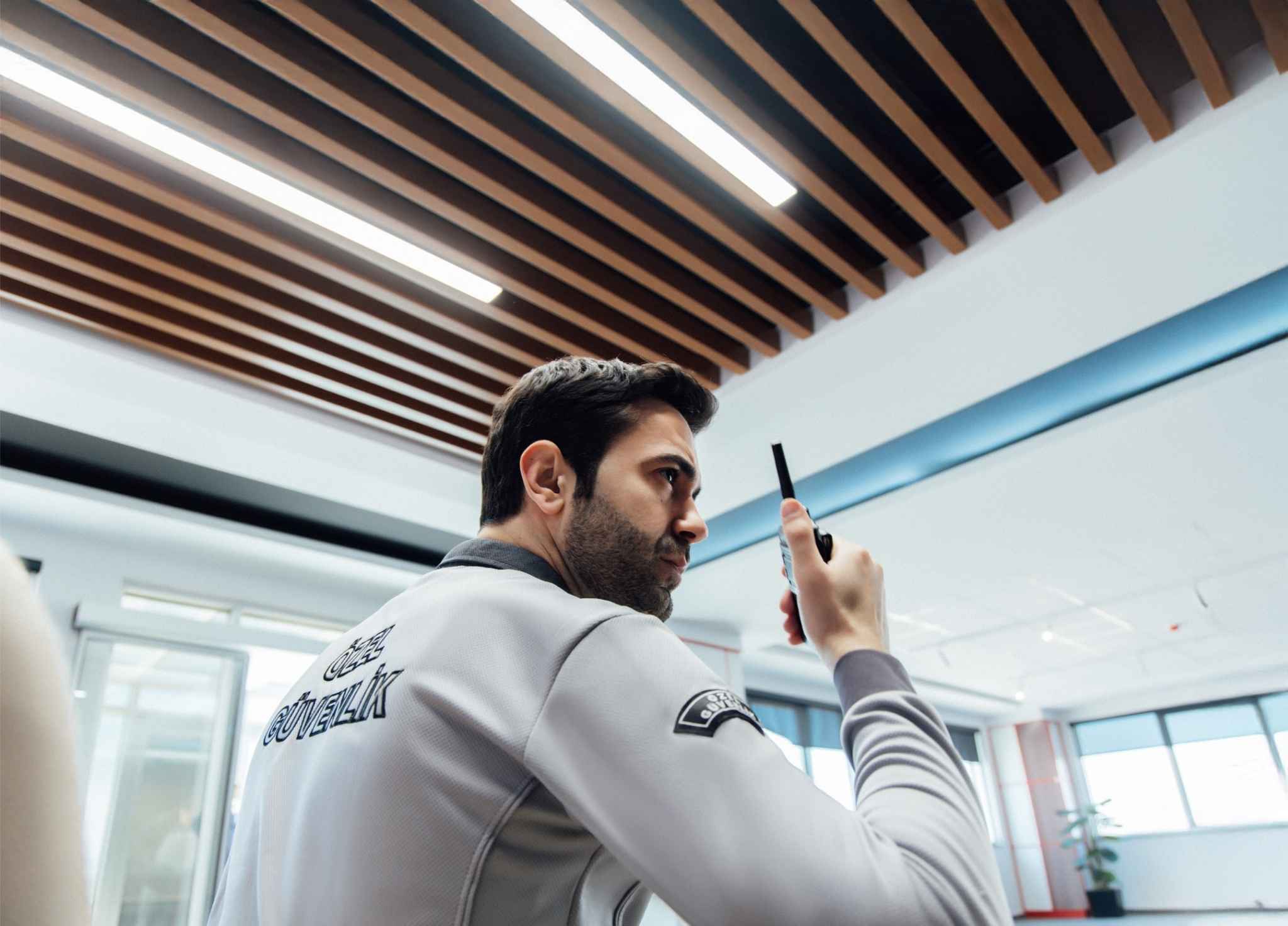
A Titan Savunma officer in a private security uniform communicating by radio inside a building.
How should you decide between security firms in Amasya?

According to 2025 social security data, 46 workplaces and 294 insured employees are registered under investigation and security activities in the province; that figure does not show every private security officer working there. When you set the proposals side by side, ask each firm for four written answers: its Ministry of the Interior operating licence, the person responsible for your site, who audits the service and how often, and which document will show you the governorship notifications. In our case the person answerable locally is our Amasya City Manager, while our regional directorate and head office run their own unannounced audits on top.

Do you also serve sites in Merzifon, Suluova or Taşova?

Yes. For a site outside the provincial centre, our City Manager plans by location which district officers will be recruited from and how shift handovers and audit visits will work. This plan appears as a separate section of the proposal, so you know before signing how your district site will be run.

What is the route to a private security permit in Amasya?

The application to the Governorship of Amasya is made by the organisation buying the service, in its own name. Under Article 3 of Law No. 5188 the provincial private security commission discusses the file and the governor issues the permit on the strength of its decision; under the implementing regulation, such applications are to be decided within ten working days at most. Our City Manager supports you in preparing the file.

What should I share to get a proposal?

Stating the site’s district or industrial zone, line of business, working hours, number of entry points and peak dispatch periods in the form is enough for a first proposal; our City Manager settles the remaining details on site during the survey.

How do I apply for a job as a private security officer in Amasya?

We accept applications through our Careers page. Article 10 of Law No. 5188 lists the conditions for becoming a private security officer; one of them is successfully completing the basic training set out in Article 14. The work permit is issued by the governorship under Article 11. Wherever we can, we fill posts at Amasya sites with people who live in the province’s own districts.

How are outdoor posts planned for Amasya’s hot summers?

The Turkish State Meteorological Service’s 1961–2025 records for Amasya give an average July high of 31.2 °C and a record high of 45.0 °C. For sun-exposed gates, weighbridges and stockyard posts we plan shade, drinking water, summer uniforms and shorter rotations around midday, and the contract states who provides them.

How does staffing change during harvest and peak dispatch?

By our calculation from 2025 social security data, the province’s share of jobs in crop and livestock production is about 3.5 times the Turkish average, and food manufacturing is its largest industrial sector. In the weeks when intake and dispatch peak, vehicle numbers at the gate and night working both rise. For these sites we write two duty routines, one for normal periods and one for peak periods, and set the changeover dates and the number of extra officers in the contract.

What role do officers play in readiness for earthquakes and floods?

The international ThinkHazard assessment places Amasya in the high hazard class for earthquakes, river flooding and landslides. We suggest that the protection and security plan spells out what officers do in an emergency, from keeping escape routes open and guiding staff to the assembly point to helping with the headcount and opening the gate for emergency crews, and that officers join the site’s drills. These roles complement the site’s emergency plan; they do not replace it.

Get a Written Proposal for Your Site in Amasya

Share your site’s district or industrial zone, line of business, working hours and number of entry points in the form; our Amasya City Manager will get in touch to set a survey date, and we will then work out with you a written duty proposal built around your site.

Request a Security Proposal

Contact

Request a Security Proposal for Your Organisation

Tell us your facility type, location and general requirements. Together, we can define a service scope that suits your organisation.

Tell Us What You Need

Fields marked * are required.

What Happens Next

  1. Initial DiscussionWe respond within 15 minutes and clarify your requirements and facility details together.
  2. Service ScopeWe assess staffing needs and the working arrangements.
  3. ProposalWe prepare our proposal for the agreed service scope.

General Directorates

Ankara · Çankaya
İstanbul · Levent

Nine regional directorates · 81 provinces

Looking for a role? Visit our careers page