For the Public Campuses, Olive Oil Businesses and Factories of Kilis · Turkey

Private Security Company in Kilis

In Kilis, Titan Savunma protects public buildings, university campuses, olive oil and food businesses, and plastics and chemical plants; as a private security company we hold the operating permit the Interior Ministry grants under Law No. 5188. If your organisation is choosing between security companies in Kilis, the most useful question to ask is this: once the contract is signed, which manager will see the premises every day and settle problems where they arise? With us, that manager is our Kilis City Manager, who walks your site, picks the officers, heads the team and handles both the daily checks and contact with your organisation. The Kilis City Manager reports to the Gaziantep-centred Southeast Anatolia Regional Directorate, and that directorate in turn reports to the Ankara General Directorate. These two levels help shape each plan, make site inspections nobody is warned about and lay down one yardstick for training and reporting. Every plan we draw up for Kilis starts from the province’s own picture: half of all dependent employees working in the public sector, olive oil processing that gathers pace in autumn, a university spread across three campuses in the city centre, and summers with almost no rain from June to September and a recorded high of 47.6 °C.

Private Security Company in Kilis

Service Scope

What We Take On in Kilis

Kilis is a small provincial economy with a clear shape. The 2025 social security yearbook records 22,152 compulsorily insured employees at 2,050 workplaces, 30% of them at public workplaces against 12.5% across Turkey. Food and plastics are the two largest branches of manufacturing: food processing has 100 workplaces and 1,530 insured staff, rubber and plastics has 1,225, and in the latter the province ranks 27th nationally. Education and human health services also employ well above their national weight. We organise our duty plans under four headings that follow this pattern.

Olive Oil and Food Plant Security in Kilis

We follow the vehicle traffic that builds up during the olive harvest and pressing season through weighbridge and gate records, and set timed out-of-hours rounds for oil tanks, packaging stores and finished-goods warehouses.

Factory and Industrial Zone Security in Kilis

At plastics, chemical and mineral products plants we cover flammable raw material areas, gate traffic at shift change and production halls left empty overnight, with orders written separately for each plot in the organised industrial zone.

Campus and Hospital Security in Kilis

At the city-centre campuses of Kilis 7 Aralık University and at healthcare sites we work with unarmed officers, as the Law requires, on a post schedule that shifts with the timetable, exam weeks and visiting hours.

Public Building and Construction Site Security in Kilis

In public service buildings we keep strictly to the posts and hours set in the tender specification; on infrastructure and building sites we apply a protection plan for materials, fuel and plant that is updated phase by phase.

A Planned Start

How the Service Is Planned

Before we price a public building, food business or factory in Kilis, we agree three things with you: the hours when the premises are least watched, who will run the team on the ground, and which record will prove each round took place.

  1. Separate Daytime and Night-Time Site Walks

    Our Kilis City Manager walks your premises once at the busiest working hour and again after dark, noting gates, lighting, camera coverage, stores and tank areas, weak points in the perimeter fence and the flow of staff and vehicles.

  2. Putting the File Together for the Governorship of Kilis

    The permit request goes to the Governorship of Kilis in the name of the organisation receiving the service. Our City Manager goes through the documents with you one by one, and anything missing is completed before the file is submitted.

  3. Picking the Team and Putting Its Duties in Writing

    Our City Manager decides who stands at which post, who leads each shift and who provides cover, drafts the instructions for gates, stores and patrols to fit your working calendar or the harvest season, and manages the team every day. If the team will number fifteen or more, this is also the step at which the security supervisor the Law calls for, holding at least an associate degree, is chosen.

  4. Unannounced Inspections and a Monthly Report

    The City Manager carries out each day’s checks. Inspectors from the regional directorate and the Ankara General Directorate then look at whether those checks hold up in practice, sometimes arriving with no warning at all. The report prepared in the last week of each month brings together that month’s findings, the gaps closed and the work still under way.

Your Sector’s Priorities

Management on the Ground in Kilis, Regional Assurance from Gaziantep

The workforce in Kilis has two poles. Social security data for 2025 show that 83.6% of workplaces employ nine people or fewer, while the 63 workplaces with 50 or more staff account for 53.1% of insured jobs and the 11 with 250 or more for 26.2%. Since the province’s 134 public workplaces employ 30% of insured staff, public bodies make up a large share of those big employers. In a province like this, service quality depends on a manager who knows how the client organisation works and visits the site every day. In Kilis that manager is our City Manager. Two levels of the company back that manager up. The regional directorate for Southeast Anatolia, run from Gaziantep, and the Ankara General Directorate to which it answers go over the plan, carry out inspections the City Manager does not know about in advance, keep training identical across teams and hold every report to one layout.

Law Enforcement Background

The professional experience and security training of retired law enforcement personnel within our team contribute to our approach.

  • Shade, Water and Shorter Stints in the Dry Summer

    Open-air posts get a separate duty pattern built around the midday hours from June to September.

  • More Frequent Store Rounds in Pressing Season

    In autumn and winter, when olive and oil stocks build up, rounds are tightened and every checkpoint is time-stamped.

  • Timely Notices to the Governorship of Kilis

    The contract copy and every officer joining, leaving or moving post are reported to the Governorship of Kilis within the legal deadlines.

For International Companies

For international brands in Turkey, we offer a single point of contact, a written scope and regular reporting. Work with us as your security partner

Expert View and Recommendations

Choosing a security firm in Kilis: what to know about the public sector, olives and summer heat

The questions organisations ask when looking for security in Kilis come from the province’s own make-up. How do you keep the tender specification and the site in step at public bodies that employ half of all dependent workers? How is a filled oil tank and finished-goods store protected at night during pressing season? How are fire-prevention rounds built at plastics and chemical plants that rank well nationally? How is an unarmed team planned across three campuses inside the city? How do you keep an open-air post going through a very hot, rainless summer? What follows in six parts rests on figures from the social security institution, the state meteorological service and Kilis 7 Aralık University, and every recommendation stays inside the framework of private security law.

Research we draw on (5)
  1. 5188 sayılı Özel Güvenlik Hizmetlerine Dair Kanun — Mevzuat Bilgi Sistemi
  2. Özel Güvenlik Hizmetlerine Dair Kanunun Uygulanmasına İlişkin Yönetmelik (Mevzuat Bilgi Sistemi, güncel metin)
  3. SGK İstatistik Yıllığı 2025
  4. Kilis 7 Aralık Üniversitesi — 2025 Yılı İdare Faaliyet Raporu
  5. Meteoroloji Genel Müdürlüğü — Kilis il istatistikleri

A public-sector economy: service tied to the specification, with clear reporting

Kilis is one of the provinces where the public sector weighs most heavily in employment. According to the 2025 social security yearbook, public workplaces account for 30.0% of 4/1-a insured employees, compared with a national 12.5%, placing Kilis 16th among the 81 provinces. Once civil servants are counted, 50.8% of all dependent employees, roughly one person in every two, work in the public sector (28.1% nationally). Building services and administrative support also run above the national average, which suggests that public buildings may buy in outside services widely.

At public bodies the scope of service is usually set by a tender specification, so we build our proposal on these headings:

  • Matching the specification: Post numbers, working hours, uniform and equipment items met line by line in the bid
  • Visitor flow: Orderly foot traffic at the entrances to service buildings and visitor logging under the rules the institution sets
  • Out of hours: Archives, server rooms and plant rooms tied to timed rounds
  • Reports that fit the payment cycle: A monthly report laid out the way the institution’s inspection staff expect

Tasks outside protection, such as reception or carrying documents, cannot be given to an officer under Article 16 of the Law, and we show that division clearly in both orders and reports.

Olive oil and food processing: seasonal stock, tank yards and intake gates

Social security data for 2025 show 100 workplaces and 1,530 insured employees in food manufacturing in Kilis; the sector holds 2.1 times its national share of local jobs and accounts for about 28% of manufacturing employment. Olives and vineyards stand out in Kilis farming, and olive oil processing and grape products are both counted within this sector. Self-employed farmers also weigh more in the province than in Turkey as a whole, which means many small growers bring produce to the plants.

That structure ties security needs to the calendar. In the autumn and winter pressing season, the points we stress are:

  • Intake gate: Growers’ vehicles logged with plate, time and unloading point, and a waiting area arranged so queues do not spill onto the road
  • Tank yard: Valve and lid seals checked on every round and yard lighting monitored through the night
  • Finished-goods store: Entry to the packed-product area by authorised list only, with an officer at the ramp during dispatch
  • Staffing by season: An extra post when stock peaks, scaled back when the season ends

Weighing, intake and quality control are the business’s own work. The officer helps get them on record but does not take them on.

Plastics, chemicals and mineral products: flammable materials and shift changeovers

The branch that stands out in the industrial profile of Kilis is rubber and plastic products. The 2025 social security yearbook records 30 workplaces and 1,225 insured staff in it; the sector carries 4.3 times its national share of local employment, and the province ranks 27th in the country by insured headcount. In chemical products it ranks 32nd with 396 insured staff, and non-metallic mineral products employ 577. For a province that is 77th nationally by insured employees, that concentration is marked.

At these plants risk turns largely on flammable raw materials and shift patterns. The routine we recommend:

  • Raw material areas: Fire-prevention rounds where granules, solvents and packaging are stored, with the smoking and naked-flame rule monitored
  • Shift changeover: Staff, shuttle buses and goods vehicles kept in separate lanes, with a backup record from the shift list if the entry system fails
  • Night: Production halls, the boiler house and compressor room tied to timed checkpoints
  • Dispatch: Vehicle, delivery note and seal number matched at the gate for every outgoing load

For businesses with several buildings in the organised industrial zone we use one shared checklist and a monthly report split building by building.

University and healthcare: three city-centre campuses and unarmed teams

Kilis 7 Aralık University’s 2025 administrative activity report shows 13,759 students, 467 academic staff and 383 administrative staff. All three campuses are in the city centre, and the main campus covers about 258,700 m². Social security figures for 2025 put 1,750 insured jobs in education and 1,978 in human health services, both well above what those sectors carry nationally.

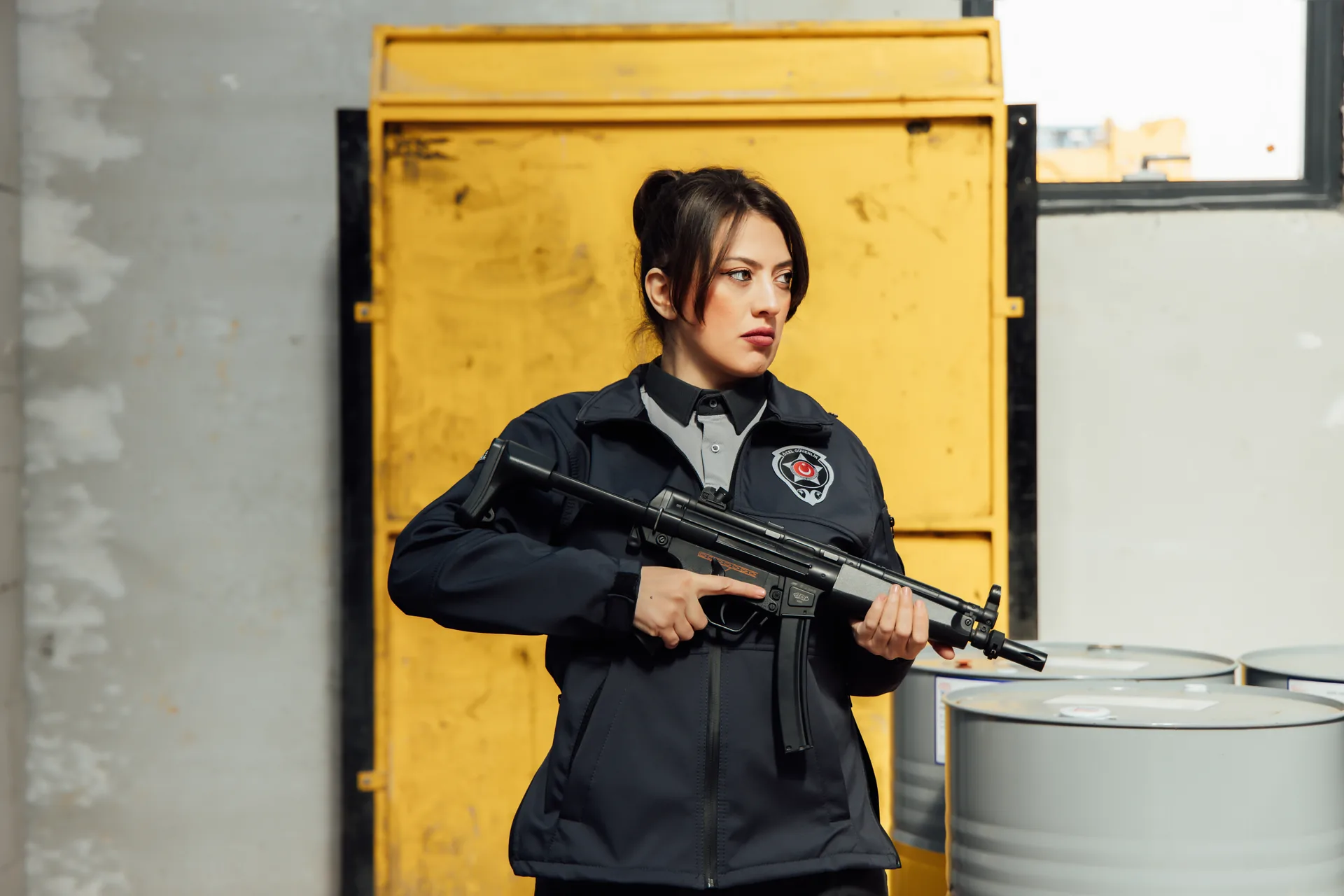
Officers at universities, schools and health facilities may not carry firearms (Law No. 5188, Art. 8); the teams we place there are unarmed and picked for how well they communicate. What matters most by setting:

  • Campus gates: Separate pedestrian and vehicle flows, with an extra officer at the gate as classes start and finish
  • Consistency across campuses: One patrol form for all three sites and a single monthly report
  • Evenings and weekends: Door, window and laboratory checks in faculty buildings that have emptied
  • Hospital: An officer permanently at the emergency entrance who knows how to calm tempers, an ambulance lane that is never blocked, and help for visitors finding their way during visiting times

We agree the division of duties with the university’s and the hospital’s own security units in writing; patient registration, the information desk and student affairs remain outside security work.

Very hot, dry summers and emergency planning: outdoor posts and continuity

Weather records kept in central Kilis from 1959 to 2025 by the state meteorological service describe a long, dry summer. July averages 28.2 °C with a mean daily high of 36.4 °C, and the highest reading on record is 47.6 °C, reached in August. Annual precipitation is about 495 mm, yet the four months from June to September bring only around 25 mm in total; most rain falls between December and March. January averages a mild 5.9 °C, though a low of −12.0 °C has been recorded and snow has reached 35 cm.

For posts in the open, our orders normally cover:

  • Sun-proof, airy shelter at each post, a generous water supply and changeovers brought closer together as noon approaches
  • A shift lead who watches for early signs of heat illness and phones any lone officer on a fixed schedule
  • Closer fire watch through the summer where dry grass and packaging waste collect
  • On the rare snowy days, a heated hut and a named stand-by officer so handovers are not disrupted

The plan also has a general emergency side. A fire, flooding after a downpour or a long power cut is handled as a question of emergency readiness and continuity. Once an evacuation is called, the team opens electric gates and barriers by hand, directs staff or students to the assembly area, helps with the roll call, keeps the way clear for fire engines and ambulances and stops anyone entering evacuated sections. Each step is tied to its counterpart in the organisation’s emergency plan, the split of tasks is put on paper, and drills are used to make it routine.

Permits from the Governorship of Kilis, ongoing notices and how the City Manager and regional directorate share the load

Before an organisation in Kilis can receive private security, it must obtain a permit in its own name. The request is addressed, as Article 3 of the Law provides, to the Governorship of Kilis; the file goes before the province’s private security commission, and the permit comes into being when the governor signs off. The Regulation (Art. 8) expects the decision inside ten working days. Because the document list can change, checking it with the governorship before you assemble the file saves time.

From the start of the contract we keep track of the following:

  • Signed contract: A copy goes to the governorship by the close of business on the day service begins (Law, Art. 5; Regulation, Art. 10).
  • Movements in the team: Each officer who arrives, leaves or moves post must be notified to the governorship within fifteen days (Arts. 11–12 of the Law, Art. 8 of the Regulation).
  • Supervisor at fifteen: The Law (Art. 5) asks for a security supervisor with no less than an associate degree wherever one site reaches fifteen officers.

Our Kilis City Manager runs those dates and the site itself. With the survey, officer selection, daily checks and correspondence with your organisation all in one pair of hands, the manager who notices a fault does not have to wait for anyone else’s approval to deal with it. Local management is completed by two higher levels: the regional directorate for Southeast Anatolia, with Gaziantep as its centre, and the Ankara General Directorate at the apex. They contribute to drafting the plan, come to sites unannounced and fix the yardstick for training and reporting.

When recruiting, Kilis itself is the first place we look. The 2025 social security yearbook records 134 insured employees at 18 workplaces in security and investigation activities in the province. Security staff employed directly by institutions, such as the university’s own guards, do not appear in that figure; still, the local pool is plainly narrow, and selection has to be careful. The frequency of routine checks and unannounced inspections is written into the proposal, and the results come to you every month in the report.

Before We Speak

Frequently Asked Questions

A uniformed Titan Savunma security officer on duty with a radio at an office entrance.
What should we look at when choosing between security firms in Kilis?

Ask first for proof of authorisation: a company may provide this service in Kilis only once the Interior Ministry has authorised it under Law No. 5188. Then make the comparison concrete by asking each bidder, in writing, about four things: the role of the person leading the team on site and how many times a week they will come by; the form or system that will prove night rounds happened; how cover is arranged when an officer is ill or absent; and who runs unannounced inspections and in which report you will see them. Set the price beside those answers. Public bodies should also hold each answer up against the matching clause of their tender specification.

Who is our day-to-day contact in Kilis?

You have one point of contact: our Kilis City Manager. The manager who tours your premises and draws up the plan is also the one who picks the officers and leads them, so a request for an added post, a change of officer or the outcome of an incident goes straight there. The quality of that work is watched in turn by our Southeast Anatolia Regional Directorate, centred in Gaziantep, and the Ankara General Directorate, which turn up on site from time to time unannounced and decide training content and report format centrally.

On what basis do public bodies buy private security services?

Public bodies apply to the Governorship of Kilis for a private security permit just as any other organisation does; the provincial commission on private security considers the request and the governor’s approval makes it final. The Regulation expects that decision within ten working days at most. The service itself is usually defined by a tender specification. When preparing our bid we match post numbers, working hours, uniform and equipment items and report content to the specification line by line. Work outside protection, such as reception, document handling or cleaning, cannot be given to an officer (Law, Art. 16), and we state that plainly in the orders.

How do I apply for work as a private security officer in Kilis?

Applications come in through the form on our Careers page; those for Kilis are reviewed by our Kilis City Manager, who also holds the interviews. You will be told plainly about night work, posts in the strong summer sun and the shift hours. Who may serve as an officer is governed by Article 10 of the Law, which requires among other things Turkish citizenship, a minimum age of 18 and successful completion of basic training. Before your first shift you also need a work permit and a private security identity card from the Governorship of Kilis (Arts. 11–12).

How is security planned for an olive mill or food store during pressing season?

Olives and vineyards stand out in Kilis farming, and in the 2025 social security data food manufacturing carries more than twice its national weight in local jobs. In pressing season many growers’ vehicles arrive within a short period, tanks fill up and dispatch of bottled product speeds up. For that period we recommend recording plate, time and unloading point at the intake gate, timed rounds of the tank yard and finished-goods store through the night, an extra post that is wound down when the season ends, and a check of fire-sensitive spots on every round. Weighing, intake and stocktaking belong to the business’s own staff; the officer helps get them on record but does not take them over.

What does the scorching Kilis summer mean for officers posted outdoors?

The state weather service’s readings for central Kilis give a July mean of 28.2 °C and an average daily high of 36.4 °C, with a record of 47.6 °C reached in August. The four months from June to September bring only about 25 mm of rain between them. That is why the orders for gates, car parks and open storage posts include four items: a shelter that shades the officer and stays ventilated, water to last the whole stint, shorter turns in the midday heat and a shift lead who keeps an eye on officers for heatstroke. Winters are usually mild, with a January mean of 5.9 °C, yet the temperature has fallen to −12.0 °C and snow has lain 35 cm deep. For the rare snowy days we provide a heated hut and a fallback plan that keeps shift handovers on track.

How does a security team work on university campuses?

According to Kilis 7 Aralık University’s 2025 administrative activity report, 13,759 students study there and all three of its campuses are in the city centre. Article 8 of the Law does not allow armed officers at education facilities, so our campus teams are unarmed. The plan covers people on foot and cars kept apart at the principal entrances, door and window checks in faculty buildings that empty in the evening, extra posts during enrolment and exam weeks, and a consistent patrol record across the campuses. The division of duties with the university’s own security unit is set out in writing, and student affairs and information desk work stay outside the security orders.

What does the security team do in an emergency such as a fire?

Fire, flooding or a long power cut are planning topics for us, handled within emergency readiness and continuity of work. The emergency plan belongs to your organisation; the security team carries out the steps the plan assigns to it. These usually include opening electric gates and barriers by hand, guiding staff or students to the assembly area, helping with the roll call, keeping the route clear for fire engines and ambulances and stopping entry to evacuated sections. We put each officer’s task in writing and practise it together in the organisation’s drills.

Arrange a Survey Day for Your Organisation in Kilis

In the form, simply tell us what kind of premises you have, whether it is in the city centre or an industrial zone, how many entrances it has, your working hours and whether the service is governed by a tender specification. Our Kilis City Manager will then call to agree a date for the survey, and a written proposal follows listing posts, officer numbers and price.

Request a Security Proposal

Contact

Request a Security Proposal for Your Organisation

Tell us your facility type, location and general requirements. Together, we can define a service scope that suits your organisation.

Tell Us What You Need

Fields marked * are required.

What Happens Next

  1. Initial DiscussionWe respond within 15 minutes and clarify your requirements and facility details together.
  2. Service ScopeWe assess staffing needs and the working arrangements.
  3. ProposalWe prepare our proposal for the agreed service scope.

General Directorates

Ankara · Çankaya
İstanbul · Levent

Nine regional directorates · 81 provinces

Looking for a role? Visit our careers page