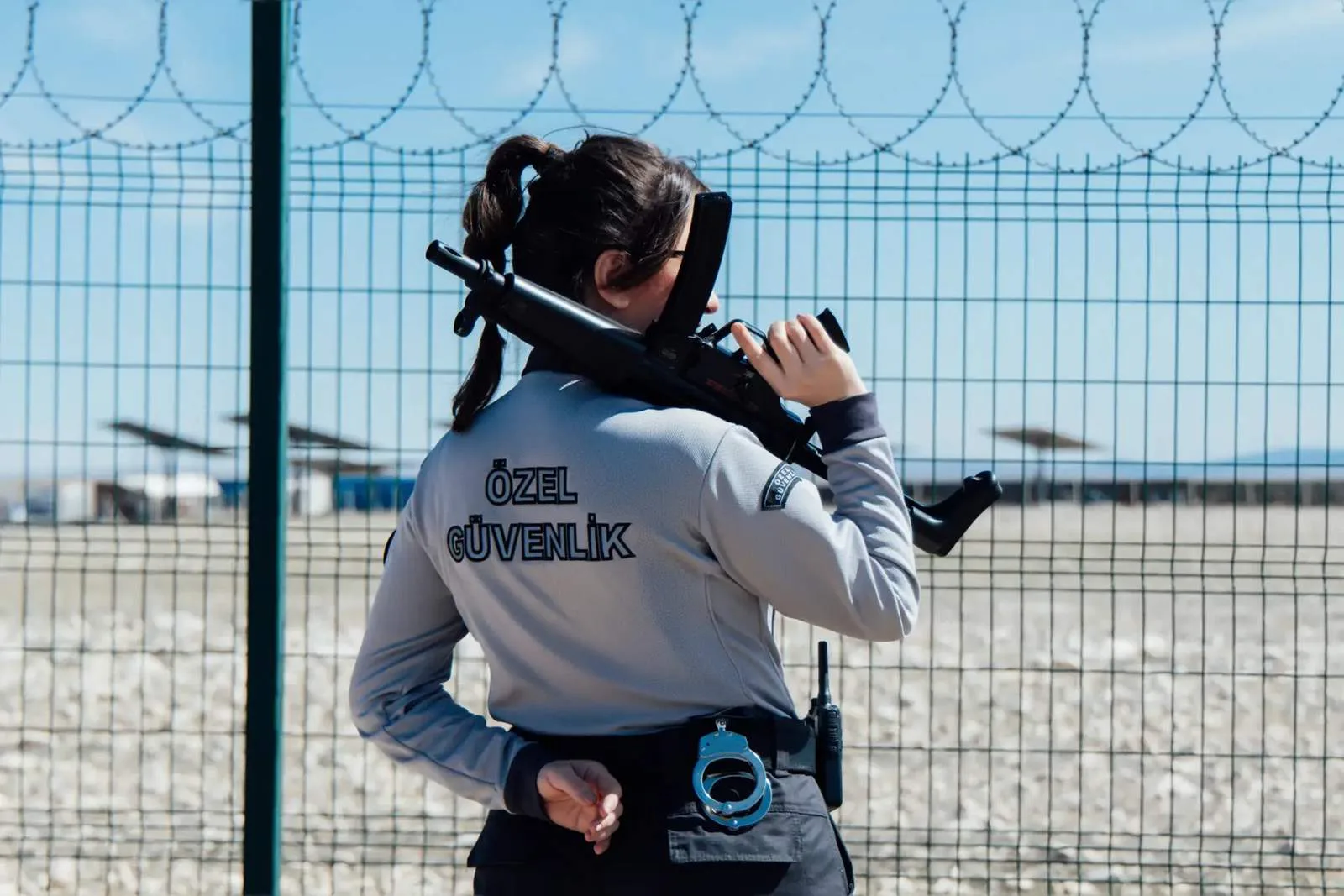
Short answer: At a state hospital in Bingöl, visiting and companion arrangements are run on the hospital's own written procedure, not on rules invented by the security officer: whether a patient may have a companion depends on the approval of the doctor responsible for treatment, and the hospital decides when visits take place and how many people may come. The officer's job is to apply those decisions in the same way at every door and on every floor, politely and with a record: checking the companion pass, pacing access to the wards during visiting hours, and receiving the extra crowds that arrive on religious holidays. Private security officers at health facilities in Türkiye work unarmed (Law No. 5188, Article 8), so the arrangement rests on clear written post orders, officers placed in the right spots and plain, calm language.
This article is general information, not legal advice.
Why hospital visiting needs its own plan in Bingöl
According to the Social Security Institution (SGK) Statistical Yearbook 2025, Bingöl's human health sector employs 1,859 people insured under category 4/1-a at 79 workplaces. Health, education and public administration together account for about a quarter (25.0%) of the province's compulsorily insured workforce, against 11.3% for Türkiye as a whole (our own calculation; tenured civil servants are not included in these figures). In a province where public services weigh this heavily, the state hospital is one of the busiest meeting places in the city centre. A family travelling in from a district may accompany someone to an outpatient clinic and visit a relative on a ward on the same day, so visiting hours, companion changeovers and clinic traffic can all pile up in the same entrance hall.
The second factor is winter. Records from the Turkish State Meteorological Service for 1961–2025 give a January mean of −2.1 °C in central Bingöl and a greatest recorded snow depth of 200 cm. In a winter like that, visitors cannot queue outside; everyone gathers in the entrance hall and in front of the lifts, and wet floors, heavy coats and parcels narrow the space. A visiting plan in Bingöl therefore has to answer not only who goes through the door, but where and how people wait inside.
Whose rule is it? The hospital sets it, the officer applies it
In Türkiye the framework is set by the Patient Rights Regulation. Under Article 39, visitors are admitted in line with the procedures the institution sets and in a way that does not disturb patients' peace. Article 40 ties the presence of a companion to the extent allowed by law and the institution's means and required by the patient's condition, subject to the approval of the doctor responsible for treatment, and leaves the way this right is exercised to the rules on each institution's working procedures. Article 37 obliges health institutions to take the measures needed to protect the safety of patients and of relatives such as visitors and companions.
The practical consequence is useful on the ground: the companion pass is the hospital's tool, not the security team's. Which unit issues it, how many passes a patient may have, where and when day and night companions swap over, and which wards apply extra rules are all decisions for the hospital. The officer neither grants exceptions nor makes up rules; clinical staff grant exceptions, and the officer records them and passes them on at shift handover. This division softens potential arguments with relatives and never leaves the officer having to make a decision beyond their authority.
What does the research say?
1. Flexible visiting may help patients and families, and may add to staff strain
A systematic review comparing flexible and restrictive visiting policies in intensive care units examined 16 studies and pooled 7 in a meta-analysis. Under flexible policies, delirium was less frequent (odds ratio 0.39) and patients' anxiety was lower, with no significant increase in ICU-acquired infections, mortality or length of stay. Families were more satisfied with flexible visiting, while flexible policies were associated with higher burnout among ICU staff. The authors state plainly that these conclusions rest on a small number of studies with small samples and a moderate risk of bias (Nassar Junior et al., Critical Care Medicine, 2018).
2. A large trial painted a more cautious picture
A cluster-crossover randomised trial in 36 adult intensive care units in Brazil compared flexible visiting of up to 12 hours a day, supported by family education, with usual restricted visiting of a median 1.5 hours a day. Flexible visiting markedly increased visiting time but did not significantly change the incidence of delirium (18.9% vs 20.1%). Family members had lower anxiety and depression scores under the flexible arrangement, while most other secondary outcomes, including ICU-acquired infections and staff burnout, showed no significant difference (Rosa et al., JAMA, 2019). The lesson we draw from the two studies: visiting time is a clinical and management decision, and security's task is not to debate it but to run whichever arrangement is chosen smoothly at the door and on the ward.
3. A companion is not a crowd but can be part of care
A Cochrane review of continuous support during childbirth assessed 26 trials providing data on 15,858 women in 17 countries. Women receiving continuous support were more likely to have a spontaneous vaginal birth (risk ratio 1.08) and less likely to have a caesarean (risk ratio 0.75) (Bohren et al., Cochrane Database of Systematic Reviews, 2017). The finding is specific to childbirth and cannot be generalised to every ward, but it is a reminder that the person at the bedside is sometimes part of the treatment. The officer at the door should see a companion accordingly: not a stranger to be policed, but a helper the hospital has approved.
4. Visitors and infection: the evidence is still unclear
A review of infection control precautions for visitors to healthcare facilities notes that visiting is very common but that visitors' role in transmission remains unclear, as does whether the isolation precautions used by staff should also apply to visitors. The authors argue that decisions should reflect the organism, its route of transmission, and the characteristics of the visitor and the setting, and that more research is needed (Banach et al., Expert Review of Anti-Infective Therapy, 2015). In practice this is simple: when the hospital's infection control team sets extra rules for a period, on masks, hand sanitiser or the number of visitors, the rule reaches the door in writing and the officer applies it, neither tightening nor relaxing it on their own.
Companion passes: one procedure, the same at every door
- The pass belongs to the hospital: officers do not print or hand out passes. Post orders state which unit issues the pass and what it shows (for example ward and bed number); no diagnosis or medical information appears on it.
- Changeover time and place: where day and night companions hand over the pass is fixed in advance. Doing the changeover at the ward's nursing station rather than at the door stops two people waiting at the entrance with one pass.
- Lost passes: the officer does not issue a new one; they confirm with the ward by phone, note it in the log and direct the relative to the right unit.
- Discharge and return: the ward follows up the return of a discharged patient's pass; passes not returned are listed regularly and treated as void.
- Night access: outside visiting hours, one designated door stays open for companions; no other door is used at night.
- Personal data: the companion log and camera recordings hold only what is needed; retention periods and access rights are agreed with the hospital under Türkiye's Personal Data Protection Law No. 6698.
Access to the wards during visiting hours
The first minutes of visiting time are among the most congested of the day: queues form at the lifts, stairs fill up and several families try to reach the same room at once. A few steps help:
- Ground-floor guidance: clear signs showing which ward is on which floor, and a guidance point at the entrance. Officers do not give out patient information; questions such as "Which room is she in?" go to patient admissions or the information desk.
- Lifts: the lift used for patients and beds stays closed to visitors; an orderly queue forms in front of the visitor lifts.
- Ward entry: companion-pass and visiting-hours checks happen at one point at the head of the ward corridor; the officer does not go from door to door.
- Special units: extra hospital rules for intensive care, neonatal, children's and maternity wards (number of visitors, hours, child visitors) are given to officers on a separate written card.
- End of visiting: a polite announcement shortly before the end, then a short round of the floor together with the ward nurse. If a room is crowded, the nurse speaks to the family and the officer accompanies.
Religious holidays: planning for the crowd in advance
Visiting the sick during the religious holidays (bayram) is a deep-rooted tradition in Türkiye and can bring noticeably more people through a hospital entrance than on an ordinary day. Because the Hijri calendar moves back by about 11 days each year, Ramadan Bayram will fall in February and March over the next few years, so in Bingöl holiday crowds and winter conditions may well arrive together. The holiday plan should therefore be made several weeks ahead:
- A short meeting with hospital management before the holiday to settle visiting hours and the number of visitors allowed, ideally announced by the hospital in advance.
- Officer leave planned around the holiday, with an extra guidance point at the entrance and in front of the lifts.
- A second waiting area marked out in the entrance hall, with mats and wet-floor signs ready.
- A pre-written procedure for lost children and lost property: the child is taken to the information desk and any announcement follows the hospital's own method.
- The hospital's rule on food and flowers for the wards stated at the door in one sentence, the same way every time.
Checklist: visiting and companion routine
| Area | What to do | Why |
|---|---|---|
| Written procedure | Visiting hours, companion numbers and authority for exceptions given to officers as the hospital's written decision. | Visiting and companions are decided by the institution and the doctor. |
| Companion pass | One type of pass, a fixed changeover point, a lost-pass and return procedure. | The same rule applied the same way at every door means fewer arguments. |
| Ward entry | One check point; patient lift closed to visitors. | An officer roaming the corridor gets in the way of care and privacy. |
| Special units | A separate written rule card for intensive care, neonatal and children's wards. | Visiting rules may differ by ward. |
| Infection periods | Extra rules from infection control reach the door in writing. | Precautions for visitors should be decided case by case. |
| Winter | A waiting plan for the hall, mats, wet-floor warnings. | In heavy snow and cold, everyone waits indoors. |
| Bayram | An advance meeting, an announcement, an extra guidance point, a lost-child procedure. | Holiday visiting can noticeably increase entrance traffic. |
| Records | Exceptions, lost passes and complaints logged; a monthly review. | Only records show which rule is under strain. |
Common mistakes
- Passing companion rules to officers by word of mouth, so the rule shifts a little with every shift.
- Leaving exception decisions to the officer, or not recording permission given by a doctor.
- Running pass changeovers at the door and tolerating two companions waiting with one pass.
- Leaving the patient lift open to visitors.
- Expecting officers to give patient information, room numbers or medical explanations.
- Planning a holiday like an ordinary day, or bunching officer leave on holiday dates.
- Making visitors wait outside in winter, or leaving a slippery hall floor until morning.
A note on practice in Türkiye
Under Article 8 of Law No. 5188, armed private security officers may not be employed at health facilities, and under Article 9 incidents that would require the use of force or an apprehension are reported to the police or gendarmerie by the fastest means. So in visiting and companion matters the officer guides people, explains the hospital's rule, writes things down and, when a situation calls for it, brings in the relevant hospital unit. For a public hospital, the tender's technical specification normally defines what the service covers; our advice is to draft the post orders together with three documents: that specification, the hospital's visiting and companion procedure based on the Patient Rights Regulation, and the rules issued by its infection control team. Before drafting, spend one weekday visiting period at the entrance and, if you can, one holiday morning too; an hour of watching reveals more than a flow chart.
For the full list of tasks we take on at clinics and hospitals, see healthcare security; for our approach to Bingöl's public buildings, workshops and health facilities, see private security company in Bingöl.
Titan Savunma is an Ankara-based private security company licensed by the Ministry of Interior under Law No. 5188 and certified to ISO 9001, 14001, 45001, 22301 and 28000. We work with international companies in English and Turkish, and our Bingöl City Manager, supported by our Eastern Anatolia Regional Directorate and our Ankara General Directorate, reviews your hospital's visiting and companion procedure on site and writes with you an unarmed set of post orders that fits your specification. To arrange a site visit, write to us via our contact page.
Sources and Further Reading
- Nassar Junior, A. P., Besen, B. A. M. P., Robinson, C. C., Falavigna, M., Teixeira, C. & Rosa, R. G. — Flexible Versus Restrictive Visiting Policies in ICUs: A Systematic Review and Meta-Analysis, Critical Care Medicine 46(7):1175–1180 (2018)
- Rosa, R. G., Falavigna, M., da Silva, D. B. ve ark. (ICU Visits Study Group Investigators, BRICNet) — Effect of Flexible Family Visitation on Delirium Among Patients in the Intensive Care Unit: The ICU Visits Randomized Clinical Trial, JAMA 322(3):216–228 (2019)
- Bohren, M. A., Hofmeyr, G. J., Sakala, C., Fukuzawa, R. K. & Cuthbert, A. — Continuous support for women during childbirth, Cochrane Database of Systematic Reviews 2017(7):CD003766
- Banach, D. B., Bearman, G. M., Morgan, D. J. & Munoz-Price, L. S. — Infection control precautions for visitors to healthcare facilities, Expert Review of Anti-Infective Therapy 13(9):1047–1050 (2015)
- Hasta Hakları Yönetmeliği (Resmî Gazete 01.08.1998, Sayı 23420; 08.05.2014, 23.12.2016 ve 16.01.2019 değişiklikleri işlenmiş güncel metin), md. 37, 39, 40 — Mevzuat Bilgi Sistemi
- 5188 sayılı Özel Güvenlik Hizmetlerine Dair Kanun (md. 8, 9), Mevzuat Bilgi Sistemi
- SGK — İstatistik Yıllığı 2025 (Sigortalı ve İşyeri İstatistikleri, Tablo 1.7, 1.11)
- Meteoroloji Genel Müdürlüğü — Resmî İstatistikler: Bingöl (1961–2025)