For Bingöl’s Public Buildings, Garment Workshops, Building Sites and Schools · Turkey

Private Security Company in Bingöl

In Bingöl, Titan Savunma acts as a private security company for public service buildings, garment and food workshops, building and infrastructure sites, and schools, campuses and health facilities, holding the Interior Ministry operating licence that Law No. 5188 requires. When making a choice among security companies in Bingöl, we would ask you to establish at the outset who will answer for the officer on your gate once the contract is signed; with us, the answer is our Bingöl City Manager. The City Manager walks your site on day one, selects and trains the officers, builds the duty rota and talks to you every day. Backing up that local role is our Eastern Anatolia Regional Directorate, part of the structure that answers to our Ankara General Directorate: it goes over each plan with the City Manager, sends auditors to sites without prior notice, and sets the content of training and the format of reports. Every plan we write for Bingöl starts from the province’s own facts: the public sector pays more than half of all wage earners, insured employment has grown by half in nine years, the garment sector is almost three times as concentrated as the Turkish average, and the same province has recorded snow two metres deep and summer heat above forty degrees.

Private Security Company in Bingöl

Service Scope

Sites We Plan Security For in Bingöl

According to the 2025 yearbook of the Social Security Institution (SGK), 33,002 compulsorily insured employees work at 3,387 workplaces in Bingöl. Of these, 30.4% are at public-sector workplaces, against 12.5% in Turkey as a whole. The largest sectors, in order, are building construction, public administration, education and clothing manufacture, each employing roughly three to four and a half thousand people. Because almost half of insured staff (48.7%) work at places with fifty or more employees, demand for security also gathers in a few large kinds of site. We therefore build our plans around four types of site.

Public Service Building Security in Bingöl

At buildings that receive members of the public all day, such as the governorship, provincial directorates and municipal service buildings, we take on order in waiting halls, a sweep of each floor once the doors close to the public, and a separate set of orders for every post named in the tender specification.

Garment Workshop and Factory Security in Bingöl

At sewing workshops where hundreds of people arrive and leave at the same hour, we run shift changes calmly and on record, and check the doors of fabric, trimmings and packed-goods stores and every vehicle arriving at or leaving the loading bay against the list the business sets.

Construction and Energy Site Security in Bingöl

On building projects and the temporary sites of road, line and energy works, we watch over steel, cable, fuel and plant through the night, and update the number of posts as the site expands or contracts and each new stage of the works programme begins.

School, Campus and Health Facility Security in Bingöl

At school entrances, the university campus and health facilities we work with unarmed officers, placing gate and car park order at the busy hours for pupils, parents, patients and visitors, and perimeter rounds of the buildings in the evening, at the heart of the plan.

A Planned Start

How the Service Is Planned

Before writing any figure for a service building, workshop, building site or school in Bingöl, we settle three things together: at which hours the most people come and go, which posts will be exposed both to snow in winter and to midday heat in summer, and in what format and how often the records officers keep will reach you.

  1. A Site Walk That Accounts for Both Seasons

    At the liveliest moment of your day, say a shift change or a queue at the counters, our Bingöl City Manager goes round the site and sketches the gates, store and loading bay entrances, lighting, camera coverage and the posts that will sit in snow in winter and in full sun in summer.

  2. The Permit Application to the Governorship of Bingöl

    The private security permit is requested from the Governorship of Bingöl in the name of the organisation or business receiving the service. Our City Manager works through the governorship’s current list of papers with you item by item, and a final check is made before submission so that the file does not come back for a missing document.

  3. Picking the Team, Putting Duties on Paper

    Officers and shift leads are hand-picked by our City Manager, who writes orders for each post to suit your workshop shifts, your organisation’s working hours or the site’s works programme, and personally guides the team on the ground in the first weeks. A site that needs fifteen officers or more also gets the security supervisor Law 5188 calls for, named during this step.

  4. Surprise Inspections, One Report a Month

    Day-to-day control rests with our City Manager. On top of that, inspectors sent by our regional and general directorates turn up, usually unannounced, to test whether the orders live on the ground or only on paper. Gaps found, gaps closed and items still open come together in one report a month.

Your Sector’s Priorities

Local Management in Bingöl, Backed by Our Regional and General Directorates

Bingöl is a fast-growing labour market. SGK records show compulsorily insured employees rising from 21,670 in 2016 to 33,002 in 2025, with an increase of 12.0% in the last year alone, while the number of workplaces grew by half over the same period. Some 83.6% of workplaces have nine or fewer employees, yet the 16 workplaces with 250 or more staff account for 24.2% of insured employees on their own. In a picture like this, the quality of a security service is decided by a local manager who can take a fresh look every week at a site that keeps growing and changing; in Bingöl that manager is our City Manager. The City Manager makes decisions on site, supported by our Eastern Anatolia Regional Directorate, which takes part in planning, audits sites independently and organises training. Over both sits our Ankara General Directorate, setting the report layout and company rules used in every province.

Law Enforcement Background

The professional experience and security training of retired law enforcement personnel within our team contribute to our approach.

  • A Reserve List Ready for Snow Days

    Who takes over on days when roads are closed by snow is written down in advance; no officer leaves until the relief has reached the post.

  • Shade, Water and Short Spells at Summer Midday

    In the hot months, shade, drinking water and shorter spells around midday at open posts are written into the orders.

  • Keeping to the Governorship’s Calendar

    The contract copy on day one, then every staffing movement: every notice due to the Bingöl Governorship goes on the schedule with its legal deadline.

For International Companies

For international brands in Turkey, we offer a single point of contact, a written scope and regular reporting. Work with us as your security partner

Expert View and Recommendations

What to weigh when choosing a security firm in Bingöl, a province where public services, garment making and construction sit side by side

The questions an organisation looking for security in Bingöl asks spring from three different sides of the province. With the public sector paying more than half of the province’s wage earners, how does a tender specification turn into instructions for the officer on the gate? At a workshop where hundreds of machinists change shift at the same moment, how is order kept? In a province where temporary workplaces make up a quarter of employment, how does a building-site team grow and shrink? Add a climate that brings a two-metre snow record and forty-two degrees of summer heat within the same year. The six sections below work through these points using SGK, Turkish State Meteorological Service and Bingöl University records, and stay inside what Law No. 5188 permits.

Research we draw on (5)
  1. 5188 sayılı Özel Güvenlik Hizmetlerine Dair Kanun — Mevzuat Bilgi Sistemi
  2. Özel Güvenlik Hizmetlerine Dair Kanunun Uygulanmasına İlişkin Yönetmelik (Mevzuat Bilgi Sistemi, güncel metin)
  3. SGK İstatistik Yıllığı 2025
  4. Bingöl Üniversitesi — 2025 Yılı Stratejik Plan Değerlendirme Raporu
  5. Meteoroloji Genel Müdürlüğü — Bingöl il istatistikleri

The weight of the state: service buildings and tender specifications

According to 2025 SGK data, 30.4% of compulsorily insured employees in Bingöl work at public-sector workplaces, placing the province fifteenth of 81 on this measure. Counting civil servants too, 55.0% of the province’s dependent workers are on the public payroll; the Turkish figure is 28.1%. The public administration sector alone has 3,498 insured staff, and its share of local employment (10.6%) ranks fourth in the country. Health, education and public administration together employ 25% of insured staff, against 11.3% nationally.

This means a large part of the demand for security in Bingöl comes from public service buildings and through tenders. At such sites our contribution falls under these headings:

  • From specification to orders: A separate, written set of post orders is prepared for every post, shift and officer count listed in the specification.
  • Public footfall: In buildings serving the public all day, order is kept in waiting areas and visitors are directed to the right department.
  • After hours: A floor-by-floor round is made at closing, and the time each archive, plant room and server room door is checked goes into the log.
  • Records for acceptance: The month’s rota, patrol times and incident notes are handed over in a form the organisation’s inspection and acceptance file can take as it is.

Our officers do not carry correspondence or cover reception desks; Law 5188 confines them to protection and security.

Garments and food: entry, stores and dispatch at shift-based workshops

The 2025 SGK yearbook shows 36 workplaces and 2,864 insured employees in the manufacture of wearing apparel in Bingöl. The sector’s share of local employment is 8.7%, about three times the Turkish average, and on that share the province ranks eleventh of 81. Food manufacturing employs 1,720 insured staff at 135 workplaces. Although manufacturing as a whole accounts for 17.2% of local employment, below the national 23.8%, roughly four-fifths of the province’s manufacturing jobs sit in these two sectors.

At garment and food workshops the security plan follows the flow of production through the day:

  • Shift change: Order at a gate that hundreds pass through in a short time, watching the staff card reader and helping with the entry and exit record
  • Raw material and product stores: Key handover records and door checks at fabric, trimmings, packaging and packed-goods stores
  • Loading bay: Matching outgoing and incoming vehicles to the business’s list and the delivery note, and keeping the bay closed outside working hours
  • Food businesses: Checking cold room and store doors at the end of each shift, and reporting unauthorised entry into hygiene areas to the business

Measures such as bag or vehicle checks rest on a written rule the business has announced to its employees in advance; production, hiring and discipline remain the business’s own domain.

Building and energy sites: a flexible team for temporary workplaces

Building construction is Bingöl’s largest employment sector: 2025 SGK data show 4,600 insured employees at 316 workplaces. Civil engineering accounts for 1,449 insured staff; relative to total jobs it weighs over 2.3 times what it does nationally. Energy supply (electricity, gas and steam) runs at about 2.4 times the national share as well. Temporary workplaces employ 8,131 insured staff, which is 24.6% of the province’s compulsorily insured employees.

Temporary sites call for a different security logic from a permanent building: perimeters, entrances and valuable materials change as the work moves on. Our plan is therefore divided into stages:

  • Set-up: Agreeing fencing, a single vehicle entrance, lighting and camera positions with the employer
  • Peak works: Night patrols for steel, cable, fuel and plant, and matching material movements to delivery notes
  • Winter pause: Fewer posts in the months when work slows, and telling the employer when snow loads bend fences or jam gates
  • Before handover: Floor rounds in nearly finished buildings against theft of fittings and installations

We revisit the number of posts at the start of each stage and write that flexibility into the contract from the outset.

Schools, Bingöl University and health facilities: unarmed, calm order

According to 2025 SGK data, education in Bingöl counts 126 workplaces and 2,882 insured staff, more than double the sector’s national weight in employment. Human health services employ 1,859 insured staff. Bingöl University’s 2025 strategic plan evaluation report records 19,373 graduates in its alumni information system; the campus holds an important place in both the education and the everyday life of the province.

Firearms have no place at these institutions under Article 8 of Law 5188, so the team works unarmed. We build the plan around these points:

  • School start and finish times: Keeping parents’ cars from piling up at the gate and pupils on a safe walking route
  • Campus calendar: Additional wayfinding posts during registration and exam weeks, with library and residence rounds after dark
  • Health facilities: Keeping the emergency entrance and ambulance route clear, and calm communication in waiting areas at busy times
  • Winter and summer: Reporting icy footpaths and long queues in the heat to the institution’s management in good time

Student affairs, discipline, patient admission and medical direction stay with the institution’s own staff; officers apply the entry rules the institution sets and report any breach.

A climate of two extremes: two metres of snow and forty-two degrees

The Turkish State Meteorological Service’s statistics for central Bingöl, covering 1961–2025, show why a security plan has to change with the seasons. The January mean is −2.1 °C, with mean minimums of −5.7 °C in January and −4.8 °C in February. The coldest the thermometer has shown is −25.1 °C, and on 7 February 1992 the snow cover reached 200 cm. Summer turns the picture round: the July mean is 26.7 °C and the hottest day on record reached 42.0 °C.

At outdoor posts we therefore apply two separate seasonal orders:

  • Winter: A sheltered, heated booth and proper cold-weather kit; a reserve list and flexible handover times for days when roads close; reporting fences, gates and cameras buried under snow to the business
  • Summer: Shade, drinking water and shorter spells around midday, with written guidance on how an officer should act at signs of heat stroke
  • Both seasons: No officer leaves a post before the relief has arrived

The weather, not the calendar, decides which orders apply: our City Manager tells the team in writing when to switch to the winter routine at the first snow warning in autumn, and to the summer routine once temperatures climb in spring. During the changeover weeks, the kit for both sets of orders is kept on site.

The permit and notice calendar with the Bingöl Governorship, and the chain of oversight from local management to the General Directorate

The permit process opens with a petition from the organisation or business that will buy the guarding service. Article 3 of Law 5188 sends that petition to the Bingöl Governorship; it goes on the agenda of the provincial private security commission, and the permit takes effect once the governor endorses the commission’s ruling. Article 8 of the Regulation allows at most ten working days for the decision. The list of papers is revised from time to time, so asking the governorship for the latest version at the outset saves time.

Once guarding actually starts, we keep three calendars with the governorship:

  • Day one: The signed contract’s copy is at the governorship before that day’s working hours end (Regulation, Art. 10).
  • Staff movements: Notice for an arriving, departing or reassigned officer is due within fifteen days, and our City Manager’s schedule tracks that window (Law, Arts. 11–12; Regulation, Art. 8).
  • Supervisor: When a team reaches fifteen officers, a security supervisor with an associate degree or above is assigned to the site (Law, Art. 5).

The person keeping that calendar is the same one directing the officer on your gate: our Bingöl City Manager. Because survey, selection, daily site visits and conversations with you rest with one manager, whoever spots a lapse also holds the power to fix it. Our Eastern Anatolia Regional Directorate joins as a second pair of eyes on the City Manager’s plans and sends its own inspectors on unannounced visits; above it, our Ankara General Directorate keeps training content and reporting criteria on one line across every province.

When building the roster we put Bingöl residents first: someone who has lived through both the frost and the midday heat needs no explanation of why there are two seasonal sets of orders. The registered security sector here is small: the 2025 SGK yearbook counts 24 workplaces and 349 insured staff in investigation and security activities, about seventy per cent of the sector’s national share of employment. Public bodies running their own guard units and staff of firms registered in other provinces fall outside that count. How often routine checks and surprise visits happen is written into our proposal, and the monthly report shows what they found.

Before We Speak

Frequently Asked Questions

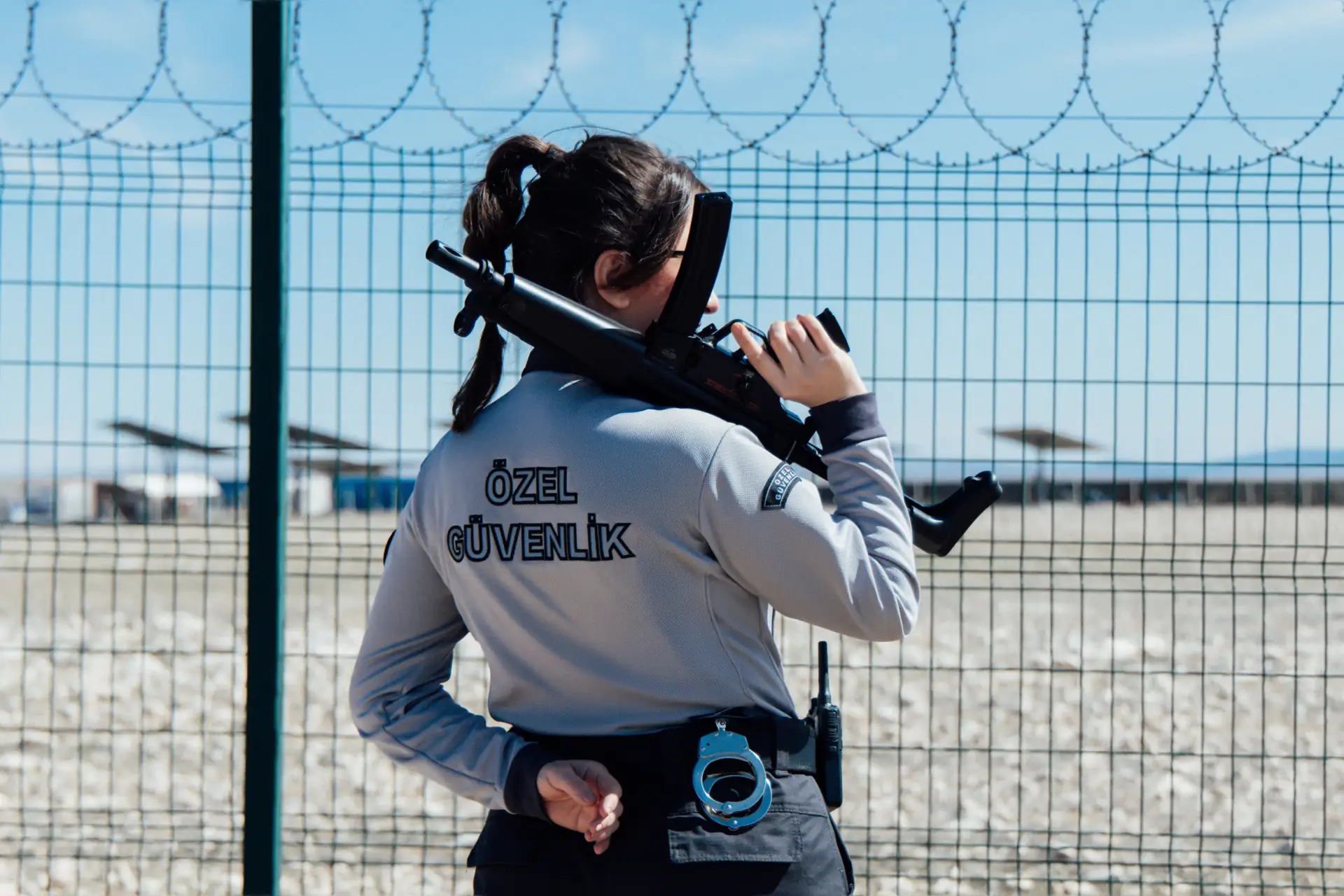
A uniformed Titan Savunma security officer on duty with a radio at an office entrance.
Which questions help compare security firms in Bingöl?

Start by checking that each candidate’s licence from the Ministry of the Interior is current; Law No. 5188 makes it a precondition. Then put an identical questionnaire to every bidder, in writing: who is the named manager for Bingöl, and how many days a week will they be on site? Who carries out unannounced inspections, and at what interval? How often will reports arrive, and what will they contain? How will a post be handed over on a snow day when roads are closed, or when an officer fails to turn up? How quickly can extra posts be opened when a workshop or building site grows? Once the written answers are side by side, it also becomes clear which item in each quote the price difference comes from.

Who will be our point of contact for our site in Bingöl?

Our Bingöl City Manager. It is the same person who carries out the survey, sets up the team, manages the officers and checks on them daily; the City Manager’s is the first number you call to have a new post opened, ask for an officer to be changed or find out the outcome of an incident. Two tiers stand behind that person. Our Eastern Anatolia Regional Directorate reads draft plans with the City Manager and sends inspectors to your site unannounced, while our Ankara General Directorate, which the regional tier answers to, fixes the training syllabus and the layout of the monthly report.

What steps lead to a private security permit from the Governorship of Bingöl?

A petition goes to the Governorship of Bingöl under the name of the body or company that will use the guarding service. The provincial private security commission at the governorship examines it, and the permit comes into being when the governor endorses the decision. Ten working days is the ceiling the Regulation sets. Where a public body buys by tender, the specification spells out its expectations for posts, shifts and reporting, and our post orders follow its clauses. You put the file together with our City Manager.

Where do I apply to work as a private security officer in Bingöl?

Apply through our Careers page. Our City Manager decides who joins the Bingöl roster, looking at which kind of site you want, whether a workshop, building site or school, and at its duty hours, and putting residents of the province first. The legal prerequisites sit in Article 10 of Law 5188: chief among them are Turkish citizenship, having turned eighteen and holding a pass certificate from the basic training course. Before the first shift, the Governorship of Bingöl issues the work permit and the private security ID card (Arts. 11–12).

How is outdoor duty planned for both a snowy winter and a hot summer?

Readings from the Turkish State Meteorological Service station in central Bingöl put the January mean at −2.1 °C and the lowest temperature measured at −25.1 °C, and the deepest snow cover on record reached 200 cm. At the same station, the July mean is 26.7 °C and the hottest reading is 42.0 °C. Rather than a single routine for the whole year, we therefore write two separate seasonal orders for outdoor posts. The winter orders cover a booth with its own heater, clothing worn in layers, boots that grip on ice and a reserve list that comes into play when roads close. The summer orders set out shade, drinking water, shorter spells around midday and what to do at signs of heat stroke. An officer who finds ice on a ramp or pavement tells the business; shovelling and spreading salt stay with the business’s own crew.

How are shift changes and dispatch protected at our garment workshop?

At sewing workshops the busiest moment for the security team is the shift change, when hundreds of people pass through the same gate within a few minutes. At that point we keep order at the turnstile or gate, make sure the reader is working where staff cards are used, and help the business keep a complete record of comings and goings by the method it has chosen. At fabric, trimmings and packed-goods stores, keys and doors are checked, and at the loading bay vehicles are matched to delivery notes against the list the business provides. Measures such as bag checks only go into the orders if the business has a written rule announced to employees in advance. Production planning, hiring and staff discipline stay with the business’s own departments.

What does the security team take on, and leave alone, at schools, campuses and health facilities?

Our officers carry no weapons at schools, campuses or health facilities, because Article 8 of Law 5188 keeps such institutions outside armed private security. The team keeps order at gates and car parks, guides pupils, parents, patients and visitors to the right entrance at busy times, patrols the buildings’ surroundings in the evening and passes on any problem it sees without delay to the person the institution has named. Student affairs, discipline, patient admission and medical direction are the work of the institution’s own staff, and our officers stay out of them. When tension rises, an officer’s first tool is a calm conversation.

What does the security team do in a fire, a flood or a long power cut?

How such events are handled is laid down in the organisation’s own emergency plan; the security team performs the tasks that plan gives it. In Bingöl the list should also include sudden downpours and heavy snow capable of closing roads. The team’s tasks are typically these: freeing turnstiles and barriers that lock when power fails, leading evacuees to the muster point, accompanying the manager during a roll call against the shift sheet, clearing vehicles from the lane fire crews and ambulances will use, and taping off unsafe sections so nobody walks in. We write down in advance who does what at which gate, and bring our team into the organisation’s drills.

Request a Written Plan Built for Your Bingöl Site

Tell us briefly on the form what sort of place it is, how many gates it has, the hours its shifts or working day run to, and whether purchase will be by tender or a direct agreement. Our Bingöl City Manager will come back to you to fix a survey day; a written duty plan and price, built around your site, your work calendar and the province’s two seasons, will follow.

Request a Security Proposal

Contact

Request a Security Proposal for Your Organisation

Tell us your facility type, location and general requirements. Together, we can define a service scope that suits your organisation.

Tell Us What You Need

Fields marked * are required.

What Happens Next

  1. Initial DiscussionWe respond within 15 minutes and clarify your requirements and facility details together.
  2. Service ScopeWe assess staffing needs and the working arrangements.
  3. ProposalWe prepare our proposal for the agreed service scope.

General Directorates

Ankara · Çankaya
İstanbul · Levent

Nine regional directorates · 81 provinces

Looking for a role? Visit our careers page